
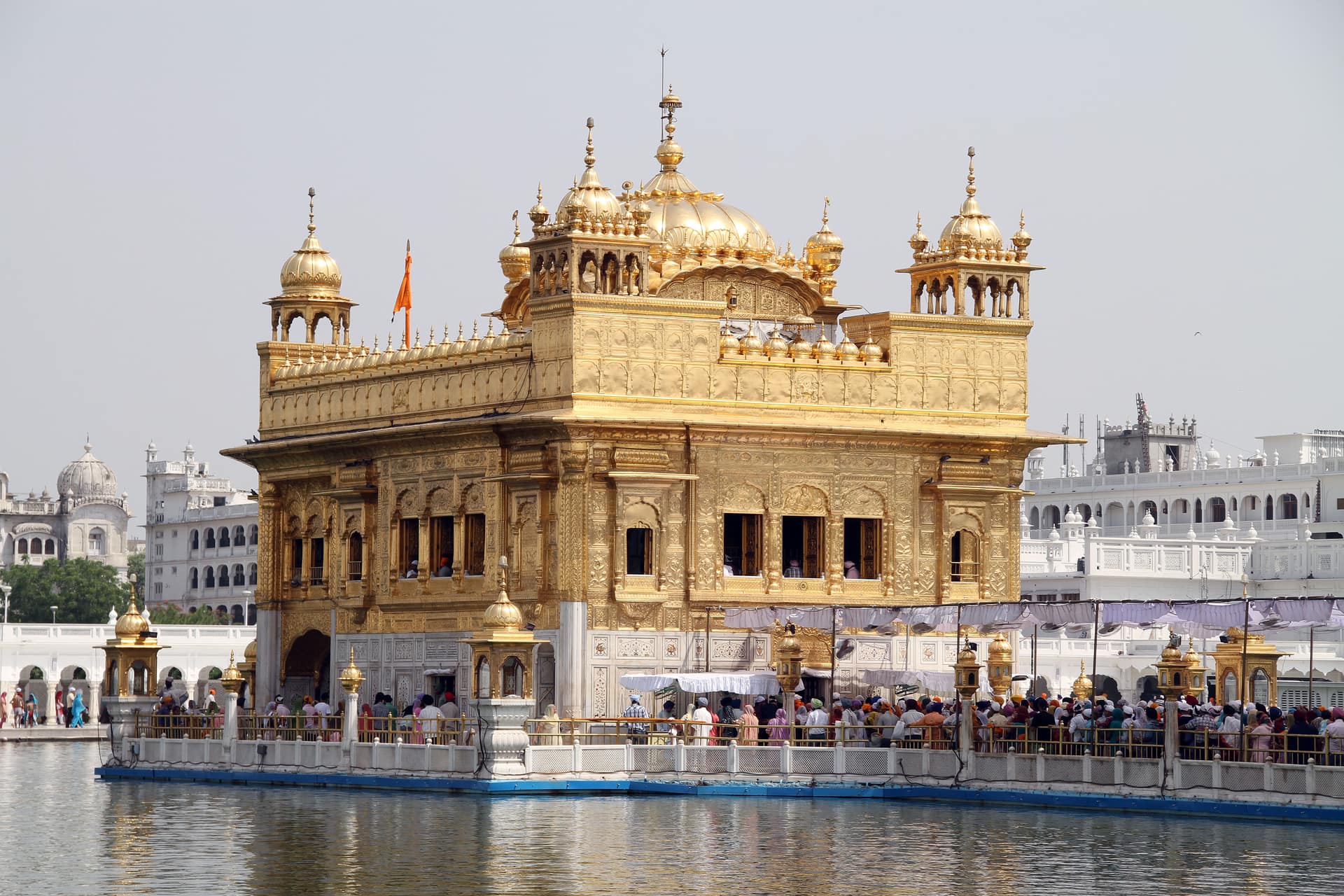
Temple in Amritsar
Harmandir Sahib (Golden Temple)
Amritsar, Punjab
Open around the clock, open to everyone, and free — including the food. The rules that exist are few and are enforced by the sevadars on duty rather than posted and ignored.
Photo: Oleg Yunakov — CC BY-SA 3.0, via Wikimedia Commons
Overview
Who it's to, and what's expected
Deity
Guru Granth Sahib
Tradition
Sikh shrine
- Entry
Open to visitors of every religion and nationality, at any hour, free of charge.
- Footwear
Shoes deposited at the free counters, then feet washed in the shallow water channel you walk through on the way in. Both are required, not optional.
- Access
The complex is flat and paved, with the marble parikrama circling the sarovar at ground level and the sanctum reached by a causeway and a short flight of steps - considerably easier than most of India's major shrines. The practical requirements are the head covering, the shoe deposit and the foot-washing channel, all of which every visitor completes, and crowds around the sanctum at the Palki Sahib ceremonies and through the night. Seva volunteers and sevadars are present throughout and will assist if asked.
- Prasadam
Karah parshad - a sweet of flour, ghee and sugar - is distributed in the sanctum and is received cupped in both hands. Separately, the langar serves free vegetarian food to anyone who comes, all day and night, with diners seated on the floor in rows (pangat) and served identically regardless of caste, religion, nationality or wealth. Nothing in either case is charged for, and there is no way to pay for a better place, because the seating arrangement exists precisely so that no such thing can.
Usually visited with
Time your visit
The darshan clock
A single opening-hours line cannot express a midday closure or an evening ceremony.
2:30 amapprox
The complex opens for Amrit Vela
The hours before dawn are the quietest and the most worth setting an alarm for.
5:00 amapprox
Morning Hukamnama
The daily reading.
9:45 pmapprox
Night Hukamnama
Before the Guru Granth Sahib is carried back for the night.
All day and night
Langar
The free community kitchen runs round the clock and serves everyone without exception. Sitting down to eat it is part of the visit, not a service for the needy.
Rules, timings and fees change — confirm locally before you rely on this.
How long this takes
Ways in
The difference between a twenty-minute visit and a three-hour one.
General entry
- Free, continuous, and open around the clock with no ticket and no timed slot
- The complex never closes; what changes through the night is whether the Guru Granth Sahib is installed in the sanctum
Sanctum queue
- The line to the Harmandir Sahib itself moves continuously but lengthens sharply around the Palki Sahib ceremonies, at weekends and during festivals and Vaisakhi
- Early morning and late night are the calm windows
Langar
- No queue in the darshan sense - you are seated on the floor in rows and served
- It runs all day and night and feeds between 50,000 and 100,000 people daily, so there is always somewhere to sit
Vaisakhi and martyrdom days
- Vaisakhi in April is the largest occasion of the year, with the city and the complex at capacity
- Nagar kirtan processions run through Amritsar
At the gate
Before you go in
What gets refused, and what you cannot take past the door.
What to wear
Head covered at all times inside the complex — scarves are handed out free at the entrance if you have not brought one. Shoulders and knees covered. No tobacco, alcohol, meat or drugs anywhere on the premises, and that is enforced rather than requested.
Phones and cameras
Photography is permitted in the courtyard and along the parikrama around the sarovar, which is where the gilded sanctum and its reflection are shot, but it is not permitted inside the sanctum where the Guru Granth Sahib is installed. Follow the attendants rather than assuming, and keep phones silent throughout - the continuous kirtan is the sound of the place and talking over it is the most common breach of etiquette.
Rules, timings and fees change — confirm locally before you rely on this.
When not to come — unless you mean to
Festival windows
These follow lunar calendars and move by weeks each year, so the windows are months, not dates.
Vaisakhi
Guru Nanak Jayanti (Gurpurab)
Martyrdom day of Guru Arjan Dev
Best visiting season
Practicalities
The things that go wrong
Book through official channels, and treat anyone promising a guaranteed slot as a warning sign.
What to watch for
- Anyone asking for money at the entrance
- Entry to Harmandir Sahib is free for everyone at every hour, and the langar is free; no payment is required or authorised anywhere in the complex
- Offering a scarf or head covering for sale when free ones are handed out at the entrance
- Bring your own or take the free scarf, and do not pay at the gate
- Guides attaching themselves inside the complex and producing a fee at the end
- The complex is well signed and sevadars will answer questions without charge; if you want a guide, arrange one through your hotel at an agreed price before arriving
- Anyone offering a faster route into the sanctum or a special viewing position
- There is no such arrangement, and the egalitarian structure of the complex is the point of the place
- Shoe-storage attendants outside the official free counters charging inflated rates
- Use the temple's own free deposit counters
- Third parties at the Wagah Border or Jallianwala Bagh folding the Golden Temple into an inflated package price
- The temple is free and independently visitable; agree any transport fare separately and in advance
General guidance
Planning the visit
Customary practice and what Amritsar's climate means for a barefoot visit — not rules posted at this temple. Anything specific to Harmandir Sahib (Golden Temple) is above.
Langar is open to you
The community kitchen serves anyone who sits down, without charge or expectation, and sitting on the floor in the row is part of the point. Tobacco and alcohol must not be carried onto the premises at all.
Come in winter
Winter is when Amritsar is most comfortable to walk around, which matters here because a temple visit is done on foot and barefoot. Locally the window is given as october to march.
Stone gets hot — go early
You will be barefoot from the shoe rack onwards, often across an open courtyard. Between late morning and mid-afternoon in the hot months that stone is genuinely painful to stand on. Socks help, and are permitted almost everywhere shoes are not.
Arriving by train
Amritsar has a railway station, and auto-rickshaws wait outside it. Agree the fare or use a meter before you set off, and expect to be dropped a short walk from the temple rather than at its door.
Outfit guide
What to wear at Harmandir Sahib (Golden Temple)
Cover shoulders and knees — the rules above win over anything here.
Trending wear for this spot
Modern, camera-ready looks picked for Harmandir Sahib (Golden Temple).

Traditional wear for this spot
Timeless, cultural looks that suit Harmandir Sahib (Golden Temple).

Harmandir Sahib (the Golden Temple), Amritsar
Harmandir Sahib is open around the clock, open to everyone, and free — including the food. The rules that exist are few, and they are enforced by the sevadars on duty rather than posted and ignored.
It is the most visited place of worship in India, and it does not behave like one. There is no queue discipline built around status, no ticket, and no closed hour. The complex is open all night, and the langar — the community kitchen — serves continuously.
📖 The Guru is a book
The presiding presence in the Harmandir Sahib is the Guru Granth Sahib, the Sikh scripture, which is regarded not as a text but as the living Guru — the eleventh and final Guru of the Sikhs, installed permanently after Guru Gobind Singh.
That single fact governs everything about a visit. What you attend is not a statue or an icon but a book treated as a sovereign: it is installed each morning with ceremony, honoured through the day, and put to rest each night. The daily rhythm of the temple is the rhythm of the Guru's own day.
🌅 The day, and the two ceremonies worth timing
- Kiwad (portal) opening — around 2:00 AM, later in some seasons.
- Amrit Vela kirtan — hymns in the early dawn, from around 2:00 to 3:30 AM.
- Asa di Var — the morning hymn, around 3:00 to 4:00 AM. This is the most musically celebrated service of the day.
- Prakash / Palki Sahib — around 4:00 to 5:00 AM: the Guru Granth Sahib is carried in procession from the Akal Takht to the Harmandir Sahib in a decorated palanquin, with hymns and chanting. This is the moment the sanctum becomes what it is during the day.
- Continuous kirtan inside the sanctum from about 4:00 AM until 9:45 PM.
- Rehras Sahib and Ardas — around 9:15 to 9:45 PM, the evening prayer.
- Sukhasan / Palki Sahib — around 9:45 to 10:00 PM: the Guru Granth Sahib is carried back to the Akal Takht for the night.
Between roughly 10:00 PM and the pre-dawn Prakash, the complex stays open but the sanctum does not hold the Guru Granth Sahib. That is worth knowing, because visitors who come at midnight for "darshan" find the courtyard and the water but not the scripture in the sanctum. The two ceremonies to time a visit around are the morning and evening Palki Sahib.
The Hukamnama — the daily reading taken at random from the Guru Granth Sahib and announced as the day's guidance — is read in the morning around 5:00 AM and at night around 9:45 PM.
🍲 The langar
The langar serves between 50,000 and 100,000 people every day, free, to anyone who comes. It runs all day and night and has done so for centuries.
It is the institutional expression of the faith's central social claim. Diners sit on the floor in rows — pangat — and are served in the same row regardless of caste, religion, nationality, wealth or rank. There is no separate seating for anyone and no way to pay for a better place, because the arrangement is precisely designed so that no such thing can exist.
You may eat, and you may volunteer. Peeling vegetables, washing dishes, serving, or rolling rotis in the kitchen is seva — voluntary service — and is open to any visitor for as long or short a time as you like. Many travellers find that an hour in the kitchen tells them more about the place than any amount of looking at the building.
🕌 The complex, and what else is in it
- The Harmandir Sahib itself — the gilded sanctum standing in the middle of the Amrit Sarovar, the pool of nectar, reached by a marble causeway. Its gold cladding dates from the early nineteenth century under Maharaja Ranjit Singh, which is why it is called the Golden Temple; its formal name is Harmandir Sahib, the House of God, or Darbar Sahib, the Court of the Lord.
- Doors on all four sides — traditionally read as an explicit statement that the shrine is open to people of every caste and from every direction.
- The Akal Takht — facing the Harmandir Sahib, the seat of temporal authority in Sikhism, where the Guru Granth Sahib rests at night.
- The Central Sikh Museum — free, roughly 7:00 AM to 7:00 PM in summer and 8:00 AM to 6:00 PM in winter; allow 30 to 45 minutes.
- Gurdwara locations around the sarovar, the clock tower entrance, and the parikrama — the marble walkway that circles the pool, which is the route everyone uses.
👳 Rules — few, and enforced
Head covered at all times inside the complex. Scarves are handed out free at the entrance if you have not brought one. Shoulders and knees covered.
No tobacco, alcohol, meat or drugs anywhere on the premises, and this is enforced rather than requested. That includes not carrying any of these into the complex, so finish or dispose of them before you arrive.
Shoes are deposited at the free counters, then you walk through a shallow water channel to wash your feet. Both steps are required, not optional — the foot-washing channel is part of the entrance sequence and everyone uses it.
Photography: permitted in the courtyard and around the parikrama, not inside the sanctum. Follow the attendants.
Circumambulate the pool clockwise, as everyone does, and do not turn your back on the sanctum when sitting near it.
🕰️ How long, and when
Allow a minimum of two hours; three to four is better, and the complex rewards a second visit at a different hour.
The night visit is the one people remember — the gilded sanctum lit and reflected in the still water of the sarovar, with the parikrama quieter than at any daytime hour. Many visitors come once at the morning Palki Sahib and once after dark, and that pair is the right way to see it.
Amritsar is comfortable from October to March; April to June is severely hot and July to September is monsoon.
📍 Amritsar around it
The complex sits in the old city, and the two standard companions are Jallianwala Bagh, a few minutes' walk away, and the Wagah Border ceremony about 30 km out at the Pakistan frontier.
A sensible Amritsar day: the Golden Temple at the morning Palki Sahib, Jallianwala Bagh mid-morning, lunch in the langar or in the old city's kulcha lanes, Wagah in the late afternoon, then back to the Golden Temple after dark for the reflection and the evening Sukhasan.
⚠️ Practical notes
- Cover your head before you reach the entrance, not at it — the queue for a free scarf is its own queue.
- Deposit shoes and wash your feet; both are required.
- Eat in the langar. Sitting on the floor in a row is the point of the place.
- Spend an hour in the kitchen if you have it.
- Come back after dark. The reflection is the image everyone carries home.
- Nothing here costs anything, and nobody is authorised to sell you anything.
Last verified: 2026. The complex is open 24 hours with free entry and no ticket; the langar serves 50,000-100,000 people daily; the Palki Sahib ceremonies run at roughly 4:00-5:00 AM and 9:45-10:00 PM; the sanctum does not hold the Guru Granth Sahib overnight. Portal opening and Asa di Var times shift with the season and are published by the temple itself, so confirm locally for your date.
Questions
Harmandir Sahib (Golden Temple) — FAQ
Who is Harmandir Sahib (Golden Temple) dedicated to?
Harmandir Sahib (Golden Temple) in Amritsar is dedicated to Guru Granth Sahib.
Who can enter Harmandir Sahib (Golden Temple)?
Open to visitors of every religion and nationality, at any hour, free of charge.
What is the dress code at Harmandir Sahib (Golden Temple)?
Head covered at all times inside the complex — scarves are handed out free at the entrance if you have not brought one. Shoulders and knees covered. No tobacco, alcohol, meat or drugs anywhere on the premises, and that is enforced rather than requested.
Do I have to take my shoes off at Harmandir Sahib (Golden Temple)?
Shoes deposited at the free counters, then feet washed in the shallow water channel you walk through on the way in. Both are required, not optional.
Can I take photos inside Harmandir Sahib (Golden Temple)?
Photography is permitted in the courtyard and along the parikrama around the sarovar, which is where the gilded sanctum and its reflection are shot, but it is not permitted inside the sanctum where the Guru Granth Sahib is installed. Follow the attendants rather than assuming, and keep phones silent throughout - the continuous kirtan is the sound of the place and talking over it is the most common breach of etiquette.
What prasadam is offered at Harmandir Sahib (Golden Temple)?
Karah parshad - a sweet of flour, ghee and sugar - is distributed in the sanctum and is received cupped in both hands. Separately, the langar serves free vegetarian food to anyone who comes, all day and night, with diners seated on the floor in rows (pangat) and served identically regardless of caste, religion, nationality or wealth. Nothing in either case is charged for, and there is no way to pay for a better place, because the seating arrangement exists precisely so that no such thing can.
Is Harmandir Sahib (Golden Temple) wheelchair accessible?
The complex is flat and paved, with the marble parikrama circling the sarovar at ground level and the sanctum reached by a causeway and a short flight of steps - considerably easier than most of India's major shrines. The practical requirements are the head covering, the shoe deposit and the foot-washing channel, all of which every visitor completes, and crowds around the sanctum at the Palki Sahib ceremonies and through the night. Seva volunteers and sevadars are present throughout and will assist if asked.
Checked, not remembered
Sources
Every rule and timing above traces back to one of these.