
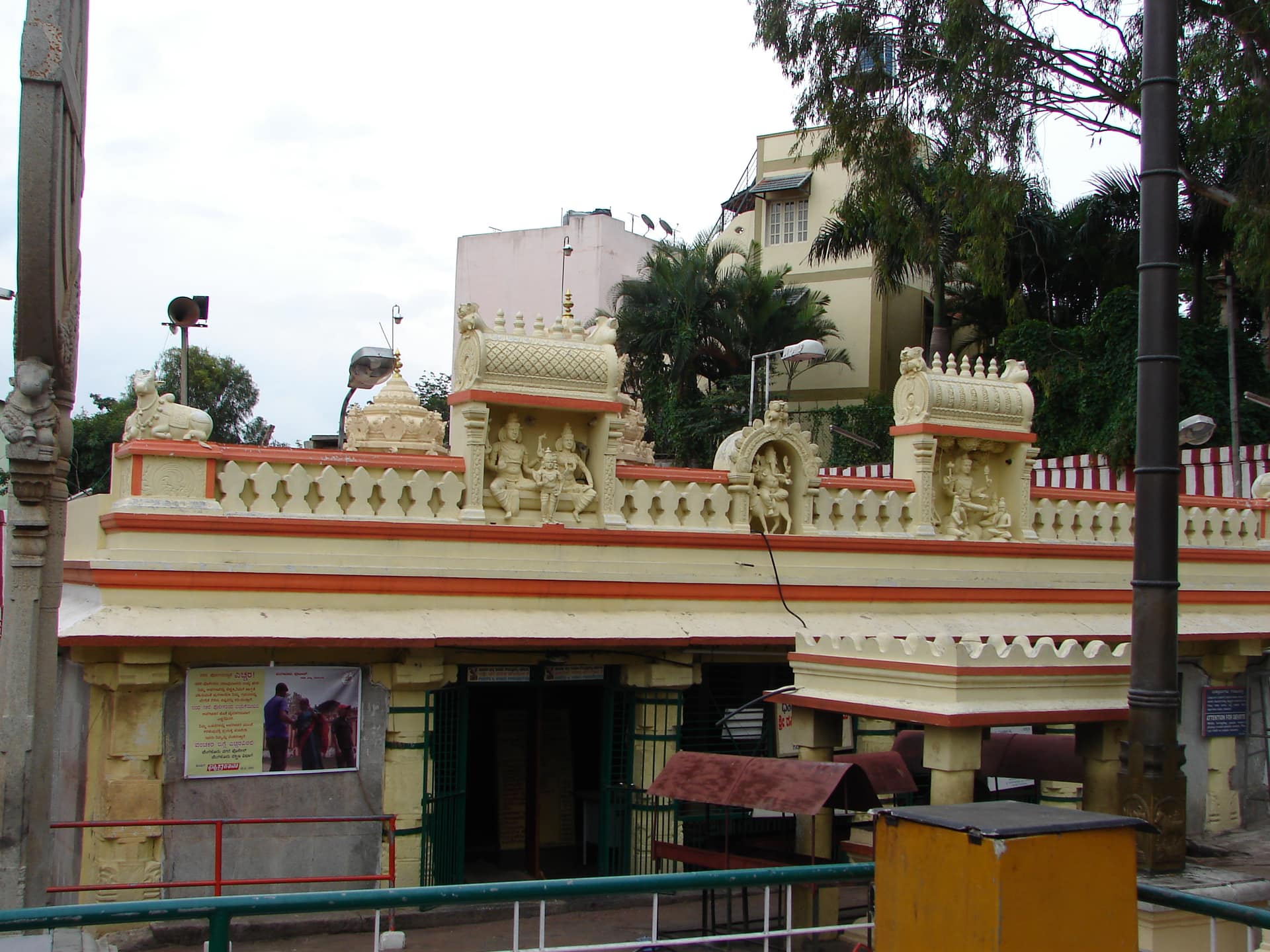
Temple in Bengaluru
Gavi Gangadhareshwara Temple
Bengaluru, Karnataka
A cave temple in Basavanagudi, cut partly into rock, and one of very few buildings anywhere designed around a single day of the year: on Makar Sankranti the setting sun passes between the horns of the stone Nandi outside and lands on the lingam in the cave.
Photo: Dineshkannambadi — CC BY-SA 4.0, via Wikimedia Commons
Overview
Who it's to, and what's expected
Deity
Shiva as Gangadhareshwara
Tradition
Shiva temple
- Footwear
You must remove your footwear before entering the temple premises.
Time your visit
The darshan clock
A single opening-hours line cannot express a midday closure or an evening ceremony.
6:00 AM
Opening hours
The temple is open daily from 6:00 AM to 12:30 PM and 5:00 PM to 8:00 PM. Daily rituals include Morning Abhisheka (6:00 AM – 7:30 AM), Madhyana Pooja (12:00 PM – 12:30 PM), Evening Pooja (5:30 PM – 6:30 PM), Rudrabhishekam (9:00 AM – 11:00 AM), and Ekadasha Rudrabhishekam (6:00 PM – 7:00 PM).
Rules, timings and fees change — confirm locally before you rely on this.
How long this takes
Ways in
The difference between a twenty-minute visit and a three-hour one.
General darshan
- Free and unhurried through the two daily sessions; the cave is small and the queue brief on ordinary days
The January alignment window
- Roughly 13 to 16 January, when the afternoon crowd builds for the sun's passage between Nandi's horns - arrive hours early for a view into the cave
Maha Shivaratri
- The temple's other great night, with worship through the dark hours
At the gate
Before you go in
What gets refused, and what you cannot take past the door.
What to wear
Visitors are required to wear traditional attire. Men should wear items like dhotis, kurtas, or full-length pants and shirts, while women should wear sarees, salwar kameez, or long skirts that cover the shoulders and knees.
When not to come — unless you mean to
Festival windows
These follow lunar calendars and move by weeks each year, so the windows are months, not dates.
14 January, in the evening; partially again around 30 November
BusyMakar Sankranti — the sun through Nandi's horns
Light passes between the horns of the Nandi and illuminates the lingam inside the cave for about an hour. Crowds are heavy for it. The November alignment is partial and far less attended.
Crowd levels are our reading of the notes above, not an official measure. Rules, timings and fees change — confirm locally before you rely on this.
General guidance
Planning the visit
Customary practice and what Bengaluru's climate means for a barefoot visit — not rules posted at this temple. Anything specific to Gavi Gangadhareshwara Temple is above.
Circling the shrine
At most Shaiva temples the circuit around the sanctum is not completed in a full circle — the channel draining the abhishekam is not crossed. Walk to it, turn, and come back the way you came. Watching what the queue in front of you does is the reliable guide.
Come in winter
Winter is when Bengaluru is most comfortable to walk around, which matters here because a temple visit is done on foot and barefoot. Locally the window is given as october to february.
Stone gets hot — go early
You will be barefoot from the shoe rack onwards, often across an open courtyard. Between late morning and mid-afternoon in the hot months that stone is genuinely painful to stand on. Socks help, and are permitted almost everywhere shoes are not.
Metro, then walk
Bengaluru has a metro, and it is usually the fastest way to get near a busy temple — the streets immediately around one are often closed to vehicles or jammed with them.
Outfit guide
What to wear at Gavi Gangadhareshwara Temple
Cover shoulders and knees — the rules above win over anything here.
Trending wear for this spot
Popular modern looks travellers are wearing across Bengaluru.


Traditional wear for this spot
Timeless, cultural outfits worn across Bengaluru.
Gavi Gangadhareshwara Temple, Bengaluru
A rock-cut cave temple in Gavipuram, Basavanagudi — one of very few buildings anywhere designed around a single evening of the year, when the setting sun passes between the horns of the stone Nandi and lands on the lingam in the cave.
☀️ The Sankranti alignment
On Makar Sankranti, in mid-January, the temple performs its own miracle of astronomy: in the late afternoon the sun drops between the horns of the Nandi and its light travels into the cave to touch the lingam, illuminating the sanctum for close to an hour.
Lakhs of devotees come for it — the crowd builds through the afternoon for a few minutes of light on stone, and the temple's whole fame rests on those minutes. The alignment is not a single day, in fact, but a short window: roughly 13 to 16 January each year, in the late afternoons. A second, partial window runs from about 26 November to 2 December — far less attended, and far easier to watch.
Eighteenth-century drawings of the temple suggest the alignment once marked the solstices, before later building changed the sightlines — the phenomenon has history inside it, not just geometry.
🕳️ The cave
'Gavi' means cave, and the shrine is one: the sanctum is cut into a natural rock formation, dedicated to Shiva as Gangadhareshwara — the bearer of the Ganga. The inner sanctum is carved from a single rock, and holds, besides the lingam, an unusual image of Agnimurthi with two heads, seven hands and three legs, revered in the local tradition for the cure of eye ailments.
The temple stands by the old Kempambudi tank, in the older Bengaluru of Gavipuram — a village that the city grew around and kept. Inside, the cave is dark and cool at any hour, oil lamps doing the work the sun does only in January, and the rock's silence holding the city away.
🗿 The forecourt and its discs
The courtyard is a gallery of monoliths: four great pillars — one carrying a damaru, one a trishul — and two granite pillars supporting two large circular discs, the sun and the moon. Two further pillars carry rows of seated Nandis.
What the discs measured, if they measured anything, the temple does not say — they stand in the forecourt as the area's great puzzle, and every guide offers a different reading of them. They are the most photographed stones in Gavipuram, and the alignment that gives the temple its fame is only a few metres away.
🏛️ Kempe Gowda's shrine
The temple's found-story belongs to the city's founder: the tradition credits the original cave shrine to the sages Gautama and Bharadwaja in the Vedic age, and its sixteenth-century rebuilding to Kempe Gowda I — the founder of Bengaluru, who is held to have raised it in gratitude after his release from five years of imprisonment under Vijayanagara's Rama Raya.
The shrine is a protected monument under the Karnataka Ancient and Historical Monuments Act, which makes it one of the few places in the city where worship continues inside a state-protected rock-cut structure.
🕒 Timings and rituals
Open daily about 6:00 AM to 12:30 PM and 5:00 to 8:00 PM. The morning abhisheka runs 6:00 to 7:30 AM, the Rudrabhishekam 9:00 to 11:00 AM, the midday pooja closes the morning, and the evening pooja falls about 5:30 to 6:30 PM.
Footwear comes off before the premises; traditional dress is preferred — dhoti, kurta or full-length trousers for men, saree, salwar or long skirts for women, shoulders and knees covered.
Maha Shivaratri is the temple's other great night, and the January alignment window its other crowd — outside those, the cave is one of the quiet, dark, ancient-feeling shrines of the old city.
🌌 Watching the alignment — practical
For the January window, arrive by mid-afternoon: the courtyard fills hours before the light arrives, and the view into the cave mouth — where the sunbeam lands — is the contested ground. The temple stewards manage the crowd as the hour approaches; follow their placing and keep the elderly and children back from the press.
The November window is the connoisseur's choice: the same geometry at lower strength, a handful of devotees, and the light to yourself. Photograph the discs in the forecourt before you queue — after the alignment, everyone is photographing them.
🚶 The Basavanagudi walk
Gavipuram sits in Basavanagudi, the old neighbourhood that preserves the Bengaluru of a century ago — and the temple belongs to its walk. The classic morning: the Bull Temple and its colossal Nandi, the Dodda Ganesha with its pendant belly, Bugle Rock's park and its bats, and the Gavi Gangadhareshwara cave — all within a couple of kilometres, all best before the traffic wakes.
Gandhi Bazaar's flower-scented streets sit at the centre of it, and the walk ends there, as Basavanagudi mornings should.
Last verified: 2026. The Makar Sankranti illumination of the lingam through Nandi's horns with its 13-16 January window and the partial 26 November to 2 December window, the rock-cut sanctum with the two-headed seven-handed three-legged Agnimurthi and the eye-ailment tradition, the sun-and-moon discs and monolithic pillars, the Kempe Gowda rebuilding and Rama Raya imprisonment tradition, the protected-monument status, the ritual schedule, and the Shivaratri observance are documented. The alignment window's exact minutes shift with the year; the temple's own notice on the day is authoritative.
Questions
Gavi Gangadhareshwara Temple — FAQ
Who is Gavi Gangadhareshwara Temple dedicated to?
Gavi Gangadhareshwara Temple in Bengaluru is dedicated to Shiva as Gangadhareshwara.
What is the dress code at Gavi Gangadhareshwara Temple?
Visitors are required to wear traditional attire. Men should wear items like dhotis, kurtas, or full-length pants and shirts, while women should wear sarees, salwar kameez, or long skirts that cover the shoulders and knees.
Do I have to take my shoes off at Gavi Gangadhareshwara Temple?
You must remove your footwear before entering the temple premises.
Checked, not remembered
Sources
Every rule and timing above traces back to one of these.