
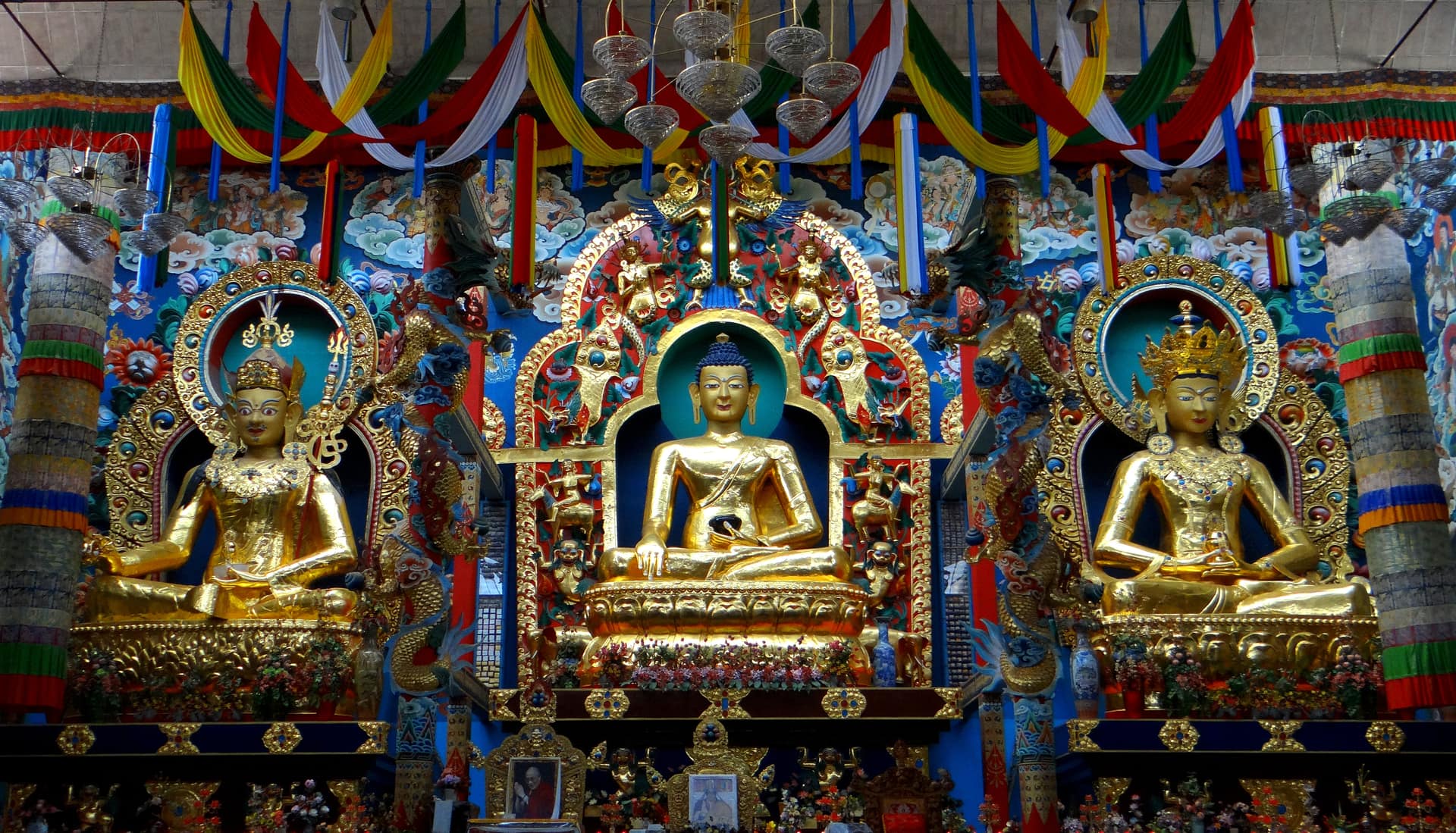
Temple in Coorg (Madikeri)
Namdroling Monastery (the Golden Temple)
Coorg (Madikeri), Karnataka
At Bylakuppe, in a Tibetan settlement of some sixteen thousand people — and the largest teaching centre of the Nyingma school, the oldest of the four Tibetan Buddhist traditions, anywhere in the world. Several thousand monks and nuns live and study here. The three gilded figures in the main hall stand about 60 feet.
Photo: Sahyadri H S — CC BY-SA 3.0, via Wikimedia Commons
Overview
Who it's to, and what's expected
Deity
Nyingma lineage
Tradition
Buddhist temple
- Entry
Visitors must dress modestly, covering their shoulders and knees, and remove their shoes when entering certain areas of the monastery.
- Footwear
You are required to remove your shoes before entering certain areas of the monastery.
Usually visited with
Time your visit
The darshan clock
A single opening-hours line cannot express a midday closure or an evening ceremony.
9:00 AM
Opening hours
The monastery is open to visitors daily from 9:00 AM to 6:00 PM, during which time you may observe or join the monks for their daily prayers.
Rules, timings and fees change — confirm locally before you rely on this.
How long this takes
Ways in
The difference between a twenty-minute visit and a three-hour one.
General visiting
- Free and open through the day; the hall is quietest in mid-morning after prayers
Morning prayer session
- The hall at its fullest and most sonorous - visitors sit at the back and observe in silence
Festival days
- Lhosar and the lama dances draw large local crowds; the monastery's notices govern seating and access
At the gate
Before you go in
What gets refused, and what you cannot take past the door.
What to wear
Visitors are required to dress modestly, ensuring their shoulders and knees are covered.
Phones and cameras
Photography is permitted, but visitors are advised to be mindful of the specific rules regarding photography while on the monastery premises.
Rules, timings and fees change — confirm locally before you rely on this.
Practicalities
The things that go wrong
Book through official channels, and treat anyone promising a guaranteed slot as a warning sign.
What to watch for
- Self-styled guides at the gate charging for monastery 'tours' - the complex is freely walkable and the halls explain themselves
- Shopkeepers presenting craft items as monastery products - the settlement's shops are private; buy what you like at the marked price
- Third parties collecting 'monastery entry fees' - entry is free, and donations belong in the hall's own boxes
- Photographers charging compulsory fees for cameras - photography of the halls is permitted and free; follow posted restrictions
- Drivers combining the visit with fixed shopping stops - the standard Coorg circuit covers the monastery without detours
General guidance
Planning the visit
Customary practice and what Coorg (Madikeri)'s climate means for a barefoot visit — not rules posted at this temple. Anything specific to Namdroling Monastery (the Golden Temple) is above.
Walk clockwise, and mind the feet
Circumambulation is clockwise, and prayer wheels are turned the same way. Pointing your feet at an image of the Buddha — sitting with legs outstretched towards the shrine — is the commonest unintended offence, and sitting cross-legged or kneeling avoids it.
Come in winter
Winter is when Coorg (Madikeri) is most comfortable to walk around, which matters here because a temple visit is done on foot and barefoot. Locally the window is given as october to march.
Cold stone, early starts
Barefoot on stone at altitude before sunrise is colder than the air temperature suggests, and the first darshan of the day is usually the coldest hour. Socks are permitted almost everywhere shoes are not.
No airport here
Coorg (Madikeri) has no airport of its own, so the last leg is by road or rail. Plan the return the same way — the last bus out is often earlier than visitors expect.
Outfit guide
What to wear at Namdroling Monastery (the Golden Temple)
Cover shoulders and knees — the rules above win over anything here.
Trending wear for this spot
Popular modern looks travellers are wearing across Coorg (Madikeri).

Traditional wear for this spot
Timeless, cultural looks that suit Namdroling Monastery (the Golden Temple).
Namdroling Monastery, Bylakuppe: The Golden Temple of the Tibetans
At Bylakuppe, on the Mysuru-Coorg road, the road turns into another country: a Tibetan settlement of some sixteen thousand people, prayer flags over the shopfronts, and - at its centre - the golden roof of the Namdroling monastery's main temple, the largest teaching centre of the Nyingma school anywhere in the world. The 'Golden Temple' that visitors come for is the public face of a full monastic city: thousands of monks and nuns, schools, a nunnery, and a routine of study and prayer that runs all day.
🏛️ The founding
The monastery was founded in 1963 by Pema Norbu Rinpoche, the eleventh throne-holder of the Palyul lineage - one of the six great mother monasteries of the Nyingma tradition, the oldest of the four schools of Tibetan Buddhism. The first structures were bamboo; what stands today - halls, colleges, quarters, and the golden temple itself - was built over decades by the community's own hands and donations.
The main shrine, the Padmasambhava Vihara, opened in 1999 and is the image the world knows: high bright halls, painted columns, and three gilded figures that stop every visitor at the door. Photographs do not prepare you for the scale or the gold.
🖼️ The three statues
The prayer hall is arranged around Guru Padmasambhava - the great teacher who carried Buddhism to the Himalayas - flanked by Buddha Shakyamuni and Buddha Amitayus, each gilded and roughly forty to sixty feet tall by differing accounts, with the Padmasambhava the tallest. Inside the statues, by the monastery's tradition, are sacred scriptures and small clay stupas representing the body, speech and mind of the Buddhas.
The walls carry the teaching in full colour: thangka-scale paintings of the life of the Buddha, the taming of Mara, and the deities of the Nyingma pantheon, by artists of repute. Walk the hall clockwise, as the community does - the circumambulation is the visit.
🕯️ The morning prayers
The monastery's day is worth planning around: in the morning the prayer hall fills with rows of monks in maroon, the long horns and drums of the Tibetan liturgy sound, and butter lamps and tea move through the rows. Visitors may sit at the back and simply watch - it is one of the great sights of south Indian religious life, and it happens here every day.
The temple is open to visitors through the day, about 9:00 AM to 6:00 PM, but the morning session is the experience. The younger monks are children doing what children do between duties; the community is hospitable, unhurried, and used to visitors - courtesy, modest dress and quiet cameras are the whole etiquette.
Around the monastery, the settlement itself rewards the walk. The old camp market behind the temple sells the community's crafts, incense and woollens; small cafes serve thukpa, momos and butter tea with a seriousness the cities have lost; and the settlement's schools and institutes carry names that map a whole tradition relocated and rebuilt. None of it is staged for visitors - which is precisely why it stays with people.
Give the golden hall one circuit, then sit: the light off the statues changes through the morning as the sun climbs past the high windows, and the hall's caretakers are used to travellers who simply stay. If your dates allow a return, come back at four in the afternoon for the debate horns - the sound of the schools at work.
🎎 Lhosar and the lama dances
Tibetan New Year - Lhosar, in February or March by the lunar calendar - transforms the settlement: butter sculptures, new clothes, visits, and the monastery's biggest public days. Across the year the monastery also stages its ceremonial lama dances, the masked cham performances whose costumes and choreography carry the tradition's whole dramatic repertoire - dates follow the lunar calendar, and the settlement's notices announce them.
Outside the festival calendar, an ordinary day is the best-kept secret: the golden hall nearly empty at ten in the morning, the old camp market behind it, and the whole settlement going about a life that is itself the sight.
🚗 Bylakuppe and Coorg
Bylakuppe sits near Kushalnagar, on the eastern edge of Coorg - and the Golden Temple slots perfectly into the Coorg circuit. The Cauvery Nisargadhama river island and the Dubare elephant camp are minutes away; Madikeri, Abbey Falls and the coffee estates are the classic onward route; Mysuru, about eighty kilometres east, is the usual gateway.
Give the monastery a half-day at minimum, more if the morning prayers are on. Tibetan food - thukpa, momos, butter tea - is available in the settlement's small cafes, and the market's crafts support the community's schools. It is the rare great monastery that is also easy - flat, close to the road, open all day - and it rewards the early start like everywhere else in this guide.
Last verified: 2026. The 1963 founding by Pema Norbu Rinpoche of the Palyul lineage with the bamboo beginnings, the Padmasambhava Vihara opened in 1999, the three gilded statues of Padmasambhava, Buddha Shakyamuni and Amitayus with the differing height accounts, the scriptures and clay stupas within by tradition, the several-thousand-strong monastic community, the about 9:00 AM-6:00 PM visitor hours with the morning prayer session, the Lhosar and lama-dance calendar, and the Coorg circuit pairing are documented. Prayer and festival dates follow the lunar calendar; the monastery's own notices are authoritative.
Questions
Namdroling Monastery (the Golden Temple) — FAQ
Who is Namdroling Monastery (the Golden Temple) dedicated to?
Namdroling Monastery (the Golden Temple) in Coorg (Madikeri) is dedicated to Nyingma lineage.
Who can enter Namdroling Monastery (the Golden Temple)?
Visitors must dress modestly, covering their shoulders and knees, and remove their shoes when entering certain areas of the monastery.
What is the dress code at Namdroling Monastery (the Golden Temple)?
Visitors are required to dress modestly, ensuring their shoulders and knees are covered.
Do I have to take my shoes off at Namdroling Monastery (the Golden Temple)?
You are required to remove your shoes before entering certain areas of the monastery.
Can I take photos inside Namdroling Monastery (the Golden Temple)?
Photography is permitted, but visitors are advised to be mindful of the specific rules regarding photography while on the monastery premises.
Checked, not remembered
Sources
Every rule and timing above traces back to one of these.