
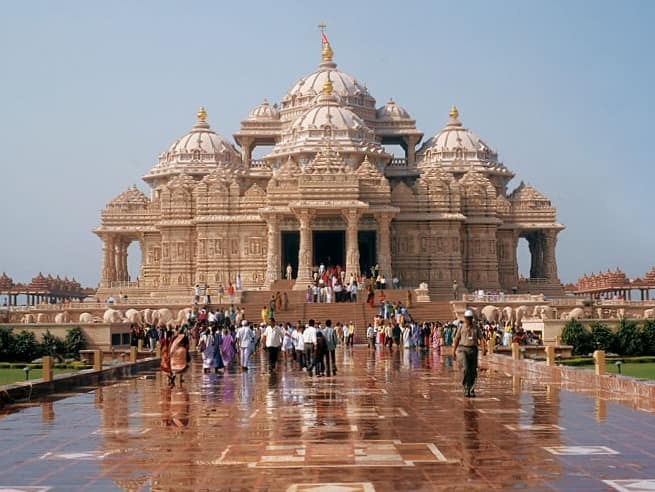
Temple in Delhi
Swaminarayan Akshardham
Delhi, India
A vast sandstone and marble complex on the Yamuna, opened in 2005, with exhibitions, a boat ride and a musical fountain alongside the temple. Plan it as a half-day, and plan the security queue into it.
Photo: Swaminarayan Sanstha — CC BY-SA 3.0, via Wikimedia Commons
Overview
Who it's to, and what's expected
Deity
Swaminarayan
Tradition
Vishnu · Krishna temple
- Entry
Visitors must dress respectfully by covering their shoulders and knees, and they are prohibited from bringing electronic items, bags, food, or tobacco products into the complex.
- Footwear
Shoes are NOT allowed in the Mandir. Deposit them in the shoe-house located in front of the mandir, and collect them back before you visit the Gajendra Peeth - so footwear is a two-stage process rather than a single deposit, and you will need your shoes again for the rest of the complex. Wear something easy to remove and put back on, and consider socks for the marble.
- Access
Wheelchairs are available for visitors at the temple complex with a refundable deposit of Rs.
- Prasadam
Prasad is distributed at the Mandir in connection with the aartis at 10:30 AM and 6:00 PM, and the Abhishek Darshan - which is free - is the devotional centre of the visit. Note that no food may be brought into the complex; the on-site food court operates from about 11:00 AM to 8:00 PM and is vegetarian only.
Usually visited with
Time your visit
The darshan clock
A single opening-hours line cannot express a midday closure or an evening ceremony.
9:30 AM
Opening hours
The temple is open from 9:30 AM to 6:30 PM, with exhibitions running from 10:00 AM to 5:00 PM. The complex is closed on Mondays.
Rules, timings and fees change — confirm locally before you rely on this.
How long this takes
Ways in
The difference between a twenty-minute visit and a three-hour one.
Darshan options
- Entry to the temple complex, gardens, and Abhishek Darshan are free, while exhibitions, the musical fountain, and Abhishek Puja require a paid ticket
At the gate
Before you go in
What gets refused, and what you cannot take past the door.
What to wear
Visitors are required to dress respectfully by ensuring their shoulders and knees are covered. If needed, wraps are available for a refundable deposit of Rs.
Phones and cameras
Electronic items including mobile phones, cameras, pen drives, and hands-free devices are strictly prohibited inside the temple complex.
Rules, timings and fees change — confirm locally before you rely on this.
When not to come — unless you mean to
Festival windows
These follow lunar calendars and move by weeks each year, so the windows are months, not dates.
Diwali
Janmashtami
Guru anniversaries
Practicalities
The things that go wrong
Book through official channels, and treat anyone promising a guaranteed slot as a warning sign.
What to watch for
- Selling tickets for the free parts of Akshardham
- Entry to the temple complex, the gardens and the Abhishek Darshan is free - only the exhibitions, boat ride and musical fountain are ticketed, and those are sold at the complex
- Claiming the Monday closure does not apply, or that entry can be arranged on a Monday
- The complex is closed on Mondays; only major festival days generally suspend that, and no payment opens it
- Anyone offering to store your phone or camera for a fee outside the gates
- Electronics are prohibited inside the complex, and informal storage outside is unregulated - travel with nothing you cannot leave elsewhere
- Charging for wraps or wheelchairs as a fee rather than the Rs100 refundable deposit
- Both are refundable on return; anyone describing them as a purchase is misrepresenting them
- Guides attaching themselves at the entrance and producing a fee inside
- The complex is thoroughly signposted and the Narayan Peeth's bronze panels narrate the tradition's own story; a guide adds little and is not required
- Third parties claiming photography can be arranged inside for a payment
- No photography is permitted anywhere in the complex and no payment changes that
One place, many temples
Other temples in Delhi
General guidance
Planning the visit
Customary practice and what Delhi's climate means for a barefoot visit — not rules posted at this temple. Anything specific to Swaminarayan Akshardham is above.
The queue is the ritual
Vaishnava temples in India are usually organised around a moving darshan queue rather than time spent in front of the deity. Expect to keep walking, and expect the view of the sanctum to be brief — that is the intended experience, not a rushed one.
Come in winter
Winter is when Delhi is most comfortable to walk around, which matters here because a temple visit is done on foot and barefoot. Locally the window is given as october to march.
Stone gets hot — go early
You will be barefoot from the shoe rack onwards, often across an open courtyard. Between late morning and mid-afternoon in the hot months that stone is genuinely painful to stand on. Socks help, and are permitted almost everywhere shoes are not.
Metro, then walk
Delhi has a metro, and it is usually the fastest way to get near a busy temple — the streets immediately around one are often closed to vehicles or jammed with them.
Outfit guide
What to wear at Swaminarayan Akshardham
Cover shoulders and knees — the rules above win over anything here.
Trending wear for this spot
Popular modern looks travellers are wearing across Delhi.


Traditional wear for this spot
Timeless, cultural outfits worn across Delhi.
Swaminarayan Akshardham, Delhi
Akshardham is a vast sandstone and marble complex on the Yamuna, opened in 2005, with exhibitions, a boat ride and a musical fountain alongside the temple itself. It is not a single shrine but an ensemble, and the correct way to plan it is as a half-day with the security queue counted inside that half-day.
That last point is the one visitors most often get wrong: you cannot bring electronics in, and the security process takes real time. Arriving without accounting for it is how people lose an afternoon.
🚫 Security: what you cannot bring
Electronic items are strictly prohibited inside the complex — including mobile phones, cameras, pen drives and hands-free devices. Also prohibited: bags, food and tobacco products.
This is not a bag-check where your phone goes in a tray. It is a full prohibition, and there is no way to carry a phone in. Plan accordingly:
- Travel light. Bring only what you can leave behind or deposit.
- Allow substantial time for security before your intended entry time, and factor it into the half-day.
- If you are meeting someone afterwards, agree the meeting point before you go in — you will have no phone inside.
- There is no photography inside the complex at all, so do not expect images of the mandir. This surprises many visitors and is worth knowing before you arrive.
👞 Footwear — the shoe-house, and a specific sequence
Shoes are not allowed in the Mandir. Deposit them in the shoe-house located in front of the mandir, and collect them back before you visit the Gajendra Peeth.
That sequence is worth stating exactly, because it is a two-stage process rather than a single deposit:
- Deposit footwear at the shoe-house in front of the Mandir before entering it.
- Collect your footwear again before moving on to the Gajendra Peeth, which is the next part of the complex.
So you will be barefoot or in socks through the Mandir and will need your shoes back for the rest of the visit. Visitors who deposit shoes expecting to finish the complex barefoot, or who expect to wear shoes throughout, are both wrong — the official guidance is explicit about the two stages.
🕉️ The Mandir itself
The inner sanctum, the garbhagruh, is home to Bhagwan Swaminarayan and his divine succession of gurus — Gunatitanand Swami, Bhagatji Maharaj, Shastriji Maharaj, Yogiji Maharaj and Pramukh Swami Maharaj, all understood as manifestations of Aksharbrahma and as God's eternal servants.
The circumambulation path, the Narayan Peeth, carries three bronze relief panels each 60 feet long, illustrating incidents from Bhagwan Swaminarayan's life. Walking the pradakshina clockwise is the traditional act of respect here, and the panels are designed to be experienced during that walk rather than viewed statically — which is why they are so long.
Allow about 45 minutes for the Mandir. That is the official figure, and it is accurate for the temple alone.
🕒 Timings, aarti, and the Monday closure
- Complex opening: around 9:30 AM
- Mandir: 10:00 AM to 8:00 PM
- Aarti: 10:30 AM and 6:00 PM (one source gives the morning aarti at 10:00 AM)
- Last entry: around 6:30 PM
- CLOSED ON MONDAYS
The Monday closure is the single most important practical fact on this page and is easy to miss, because Akshardham is often listed among Delhi's always-open attractions. Do not plan it for a Monday.
Exhibitions run from 10:00 AM to 5:00 PM, so if the exhibitions matter to you, arrive well before mid-afternoon — the last useful entry for them is considerably earlier than the last entry for the complex.
🎟️ What is free and what is not
Entry to the temple complex, the gardens and the Abhishek Darshan is free.
The exhibitions, the boat ride and the musical fountain are ticketed separately, and the tickets are available from 10:00 AM to 5:00 PM.
Two other charges exist and both are refundable deposits rather than fees:
- Wraps, if you need to cover shoulders or knees, are available for a refundable deposit of ₹100.
- Wheelchairs are available for a refundable deposit of ₹100.
Refundable means you get the money back on return, so neither is a cost — but carry small cash for the deposits, since you will have no phone for a digital payment inside and the complex does not assume you are carrying a card.
👘 Dress code
Visitors are required to dress respectfully, with shoulders and knees covered. This is enforced, and it is the reason the ₹100 wrap deposit exists — people arrive in Delhi summer clothing and cannot enter.
The simple fix is to dress for it deliberately, or to carry a shawl or stole. Do not plan on buying a wrap at the gate as your strategy; it works, but it costs time at a site where time is already consumed by security.
♿ Access
Wheelchairs are available for visitors at the complex with a refundable deposit of ₹100, which is a genuine provision rather than a token one — the complex is large, paved and largely flat, and it is one of the more manageable major religious sites in Delhi for visitors with mobility limitations.
The main constraints are distance and duration rather than terrain: the complex takes two to three hours properly, there is a great deal of walking between the Mandir, the exhibitions and the gardens, and there is no phone to navigate or coordinate with inside.
🌊 The rest of the complex
Beyond the Mandir:
- The Gajendra Peeth — the stone elephant pavilion, which you reach after collecting your footwear
- The exhibitions — ticketed, 10:00 AM to 5:00 PM, and the most substantial content after the temple
- The boat ride — ticketed, a guided circuit through dioramas of Indian history
- The musical fountain — ticketed, held in the evening, and the day's usual finale
- The gardens — free, and where much of the complex's scale reads best
- A food court, operating from about 11:00 AM to 8:00 PM — vegetarian only, consistent with the complex's practice
Allow two to three hours for a full tour, and more if you take every ticketed element. The evening fountain show is what most people build the visit around, which means arriving in the afternoon, seeing the Mandir and exhibitions, then staying for the fountain.
🌸 Festivals
Diwali is the complex at its most spectacular, with the whole site lit and heavy visitor numbers. Janmashtami and the anniversaries of the Swaminarayan tradition's gurus — particularly Pramukh Swami Maharaj — are significant occasions. The Monday closure is generally suspended on major festival days, but confirm rather than assuming.
⚠️ Practical notes
- Not on a Monday. The single most common planning error.
- Travel with nothing you cannot deposit. No phone, no camera, no bag, no food.
- Arrive mid-morning, see the Mandir and exhibitions, then stay for the evening fountain.
- Carry small cash for the ₹100 refundable deposits on wraps and wheelchairs.
- Agree a meeting point before entering, because you will have no phone inside.
- Dress for shoulders and knees covered rather than relying on the wrap deposit.
Last verified: 2026. Timings, entry arrangements and any charges are published by the temple itself and do change - confirm them with the temple's own official website or counter before travelling rather than relying on any third-party listing.
Questions
Swaminarayan Akshardham — FAQ
Who is Swaminarayan Akshardham dedicated to?
Swaminarayan Akshardham in Delhi is dedicated to Swaminarayan.
Who can enter Swaminarayan Akshardham?
Visitors must dress respectfully by covering their shoulders and knees, and they are prohibited from bringing electronic items, bags, food, or tobacco products into the complex.
What is the dress code at Swaminarayan Akshardham?
Visitors are required to dress respectfully by ensuring their shoulders and knees are covered. If needed, wraps are available for a refundable deposit of Rs.
Do I have to take my shoes off at Swaminarayan Akshardham?
Shoes are NOT allowed in the Mandir. Deposit them in the shoe-house located in front of the mandir, and collect them back before you visit the Gajendra Peeth - so footwear is a two-stage process rather than a single deposit, and you will need your shoes again for the rest of the complex. Wear something easy to remove and put back on, and consider socks for the marble.
Can I take photos inside Swaminarayan Akshardham?
Electronic items including mobile phones, cameras, pen drives, and hands-free devices are strictly prohibited inside the temple complex.
What prasadam is offered at Swaminarayan Akshardham?
Prasad is distributed at the Mandir in connection with the aartis at 10:30 AM and 6:00 PM, and the Abhishek Darshan - which is free - is the devotional centre of the visit. Note that no food may be brought into the complex; the on-site food court operates from about 11:00 AM to 8:00 PM and is vegetarian only.
Is Swaminarayan Akshardham wheelchair accessible?
Wheelchairs are available for visitors at the temple complex with a refundable deposit of Rs.
Checked, not remembered
Sources
Every rule and timing above traces back to one of these.