
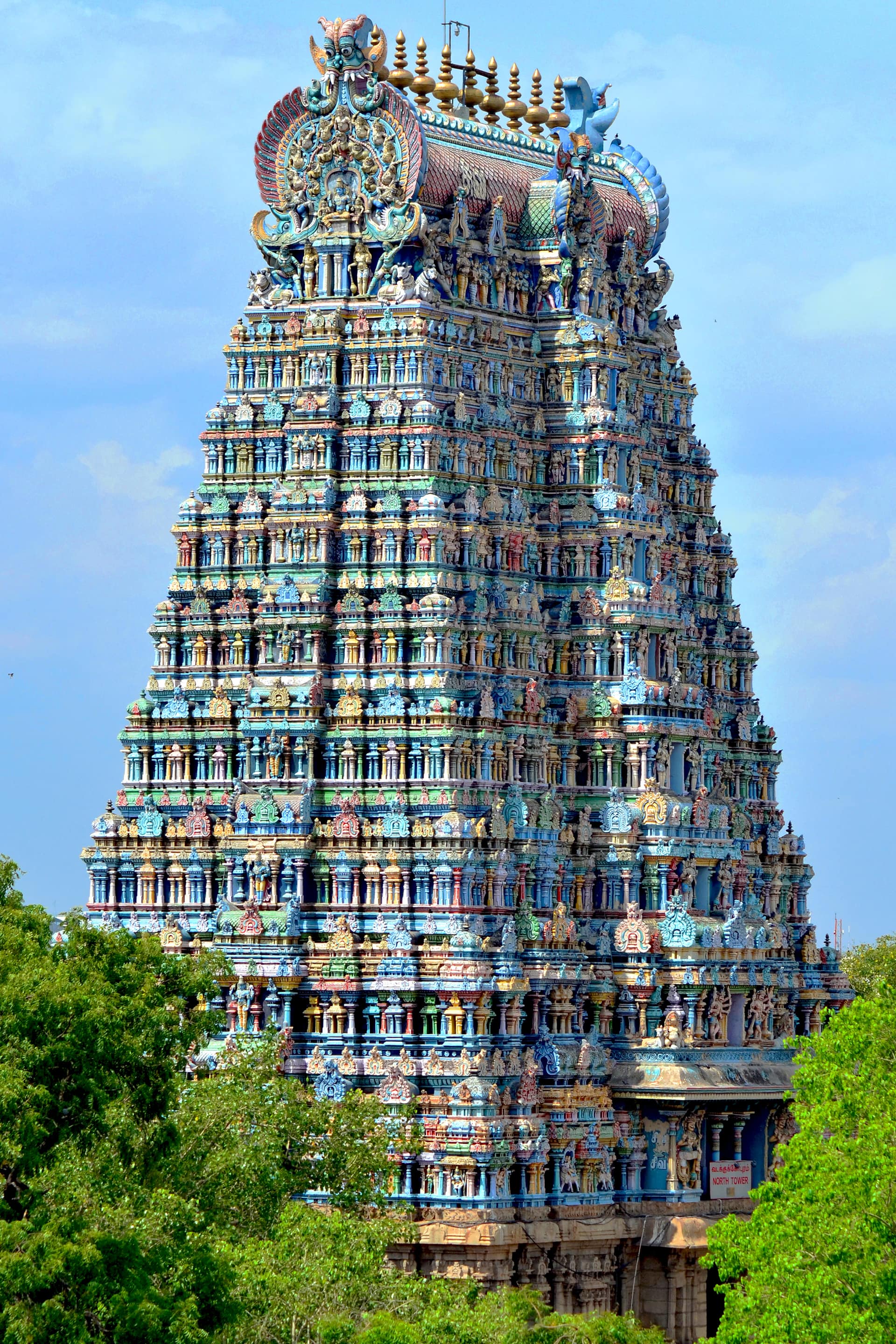
Temple in Madurai
Meenakshi Amman Temple
Madurai, Tamil Nadu
A working temple city rather than a monument — fourteen towers over the old town, still the daily centre of Madurai rather than a preserved ruin. The thing most visitors miss is that the best ceremony of the day happens last thing at night.
Photo: Mamichaelraj — CC BY-SA 4.0, via Wikimedia Commons
Overview
Who it's to, and what's expected
Deity
Meenakshi and Sundareswarar
Tradition
Devi · Shakti temple
- Entry
Open to visitors of all faiths, around 5:00 AM to 12:30 PM and 4:00 PM to 9:30 PM (one published account gives a 10:00 PM close), with a firm midday closure from 12:30 to 4:00 PM - arriving at 1:00 PM finds the temple shut for three hours. Phones and cameras are not allowed inside and there are deposit facilities, so everything you photograph will have been shot from outside the walls. Dress is enforced rather than advisory: shorts, sleeveless tops and tight clothing are refused at the entrance, and there is no wrap or loan system. Allow two to three hours at a relaxed pace, four to five during festivals, and stay until the 9:15-9:30 PM Palliarai ceremony before closing.
- Footwear
Remove footwear before entering, with deposit facilities at the gates. The complex is extensive - two to three hours at a relaxed pace and four to five during festivals - and its stone corridors hold heat, so a morning or post-4:00 PM visit is considerably more comfortable underfoot than midday, and something easy to slip off matters more here than at most temples.
- Access
The complex is extensive and involves a great deal of walking through corridors, courtyards and around the Potramarai Kulam tank, with thresholds and steps between precincts and a visit of two to three hours at a relaxed pace. Stone surfaces hold heat, so the principal constraint for older visitors is duration and temperature rather than any single obstacle - the 5:00 AM opening or a post-4:00 PM session is far more manageable than midday. Enquire at the temple office about assistance, and note that phones and cameras must be deposited before entry.
- Prasadam
Prasad is distributed at the temple following the daily pujas, of which there are six across the day from Thiruvanandal at 5:00 AM through Kalasandhi, Uchikkala, Maalai and Ardhajama to the Palliarai ceremony at 9:15 PM. Arriving at a puja window rather than between them is how visitors encounter it, since darshan pauses during each of the six services.
Usually visited with
Time your visit
The darshan clock
A single opening-hours line cannot express a midday closure or an evening ceremony.
5:00 AM
Opening hours
The temple is open from 5:00 AM to 12:30 PM and 4:00 PM to 10:00 PM, with a daily closure between 12:30 PM and 4:00 PM. Daily rituals include Thiruvananthal Pooja (5:30 AM), Vila Pooja (6:30 AM), Kalasandhi Pooja (10:30 AM), Malai Pooja (4:30 PM), Arthajama Pooja (7:30 PM), and Palliyarai Pooja (9:30 PM).
Rules, timings and fees change — confirm locally before you rely on this.
How long this takes
Ways in
The difference between a twenty-minute visit and a three-hour one.
General darshan
- Free, with darshan windows running 7:15 to 10:30 AM, 11:15 AM to 12:30 PM, 5:15 to 7:30 PM and 8:15 to 9:15 PM between the six daily pujas
- The queue lengthens sharply at festival times and on Fridays, which are the goddess's day
Palliarai ceremony
- The bedchamber ceremony at about 9:15 to 9:30 PM, immediately before closing, when the bronze Sundareswarar is carried in a silver palanquin to Meenakshi's chamber with torchbearers and nadaswaram musicians
- It is brief and the last thing of the day, so visitors who leave after the evening darshan miss it
Chithirai Thiruvizha
- The temple's great festival and one of the largest in Tamil Nadu, when Madurai is at absolute capacity
- Expect substantially longer waits throughout and plan the visit around the processions rather than around darshan
At the gate
Before you go in
What gets refused, and what you cannot take past the door.
What to wear
Dhoti or full-length trousers for men, saree, long skirt or salwar kameez for women. Shorts, sleeveless tops and tight clothing are refused rather than frowned at.
Phones and cameras
Phones and cameras are not allowed inside. Everything you leave Madurai with is shot from outside the walls, so see the interior without a camera and keep the light for the exterior.
Rules, timings and fees change — confirm locally before you rely on this.
When not to come — unless you mean to
Festival windows
These follow lunar calendars and move by weeks each year, so the windows are months, not dates.
April, over about twelve days
Extreme crowdsChithirai Thiruvizha
The wedding of Meenakshi and Sundareswarar, and the largest festival in the Tamil calendar after Pongal. The old city is impassable and accommodation goes months ahead.
Crowd levels are our reading of the notes above, not an official measure. Rules, timings and fees change — confirm locally before you rely on this.
Practicalities
The things that go wrong
Book through official channels, and treat anyone promising a guaranteed slot as a warning sign.
What to watch for
- Charging for entry, or claiming a ticket is required for the Hall of Thousand Pillars or the Potramarai Kulam
- Darshan at Meenakshi is free and the temple's principal spaces are part of the general visit
- Offering to store your phone or camera for an inflated fee
- Deposit facilities exist at the gates - use the temple's own rather than paying an attendant on the street, and note that nothing you carry inside will be usable
- Guides attaching themselves at the gopuram entrance and producing a fee at the end
- Arrange a guide through your hotel at an agreed price before arriving if you want one; the complex is well signed
- Anyone claiming the Palliarai ceremony can be viewed from a special position for a payment
- It takes place at about 9:15 to 9:30 PM in the ordinary course of the temple's closing ritual and is open to those present
- Flower, garland and prasad sellers at the gates pressing trays at inflated prices
- You are not required to bring an offering to have darshan
- Auto and cycle-rickshaw drivers quoting a fare only on arrival, or claiming the temple is closed
- Madurai Junction is about 1.5 km away and the temple's hours are published; agree a fare before travelling and check the midday closure (12:30 to 4:00 PM) rather than accepting that the temple is shut for the day
- Sellers claiming a shawl or wrap will satisfy the dress requirement
- Shorts, sleeveless tops and tight clothing are refused at the entrance and there is no wrap or loan system, so the answer is to change, not to buy
General guidance
Planning the visit
Customary practice and what Madurai's climate means for a barefoot visit — not rules posted at this temple. Anything specific to Meenakshi Amman Temple is above.
Offerings differ here
Shakta shrines often accept offerings that other temples do not, and a few remain associated with animal sacrifice on particular days. What is sold at the stalls outside is the honest signal of what is expected inside.
Come in winter
Winter is when Madurai is most comfortable to walk around, which matters here because a temple visit is done on foot and barefoot. Locally the window is given as october to march.
Stone gets hot — go early
You will be barefoot from the shoe rack onwards, often across an open courtyard. Between late morning and mid-afternoon in the hot months that stone is genuinely painful to stand on. Socks help, and are permitted almost everywhere shoes are not.
Arriving by train
Madurai has a railway station, and auto-rickshaws wait outside it. Agree the fare or use a meter before you set off, and expect to be dropped a short walk from the temple rather than at its door.
Outfit guide
What to wear at Meenakshi Amman Temple
Cover shoulders and knees — the rules above win over anything here.
Trending wear for this spot
Modern, camera-ready looks picked for Meenakshi Amman Temple.
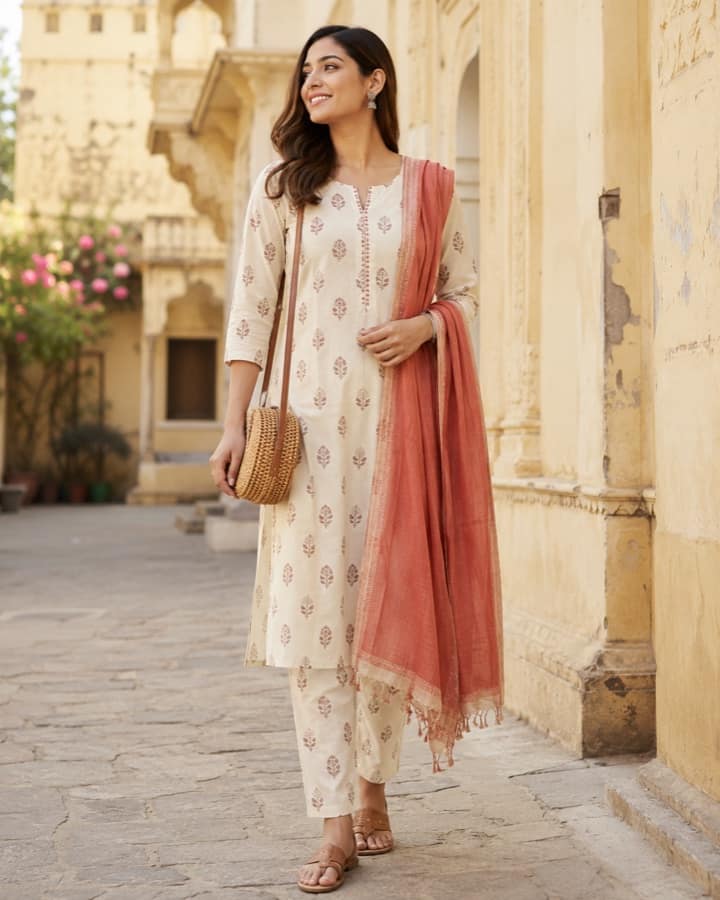
Traditional wear for this spot
Timeless, cultural looks that suit Meenakshi Amman Temple.
Meenakshi Amman Temple, Madurai
Meenakshi is a working temple city rather than a monument. Fourteen towers rise over the old town of Madurai, and the complex is still the daily centre of the city rather than a preserved ruin — which is why it reads differently from any of the great temple sites in South India.
The thing most visitors miss is that the best ceremony of the day happens last thing at night.
🌙 The Palliarai ceremony — the reason to stay late
Every evening at around 9:15 to 9:30 PM, the bronze processional image of Lord Sundareswarar is placed in an ornate silver palanquin and escorted across the complex to Meenakshi's chamber, with torchbearers and musicians playing the nadaswaram.
This is the Palliarai puja — the bedchamber ceremony — and it is the temple's most distinctive daily ritual.
The direction of the procession is the whole point. In almost every Shiva temple in India the goddess is the consort and moves toward the lord. At Madurai it is the reverse: Meenakshi is the sovereign and Sundareswarar is her consort, and each night he is carried to her. That inversion runs through the temple's theology, its ritual order and its architecture, and the Palliarai is where a visitor actually sees it.
The ceremony is brief and it is the last thing before the temple closes at 9:30 PM. Visitors who leave after the evening darshan miss it entirely, which is the most common regret at Meenakshi.
👑 Meenakshi, and why she comes first
The temple's own account: Meenakshi was born to the Pandya king Malayadwaja with three breasts, and a prophecy held that the third would disappear when she met her true husband. She grew into a warrior queen, conquered the directions, and on reaching Kailash met Shiva — at which point the third breast vanished and she bowed. They married and returned to Madurai, where she ruled as queen with Shiva as her consort.
That is why her shrine takes precedence here. The complex holds two principal sanctums, and Meenakshi's is the one most devotees visit first, with Sundareswarar's alongside it. A temple whose presiding deity is the goddess rather than the god is uncommon at this scale, and it is what makes Madurai's ritual calendar unlike anyone else's.
🏛️ Fourteen gopurams, and the inverted emphasis
The complex has fourteen gopurams — gateway towers — the tallest of them the southern tower at about 52 metres. They are covered in brightly painted sculpture: deities, mythic creatures, guardians and narrative figures, in a density that no photograph conveys.
Note the inversion here too. In most Dravidian temple traditions the gateway towers grew larger over the centuries while the sanctum tower stayed modest. At Meenakshi the gopurams utterly dominate, and the complex is read from its gateways inward rather than from its shrine outward. The present structure dates largely to the sixteenth and seventeenth centuries under the Nayak rulers, following the loss of an earlier building, so what stands is Nayak-period work on a much older sacred site.
🏛️ The two halls and the tank
- The Ayiram Kaal Mandapam — the Hall of Thousand Pillars — is the complex's most celebrated interior space, with pillars carved at a scale and finish that made it famous across South India. It houses the temple museum.
- The Potramarai Kulam, the Golden Lotus Tank, is the sacred pond at the centre of the complex, used for ritual bathing and as the setting for festival processions. Its walls carry painted narrative panels, and the tank is the axis around which much of the complex is arranged.
- Numerous smaller shrines, mandapas and corridors fill the space between, which is why the complex functions as a town rather than a building.
🕒 Timings, and the daily puja cycle
Open around 5:00 AM to 12:30 PM and 4:00 PM to 9:30 PM (some published accounts give a 10:00 PM close), with a firm midday closure. The detailed cycle:
- 4:30–5:00 AM temple opens
- 5:00–6:00 AM Thiruvanandal pooja
- 6:30–7:15 AM Kalasandhi and Vizha pooja
- 7:15–10:30 AM darshan
- 10:30–11:15 AM Uchikkala and Thrikalasandhi pooja
- 11:15 AM–12:30 PM darshan
- 12:30–4:00 PM CLOSED
- 4:00 PM reopens; 4:30–5:15 PM Maalai pooja
- 5:15–7:30 PM darshan, with Sayaratchai around 6:00 PM
- 7:30–8:15 PM Ardhajama (night) pooja
- 8:15–9:15 PM darshan
- 9:15–9:30 PM Palliarai pooja — the bedchamber ceremony
The midday closure is the practical fact that matters most: arriving at 1:00 PM finds the temple shut for three hours.
Allow two to three hours at a relaxed pace, and four to five during festivals.
🚫 Phones and cameras
Phones and cameras are not allowed inside. This is enforced and there are deposit facilities.
The consequence is worth internalising before you go in: everything you leave Madurai with will have been shot from outside the walls. So see the interior without a camera, and save the photography for the exterior — the gopurams, the tank and the tower lines, which are in any case what the temple is famous for.
👔 Dress — refused, not frowned at
Dhoti or full-length trousers for men; saree, long skirt or salwar kameez for women.
Shorts, sleeveless tops and tight clothing are refused rather than frowned at. That distinction matters: this is not a temple where a shawl resolves an objection. Visitors in western casual dress are turned away at the entrance, and there is no wrap or loan system.
Footwear is removed before entering, with deposit facilities at the gates.
🌸 Chithirai Thiruvizha
The Chithirai festival, in the Tamil month of Chithirai (April–May), is the temple's great annual occasion and one of the largest festivals in Tamil Nadu. It runs over roughly ten days and its distinctive feature is that it unites two separate traditions: the celebration of Meenakshi's coronation and marriage to Sundareswarar, and the arrival of Lord Alagar (Vishnu) from the nearby Alagar Kovil — who is held to journey to Madurai for his sister Meenakshi's wedding and arrives, in the traditional account, after the ceremony is complete.
The procession of the deities through the streets of Madurai, the temple car, and the Vaigai river crossing are the centrepieces, and the city is at absolute capacity throughout.
📍 Madurai around it
The temple is the city's centre, with the old town's concentric streets laid out around it in the traditional prakara pattern — the streets still named for the months in which festivals run along them.
Madurai Junction is about 1.5 km away and Madurai International Airport about 12 km. The standard companions are Thiruparankundram Murugan Temple and Alagar Kovil, both of which are drawn into the Chithirai festival, plus the Thirumalai Nayakkar Mahal.
⚠️ Practical notes
- Stay until 9:30 PM for the Palliarai. It is the ceremony that explains the temple.
- Deposit phones and cameras before queueing, and accept that you will not photograph the interior.
- Dress to be admitted, not to be tolerated. Shorts and sleeveless tops are refused.
- Avoid the 12:30–4:00 PM closure.
- Go early or in the evening — the stone corridors hold heat and the crowds peak mid-morning.
- October to March for weather; April–May for the Chithirai festival, if you want the city at full intensity.
Last verified: 2026. Opening around 5:00 AM to 12:30 PM and 4:00 PM to 9:30 PM (one account gives a 10:00 PM close), the full daily puja cycle, the Palliarai bedchamber ceremony at about 9:15-9:30 PM with the bronze Sundareswarar carried in a silver palanquin, the prohibition on phones and cameras, the fourteen gopurams with the southern tower at about 52 metres, and the Chithirai festival are all documented. The sixteenth-to-seventeenth-century Nayak dating of the present structure is consistent across sources.
Questions
Meenakshi Amman Temple — FAQ
Who is Meenakshi Amman Temple dedicated to?
Meenakshi Amman Temple in Madurai is dedicated to Meenakshi and Sundareswarar.
Who can enter Meenakshi Amman Temple?
Open to visitors of all faiths, around 5:00 AM to 12:30 PM and 4:00 PM to 9:30 PM (one published account gives a 10:00 PM close), with a firm midday closure from 12:30 to 4:00 PM - arriving at 1:00 PM finds the temple shut for three hours. Phones and cameras are not allowed inside and there are deposit facilities, so everything you photograph will have been shot from outside the walls. Dress is enforced rather than advisory: shorts, sleeveless tops and tight clothing are refused at the entrance, and there is no wrap or loan system. Allow two to three hours at a relaxed pace, four to five during festivals, and stay until the 9:15-9:30 PM Palliarai ceremony before closing.
What is the dress code at Meenakshi Amman Temple?
Dhoti or full-length trousers for men, saree, long skirt or salwar kameez for women. Shorts, sleeveless tops and tight clothing are refused rather than frowned at.
Do I have to take my shoes off at Meenakshi Amman Temple?
Remove footwear before entering, with deposit facilities at the gates. The complex is extensive - two to three hours at a relaxed pace and four to five during festivals - and its stone corridors hold heat, so a morning or post-4:00 PM visit is considerably more comfortable underfoot than midday, and something easy to slip off matters more here than at most temples.
Can I take photos inside Meenakshi Amman Temple?
Phones and cameras are not allowed inside. Everything you leave Madurai with is shot from outside the walls, so see the interior without a camera and keep the light for the exterior.
What prasadam is offered at Meenakshi Amman Temple?
Prasad is distributed at the temple following the daily pujas, of which there are six across the day from Thiruvanandal at 5:00 AM through Kalasandhi, Uchikkala, Maalai and Ardhajama to the Palliarai ceremony at 9:15 PM. Arriving at a puja window rather than between them is how visitors encounter it, since darshan pauses during each of the six services.
Is Meenakshi Amman Temple wheelchair accessible?
The complex is extensive and involves a great deal of walking through corridors, courtyards and around the Potramarai Kulam tank, with thresholds and steps between precincts and a visit of two to three hours at a relaxed pace. Stone surfaces hold heat, so the principal constraint for older visitors is duration and temperature rather than any single obstacle - the 5:00 AM opening or a post-4:00 PM session is far more manageable than midday. Enquire at the temple office about assistance, and note that phones and cameras must be deposited before entry.
Checked, not remembered
Sources
Every rule and timing above traces back to one of these.