
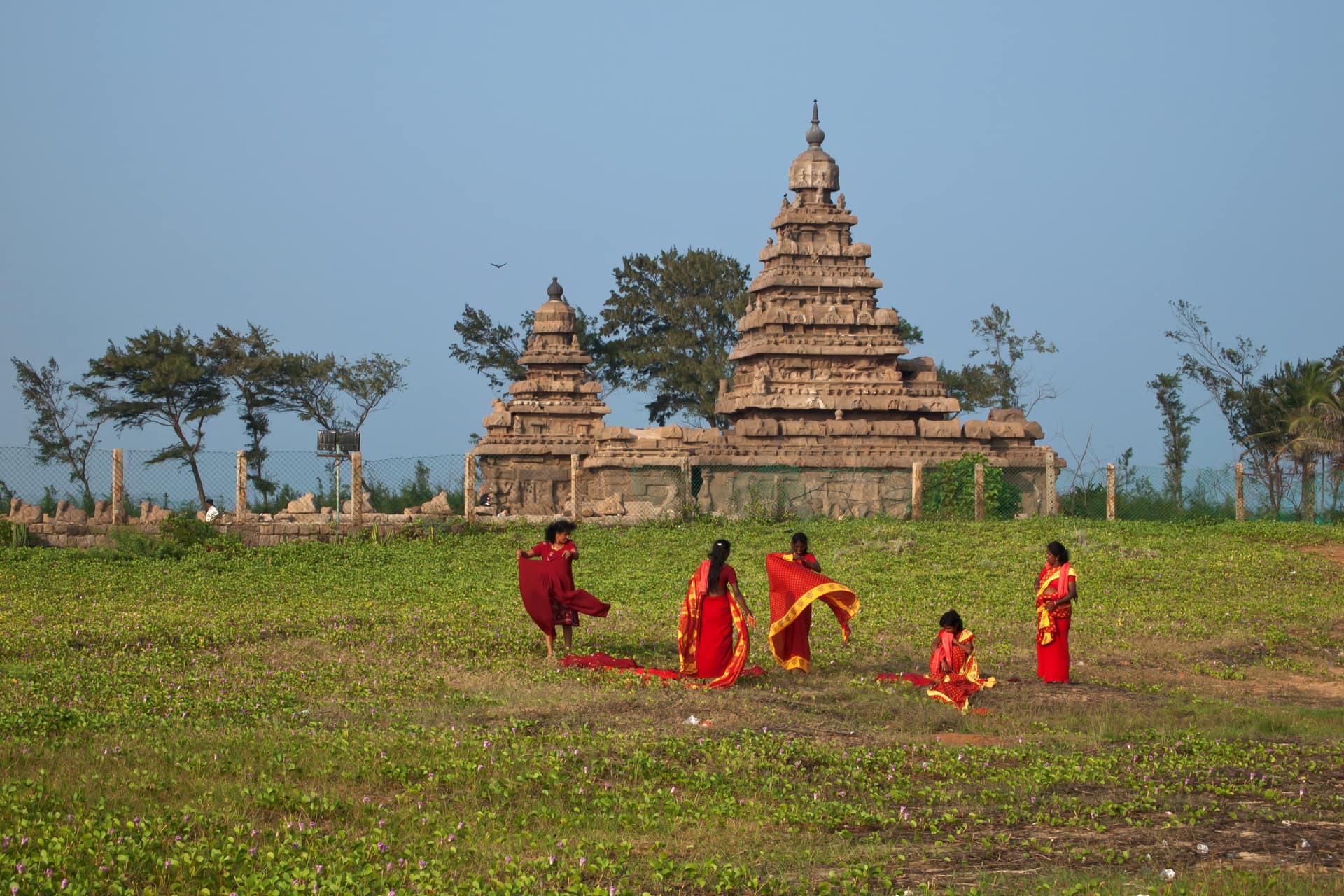
Temple in Mahabalipuram
Shore Temple
Mahabalipuram, Tamil Nadu
One of the earliest free-standing stone temples in south India, built by the Pallavas in the early 8th century — and unusual in holding both Shiva and a reclining Vishnu. It has stood in salt wind on an open beach for thirteen centuries, which is why it now sits behind a sea wall.
Photo: Vyacheslav Argenberg — CC BY 4.0, via Wikimedia Commons
Overview
Who it's to, and what's expected
Deity
Shiva, and Vishnu reclining
Tradition
Shiva temple
- Entry
The temple features a circumambulatory passage for ritualistic clockwise movement around the main shrine, and the sanctum sanctorum is encased within a robust outer wall that allows limited space for circumambulation.
- Footwear
Footwear comes off before the temple areas. The site is on an open beach, so expect sand as well as stone underfoot and choose footwear accordingly - something easy to remove and not ruined by sand. The sanctums are small and the circumambulatory passage is tight, and the exposed coastal setting means the stone gets hot, so sunrise or sunset visits are far more comfortable than midday.
- Access
The temple stands on an open beach platform reached across sand and stone, with steps and uneven surfaces at the shrine approaches, and the ASI sea-protection works including the breakwater form part of the modern site. The sanctum sanctorum is encased within a robust outer wall that allows only limited space for circumambulation, so the ritual passage is tight and can involve waiting at peak times. The wider Mahabalipuram group requires substantial walking between the rathas, the Great Relief, the caves and the Shore Temple, and needs a full day.
Usually visited with
How long this takes
Ways in
The difference between a twenty-minute visit and a three-hour one.
ASI monument entry
- A ticketed archaeological monument with no darshan queue in the temple sense, though worship is not entirely absent at the site
- One ASI ticket covers the Mahabalipuram group at Rs40 for Indian nationals and Rs600 for foreign nationals, with children under 15 free."
The circumambulation passage
- The sanctum is encased within a robust outer wall leaving limited space for the ritual clockwise movement, so the passage is tight and can involve waiting at peak times - a genuine constraint rather than a crowd-management issue
Dance festival evenings
- The Mahabalipuram Dance Festival stages classical dance in an open-air auditorium against the floodlit Shore Temple, when the site is at its most atmospheric and its busiest
At the gate
Before you go in
What gets refused, and what you cannot take past the door.
What to wear
Visitors are advised to wear modest, traditional clothing that covers the shoulders and knees.
Phones and cameras
Photography is permitted at the temple, but only from the outside.
Rules, timings and fees change — confirm locally before you rely on this.
When not to come — unless you mean to
Festival windows
These follow lunar calendars and move by weeks each year, so the windows are months, not dates.
Mahabalipuram Dance Festival
Maha Shivratri
Best visiting season
Practicalities
The things that go wrong
Book through official channels, and treat anyone promising a guaranteed slot as a warning sign.
What to watch for
- Charging above the ASI ticket rate, or selling a separate ticket for the Shore Temple apart from the Mahabalipuram group
- One ASI ticket covers the UNESCO-listed group at Rs40 for Indian nationals and Rs600 for foreign nationals, with children under 15 free
- Offering paid photography inside the temple
- Photography is permitted at the temple but only from the outside - a restriction recorded for this site and not lifted by payment
- Claiming access to the submerged structures offshore
- The 2004 tsunami exposed masonry and possible shrine remains under the sea, confirmed by subsequent survey, but they are an archaeological context and not a visitor attraction; anyone offering a dive or boat trip to 'see the sunken temples' is not offering sanctioned access
- Unlicensed guides at the beach
- Mahabalipuram genuinely rewards a guide because the rathas, the Great Relief and the Pallava sequence from rock-cut to structural building are hard to read unaided - but arrange one through the ASI counter or your hotel at an agreed price
- Third parties claiming the Shore Temple is closed at sunrise or sunset
- Both edges are within the standard ASI opening pattern and are when the temple is at its best
- Drone photography being offered or arranged
- Drones are prohibited across ASI sites and require prior permission that cannot be granted on the spot
General guidance
Planning the visit
Customary practice and what Mahabalipuram's climate means for a barefoot visit — not rules posted at this temple. Anything specific to Shore Temple is above.
Circling the shrine
At most Shaiva temples the circuit around the sanctum is not completed in a full circle — the channel draining the abhishekam is not crossed. Walk to it, turn, and come back the way you came. Watching what the queue in front of you does is the reliable guide.
Come in winter
Winter is when Mahabalipuram is most comfortable to walk around, which matters here because a temple visit is done on foot and barefoot. Locally the window is given as november to february.
Salt air and bare feet
Coastal temple courtyards stay damp and the stone can be slick underfoot, particularly near a tank or a sea-facing entrance. Take the steps slowly rather than the queue's pace.
No airport here
Mahabalipuram has no airport of its own, so the last leg is by road or rail. Plan the return the same way — the last bus out is often earlier than visitors expect.
Outfit guide
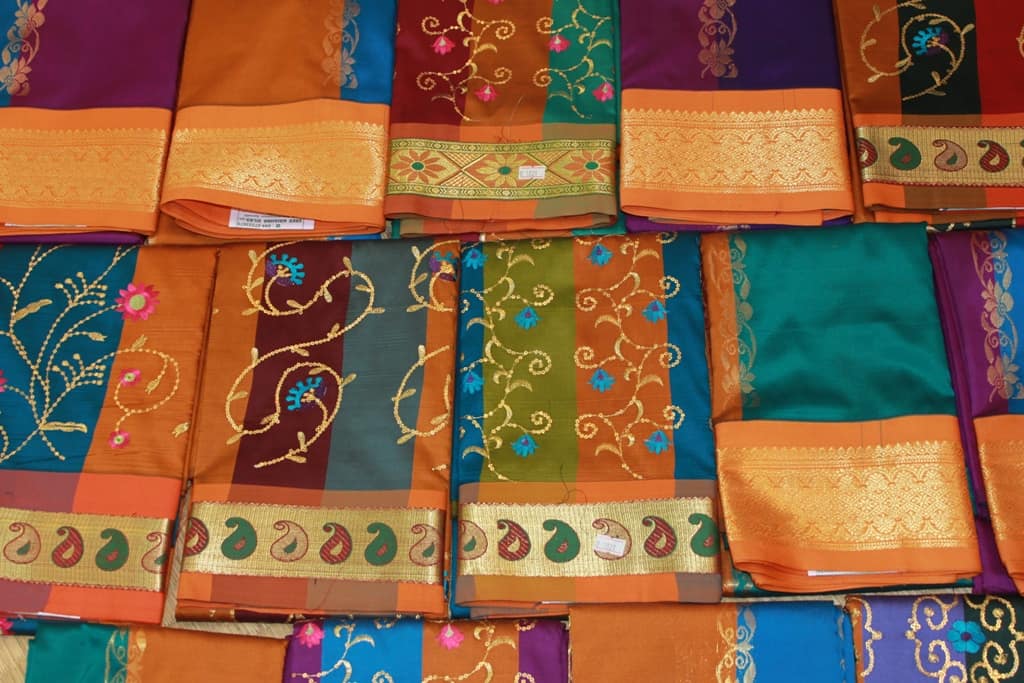
What to wear at Shore Temple
Cover shoulders and knees — the rules above win over anything here.
Trending wear for this spot
Modern, camera-ready looks picked for Shore Temple.

Traditional wear for this spot
Timeless, cultural looks that suit Shore Temple.
Shore Temple, Mahabalipuram
The Shore Temple is one of the earliest free-standing stone temples in south India, built by the Pallavas in the early eighth century — and it is unusual in holding both Shiva and a reclining Vishnu in one complex.
It has stood in salt wind on an open beach for thirteen centuries, which is why it now sits behind a sea wall. The building you see is weathered in a way no inland temple is, and that weathering is part of what it is rather than a defect in it.
🌊 The temple on the beach
The Shore Temple stands directly on the Bay of Bengal at Mahabalipuram (Mamallapuram), on the Tamil Nadu coast south of Chennai. Its setting is not incidental: it was built as a landmark temple on a busy maritime coast, and its silhouette against the sea is the image the site is known for.
Thirteen centuries of salt-laden wind have rounded and softened its sculpture, so the temple reads differently from the Pallava rock-cut work a short distance inland. The rathas and the cave shrines of Mahabalipuram are cut into granite and retain crisp detail; the Shore Temple is built in stone and has been eroded by the sea. Comparing the two is the clearest possible demonstration of what exposure does.
ASI sea-protection works now stand between the temple and the surf, including a breakwater and a planted shelter belt, built after the structure's deterioration became a conservation concern. The sea wall is visible and is part of the modern site, and visitors sometimes find it intrusive — but without it the temple would not be standing.
🕉️ Shiva and Vishnu together
The complex is unusual in holding both traditions. There are three sanctums:
- Two shrines to Shiva, facing east and west — so one catches the sunrise and the other the sunset
- One shrine to Vishnu reclining, between them
The east-facing Shiva shrine is the principal one, and the reclining Vishnu (Ananthasayi) occupies a smaller cell between the two. A single Pallava complex housing both major Vaishnava and Shaiva dedications is genuinely uncommon, and it reflects the Pallavas' patronage across sectarian lines rather than a later addition.
The lingams are small, and the sanctums are correspondingly compact — the existing note on this page is precise about it: the sanctum sanctorum is encased within a robust outer wall that allows limited space for circumambulation. The circumambulatory passage exists for ritual clockwise movement around the main shrine, but it is tight, and that is worth knowing before joining a queue to walk it.
🏛️ Rajasimha, and the beginning of a tradition
The temple was built under Narasimhavarman II, known as Rajasimha, the Pallava king who is also credited with the great rock-cut Kailasanathar temple at Kanchipuram — the oldest temple in that town, built around 685–705 CE in sandstone.
The connection matters. Rajasimha's reign is the moment when Pallava patronage moved from rock-cut to free-standing structural temples, and the Shore Temple and Kailasanathar are the two surviving statements of that transition — one on the coast in stone, one inland in sandstone.
So the Shore Temple is not merely old; it is early in a specific sense. It belongs to the first generation of south Indian temples built up from masonry rather than cut down into rock, which is why it is described as one of the earliest free-standing stone temples in the region.
🌊 The 2004 tsunami, and what it revealed
The Indian Ocean tsunami of December 2004 struck this coast, and at Mahabalipuram it produced an archaeological revelation: as the water withdrew, it exposed structures offshore that had been submerged, including stone masonry and what appeared to be the remains of additional shrines.
Subsequent underwater survey confirmed that the Shore Temple is part of a larger submerged complex rather than an isolated building. The traditional local account of a great port city lost to the sea — sometimes told as "Seven Pagodas", of which the Shore Temple was the last surviving one — received physical support.
That is worth knowing because it reframes the site. The temple you walk around is the survivor of a group, and the sea off Mahabalipuram is an archaeological context rather than only a view.
🎟️ Tickets, hours and photography
The Shore Temple is part of the UNESCO-listed Group of Monuments at Mahabalipuram, ticketed by the ASI.
- Entry follows the standard ASI bands: ₹40 for Indian nationals, ₹600 for foreign nationals, with children under 15 free. Book online through the ASI e-ticketing portal.
- The complex opens from early morning until evening, on the standard ASI monument pattern — sunrise to sunset is the operative framing, and both edges are when the temple is at its best.
No flash, no tripods without an ASI permit, and no drones — as across ASI sites.
🎶 The dance festival
The Mahabalipuram Dance Festival is held annually, typically in January or February, with the Shore Temple floodlit as the backdrop. It is one of India's better-known classical dance festivals, staged in an open-air auditorium built against the temple.
That is the single best reason to time a visit, and it is the occasion when the temple's silhouette — which is its defining image — is used as intended, lit and seen from a distance.
📍 The Mahabalipuram complex
The Shore Temple is one element of a dense concentration of Pallava monuments, all within walking distance:
- The rathas — monolithic temple-chariots carved from single boulders, including the Pancha Rathas, each in a different architectural style and never used for worship
- The Great Relief (Arjuna's Penance / Descent of the Ganges) — one of the largest bas-reliefs in the world, carved across a rock face
- The cave temples (mandapas) with their celebrated interior panels, including the Varaha cave
- Krishna's Butterball — the famous balanced boulder
The group is a UNESCO World Heritage Site, and the whole complex needs a full day. The Shore Temple is best visited first or last, at sunrise or sunset, with the inland rock-cut work in the middle of the day when the coast is hottest and the caves are coolest.
Mahabalipuram is about 58 km south of Chennai and is an easy day trip or an overnight stay, with the beach and the town's stone-carving trade both part of the visit.
⚠️ Practical notes
- Go at sunrise or sunset. The temple's silhouette against the sea is the reason it is famous, and both edges give it.
- Photograph from outside only — the restriction is real, and the exterior is the subject.
- Do the whole group in one day: rathas, the Great Relief, the caves, then the Shore Temple at the day's edge.
- January or February for the dance festival.
- The sanctums are small and the circumambulation passage is tight — expect to wait at peak times.
- November to February for weather; the Tamil Nadu coast is hot and humid from April, and October to December is the north-east monsoon.
Last verified: 2026. The Pallava attribution to the early eighth century under Narasimhavarman II (Rajasimha), the three sanctums comprising two Shiva shrines facing east and west with a reclining Vishnu between them, the robust outer wall leaving limited circumambulation space, and the outside-only photography rule are all consistent with the existing record. The 2004 tsunami's exposure of submerged structures offshore, and the ASI sea-protection works including the breakwater, are documented. Ticket bands match those verified at Ajanta, Ellora, Konark and Halebidu this run.
Questions
Shore Temple — FAQ
Who is Shore Temple dedicated to?
Shore Temple in Mahabalipuram is dedicated to Shiva, and Vishnu reclining.
Who can enter Shore Temple?
The temple features a circumambulatory passage for ritualistic clockwise movement around the main shrine, and the sanctum sanctorum is encased within a robust outer wall that allows limited space for circumambulation.
What is the dress code at Shore Temple?
Visitors are advised to wear modest, traditional clothing that covers the shoulders and knees.
Do I have to take my shoes off at Shore Temple?
Footwear comes off before the temple areas. The site is on an open beach, so expect sand as well as stone underfoot and choose footwear accordingly - something easy to remove and not ruined by sand. The sanctums are small and the circumambulatory passage is tight, and the exposed coastal setting means the stone gets hot, so sunrise or sunset visits are far more comfortable than midday.
Can I take photos inside Shore Temple?
Photography is permitted at the temple, but only from the outside.
Is Shore Temple wheelchair accessible?
The temple stands on an open beach platform reached across sand and stone, with steps and uneven surfaces at the shrine approaches, and the ASI sea-protection works including the breakwater form part of the modern site. The sanctum sanctorum is encased within a robust outer wall that allows only limited space for circumambulation, so the ritual passage is tight and can involve waiting at peak times. The wider Mahabalipuram group requires substantial walking between the rathas, the Great Relief, the caves and the Shore Temple, and needs a full day.
Checked, not remembered
Sources
Every rule and timing above traces back to one of these.