
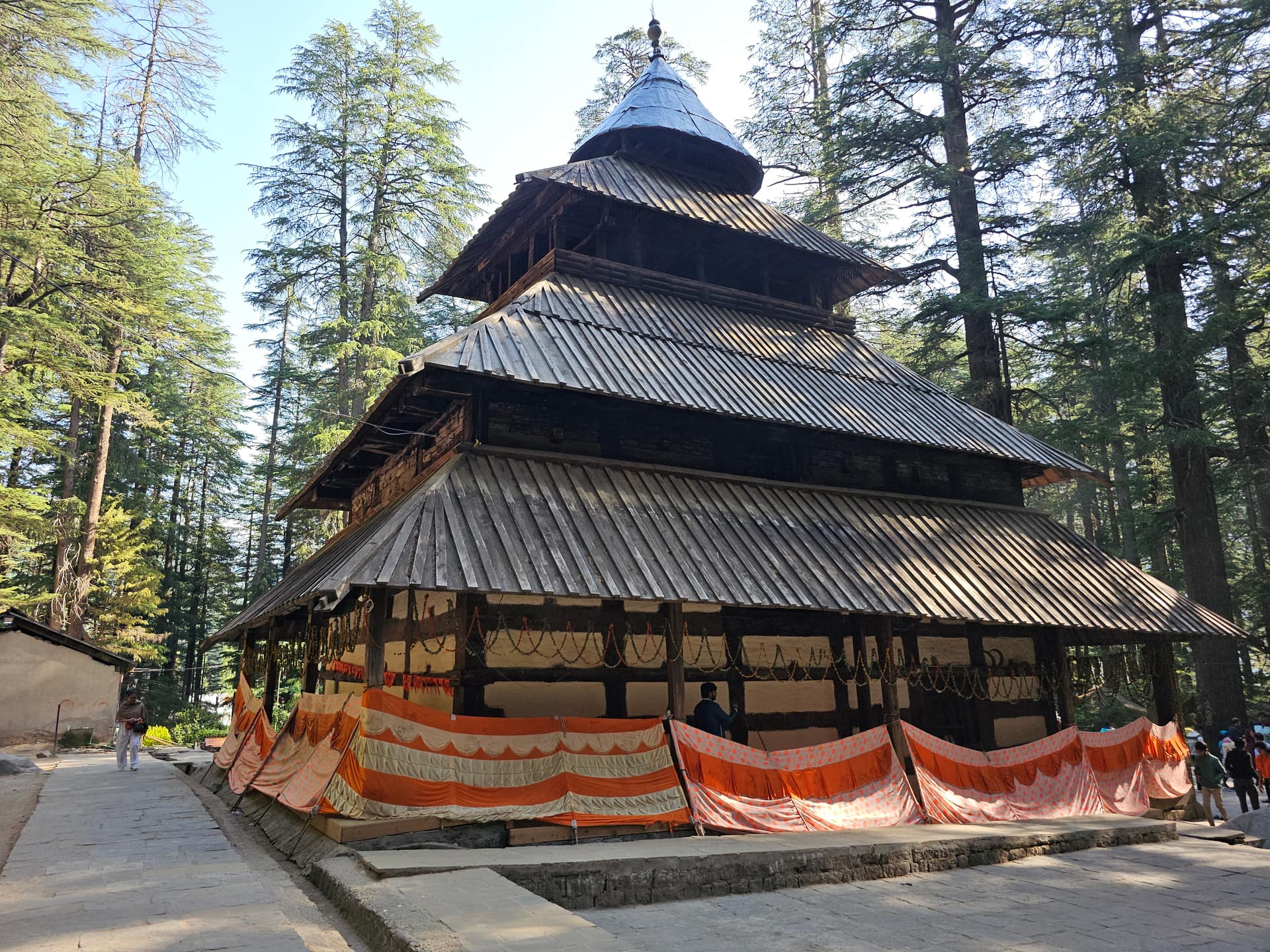
Temple in Manali
Hidimba Devi Temple
Manali, Himachal Pradesh
Built in 1553 in cedar, four tiered roofs tapering to a pagoda, standing in a deodar wood above Manali - dedicated to Bhima's wife from the Mahabharata, revered as the guardian goddess of the Kullu valley, with no image inside, only a footprint on a rock.
Photo: Ganesh Mohan T — CC BY-SA 4.0, via Wikimedia Commons
Overview
Who it's to, and what's expected
Deity
Hidimba Devi
Tradition
Devi · Shakti temple
- Entry
The temple is open to everyone without any entry fee or booking requirement. Visitors must remove their footwear before entering the shrine area, and cameras are strictly prohibited inside the inner sanctum.
- Footwear
You must remove your footwear before entering the shrine area and leave it at the designated spot.
- Access
The temple approach is paved but sloped, and the courtyard is made of uneven stone, making wheelchair access difficult without assistance. Vehicles can drop passengers near the entrance to reduce the walking distance.
Time your visit
The darshan clock
A single opening-hours line cannot express a midday closure or an evening ceremony.
8:00 AM
Opening hours
The temple is open to visitors daily from 8:00 AM to 6:00 PM.
Rules, timings and fees change — confirm locally before you rely on this.
How long this takes
Ways in
The difference between a twenty-minute visit and a three-hour one.
General darshan
- Free, no booking, open about 8:00 AM to 6:00 PM with no fixed aarti schedule - worship runs through the day
- Early morning is the quiet window; summer weekends bring the crowds
Dhungari Mela
- The May festival in the Dhungri forest, when the valley gathers around the temple
Kullu Dussehra opening
- The goddess's chariot is drawn from the temple to Kullu to open the valley's week-long October festival - the temple precinct fills for the departure
At the gate
Before you go in
What gets refused, and what you cannot take past the door.
What to wear
There is no formal dress code, but visitors are encouraged to wear modest clothing that covers their shoulders and knees. Additionally, you must remove your footwear before entering the shrine area.
Phones and cameras
Photography is permitted in the outer complex, the carved doorway, and the forest, but cameras are strictly prohibited inside the sanctum. Attendants may collect a small fee for still or video cameras.
Rules, timings and fees change — confirm locally before you rely on this.
When not to come — unless you mean to
Festival windows
These follow lunar calendars and move by weeks each year, so the windows are months, not dates.
Dhungari Mela
Kullu Dussehra
Navratri
Practicalities
The things that go wrong
Book through official channels, and treat anyone promising a guaranteed slot as a warning sign.
What to watch for
- Charging for entry or for the prasad counter
- Entry is free and there is no booking of any kind
- Yak, rabbit and photo operators at the forest approach quoting a price only after the photograph; agree everything first
- Selling 'forest guide' walks that the temple path does not need; the walk to the gate is short and signposted
- Pony and taxi operators quoting fares only on arrival; agree the fare before setting out from the Mall Road
- Prasad sellers at the approach quoting first prices; the temple's own counter is inside
General guidance
Planning the visit
Customary practice and what Manali's climate means for a barefoot visit — not rules posted at this temple. Anything specific to Hidimba Devi Temple is above.
Offerings differ here
Shakta shrines often accept offerings that other temples do not, and a few remain associated with animal sacrifice on particular days. What is sold at the stalls outside is the honest signal of what is expected inside.
Come in winter and summer
Winter and summer is when Manali is most comfortable to walk around, which matters here because a temple visit is done on foot and barefoot. Locally the window is given as march to june, and october to february for snow.
Cold stone, early starts
Barefoot on stone at altitude before sunrise is colder than the air temperature suggests, and the first darshan of the day is usually the coldest hour. Socks are permitted almost everywhere shoes are not.
Outfit guide
What to wear at Hidimba Devi Temple
Cover shoulders and knees — the rules above win over anything here.
Trending wear for this spot
Popular modern looks travellers are wearing across Manali.
Traditional wear for this spot
Timeless, cultural looks that suit Hidimba Devi Temple.
Hadimba (Hidimba Devi) Temple, Manali
Built in 1553 in deodar timber, four tiered roofs tapering to a pagoda, standing alone in a cedar wood above Manali — and dedicated to Bhima's wife from the Mahabharata, revered here as the guardian goddess of the Kullu valley.
🌲 The temple in the forest
The temple stands in the Dhungiri forest — Dhungiri Van Vihar — at the foot of the Himalaya, about 2 km uphill from Manali's Mall Road, and the walk up through the cedars is the proper approach: the pagoda appears between the trunks before the town noise has fully died away.
The structure was raised in 1553 CE by Maharaja Bahadur Singh of Kullu, and its style is unlike anything else in the region — a four-tiered wooden roof rising about 24 metres, closer to the monastery architecture of Nepal and Tibet than to mainstream Hindu temple design. The carved wooden doorway and facade are the craft of the period: legendary beings, animals and flora worked into the deodar, with three windows opening on the upper tiers and the whole resting on a stone base sunk into the slope.
🌲 The Dhungri forest
The forest is not the temple's setting; it is half the visit. Dhungiri Van Vihar wraps the temple in tall cedar, with walking paths, lawns and picnic corners run as a park alongside the shrine — and the scale of the trees does something to the light that the town below never manages. Morning mist between the deodars, the pagoda appearing and disappearing on the walk up, and the sudden quiet at the top are the reason travellers rank Hadimba above every other Manali stop. Give the forest the extra half hour it is asking for.
🕉️ The goddess with no image
Inside there is no idol. The sanctum is built around a rock jutting out of the ground, worshipped as the image of the goddess — with carved footprints marking her presence.
The goddess is Hidimba, wife of Bhima of the Mahabharata. The epic's story runs: hiding in these forests during the Pandavas' exile, she and her brother Hidimb waylaid travellers — until Bhima overcame the brother, and Hidimba asked the victor for his protection and his hand. The marriage lasted the exile and produced Ghatotkacha, who fell at Kurukshetra fighting on his father's side; the mother, the tradition holds, withdrew to these hills for meditation, and ascended into divinity — becoming the guardian deity the rajas of Kullu themselves revered, and the valley's tutelary goddess ever since. She is worshipped through the year, and especially through Navratri.
Nearby, in the same forest, a small shrine holds her son Ghatotkacha — the family the epic left in these hills, still resident.
🕒 Timings
Open daily about 8:00 AM to 6:00 PM; entry is free, and there is no fixed aarti schedule — worship runs through the day, and 30 to 60 minutes covers the temple, the doorway and the forest walk. Early morning is the quiet window, and the light through the cedars at that hour is the photograph.
Restrictions are posted and enforced: no leather, no non-vegetarian food, no alcohol, no smoking in the precincts. Photography is permitted in the outer complex and the forest, and prohibited inside the sanctum.
🎉 Dhungari Mela and Kullu Dussehra
The temple's great festival is the Dhungari Mela, held in the Dhungri forest in May, when the valley gathers around the goddess with music and dance. And Kullu Dussehra — the week-long festival of the whole valley, in October — begins with the goddess herself: her rath, her chariot, is drawn from the temple down to Kullu to open the celebrations, the first act of the valley's largest festival.
Navratri brings steady pilgrimage through the year's nine-night observances.
👣 The approach, in practice
Most visitors walk: out of the Mall Road bustle, up the Dhungri lane past the stalls and the old gateways, with the forest thickening around the last stretch — twenty to thirty minutes at visitor pace, and the correct preparation for what stands at the top. Vehicles drop closer for those who need them, and the final metres are paved but sloped, on uneven stone in the courtyard — assistance helps for wheelchairs, and the drop-off exists precisely for that.
Carry nothing that minds a bump: the walk is easy, the ground is old, and the forest keeps the light low even at noon.
📍 Getting there and pairing
About 2 km from the Mall Road — a pleasant uphill walk, or a short drive with vehicles dropping passengers near the entrance. The natural Manali loop pairs the temple with Old Manali and the Manu Temple, or adds Dhungiri Van Vihar's park paths to the forest walk.
April to June and October to November are the comfortable seasons; winter gives the pagoda in snow, which is its own kind of photograph. Allow an hour unless you plan to stay in the forest longer — many do.
Last verified: 2026. The 1553 CE founding by Maharaja Bahadur Singh, the Dhungiri cedar-forest setting, the 24-metre four-tiered pagoda in deodar, the rock sanctum with carved footprints and no idol, the Ghatotkacha shrine, the 8:00 AM to 6:00 PM hours with free entry and no fixed aarti, the posted restrictions, and the Dhungari Mela and the goddess's chariot at Kullu Dussehra are documented. Hours shift on festival days and the temple's own schedule is authoritative.
Questions
Hidimba Devi Temple — FAQ
Who is Hidimba Devi Temple dedicated to?
Hidimba Devi Temple in Manali is dedicated to Hidimba Devi.
Who can enter Hidimba Devi Temple?
The temple is open to everyone without any entry fee or booking requirement. Visitors must remove their footwear before entering the shrine area, and cameras are strictly prohibited inside the inner sanctum.
What is the dress code at Hidimba Devi Temple?
There is no formal dress code, but visitors are encouraged to wear modest clothing that covers their shoulders and knees. Additionally, you must remove your footwear before entering the shrine area.
Do I have to take my shoes off at Hidimba Devi Temple?
You must remove your footwear before entering the shrine area and leave it at the designated spot.
Can I take photos inside Hidimba Devi Temple?
Photography is permitted in the outer complex, the carved doorway, and the forest, but cameras are strictly prohibited inside the sanctum. Attendants may collect a small fee for still or video cameras.
Is Hidimba Devi Temple wheelchair accessible?
The temple approach is paved but sloped, and the courtyard is made of uneven stone, making wheelchair access difficult without assistance. Vehicles can drop passengers near the entrance to reduce the walking distance.
Checked, not remembered
Sources
Every rule and timing above traces back to one of these.