
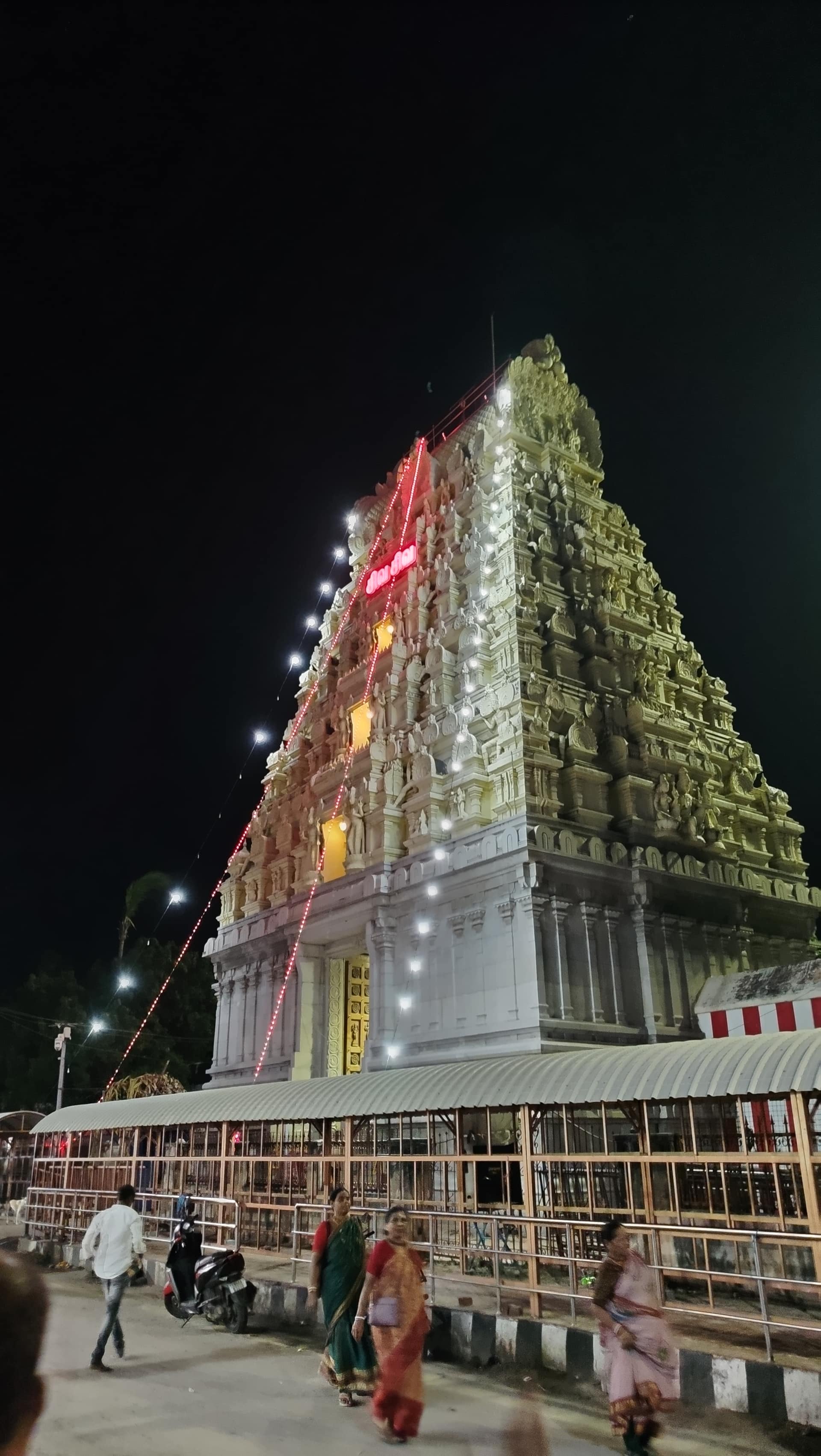
Temple in Rameswaram
Ramanathaswamy Temple
Rameswaram, Tamil Nadu
Both a Jyotirlinga and one of the Char Dham, which is a combination no other temple has. Its third corridor — about 197 m east to west — is the longest in any working Hindu temple, and the visit here is built around a bathing ritual rather than a queue.
Photo: Shajinss — CC BY-SA 4.0, via Wikimedia Commons
Overview
Who it's to, and what's expected
Deity
Shiva as Ramanathaswamy
Tradition
Shiva temple
- Entry
Open daily in two sessions - 5:00 AM to 1:00 PM and 3:00 PM to 9:00 PM - with a firm two-hour afternoon closure. A ticket is required for the twenty-two theertham bath, reported at around Rs25, and should be bought at the temple's own counter rather than from agents. The critical rule is that you cannot enter the main temple in wet clothes after the theertham bath, so the sequence must be bathe, change into dry clothes, then take darshan; there are rooms inside the complex to change in. The temple opens around 4:00-5:00 AM for Spatika Lingam darshan before general darshan from about 7:00 AM, and advance booking is recommended for special pujas.
- Footwear
Remove footwear before entering the temple, with storage facilities available. Because the visit involves the 197-metre corridor, movement between twenty-two wells and a great deal of walking on wet stone, wear footwear that is easy to slip off and back on - and note that you will be changing clothes as well, so keep both accessible.
- Access
Physically demanding, and the main constraint at Rameswaram. The visit involves a great deal of walking - the 197-metre corridor alone plus movement between twenty-two wells - on wet stone surfaces with steps at the wells, and the bathing sequence requires repeated immersion and changing. Senior citizens and families should arrange the assisted theertham service in advance rather than attempting the full sequence unaided, and visitors with mobility limitations should consider doing a shortened sequence.
- Prasadam
Prasad is distributed at the temple following the offerings. Note the specific absence that causes confusion: there is no separate abhishek offering available for purchase here, contrary to what some third parties at Rameswaram claim. Advance booking for special pujas is available through the temple and is recommended, but that is a temple service rather than something an agent arranges.
Usually visited with
Time your visit
The darshan clock
A single opening-hours line cannot express a midday closure or an evening ceremony.
5:00 AM
Opening hours
The temple is open daily in two sessions: from 5:00 AM to 1:00 PM and from 3:00 PM to 9:00 PM.
Rules, timings and fees change — confirm locally before you rely on this.
How long this takes
Ways in
The difference between a twenty-minute visit and a three-hour one.
Spatika Lingam darshan
- The pre-dawn viewing of the crystal lingam, from around 4:00 to 5:00 AM. The calmest window at Rameswaram and worth the early start if crowds are a concern
General darshan
- From about 7:00 AM. The visit is organised around the bathing ritual rather than around a queue, so the theertham sequence is what determines how long you spend here
Theertham bath peak
- 6:00 to 10:00 AM is the busiest window for the twenty-two wells
- Starting at 5:00 AM avoids it, and assisted theertham service can be booked at weekends
Maha Shivratri
- The great night at a Jyotirlinga and Rameswaram's busiest period, when both the corridor and the wells are at capacity
At the gate
Before you go in
What gets refused, and what you cannot take past the door.
What to wear
Dhoti or trousers with a shirt for men; saree, salwar or churidar for women. The rule people get caught by: you cannot enter the main temple in wet clothes after the theertham bath, so bring a full change. There are rooms inside to change in.
Phones and cameras
Photography is restricted inside the temple, particularly at the sanctum and during the theertham ritual. Do not photograph pilgrims bathing without asking: the twenty-two wells are a religious act and many participants are performing a vow, so this is a matter of consent rather than only of temple rules. Follow posted signage and the attendants.
Rules, timings and fees change — confirm locally before you rely on this.
When not to come — unless you mean to
Festival windows
These follow lunar calendars and move by weeks each year, so the windows are months, not dates.
Maha Shivratri
Ramanavami
Thirukalyanam
Theppam (float festival)
Practicalities
The things that go wrong
Book through official channels, and treat anyone promising a guaranteed slot as a warning sign.
What to watch for
- Agents and guides offering to arrange theertham tickets or a paid shortcut through the twenty-two wells for around Rs250
- The temple sells the bath ticket for roughly Rs25 at its own counter - the premium buys nothing but a longer queue elsewhere
- Claiming a separate abhishek offering is available for purchase
- Travellers specifically warn that there is no such offering here and that this is a common trap
- Third parties at the ticket area selling combinations that include the temple's own facilities at marked-up prices
- Buy at the temple counter
- Anyone telling you that you can enter the main sanctum straight after the theertham bath
- You cannot - wet clothes are not permitted in the main temple, and the sequence must be bathe, change, then darshan
- There are rooms inside to change in
- Guides attaching themselves at the Pamban bridge or Agni Theertham and producing a fee at the temple gate
- The Ramayana narrative is well signposted and the sequence of the twenty-two wells is marked
- Auto and taxi drivers quoting a fare only on arrival, or inflating the rate for Dhanushkodi
- Agree a round-trip price before setting out from Rameswaram town
General guidance
Planning the visit
Customary practice and what Rameswaram's climate means for a barefoot visit — not rules posted at this temple. Anything specific to Ramanathaswamy Temple is above.
Circling the shrine
At most Shaiva temples the circuit around the sanctum is not completed in a full circle — the channel draining the abhishekam is not crossed. Walk to it, turn, and come back the way you came. Watching what the queue in front of you does is the reliable guide.
Come in winter
Winter is when Rameswaram is most comfortable to walk around, which matters here because a temple visit is done on foot and barefoot. Locally the window is given as october to april.
Salt air and bare feet
Coastal temple courtyards stay damp and the stone can be slick underfoot, particularly near a tank or a sea-facing entrance. Take the steps slowly rather than the queue's pace.
Arriving by train
Rameswaram has a railway station, and auto-rickshaws wait outside it. Agree the fare or use a meter before you set off, and expect to be dropped a short walk from the temple rather than at its door.
No airport here
Rameswaram has no airport of its own, so the last leg is by road or rail. Plan the return the same way — the last bus out is often earlier than visitors expect.
Outfit guide
What to wear at Ramanathaswamy Temple
Cover shoulders and knees — the rules above win over anything here.
Trending wear for this spot
Modern, camera-ready looks picked for Ramanathaswamy Temple.
Traditional wear for this spot
Timeless, cultural looks that suit Ramanathaswamy Temple.
Ramanathaswamy Temple, Rameswaram
Ramanathaswamy holds a combination no other temple in India has: it is both one of the twelve Jyotirlingas and one of the four Char Dham. Every other Jyotirlinga is outside the Char Dham list, and every other Char Dham site is not a Jyotirlinga. Rameswaram is the single point where the two great Shaiva and Vaishnava pilgrimage systems overlap.
It is also famous for two physical records: the longest temple corridor in the world, and twenty-two sacred wells inside the complex.
The visit here is built around a bathing ritual rather than a queue, and that is the single most important thing to understand before you arrive.
🚶 The longest corridor in any working Hindu temple
The temple's third corridor runs about 197 metres east to west, making it the longest temple corridor in the world. It is a covered passage lined with intricately carved pillars, and its scale is the reason Rameswaram appears in architectural histories that have nothing to do with pilgrimage.
Walking it is the experience, and it is worth slowing down for. The corridor was built to shelter processional routes, and its length reads as a statement of the temple's status rather than as mere size.
💧 Twenty-two theerthams — the actual purpose of the visit
Inside the complex are twenty-two sacred wells, theerthams, each with its own name and associated benefit, and pilgrims bathe in all of them in sequence.
This is what most pilgrims come for, and it is not a quick ritual. Planning around it:
- Carry at least two extra sets of clothes in a waterproof bag. Twenty-two immersions means you will be wet for most of the visit.
- The busiest window is 6:00 to 10:00 AM. Starting at 5:00 AM gives a peaceful theertham and darshan.
- Assisted theertham service can be booked, and is worth doing at weekends to avoid long waits.
- Senior citizens and families should arrange assistance in advance rather than attempting the full sequence unaided.
- There are rooms inside the complex to change in.
👔 The rule that catches everyone out
You cannot enter the main temple in wet clothes after the theertham bath.
This is the single most common way a visit to Rameswaram goes wrong. The sequence must be: bathe in the twenty-two theerthams, change into dry clothes, then enter the main sanctum for darshan. Visitors who do it the other way round are turned back.
Bring a full change of clothing, and keep it accessible rather than buried in luggage.
Dress code for the temple itself: dhoti or trousers with a shirt for men; saree, salwar or churidar for women.
🏹 Rama, and why the temple exists
According to tradition, Lord Rama built the temple to receive Shiva's blessings after returning from Lanka. The story explains both the temple's name and its unusual arrangement of two lingams:
Having killed Ravana, Rama needed to atone for brahmahatya — the killing of a brahmin, since Ravana was one. He sent Hanuman to Mount Kailash to bring back a lingam. Hanuman was delayed, and with the auspicious hour approaching, Sita fashioned a lingam from sand, which was installed and worshipped. When Hanuman returned with his lingam from Kailash, Rama installed it too and decreed that it be worshipped first, so that Hanuman would not feel his effort had been wasted.
So the temple holds both — the sand lingam associated with Sita and Rama, and the Vishwalingam brought by Hanuman, which receives precedence in worship. That order of precedence, established to spare a devotee's feelings, is still observed.
Rameswaram's place in the Ramayana is also why the town exists as a pilgrimage centre at all, and why the Agni Theertham — the sea off the shore — is bathed in before entering the temple, as is Dhanushkodi, the tip of the island associated with the bridge to Lanka.
🔮 Spatika Lingam darshan
The temple opens around 4:00 to 5:00 AM for Spatika Lingam darshan — the early-morning viewing of the crystal lingam — before general darshan begins around 7:00 AM.
That pre-dawn window is the calmest time at Rameswaram and is worth the early start if the crowds are a concern.
🕒 Timings
Open daily in two sessions:
- Morning: 5:00 AM to 1:00 PM
- Evening: 3:00 PM to 9:00 PM
The two-hour afternoon closure is firm, and timings may vary slightly during festivals. The morning session is best for the theertham bath and Spatika Lingam darshan; the evening session includes an aarti after sunset.
🎟️ Tickets — and a warning
A ticket is required for the twenty-two theertham bath, reported at around ₹25.
Travellers' own accounts include a blunt warning worth repeating: do not fall for ticket traps. Specifically:
- Agents and guides offering to "arrange" theertham tickets or to take you through a paid shortcut for around ₹250 are selling what the temple already provides for a fraction of that.
- Buy theertham tickets at the temple's own counter.
🛕 Rules and access
Footwear is removed before entering, and there are storage facilities. Photography is restricted inside the temple, particularly at the sanctum and during the theertham ritual — do not photograph pilgrims bathing without asking, since the baths are a religious act and many participants are performing a vow.
The complex involves a great deal of walking — the 197-metre corridor alone, plus movement between twenty-two wells — on wet stone surfaces. That is the main accessibility constraint here: the ritual is physically demanding, the floors are slippery, and there are steps at the wells. Visitors with mobility limitations should arrange the assisted service in advance and should consider the sequence rather than attempting all twenty-two.
🌸 Festivals
Maha Shivratri (February or March) is the great night at a Jyotirlinga and Rameswaram's busiest period. Ramanavami (March or April) is unusually significant here, since the temple's whole identity rests on the Ramayana — Rama's birthday at the temple Rama is held to have built. Thirukalyanam, the temple's own wedding festival in July, and the float festival (Theppam) are the other major observances.
📍 The Rameswaram circuit
The temple sits on Pamban Island, reached by the Pamban bridge from the mainland. The standard circuit:
- Agni Theertham — the sea bathing before temple entry
- The temple's twenty-two theerthams and the main darshan
- Dhanushkodi — the ghost town at the island's tip, associated with the bridge to Lanka
Combine with the Jyotirlinga's Char Dham status deliberately: pilgrims completing the Char Dham (Badrinath, Dwarka, Puri, Rameswaram) treat this as one of four anchor visits, and Rameswaram is the only one of the four that is also a Jyotirlinga.
⚠️ Practical notes
- Start at 5:00 AM. For the Spatika Lingam darshan, the calm theertham baths, and the heat.
- Bring two changes of clothes in a waterproof bag. Not optional.
- Change into dry clothes before the main sanctum. The rule most visitors break.
- Buy theertham tickets at the temple counter, not from anyone offering to arrange them.
- Allow half a day minimum, and a full day if you are doing Dhanushkodi too.
- October to March is the comfortable season; the island is hot and humid for most of the year.
Last verified: 2026. The 5:00 AM-1:00 PM and 3:00 PM-9:00 PM sessions, the 22 theerthams, the ~197 m corridor and the Jyotirlinga-plus-Char-Dham combination are consistent across sources. The Spatika Lingam opening (4:00-5:00 AM) precedes general darshan from about 7:00 AM. Travellers report a ~Rs25 theertham ticket and warn against agents charging ~Rs250 for what the temple provides directly.
Questions
Ramanathaswamy Temple — FAQ
Who is Ramanathaswamy Temple dedicated to?
Ramanathaswamy Temple in Rameswaram is dedicated to Shiva as Ramanathaswamy.
Who can enter Ramanathaswamy Temple?
Open daily in two sessions - 5:00 AM to 1:00 PM and 3:00 PM to 9:00 PM - with a firm two-hour afternoon closure. A ticket is required for the twenty-two theertham bath, reported at around Rs25, and should be bought at the temple's own counter rather than from agents. The critical rule is that you cannot enter the main temple in wet clothes after the theertham bath, so the sequence must be bathe, change into dry clothes, then take darshan; there are rooms inside the complex to change in. The temple opens around 4:00-5:00 AM for Spatika Lingam darshan before general darshan from about 7:00 AM, and advance booking is recommended for special pujas.
What is the dress code at Ramanathaswamy Temple?
Dhoti or trousers with a shirt for men; saree, salwar or churidar for women. The rule people get caught by: you cannot enter the main temple in wet clothes after the theertham bath, so bring a full change. There are rooms inside to change in.
Do I have to take my shoes off at Ramanathaswamy Temple?
Remove footwear before entering the temple, with storage facilities available. Because the visit involves the 197-metre corridor, movement between twenty-two wells and a great deal of walking on wet stone, wear footwear that is easy to slip off and back on - and note that you will be changing clothes as well, so keep both accessible.
Can I take photos inside Ramanathaswamy Temple?
Photography is restricted inside the temple, particularly at the sanctum and during the theertham ritual. Do not photograph pilgrims bathing without asking: the twenty-two wells are a religious act and many participants are performing a vow, so this is a matter of consent rather than only of temple rules. Follow posted signage and the attendants.
What prasadam is offered at Ramanathaswamy Temple?
Prasad is distributed at the temple following the offerings. Note the specific absence that causes confusion: there is no separate abhishek offering available for purchase here, contrary to what some third parties at Rameswaram claim. Advance booking for special pujas is available through the temple and is recommended, but that is a temple service rather than something an agent arranges.
Is Ramanathaswamy Temple wheelchair accessible?
Physically demanding, and the main constraint at Rameswaram. The visit involves a great deal of walking - the 197-metre corridor alone plus movement between twenty-two wells - on wet stone surfaces with steps at the wells, and the bathing sequence requires repeated immersion and changing. Senior citizens and families should arrange the assisted theertham service in advance rather than attempting the full sequence unaided, and visitors with mobility limitations should consider doing a shortened sequence.
Checked, not remembered
Sources
Every rule and timing above traces back to one of these.