
Temple in Shravanabelagola
Gommateshwara (Bahubali)
Shravanabelagola, Karnataka
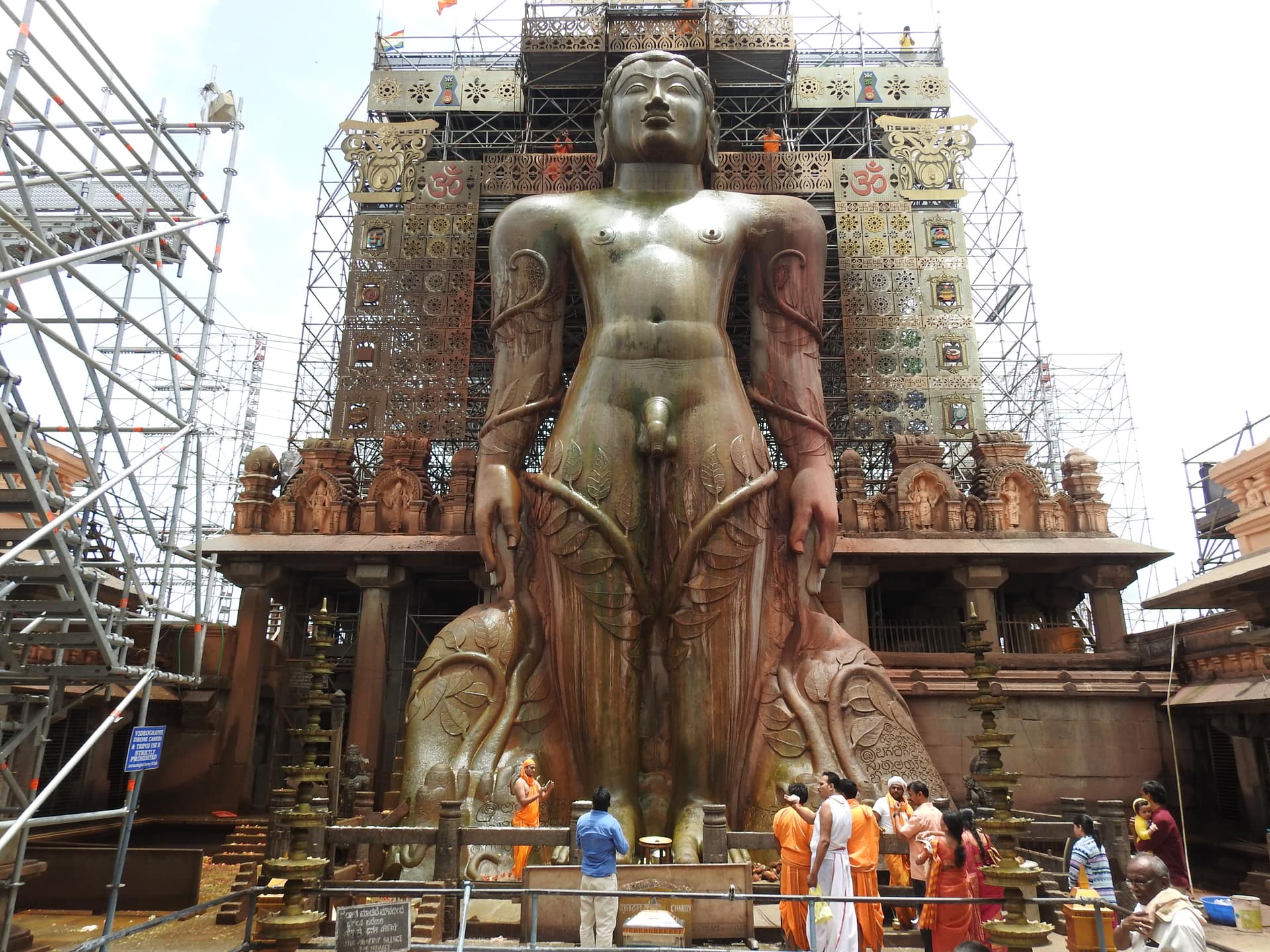
A single block of granite about 18 m high, carved around 981 CE, standing on top of Vindhyagiri hill. Getting to it means roughly 600 rock-cut steps, and they must be climbed barefoot.
Photo: Venkygrams — CC BY-SA 4.0, via Wikimedia Commons
Overview
Who it's to, and what's expected
Deity
Bahubali
Tradition
Jain temple
- Entry
Free entry. The roughly 600 steps require moderate fitness; elderly visitors and those with knee or heart conditions should pace themselves or enjoy the town-level sites. Footwear comes off at the hill's base; carry water and socks.
- Footwear
Shoes are not permitted anywhere on the hill. Lockers at the base take them, and the bare rock gets genuinely painful from late morning — socks in your bag are the fix everyone wishes they had brought.
- Access
The hill is reached only by rock-cut steps - there is no road or lift to the summit, so the colossus is not reachable for wheelchair users. The town-level basadis, Kalyani tank and museum are on flat ground.
- Prasadam
During the Maha Mastakabhisheka, holy water is distributed among the participants using specially designed vessels called Kalashas.
Usually visited with
Time your visit
The darshan clock
A single opening-hours line cannot express a midday closure or an evening ceremony.
6:30 AM
Opening hours
The hill's sites generally open in a morning window from about 6:30 to 11:30 AM and a late-afternoon window from about 3:30 to 6:30 PM; climb at the opening to avoid hot rock. Seasonal hours shift - the site's own notices are authoritative.
Rules, timings and fees change — confirm locally before you rely on this.
How long this takes
Ways in
The difference between a twenty-minute visit and a three-hour one.
The hill climb
- Free and open - the 'queue' is the staircase itself; early morning is cool and quieter
Summit courtyard darshan
- The colossus viewed from the courtyard at close range; brief waits on weekends and Jain festival days
Mahamastakabhisheka
- Once every twelve years (next due 2030) - the anointing days draw hundreds of thousands; arrangements are made by the Jain matha and committees
At the gate
Before you go in
What gets refused, and what you cannot take past the door.
What to wear
Simple, modest clothing suitable for a steep barefoot climb; shorts and sleeveless wear are discouraged. Avoid all leather items - belts, wallets and bags included - as the site is an active Jain pilgrimage.
Phones and cameras
Photography of the statue and the hills is generally permitted in the open areas; inside the basadis follow posted signage, and drones are not allowed.
Rules, timings and fees change — confirm locally before you rely on this.
When not to come — unless you mean to
Festival windows
These follow lunar calendars and move by weeks each year, so the windows are months, not dates.
Once every 12 years — last in February 2018, next due 2030
Mahamastakabhisheka
The statue is anointed from a scaffold with milk, saffron, turmeric and more, over about nine days. The 2018 ceremony drew over a million people. Outside that year the hill is an ordinary, steep, beautiful climb.
Practicalities
The things that go wrong
Book through official channels, and treat anyone promising a guaranteed slot as a warning sign.
What to watch for
- Stall-holders at the base renting 'mandatory' walking sticks or socks at inflated prices - socks from any shop beforehand cost far less
- Self-styled guides charging for the climb's 'history' - the site's published material and museum cover everything
- Third parties offering 'skip-the-climb' arrangements - there is no alternative to the steps and no fee to avoid
- Photographers at the summit charging for posed pictures of the statue - photography of the colossus is freely permitted
- Auto drivers detouring visitors to shops between the bus stand and the hill - it is a short walk
General guidance
Planning the visit
Customary practice and what Shravanabelagola's climate means for a barefoot visit — not rules posted at this temple. Anything specific to Gommateshwara (Bahubali) is above.
Come in winter
Winter is when Shravanabelagola is most comfortable to walk around, which matters here because a temple visit is done on foot and barefoot. Locally the window is given as october to march.
Stone gets hot — go early
You will be barefoot from the shoe rack onwards, often across an open courtyard. Between late morning and mid-afternoon in the hot months that stone is genuinely painful to stand on. Socks help, and are permitted almost everywhere shoes are not.
No airport here
Shravanabelagola has no airport of its own, so the last leg is by road or rail. Plan the return the same way — the last bus out is often earlier than visitors expect.
Outfit guide
What to wear at Gommateshwara (Bahubali)
Cover shoulders and knees — the rules above win over anything here.
Trending wear for this spot
Modern, camera-ready looks picked for Gommateshwara (Bahubali).

Traditional wear for this spot
Timeless, cultural outfits worn across Shravanabelagola.
Gomateshwara, Shravanabelagola: The Colossus on the Hill
On the flat summit of Vindhyagiri, above the Karnataka town of Shravanabelagola, stands a figure about 57 feet tall carved from a single block of granite - Bahubali, the Gomateshwara, in the kayotsarga posture of motionless meditation, with vines curling up his legs and anthills at his feet. Erected in 981 CE, it is among the largest free-standing monolithic statues in the world, and for more than a thousand years it has been the great pilgrimage of Jain India.
🗿 The statue
Bahubali - Gomateshwara to the local tradition - was a prince who, after defeating his brother in battle, renounced the kingdom, stood in meditation for so long that vines grew over his body, and attained omniscience standing where he was. The colossus renders the story in granite: the unmoving serenity of the face, the arms held straight down, the creepers climbing the legs.
It was commissioned in 981 CE by Chavundaraya, minister and commander of the Ganga king Rajamalla, and the inscription at its base - among the oldest records of Old Kannada - praises the commission and the mother in whose name he erected it. The statue's proportions, the calm of the face seen from below, and the sheer problem of carving one flawless figure from one stone have made it a landmark of world sculpture, not only of Jainism.
🧗 The climb - about 600 barefoot steps
Vindhyagiri is climbed on rock-cut steps - roughly six hundred of them - and the rule is barefoot for the whole hill, with lockers at the base for shoes. The stone is genuinely hot from late morning; carry socks in your bag and climb early.
The climb is a pilgrimage in itself: shaded stretches, landings with views back over the white Kalyani tank and the town between the two hills, and the gateway of Akhanda Bagilu before the summit. On the way up stand the Odegal Basadi with its Tirthankara images and the Tyagada Kamba, the carved pillar associated with Chavundaraya's gifts. At the top, the colossus appears at close range from the courtyard - most visitors go quiet.
The town below takes its name from the white Kalyani tank between the two hills - belagola, the white pond - and from the summit you read the whole geography at once: the tank, the basadis of the town, Chandragiri's green across the road, and the plains of Hassan district beyond. It is the best-oriented view in Jain India: every monument you are about to walk to is laid out beneath you like a map.
⛰️ Chandragiri: the other hill
Directly across the road rises Chandragiri, the smaller and easier twin - a few hundred steps to a summit of Jain basadis and memorials, and by tradition the hill where the emperor Chandragupta Maurya spent his last years as a Jain ascetic. The two hills between them carry several hundred inscriptions dating from the 7th to the 19th century - one of the densest epigraphic landscapes in India.
Chandragiri also gives the classic photograph: Gomateshwara's white figure across the valley, framed against Vindhyagiri's rock. Do both hills - most of the day, barefoot twice, water twice - and you have seen Shravanabelagola whole.
🪔 Mahamastakabhisheka
Once every twelve years the great anointing - the Mahamastakabhisheka - fills a scaffold around the statue, and over about nine days the colossus is drenched from above with pots of milk, sugarcane juice, saffron, sandalwood paste, turmeric and flower petals, before a crowd that runs into hundreds of thousands. The last was in February 2018; the next is due in 2030.
Outside those years the hill is an ordinary, steep, beautiful climb - which is its own kind of good fortune: the statue alone, the valley wind, and the quiet. On ordinary days holy water is offered at the small vessels at the base, and the temple rituals of the summit continue on their daily round.
🕒 Timings and the visit
The hill's sites keep a morning window from roughly 6:30 to 11:30 and a late-afternoon window from about 3:30 to 6:30; climb at the opening to beat the heat of the rock. Entry is free; allow two to three hours for Vindhyagiri and another for Chandragiri.
Wear simple clothing you can climb in, carry water and socks, and leave leather items behind - the site is a working Jain pilgrimage. The Jain matha at the base, the Akkana and Bhandari basadis of the town, and the small archaeological museum round out the visit.
🚗 The Belur-Halebidu triangle
Shravanabelagola sits on the classic Karnataka temple triangle: Belur's Chennakeshava and Halebidu's Hoysaleshwara are an hour-ish away, and the three make the single greatest day of sculpture in south India. Most travellers overnight at Hassan or do the circuit from Bengaluru, about 145 km.
Last verified: 2026. The 981 CE erection by Chavundaraya under the Ganga king Rajamalla, the approximately 57-foot single-granite-block colossus with the vine-wrapped kayotsarga iconography, the roughly 600 barefoot steps with lockers at the base, the Akhanda Bagilu gateway and Odegal Basadi en route, the Chandragiri tradition of Chandragupta Maurya with its basadis and the 7th-to-19th-century inscriptions, the twelve-yearly Mahamastakabhisheka last held in February 2018 and next due 2030, the about 6:30-11:30 AM and 3:30-6:30 PM windows with free entry, and the Belur-Halebidu pairing are documented. Seasonal hours shift; the site's own notices are authoritative.
Questions
Gommateshwara (Bahubali) — FAQ
Who is Gommateshwara (Bahubali) dedicated to?
Gommateshwara (Bahubali) in Shravanabelagola is dedicated to Bahubali.
Who can enter Gommateshwara (Bahubali)?
Free entry. The roughly 600 steps require moderate fitness; elderly visitors and those with knee or heart conditions should pace themselves or enjoy the town-level sites. Footwear comes off at the hill's base; carry water and socks.
What is the dress code at Gommateshwara (Bahubali)?
Simple, modest clothing suitable for a steep barefoot climb; shorts and sleeveless wear are discouraged. Avoid all leather items - belts, wallets and bags included - as the site is an active Jain pilgrimage.
Do I have to take my shoes off at Gommateshwara (Bahubali)?
Shoes are not permitted anywhere on the hill. Lockers at the base take them, and the bare rock gets genuinely painful from late morning — socks in your bag are the fix everyone wishes they had brought.
Can I take photos inside Gommateshwara (Bahubali)?
Photography of the statue and the hills is generally permitted in the open areas; inside the basadis follow posted signage, and drones are not allowed.
What prasadam is offered at Gommateshwara (Bahubali)?
During the Maha Mastakabhisheka, holy water is distributed among the participants using specially designed vessels called Kalashas.
Is Gommateshwara (Bahubali) wheelchair accessible?
The hill is reached only by rock-cut steps - there is no road or lift to the summit, so the colossus is not reachable for wheelchair users. The town-level basadis, Kalyani tank and museum are on flat ground.
Checked, not remembered
Sources
Every rule and timing above traces back to one of these.