
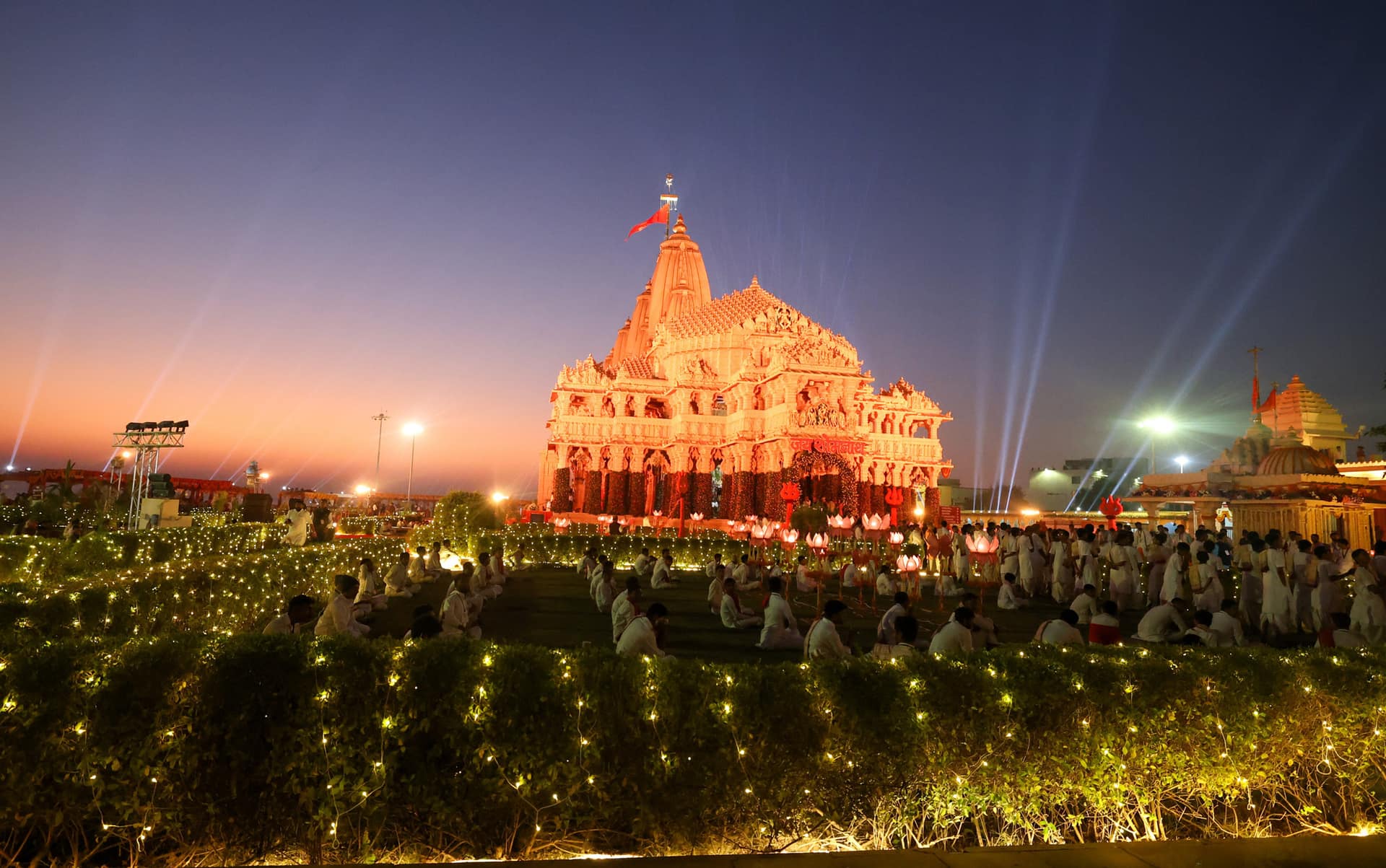
Temple in Somnath
Somnath Temple
Somnath, Gujarat
The first of the twelve Jyotirlingas, on the shore at Prabhas Patan — destroyed and rebuilt repeatedly, the present temple completed in 1951. There is nothing but sea between here and Antarctica, which the temple's own arrow pillar makes a point of.
Photo: Prime Minister's Office — GODL-India, via Wikimedia Commons
Overview
Who it's to, and what's expected
Deity
Shiva as Somnath
Tradition
Shiva temple
- Entry
Entry is free for all devotees, but visitors must pass a security check and adhere to a dress code requiring modest, traditional clothing. Electronic items, including mobile phones and cameras, are strictly prohibited inside the temple and must be deposited in lockers.
- Footwear
You must remove your footwear before entering the temple premises.
- Access
The temple provides basic facilities for elderly and disabled visitors, including seating areas and staff assistance. Wheelchair assistance is available upon request, though it is subject to availability.
- Prasadam
Prasad is distributed at the temple following the three daily aartis at 7:00 AM, 12:00 PM and 7:00 PM. Because all electronic items including smartwatches must be deposited in lockers before entry, carry any offering and the cash for it on your person rather than in a bag, since bags go into the cloakroom too.
Usually visited with
Time your visit
The darshan clock
A single opening-hours line cannot express a midday closure or an evening ceremony.
6:00 AM
Opening hours
The temple is open daily from 6:00 AM to 10:00 PM, with aarti ceremonies held at 7:00 AM, 12:00 PM, and 7:00 PM. Darshan is available throughout the day but pauses briefly during these aarti times.
Rules, timings and fees change — confirm locally before you rely on this.
How long this takes
Ways in
The difference between a twenty-minute visit and a three-hour one.
Darshan options
- The temple uses a general queue system for darshan, with wait times varying from 30 minutes to several hours depending on the day, season, and crowd levels
At the gate
Before you go in
What gets refused, and what you cannot take past the door.
What to wear
Visitors are expected to wear modest and traditional clothing, avoiding short, sleeveless, or revealing garments. Footwear must be removed before entering the temple premises.
Phones and cameras
Mobile phones, cameras, video recording devices, smartwatches, and other electronic gadgets are strictly prohibited inside the temple premises. Photography and videography are also not allowed.
Rules, timings and fees change — confirm locally before you rely on this.
When not to come — unless you mean to
Festival windows
These follow lunar calendars and move by weeks each year, so the windows are months, not dates.
Maha Shivratri
Shravan (Sawan)
Kartik Purnima
Somnath Sthapana Diwas
Practicalities
The things that go wrong
Book through official channels, and treat anyone promising a guaranteed slot as a warning sign.
What to watch for
- Charging to store electronics
- Lockers are provided for the mandatory deposit of phones, cameras and smartwatches - use the temple's own facility rather than paying an informal attendant
- Anyone offering to photograph you inside the temple for a fee
- Photography and videography are prohibited outright inside the premises and no payment permits it
- Guides attaching themselves at Veraval or the temple approach and producing a large fee afterwards
- The Jay Somnath light and sound show at 8:00 PM narrates the temple's history, which covers most of what a guide would say
- Third parties selling 'special aarti' tickets
- The three daily aartis at 7:00 AM, 12:00 PM and 7:00 PM are open to devotees attending darshan and are not separately ticketed
- Auto and taxi drivers quoting a fare only on arrival from Veraval or Diu
- Agree the round-trip price before travelling, particularly if combining with Bhalka Tirth and the Triveni Sangam
General guidance
Planning the visit
Customary practice and what Somnath's climate means for a barefoot visit — not rules posted at this temple. Anything specific to Somnath Temple is above.
Circling the shrine
At most Shaiva temples the circuit around the sanctum is not completed in a full circle — the channel draining the abhishekam is not crossed. Walk to it, turn, and come back the way you came. Watching what the queue in front of you does is the reliable guide.
Come in winter
Winter is when Somnath is most comfortable to walk around, which matters here because a temple visit is done on foot and barefoot. Locally the window is given as october to march.
Salt air and bare feet
Coastal temple courtyards stay damp and the stone can be slick underfoot, particularly near a tank or a sea-facing entrance. Take the steps slowly rather than the queue's pace.
Arriving by train
Somnath has a railway station, and auto-rickshaws wait outside it. Agree the fare or use a meter before you set off, and expect to be dropped a short walk from the temple rather than at its door.
No airport here
Somnath has no airport of its own, so the last leg is by road or rail. Plan the return the same way — the last bus out is often earlier than visitors expect.
Outfit guide
What to wear at Somnath Temple
Cover shoulders and knees — the rules above win over anything here.
Trending wear for this spot
Modern, camera-ready looks picked for Somnath Temple.

Traditional wear for this spot
Timeless, cultural outfits worn across Somnath.

Somnath Temple
Somnath is the first of the twelve Jyotirlingas, standing on the shore at Prabhas Patan near Veraval in Gujarat. Its position in the list is not arbitrary — the traditional recitation of the twelve begins here — and the temple's own claim to attention is its history of destruction and rebuilding, which is longer and more violent than that of any other Jyotirlinga.
The present temple was completed in May 1951. What stands today is a twentieth-century building on a site whose religious history reaches back well before the ninth century.
🌊 The arrow pillar, and nothing south but sea
The temple's Baan Stambh — the arrow pillar — carries an inscription making a geographical claim: that there is no land in a straight line south from Somnath until Antarctica.
It is a striking thing to find on a temple pillar, and it works as both devotion and geography. The Arabian Sea opens directly in front of the temple with no intervening landmass, which is why the shoreline here feels different from any other Jyotirlinga — the sanctum is a short walk from open ocean, and the aarti is heard against the sound of surf.
Visitors describe sitting by the sea during the evening aarti as one of the best experiences at Somnath, with the sunset and the sea breeze alongside the ritual. That combination — a Jyotirlinga on an open shore — is unique among the twelve.
🏛️ Built by the Moon God
The name means "Lord of the Moon" — Soma (the moon) and natha (lord).
According to the Skanda Purana and the Shiva Purana, the temple was originally built by Chandra Dev, the Moon God, who worshipped Shiva here to free himself from a curse. The tradition holds that a structure existed on the site before the ninth century CE, so the Puranic account sits behind a documented history of at least twelve centuries.
That origin story is what the name records, and it is worth knowing because it explains the temple's identity: this is Shiva as the one who released the moon, on the shore where the moon's namesake built him a house.
🔨 Destruction and rebuilding
The pattern of destruction and restoration is central to what Somnath means, and is the reason the present building is so much younger than its significance. Visitors come for a continuity that the fabric itself does not show.
🇮🇳 The 1951 reconstruction
After Independence, Sardar Vallabhbhai Patel visited the ruins on 13 November 1947 and resolved to rebuild the temple. The reconstruction was carried out in the traditional Chalukya (Chaulukya) style of Hindu temple architecture.
Dr Rajendra Prasad, then President of India, performed the Pran Pratishtha (consecration) on 11 May 1951.
So the temple's current form is deliberately a twentieth-century act of restoration in a medieval idiom — Chalukya style, modern construction, consecrated by the head of state. That is not a compromise; it is the point of the building.
🕒 Timings and the three aartis
Darshan: 6:00 AM to 9:00 PM daily. Entry is free for all devotees, but visitors must pass a security check.
Three aartis each day:
- Morning aarti — 7:00 AM
- Midday aarti — 12:00 PM
- Evening aarti — 7:00 PM (running roughly to 7:20 PM)
The evening aarti is the one to attend, both for the sea setting and because it leads directly into the light and sound show.
🎇 "Jay Somnath" light and sound show
A sound and light show titled Jay Somnath runs every night from 8:00 PM to 9:00 PM, staged with the temple as backdrop and the sound of the ocean around it. It narrates the temple's history, which is the most efficient way to absorb the long sequence of destructions and rebuilds.
It follows the evening aarti directly, so 7:00 PM aarti and 8:00 PM show is the natural evening sequence and the reason to stay late at Somnath rather than leaving after darshan.
🚫 Electronics: leave them behind
Mobile phones, cameras, video recording devices, smartwatches and other electronic gadgets are strictly prohibited inside the temple premises. Photography and videography are not allowed.
Lockers are provided for deposit. This is enforced, and it is comprehensive — smartwatches are included, which catches out visitors who assume a watch is not a camera. Plan to deposit before you queue, not after.
👘 Dress and access
Modest, traditional clothing is expected — avoid short, sleeveless or revealing garments. Footwear must be removed before entering the temple premises.
The temple provides basic facilities for elderly and disabled visitors, including seating areas and staff assistance. Wheelchair assistance is available on request, though subject to availability — so ask early rather than at the gate.
🌸 Festivals
Maha Shivratri (February or March) is Somnath's great occasion and the heaviest period of the year. Shravan (July to August) brings sustained heavy attendance as the month sacred to Shiva. Kartik Purnima (November) is significant at a coastal Shiva temple and draws large numbers for the full-moon observance.
The best season to visit is October to February, when Gujarat's coast is cool and the humidity is manageable.
📍 Prabhas Patan and the wider site
Somnath sits at Prabhas Patan, a tirtha in its own right, and two nearby sites are traditionally combined with it:
- Bhalka Tirth — where Krishna is held to have been struck by a hunter's arrow, a few kilometres away
- Triveni Sangam — the confluence of three rivers meeting the sea, where pilgrims bathe
Dwarka, the Char Dham site, is roughly 230 km south, and Somnath and Dwarka are conventionally combined into a single Saurashtra pilgrimage circuit — the two anchor the western end of both the Jyotirlinga and Char Dham lists.
⚠️ Practical notes
- Stay for the evening: 7:00 PM aarti, then the 8:00 PM show. Leaving after darshan misses what most people remember.
- Deposit electronics before queueing, including any smartwatch.
- Sit by the sea during the aarti if time allows.
- Go early in the morning to avoid both heat and the queue.
- October to February for weather.
Last verified: 2026. Darshan 6:00 AM to 9:00 PM with aartis at 7:00 AM, 12:00 PM and 7:00 PM, the Jay Somnath light and sound show 8:00-9:00 PM, free entry with a security check, and the prohibition on all electronics including smartwatches are consistent across sources. The 1951 consecration date of 11 May and Sardar Patel's visit of 13 November 1947 are documented.
Questions
Somnath Temple — FAQ
Who is Somnath Temple dedicated to?
Somnath Temple in Somnath is dedicated to Shiva as Somnath.
Who can enter Somnath Temple?
Entry is free for all devotees, but visitors must pass a security check and adhere to a dress code requiring modest, traditional clothing. Electronic items, including mobile phones and cameras, are strictly prohibited inside the temple and must be deposited in lockers.
What is the dress code at Somnath Temple?
Visitors are expected to wear modest and traditional clothing, avoiding short, sleeveless, or revealing garments. Footwear must be removed before entering the temple premises.
Do I have to take my shoes off at Somnath Temple?
You must remove your footwear before entering the temple premises.
Can I take photos inside Somnath Temple?
Mobile phones, cameras, video recording devices, smartwatches, and other electronic gadgets are strictly prohibited inside the temple premises. Photography and videography are also not allowed.
What prasadam is offered at Somnath Temple?
Prasad is distributed at the temple following the three daily aartis at 7:00 AM, 12:00 PM and 7:00 PM. Because all electronic items including smartwatches must be deposited in lockers before entry, carry any offering and the cash for it on your person rather than in a bag, since bags go into the cloakroom too.
Is Somnath Temple wheelchair accessible?
The temple provides basic facilities for elderly and disabled visitors, including seating areas and staff assistance. Wheelchair assistance is available upon request, though it is subject to availability.
Checked, not remembered
Sources
Every rule and timing above traces back to one of these.