
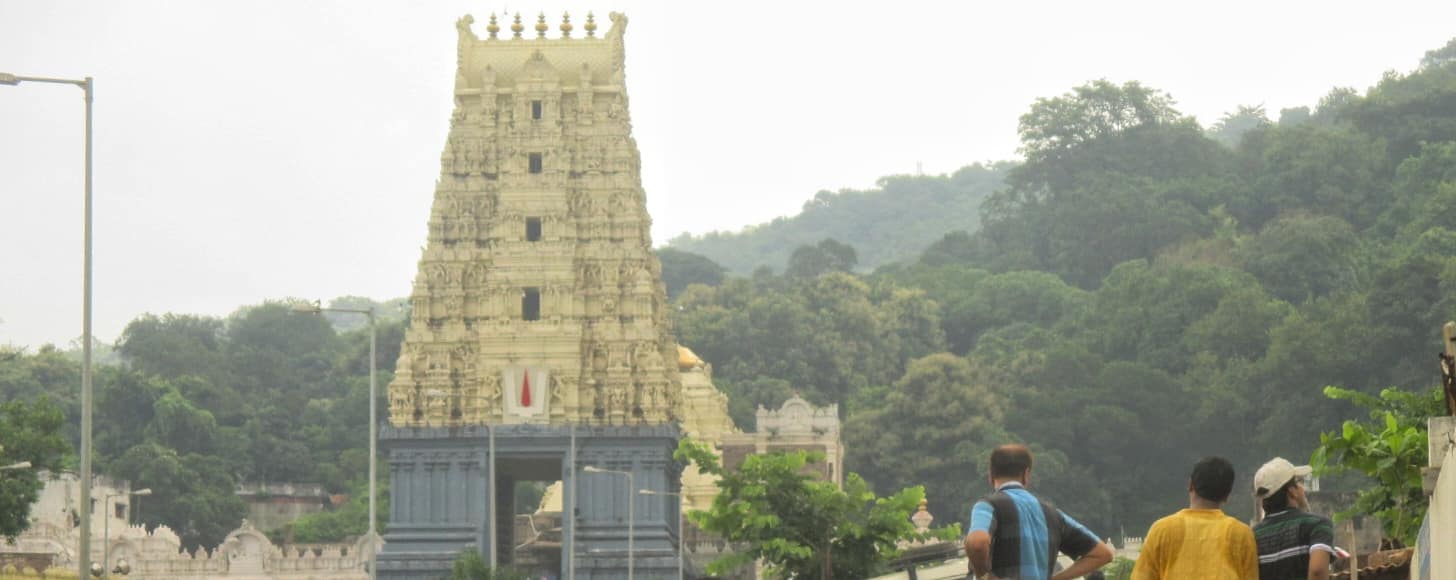
Temple in Visakhapatnam
Varaha Lakshmi Narasimha Temple, Simhachalam
Visakhapatnam, Andhra Pradesh
On a hill about 16 km from the city, and the only major Indian temple whose deity you essentially never see. The image is kept under a thick coat of sandalwood paste all year round, shaped into a lingam-like form — what is under it is shown on one day.
Photo: Billjones94 — CC BY-SA 4.0, via Wikimedia Commons
Overview
Who it's to, and what's expected
Deity
Vishnu as Varaha Narasimha
Tradition
Vishnu · Krishna temple
- Entry
Visitors are required to wear modest traditional clothing, such as a dhoti, trousers and shirt for men, or a saree or salwar kameez for women. Shorts, lungis, sleeveless tops, and revealing clothing are prohibited, and mobile phones and cameras are not allowed inside.
- Footwear
Footwear must be removed before entering, and the temple provides dedicated counters at both the foothill and hilltop for storage.
- Access
The temple path includes approximately 1,100 steps for those fulfilling vows, though temple buses are available to reach the site.
- Prasadam
The temple offers Simhachalam Laddu and Pulihora as prasadam, and free meals are provided daily between 11:30 AM and 3:30 PM.
Time your visit
The darshan clock
A single opening-hours line cannot express a midday closure or an evening ceremony.
7:00 AM
Opening hours
The temple is open daily from 7:00 AM to 4:00 PM and again from 6:00 PM to 9:00 PM.
Rules, timings and fees change — confirm locally before you rely on this.
At the gate
Before you go in
What gets refused, and what you cannot take past the door.
What to wear
Visitors are encouraged to wear modest traditional clothing. Men should wear a dhoti with angavastram or formal trousers and a shirt, while women should wear a saree or salwar kameez with a dupatta; shorts, lungis, and revealing clothes are prohibited.
Phones and cameras
The temple grounds offer many photogenic spots suitable for taking family photographs.
Rules, timings and fees change — confirm locally before you rely on this.
When not to come — unless you mean to
Festival windows
These follow lunar calendars and move by weeks each year, so the windows are months, not dates.
Chandanotsavam - Nijaroopa Darshanam
Kalyanotsavam
Narasimha Jayanti
Practicalities
The things that go wrong
Book through official channels, and treat anyone promising a guaranteed slot as a warning sign.
What to watch for
- Charging for entry or for the hill buses beyond their published fares
- Entry is free, and the buses are the temple's own service
- Offering darshan arrangements at the foothill; anything of the kind is made at the temple's own counters, and no one at the approach sells them
- Laddu and pulihora sold at the gates at first prices; the temple's own counter is inside, and the free meals run 11:30 AM to 3:30 PM
- Phone-storage attendants demanding arbitrary amounts; a small fixed charge is normal, a quoted rate is not
- Chandanotsavam day especially: anyone selling places in line or promising early entry - the queue is the temple's own, stewarded through the night, and nothing of the kind is for sale
General guidance
Planning the visit
Customary practice and what Visakhapatnam's climate means for a barefoot visit — not rules posted at this temple. Anything specific to Varaha Lakshmi Narasimha Temple, Simhachalam is above.
The queue is the ritual
Vaishnava temples in India are usually organised around a moving darshan queue rather than time spent in front of the deity. Expect to keep walking, and expect the view of the sanctum to be brief — that is the intended experience, not a rushed one.
Come in winter
Winter is when Visakhapatnam is most comfortable to walk around, which matters here because a temple visit is done on foot and barefoot. Locally the window is given as october to march.
Salt air and bare feet
Coastal temple courtyards stay damp and the stone can be slick underfoot, particularly near a tank or a sea-facing entrance. Take the steps slowly rather than the queue's pace.
Arriving by train
Visakhapatnam has a railway station, and auto-rickshaws wait outside it. Agree the fare or use a meter before you set off, and expect to be dropped a short walk from the temple rather than at its door.
Outfit guide
What to wear at Varaha Lakshmi Narasimha Temple, Simhachalam
Cover shoulders and knees — the rules above win over anything here.
Trending wear for this spot
Popular modern looks travellers are wearing across Visakhapatnam.

Traditional wear for this spot
Timeless, cultural looks that suit Varaha Lakshmi Narasimha Temple, Simhachalam.
Sri Varaha Lakshmi Narasimha Temple, Simhachalam
On a hill about 16 km from Visakhapatnam, and the only major Indian temple whose deity you essentially never see: the image is kept under a thick coat of sandalwood paste all year round, shaped into a lingam-like form — and what is under it is shown on one day.
🦁 The god under the sandalwood
The deity is Varaha Lakshmi Narasimha — Vishnu in a combined Varaha-Narasimha form, a lion's head on a human torso, standing in the tribhanga posture with two hands. And the deity stays covered: a thick coat of sandalwood paste, sourced from Srivilliputhur, is kept on the image through the year, shaped so that the god presents as a lingam-like form.
The temple's tradition explains the covering as the deity's own wish — the form beneath too radiant to be looked upon. A second tradition, from the eleventh century, tells of the paste being ordered removed and the image reacting at once — after which it was reapplied and the practice confirmed. Either way, the arrangement is absolute: the sandalwood is refreshed ceremonially on four days of the year, and removed entirely on one.
🌕 Chandanotsavam — the one day
On Akshaya Tritiya, in April or May, the sandalwood is removed at about 4:00 AM; the prayers and abhisheka are completed by about 6:00 AM; and then the doors open for Nijaroopa Darshanam — the darshan of the true form, for that single day of about twelve hours.
Around two lakh people come for it, with darshan queues forming from the small hours. In the evening the deity is bathed again — the Chandanabhisheka with sandalwood-scented water, and the Sahasrakalasabhisheka from a thousand metal pots — before the fresh coat is laid and the year's covering resumes.
If you attend: arrive overnight, follow the temple's own crowd arrangements at every stage, keep children held close, and treat the word of the stewards as final. The hill is at its fullest on this one day, and it is a day for patience above all.
🏯 The fortress temple
From outside, Simhachalam reads as a fortress — Kalinga architecture, three prakarams and five gateways climbing the hill — and its stones carry one of the densest inscription records in the south: more than 250 inscriptions in Odia and Telugu.
The earliest belong to the Cholas of 1098-99; an Eastern Ganga queen of the twelfth century recorded covering the image in gold; King Narasimha Deva raised the central shrine around 1267; and Krishnadeva Raya of Vijayanagara came twice in the 1510s, leaving the marks of imperial patronage. The temple that looks like a fort was worth fortifying — and it drew poets as well as kings: a body of Telugu court poetry grew around the shrine, and the inscriptions themselves record donations, festivals and renovations across five dynasties. For a visitor with an hour, the outer prakarams are a museum read in stone.
The deity wears only four principal ornaments, by the temple's own custom: a diamond-and-ruby namam, a string of emeralds, a gold band, and a golden crown — the austerity itself part of the shrine's character.
⛰️ The hill
'Simhachalam' means lion's hill, and the climb is part of the pilgrimage: roughly 1,100 steps for those fulfilling vows, and a ghat road with temple buses to the top for everyone else. The view opens over Visakhapatnam and the coast as you rise — the city and the sea from a holy hill, which is a combination few Indian cities can offer.
🕒 Timings, dress and prasadam
Open daily about 7:00 AM to 4:00 PM and 6:00 to 9:00 PM; entry is free. The dress code is strict and enforced: a dhoti with angavastram or trousers and shirt for men, a saree or salwar kameez with dupatta for women — shorts, lungis and revealing clothing are barred. Mobile phones and cameras are not allowed inside; counters store them at the foothill and the hilltop.
The prasadam is the Simhachalam laddu and pulihora, and free meals are served daily from about 11:30 AM to 3:30 PM.
🎉 Kalyanotsavam and the year
Kalyanotsavam — the celestial wedding of the deity — is the temple's principal celebration through the year, held with full ritual on the chosen days of the calendar. Narasimha Jayanti, the deity's manifestation day, is the other great observance, and the Telugu festival calendar fills the months between.
📍 Getting there
About 16 km from Visakhapatnam city — buses and taxis make the run through the day, and the hill stands north of the city on the road to the interior. November to February is the comfortable season; the hilltop breeze makes even the crowd hours bearable. Allow half a day for temple, hill and view together — the fortress and its inscriptions reward the slow visit.
Last verified: 2026. The year-round sandalwood covering with the Srivilliputhur sourcing and the four-day refreshment, the Akshaya Tritiya Chandanotsavam with the roughly 4:00 AM removal, the twelve-hour Nijaroopa Darshanam and the evening's thousand-pot abhisheka, the two-lakh attendance, the Kalinga fortress architecture with three prakarams and five gateways, the Chola-to-Vijayanagara inscription record, the 1,100 steps and temple buses, the 7:00 AM-4:00 PM and 6:00-9:00 PM sessions, the dress code, the phone prohibition, and the free meal window are documented. Festival-day timings extend; the temple's own schedule is authoritative.
Questions
Varaha Lakshmi Narasimha Temple, Simhachalam — FAQ
Who is Varaha Lakshmi Narasimha Temple, Simhachalam dedicated to?
Varaha Lakshmi Narasimha Temple, Simhachalam in Visakhapatnam is dedicated to Vishnu as Varaha Narasimha.
Who can enter Varaha Lakshmi Narasimha Temple, Simhachalam?
Visitors are required to wear modest traditional clothing, such as a dhoti, trousers and shirt for men, or a saree or salwar kameez for women. Shorts, lungis, sleeveless tops, and revealing clothing are prohibited, and mobile phones and cameras are not allowed inside.
What is the dress code at Varaha Lakshmi Narasimha Temple, Simhachalam?
Visitors are encouraged to wear modest traditional clothing. Men should wear a dhoti with angavastram or formal trousers and a shirt, while women should wear a saree or salwar kameez with a dupatta; shorts, lungis, and revealing clothes are prohibited.
Do I have to take my shoes off at Varaha Lakshmi Narasimha Temple, Simhachalam?
Footwear must be removed before entering, and the temple provides dedicated counters at both the foothill and hilltop for storage.
Can I take photos inside Varaha Lakshmi Narasimha Temple, Simhachalam?
The temple grounds offer many photogenic spots suitable for taking family photographs.
What prasadam is offered at Varaha Lakshmi Narasimha Temple, Simhachalam?
The temple offers Simhachalam Laddu and Pulihora as prasadam, and free meals are provided daily between 11:30 AM and 3:30 PM.
Is Varaha Lakshmi Narasimha Temple, Simhachalam wheelchair accessible?
The temple path includes approximately 1,100 steps for those fulfilling vows, though temple buses are available to reach the site.
Checked, not remembered
Sources
Every rule and timing above traces back to one of these.