
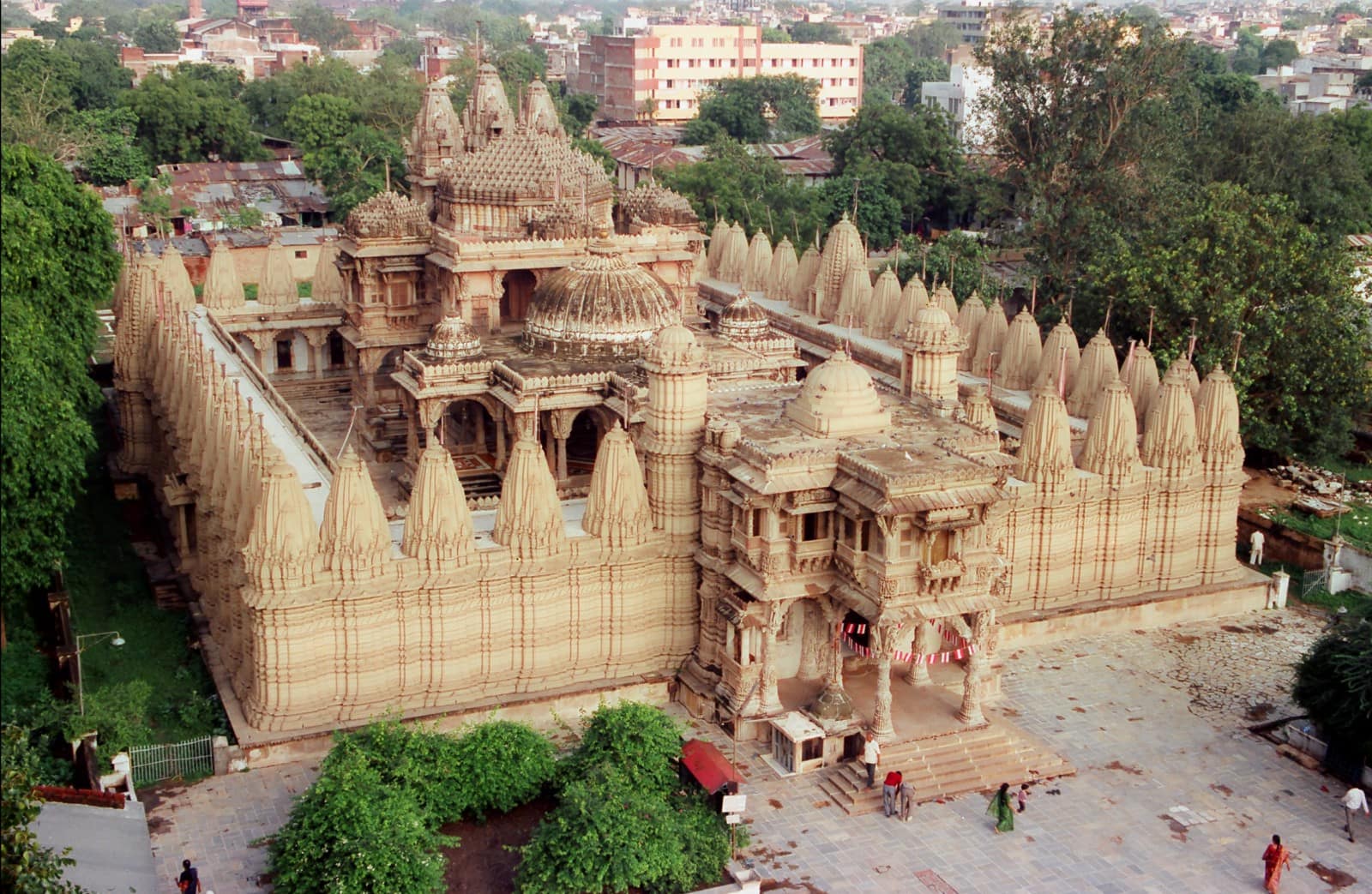
Temple in Ahmedabad
Hutheesing Jain Temple
Ahmedabad, Gujarat
Completed in 1848 in white marble, and the best-known Jain temple in the city — commissioned by a merchant family and finished by his widow after his death. Note it is a nirandhara plan: there is no circumambulatory passage around the shrine, which is unusual and immediately obvious once you know to look.
Photo: Kalyan Shah — CC BY-SA 3.0, via Wikimedia Commons
Overview
Who it's to, and what's expected
Deity
Dharmanatha
Tradition
Jain temple
- Entry
Free entry. Leather items are not carried in, dress is modest, and worship in the shrines takes precedence over sightseeing at all times.
- Footwear
Footwear is removed before entering the temple; racks are provided at the gateway.
- Access
The temple is entered by steps under the gateway pavilion, and the cloister walk and courtyard are level once inside; the basement shrines are reached by stairs only.
Usually visited with
Time your visit
The darshan clock
A single opening-hours line cannot express a midday closure or an evening ceremony.
8:00 am
Opening hours
The temple is open to visitors daily from 8:00 am to 5:00 pm.
Rules, timings and fees change — confirm locally before you rely on this.
How long this takes
Ways in
The difference between a twenty-minute visit and a three-hour one.
General darshan
- Free and unhurried - the cloister walk past the fifty-two shrines is the visit; mornings are quietest
Paryushan period
- The temple's fullest season, with the courtyards lit and worship through the day; follow the trust's arrangements
Museum and grounds
- The complex's Jain-art museum and galleries are ticketed at nominal rates if open; the temple itself is free
At the gate
Before you go in
What gets refused, and what you cannot take past the door.
What to wear
Leather is not carried in — belts, wallets and camera straps included, as at any Jain temple.
Phones and cameras
Photography inside follows the posted signs; certain shrines and the worship areas restrict it. Carry cameras loosely, without leather straps.
Rules, timings and fees change — confirm locally before you rely on this.
When not to come — unless you mean to
Festival windows
These follow lunar calendars and move by weeks each year, so the windows are months, not dates.
Paryushan
Mahavir Janma Kalyanak
Practicalities
The things that go wrong
Book through official channels, and treat anyone promising a guaranteed slot as a warning sign.
What to watch for
- Shoe-keepers at the gate demanding fixed 'tips' - the arrangement is informal and a few coins are the custom, nothing more
- Self-styled guides charging for architecture tours - the temple's plan is legible and the trust's own material covers the history
- Stall-holders selling 'temple prasad' packages outside - offerings are made inside at the temple's own counters
- Auto drivers quoting heritage-walk rates to the pols - the walk from the temple through the old quarter is short and signposted
- Third parties collecting 'museum entry' on the street - any ticketing is inside the complex and nominal
General guidance
Planning the visit
Customary practice and what Ahmedabad's climate means for a barefoot visit — not rules posted at this temple. Anything specific to Hutheesing Jain Temple is above.
Come in winter
Winter is when Ahmedabad is most comfortable to walk around, which matters here because a temple visit is done on foot and barefoot. Locally the window is given as november to february.
Stone gets hot — go early
You will be barefoot from the shoe rack onwards, often across an open courtyard. Between late morning and mid-afternoon in the hot months that stone is genuinely painful to stand on. Socks help, and are permitted almost everywhere shoes are not.
Metro, then walk
Ahmedabad has a metro, and it is usually the fastest way to get near a busy temple — the streets immediately around one are often closed to vehicles or jammed with them.
Outfit guide
What to wear at Hutheesing Jain Temple
Cover shoulders and knees — the rules above win over anything here.
Trending wear for this spot
Modern, camera-ready looks picked for Hutheesing Jain Temple.

Traditional wear for this spot
Timeless, cultural looks that suit Hutheesing Jain Temple.
Hutheesing Jain Temple, Ahmedabad: Marble in the Famine Years
On the Delhi Darwaja-Shahibaug road, behind high walls and above the traffic of one of India's busiest cities, stands a temple of white marble that Ahmedabad has loved for a century and three quarters. Commissioned by the merchant Sheth Hutheesing Kesarisinh and completed in 1848 after his death by his widow, Shethani Harkunvar, it is the best-known Jain temple of a city full of them - and one of the purest pieces of the Maru-Gurjara style anywhere.
📜 A temple built in a famine
The temple's founding story is its best one: Hutheesing is said to have undertaken the build during a severe famine in Gujarat, deliberately, so that hundreds of skilled artisans would have two years of work. He did not live to see it finished - he died at forty-nine, mid-construction - and his wife Harkunvar carried the project to completion with the architect Premchand Salat.
A temple built as famine relief, finished by a widow's determination, in a merchant city's favourite stone - the building and its story are the same thing, and Ahmedabad knows it. It remains a major religious centre for the Shvetambara Jain community, run by the family's trust.
🛕 The marble and the plan
The temple is double-storied, built of white marble throughout, dedicated to Dharmanatha - the fifteenth of the twenty-four Tirthankaras, the great teachers of the Jain path - whose marble image stands in the central sanctum. The main shrine lies to the east under a great dome carried on twelve ornate pillars; the garbhagriha holds eleven images, with six more in the basement shrines.
Around the courtyard runs the feature everyone remembers: fifty-two devakulikas, the small subsidiary shrines of the cloister, each holding its own Tirthankara image with jewel-set eyes. The count is the temple's signature - a full galaxy of teachers in miniature, and a walk that takes you past every one of them.
The approach is haveli-like: a gateway pavilion carved with musicians and dancers, jarokha balconies, balustrades and jalis, and mirror work at the entry - the domestic architecture of old Ahmedabad married to the temple tradition. Inside, the marble carries dancers, musicians, animals and flowers in low relief - the same craft that built the city's wooden pols, translated to stone.
🗼 The Manastambha
Behind the temple rises the complex's second landmark: the Manastambha, the column of honour - a six-storey tower inspired by the Kirtistambha of Chittorgarh, enshrining an image of Mahavira. It is the newest of the complex's great pieces and the thing you see first from the road, a pillar that says 'Jain temple' at a distance in the way a shikhara says it elsewhere.
The grounds hold more than the temple: gardens, a museum and galleries of Jain art, guesthouses for pilgrims - a whole wadi, the traditional temple compound of a Gujarati merchant family, at work in the middle of a metropolis. A traditional rainwater-harvesting system, still functioning after all these years, and - by the family's tradition - an eternal flame beneath the sanctum, are the details that reward a slower visit.
🕒 Timings and the visit
The temple is open to visitors daily from about 8:00 AM to 5:00 PM. Go in the morning light, when the marble glows and the cloisters are quiet; an hour does the circuit justice, two with the museum. The rules are Jain-standard: leather is left outside - belts, wallets and camera straps included - feet are bare, and photography follows the posted signs.
The cloister walk is the temple's gift to the unhurried: fifty-two shrines, each a small composition of image, carving and lamp, each with its own devotee at its own hour. Ahmedabad city moves fast outside the high walls; in here, the white marble tradition asks for exactly the same pace it has kept since 1848.
Dress and conduct modestly; worship may be under way in any of the fifty-two shrines at any time. Entry is free, the trust's arrangements are simple, and the temple is a working religious centre first and a monument second - which is exactly why it feels so alive.
🙏 Paryushan and the year
The Jain year's great observance is Paryushan, the annual period of fasting, forgiveness and renewal - for Shvetambara communities typically in August or September - and the temple is at its fullest and most beautiful then, the courtyards lit and the devakulikas garlanded. Mahavir Janma Kalyanak, the birthday of Mahavira, brings the year's other great celebration.
Visitors are welcome to observe respectfully at any time; the festival calendar simply adds the lights. However you time it, this is Ahmedabad's most complete morning of marble - and the pols, the riverfront and the mosque of Sidi Saiyyed are all within the same half-day.
Last verified: 2026. The 1848 completion under Shethani Harkunvar after Hutheesing Kesarisinh's death, the famine-employment founding tradition, the architect Premchand Salat, the white-marble Maru-Gurjara double-storied plan dedicated to Dharmanatha with the eleven sanctum images and six basement shrines, the fifty-two devakulikas of the cloister, the haveli-style gateway with the Chittorgarh-inspired Manastambha enshrining Mahavira, the functioning traditional rainwater system, the about 8:00 AM-5:00 PM hours, and the Paryushan and Mahavir Janma Kalyanak observances are documented. The eternal flame beneath the sanctum is the family trust's tradition. Hours and festival dates shift; the temple's own schedule is authoritative.
Questions
Hutheesing Jain Temple — FAQ
Who is Hutheesing Jain Temple dedicated to?
Hutheesing Jain Temple in Ahmedabad is dedicated to Dharmanatha.
Who can enter Hutheesing Jain Temple?
Free entry. Leather items are not carried in, dress is modest, and worship in the shrines takes precedence over sightseeing at all times.
What is the dress code at Hutheesing Jain Temple?
Leather is not carried in — belts, wallets and camera straps included, as at any Jain temple.
Do I have to take my shoes off at Hutheesing Jain Temple?
Footwear is removed before entering the temple; racks are provided at the gateway.
Can I take photos inside Hutheesing Jain Temple?
Photography inside follows the posted signs; certain shrines and the worship areas restrict it. Carry cameras loosely, without leather straps.
Is Hutheesing Jain Temple wheelchair accessible?
The temple is entered by steps under the gateway pavilion, and the cloister walk and courtyard are level once inside; the basement shrines are reached by stairs only.
Checked, not remembered
Sources
Every rule and timing above traces back to one of these.