
Temple on Ajanta Caves
Ajanta Cave 26 (the chaitya hall)
Ajanta Caves, Aurangabad
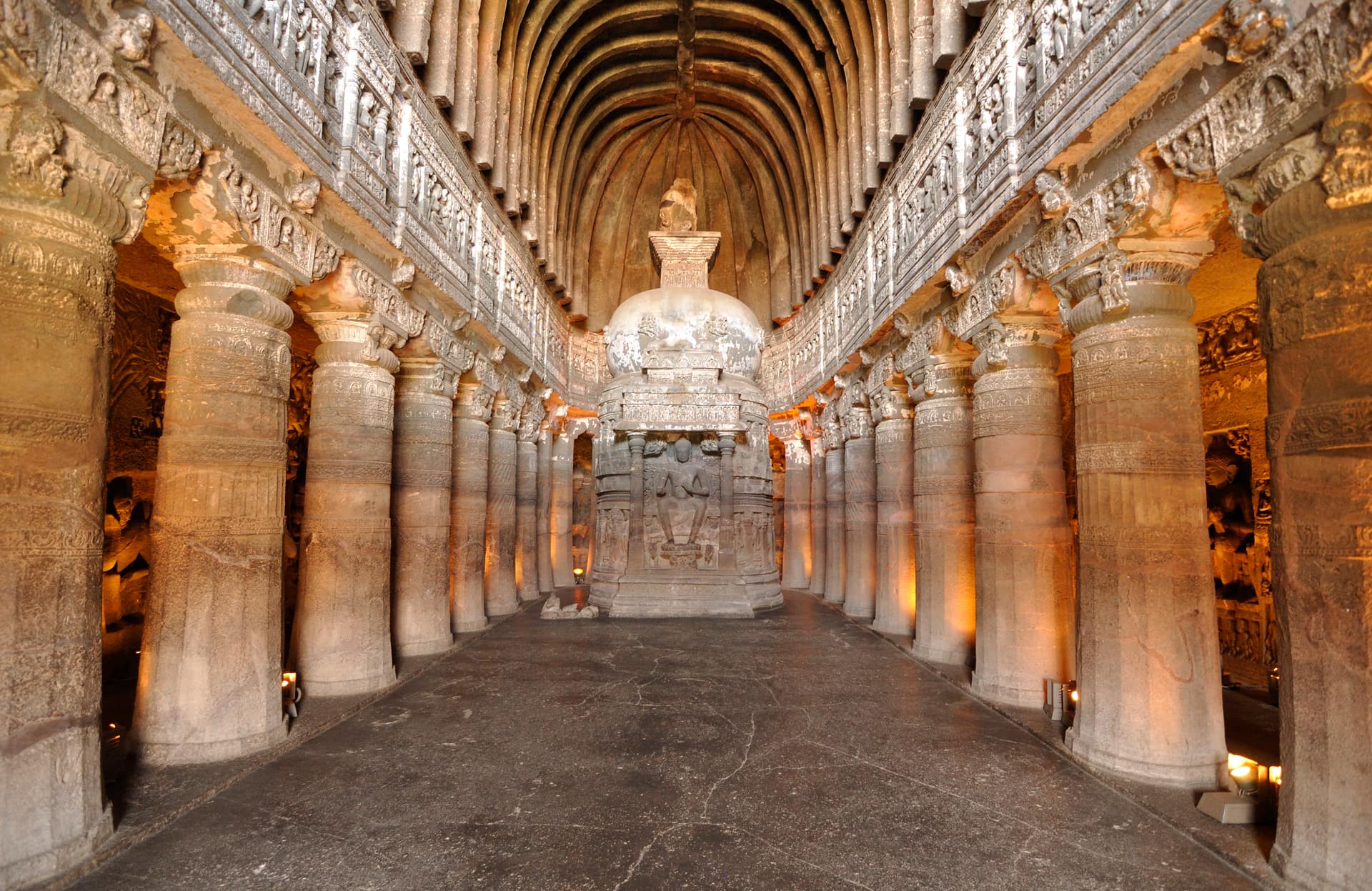
The great late chaitya hall at Ajanta, cut in the 5th century — a ribbed vault carved to imitate timber it never had, and along its left wall a reclining Buddha about 7 m long, entering parinirvana while mourners sit beneath him.
Photo: Dey.sandip — CC BY-SA 3.0, via Wikimedia Commons
Inside a larger place
Part of Ajanta Caves
Overview
Who it's to, and what's expected
Deity
The Buddha
Tradition
Buddhist temple
- Entry
One of thirty caves at a UNESCO World Heritage Site, ASI-ticketed. Ajanta closes on Mondays and Ellora on Tuesdays — the single most useful fact for anyone planning both from Aurangabad.
- Access
Demanding. The thirty caves are cut into a scarp above a river bend and reached along a cliff path with numbered access, involving considerable walking and steps, and the site is only reachable by a mandatory ASI shuttle from the Fardapur base lot after a 2.5 to 3 hour drive from Aurangabad. Allow four to five hours inside the site on top of travel. Interior light in the caves is low, and visitors with mobility limitations should discuss what is feasible before travelling out, since the distance makes an aborted visit expensive.
Usually visited with
How long this takes
Ways in
The difference between a twenty-minute visit and a three-hour one.
ASI ticketed entry
- "note": "One ASI ticket covers the whole Ajanta complex - Rs40 for Indian nationals, Rs600 for foreign nationals, children under 15 free
- Book online through the ASI e-ticketing portal to skip the queue in peak season
- There is no separate ticket for Cave 26
The shuttle queue
- Parking is at the Fardapur base lot and an ASI shuttle covers the mandatory final 4 km to the caves, in both directions
- Factor the transfer into the day at both ends - it is the part of Ajanta logistics most often left out of planning
Peak season
- The comfortable visiting window, and consequently the busiest
- Arrive early: the 2.5-3 hour drive from Aurangabad means a late start cannot be recovered inside a 9:00 AM to 5:30 PM day
When not to come — unless you mean to
Festival windows
These follow lunar calendars and move by weeks each year, so the windows are months, not dates.
Buddha Purnima (Vesak)
Ellora Ajanta Festival
Best visiting season
Practicalities
The things that go wrong
Book through official channels, and treat anyone promising a guaranteed slot as a warning sign.
What to watch for
- Charging above the ASI ticket rate, or selling a separate ticket for Cave 26 or for the painted caves
- One ASI ticket covers the whole complex at Rs40 for Indians and Rs600 for foreign nationals, with under-15s free - book through the ASI e-ticketing portal
- Drivers claiming they can take you to the cave entrance by car
- They cannot: parking is at the Fardapur base lot and an ASI shuttle covers the mandatory final 4 km
- Anyone promising direct access is selling a journey that does not exist
- Claiming Ajanta is open on Mondays
- It is closed on Mondays, and Ellora on Tuesdays - the pair of closures is the single most useful planning fact for anyone doing both from Aurangabad
- Unlicensed guides at the base lot or entrance
- ASI-licensed guides cost roughly Rs1,200 to Rs2,000 for a half-day and can be arranged at the official counter; Ajanta is the site where a good one adds the most value, so use an official one rather than whoever appears
- Offers of torch or flash photography inside the caves for a fee
- Flash is prohibited to protect the paintings, which have survived fifteen centuries, and no one on site can authorise it
- Third parties promising that all thirty caves can be done in a couple of hours
- They cannot - allow four to five hours inside the site on top of the drive, and prioritise the great late caves including 26
General guidance
Planning the visit
Customary practice and what Aurangabad's climate means for a barefoot visit — not rules posted at this temple. Anything specific to Ajanta Cave 26 (the chaitya hall) is above.
Walk clockwise, and mind the feet
Circumambulation is clockwise, and prayer wheels are turned the same way. Pointing your feet at an image of the Buddha — sitting with legs outstretched towards the shrine — is the commonest unintended offence, and sitting cross-legged or kneeling avoids it.
Come in winter
Winter is when Aurangabad is most comfortable to walk around, which matters here because a temple visit is done on foot and barefoot. Locally the window is given as october to march.
Stone gets hot — go early
You will be barefoot from the shoe rack onwards, often across an open courtyard. Between late morning and mid-afternoon in the hot months that stone is genuinely painful to stand on. Socks help, and are permitted almost everywhere shoes are not.
Arriving by train
Aurangabad has a railway station, and auto-rickshaws wait outside it. Agree the fare or use a meter before you set off, and expect to be dropped a short walk from the temple rather than at its door.
Outfit guide
What to wear at Ajanta Cave 26 (the chaitya hall)
Cover shoulders and knees — the rules above win over anything here.
Trending wear for this spot
Popular modern looks travellers are wearing across Aurangabad.

Traditional wear for this spot
Timeless, cultural outfits worn across Aurangabad.
Ajanta Cave 26 — the great late chaitya hall
Cave 26 is the great late chaitya hall at Ajanta, cut in the fifth century. Its architecture is a deliberate fiction: a ribbed stone vault carved to imitate timber construction the cave never had.
And along its left wall lies the sculpture that makes the cave famous — a reclining Buddha about seven metres long, entering parinirvana, with mourners seated beneath him.
🏛️ What a chaitya hall is
A chaitya is a Buddhist prayer hall built around a stupa — a reliquary mound — which stands at the far end of the hall and is the object of circumambulation. Ajanta's chaitya caves are therefore not shrines to an image but halls organised around a reliquary, and the ritual they were built for is walking clockwise around the stupa.
Cave 26 is the latest and most elaborately developed of Ajanta's chaitya halls, and it is the clearest place in the complex to understand what the form became.
🪵 Stone pretending to be wood
The hall's vaulted ceiling carries ribs carved in stone that imitate the timber rafters of a built hall. This is the defining feature of early Indian rock-cut architecture and the thing to look up at:
The craftsmen were reproducing in stone a building tradition they knew from wood, because the earliest Buddhist structures were timber and have not survived. So the caves preserve, in negative, the form of buildings that no longer exist. Cave 26's ribs are among the finest surviving evidence of what an early Indian timber prayer hall looked like.
The same imitation runs through the whole cave: pillars with capitals and bases that follow timber prototypes, a horseshoe-arched chaitya window above the entrance carved to imitate a wooden facade, and a vault profile that no stone structure would need.
🛌 The reclining Buddha
Along the left wall of the hall, a reclining Buddha about seven metres long depicts the moment of parinirvana — the Buddha's final passing into nirvana at Kushinagar.
Beneath him sit mourners. The composition's power is in the contrast between the two registers: the Buddha is serene and fully at rest, while the figures below him grieve. It is one of Indian sculpture's most economical statements of the Buddhist position on death — that the sorrow is the survivors', not the departed's.
This is the sculpture most visitors come to Cave 26 for, and it deserves time rather than a photograph taken from the doorway.
🗿 The seated Buddha preaching
Cave 26 also holds a large seated preaching Buddha, characteristic of the late phase at Ajanta when figural sculpture displaced the stupa as the hall's visual focus. Along with the marvellously detailed narrative reliefs — including the temptation of the Buddha by Mara and the seven great episodes of the Buddha's life — it marks the shift from an architecture of circumambulation to one of veneration.
That transition, visible within a single cave, is why Cave 26 matters art-historically and not merely as a famous reclining statue.
🎟️ Tickets, hours, and the two facts that decide your trip
Ajanta is one of thirty caves at a UNESCO World Heritage Site, ticketed by the ASI.
- Entry: ₹40 for Indian nationals, ₹600 for foreign nationals, children under 15 free. Book online through the ASI e-ticketing portal.
- Open 9:00 AM to 5:30 PM, Tuesday through Sunday.
- CLOSED ON MONDAYS.
And the single most useful fact for anyone planning both Ajanta and Ellora from Aurangabad: Ajanta closes on Mondays and Ellora closes on Tuesdays. They are closed on consecutive days, so a careless two-day plan loses one of them. Plan Ajanta Tuesday to Sunday and Ellora Wednesday to Monday.
🚌 The shuttle — mandatory, and often missed
Ajanta requires a shuttle. Visitors park at the Fardapur base lot and an ASI shuttle covers the final four kilometres to the caves. You cannot drive to the entrance.
That detail changes the timing arithmetic considerably:
- Ajanta is 100–107 km north-east of Aurangabad — a 2.5 to 3 hour drive each way.
- Add the shuttle transfer at both ends.
- Allow a full day. A taxi for the full-day return runs roughly ₹3,500 to ₹5,000.
- The "4 PM rule" applies in practice: arriving late in the day does not leave time to do thirty caves, so an early start is not optional.
Ellora by contrast is about 30 km west of Aurangabad, a 45-minute drive, with no shuttle — which is why Ellora is a half-day visit and Ajanta is not.
🕯️ Seeing the caves
Ajanta's thirty caves span roughly the second century BCE to the fifth century CE, in two distinct phases separated by a long gap. Cave 26 belongs to the later, Vakataka-period phase, which is when the famous paintings and the great figural sculpture were made.
Practical notes that matter more than the art history:
- The caves are cut into the scarp above a river bend and reached by a path along the cliff, with numbered access and considerable walking and steps.
- Interior light is low. The paintings are best seen with the site's artificial illumination, and flash is prohibited to protect them.
- Do not touch the paintings or the sculpture. The oils and abrasion from hands are the principal threat to surfaces that have survived fifteen centuries.
- Footwear rules apply at the caves; check the current requirement at the entrance.
- An ASI-licensed guide costs roughly ₹1,200 to ₹2,000 for a half-day, and Ajanta is the site where one adds the most value, because the two-phase sequence and the identification of the narrative panels are genuinely hard to read unaided.
📍 Priority, and how much time
If you have limited time at Ajanta, the caves to prioritise are the great late ones: Cave 26 for the reclining Buddha and the ribbed vault, and the celebrated painted caves of the same phase. Thirty caves in one day is not realistic, and trying to see all of them means seeing none of them properly.
Allow four to five hours inside the site, on top of the travel, which is why the full day is unavoidable.
⚠️ Practical notes
- Not on a Monday.
- Leave Aurangabad early — the drive is 2.5 to 3 hours before the shuttle.
- Cave 26 early, before the light in the hall is at its worst and before the crowds.
- No flash, no touching.
- Take a guide if the sequence interests you; this is the site where it pays.
- November to February for weather; the Deccan is punishing from March to June.
Last verified: 2026. The ASI ticket bands (Rs40 Indian, Rs600 foreign, under-15 free), the 9:00 AM-5:30 PM hours Tuesday to Sunday, the Monday closure, the 100-107 km distance from Aurangabad with a 2.5-3 hour drive, and the mandatory shuttle from Fardapur covering the final 4 km are all documented, as is Ellora's complementary Tuesday closure. The five-phase dating of the complex and the identification of Cave 26 with the late Vakataka phase follow the standard scholarly account.
Questions
Ajanta Cave 26 (the chaitya hall) — FAQ
Who is Ajanta Cave 26 (the chaitya hall) dedicated to?
Ajanta Cave 26 (the chaitya hall) in Aurangabad is dedicated to The Buddha.
Who can enter Ajanta Cave 26 (the chaitya hall)?
One of thirty caves at a UNESCO World Heritage Site, ASI-ticketed. Ajanta closes on Mondays and Ellora on Tuesdays — the single most useful fact for anyone planning both from Aurangabad.
Is Ajanta Cave 26 (the chaitya hall) wheelchair accessible?
Demanding. The thirty caves are cut into a scarp above a river bend and reached along a cliff path with numbered access, involving considerable walking and steps, and the site is only reachable by a mandatory ASI shuttle from the Fardapur base lot after a 2.5 to 3 hour drive from Aurangabad. Allow four to five hours inside the site on top of travel. Interior light in the caves is low, and visitors with mobility limitations should discuss what is feasible before travelling out, since the distance makes an aborted visit expensive.
Checked, not remembered
Sources
Every rule and timing above traces back to one of these.