
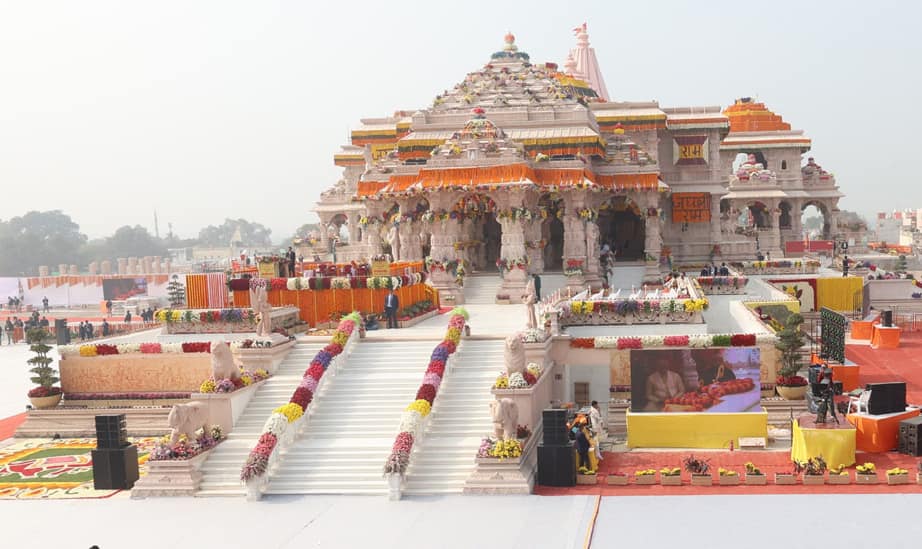
Temple in Ayodhya
Ram Mandir
Ayodhya, Uttar Pradesh
Consecrated in January 2024 and already among the most heavily managed temples in India. Nothing about the visit is casual: what you may carry in is a short list, and everything else goes in a locker before you join the line.
Photo: Prime Minister's Office — GODL-India, via Wikimedia Commons
Overview
Who it's to, and what's expected
Deity
Rama as Ram Lalla
Tradition
Vishnu · Krishna temple
- Entry
Visitors must pass through security screenings and are prohibited from bringing mobile phones, large bags, food, leather products, and certain electronics into the sanctum. You must wear simple clothing, remove your shoes before entering the inner precincts, and carry a valid government-issued photo ID like an Aadhaar card for verification.
- Footwear
Visitors are required to remove their shoes before entering the inner precincts of the temple, and leather products are prohibited inside the sanctum.
- Access
The temple provides ramps, wheelchairs and assisted entry points for elderly and differently-abled visitors. That is better provision than at most of India's major temples and reflects a complex designed new in the 2020s rather than adapted from centuries-old fabric. Visitors with mobility limitations should still expect a managed queue and substantial walking across the compound, and should confirm current assistance arrangements with the temple trust.
- Prasadam
Visitors are advised to carry a small amount of money for offerings and prasadam.
Usually visited with
Time your visit
The darshan clock
A single opening-hours line cannot express a midday closure or an evening ceremony.
4:30 amapprox
Mangala Aarti
Pass-only, and the passes are limited.
07:00–11:30 · 14:00–19:00
General darshan
No booking needed for the ordinary line, but note the two-and-a-half hour afternoon gap.
Rules, timings and fees change — confirm locally before you rely on this.
At the gate
Before you go in
What gets refused, and what you cannot take past the door.
What to wear
Visitors are advised to wear simple clothing when visiting the temple.
Phones and cameras
Mobile phones and certain electronics are prohibited inside the temple complex and must be left at designated storage counters.
Rules, timings and fees change — confirm locally before you rely on this.
When not to come — unless you mean to
Festival windows
These follow lunar calendars and move by weeks each year, so the windows are months, not dates.
Ram Navami
Deepotsav / Diwali
Consecration anniversary
Best visiting season
Practicalities
The things that go wrong
Book through official channels, and treat anyone promising a guaranteed slot as a warning sign.
What to watch for
- Paid storage for prohibited items at inflated rates outside the gates
- The temple provides designated storage counters for phones, bags, food and leather; the simpler answer is to leave them at your hotel, since anything you carry must be deposited
- Anyone claiming the photo-ID requirement can be waived for a fee
- A valid government-issued photo ID such as Aadhaar is checked at security and arriving without one is a common reason for being turned away
- Third parties at Hanuman Garhi or Ram Ki Paidi insisting the Ram Mandir queue is closed or full and offering a shortcut
- Check the published darshan sessions - 7:00 AM and 2:00 PM openings with a midday closure
- Auto and e-rickshaw drivers quoting a fare only on arrival, or inflating rates during Deepotsav and Ram Navami when the town is at capacity
- Agree a rate before travelling and book transport in advance during festivals
General guidance
Planning the visit
Customary practice and what Ayodhya's climate means for a barefoot visit — not rules posted at this temple. Anything specific to Ram Mandir is above.
The queue is the ritual
Vaishnava temples in India are usually organised around a moving darshan queue rather than time spent in front of the deity. Expect to keep walking, and expect the view of the sanctum to be brief — that is the intended experience, not a rushed one.
Come in winter
Winter is when Ayodhya is most comfortable to walk around, which matters here because a temple visit is done on foot and barefoot. Locally the window is given as october to march.
Stone gets hot — go early
You will be barefoot from the shoe rack onwards, often across an open courtyard. Between late morning and mid-afternoon in the hot months that stone is genuinely painful to stand on. Socks help, and are permitted almost everywhere shoes are not.
Arriving by train
Ayodhya has a railway station, and auto-rickshaws wait outside it. Agree the fare or use a meter before you set off, and expect to be dropped a short walk from the temple rather than at its door.
Outfit guide
What to wear at Ram Mandir
Cover shoulders and knees — the rules above win over anything here.
Trending wear for this spot
Modern, camera-ready looks picked for Ram Mandir.

Traditional wear for this spot
Timeless, cultural outfits worn across Ayodhya.
Ram Mandir, Ayodhya
The Ram Mandir was consecrated on 22 January 2024 and is already among the most heavily managed temples in India. It stands at Ram Janmabhoomi, the site held to be Lord Rama's birthplace, on the banks of the Sarayu, and the deity is Shri Ram Lalla — Rama in his child form (bal-svarupa), depicted as a five-year-old.
Nothing about the visit is casual. What you may carry in is a short list, and everything else goes into a locker before you join the line. That is the governing fact for a visitor, and it is worth reading the restrictions before you set out rather than discovering them at security.
🏛️ The building
Nagara architectural style, in pink sandstone, built by the Shri Ram Janmabhoomi Teerth Kshetra Trust.
The published dimensions:
- Length 380 feet, width 250 feet, height 161 feet
- Three storeys, each 20 feet tall
- 392 pillars and 44 doors
- A compound wall (Parkota) spanning 732 metres, 14 feet wide
Nagara architecture is the North Indian idiom of tall pyramidal shikharas topped by a kalash, with intricately carved pillars and walls carrying sculpture and relief. The temple is therefore a deliberate statement in the classical North Indian register rather than a regional or modern design — which is consistent with its intended status.
📜 The site's history, stated plainly
This is stated because a visitor cannot understand Ayodhya without it, and because the temple's security regime, its management and its crowds all follow from it. It is also worth being precise about what a traveller will encounter: the site today is a new, well-run, heavily policed temple complex, and the dispute is history rather than a present condition of visiting. Treat the subject with the care it deserves and do not raise it as conversation with staff or pilgrims.
🕒 Timings — published hours conflict
The temple opens very early for the Mangala Aarti, around 4:30 AM, before general darshan.
General darshan hours are published two ways, and the difference matters:
- Another current source: 7:00 to 11:00 AM and 2:00 to 9:00 PM
Both agree on a 7:00 AM start and a midday closure, and both agree the temple reopens at 2:00 PM. The evening closing is the discrepancy — 7:00 PM versus 9:00 PM. Plan to finish your visit by 6:30 PM to be safe under either version, and confirm locally if an evening aarti matters.
There is a firm midday closure between the two sessions, so a 12:30 PM arrival finds the temple shut.
🎟️ Three darshan tiers
The temple operates three levels of access:
- General darshan — free. The standard queue, and the one most visitors join.
🚫 What you cannot bring
Visitors must pass through security screening, and the prohibited list is specific:
- Mobile phones
- Large bags
- Food
- Leather products
- Certain other electronics
Storage counters are provided, so the practical answer is to travel to the temple with almost nothing — no phone, no bag, no belt, no wallet of leather. Anything you carry will be deposited, and queueing for the deposit adds time to an already-managed process.
You must carry a valid government-issued photo ID, such as an Aadhaar card, for verification. This is checked, and arriving without ID is a common reason for being turned away.
👔 Dress
Simple clothing is advised, and shoes must be removed before entering the inner precincts. There is no elaborate published dress code of the Tirumala kind, but modest, simple, traditional-adjacent clothing is the safe choice at a temple of this profile, and short or revealing clothing will draw comment.
♿ Access — genuinely good
This is better provision than at most of India's major temples, and reflects a complex designed new in the 2020s rather than adapted from centuries-old fabric. Visitors with mobility limitations should still expect a long managed queue and substantial walking across the compound, but the physical infrastructure is genuinely accessible.
🌸 Festivals
- Deepotsav / Diwali (October or November) — Ayodhya's signature event, when the Sarayu ghats are lined with lakhs of oil lamps and the town sets records for the number lit. The temple and Ram Ki Paidi are at their most spectacular.
- Ram Navami (March or April) — Rama's birthday, and the temple's own great occasion, celebrated at his held birthplace with the heaviest devotional crowds of the year.
- The consecration anniversary, 22 January — marked since 2024.
- Shravan, Navratri and the standard Vaishnava calendar.
Best time to visit: October to March. Ayodhya's summer heat is severe and the complex is largely exposed.
📍 The Ayodhya circuit
The temple sits within a dense circuit of Ramayana sites, all close together:
- Hanuman Garhi — the hilltop Hanuman temple, traditionally visited before the Ram Mandir, since one pays respects to the devotee before the deity
- Kanak Bhawan — the palace of Rama and Sita
- Ram Ki Paidi — the stepped ghats on the Sarayu, the centre of the evening aarti and of Deepotsav
- Saryu Aarti — the evening river aarti, the natural close to an Ayodhya day
A standard Ayodhya day: Hanuman Garhi early, the Ram Mandir mid-morning, Kanak Bhawan, then Ram Ki Paidi for the Saryu aarti at dusk. The temple's own recorded pairs — Hanuman Garhi and Ram Ki Paidi — are the two that matter most.
Nearest airport is Ayodhya's Maharshi Valmiki International Airport, and the town is well connected by rail.
⚠️ Practical notes
- Carry photo ID. Aadhaar or equivalent, checked at security.
- Carry almost nothing else. Phones, bags, food and leather all go into storage.
- Go to Hanuman Garhi first. That is the local and traditional order.
- Avoid the midday closure and finish by 6:30 PM to be safe under either published closing time.
- October to March, and Deepotsav or Ram Navami if you want the temple at full strength — but expect the town to be at capacity.
Last verified: 2026. The 22 January 2024 Pran Pratishtha, public darshan from 27 January 2024, the Nagara-style pink sandstone construction by the Shri Ram Janmabhoomi Teerth Kshetra Trust, the published dimensions (380 x 250 x 161 feet, three storeys of 20 feet, 392 pillars, 44 doors, 732-metre Parkota), the prohibited-items list and the photo-ID requirement are all documented. General darshan hours conflict between 7:00-11:30/14:00-19:00 and 7:00-11:00/14:00-21:00; both agree on a 7:00 AM start, a midday closure and a 2:00 PM reopening.
Questions
Ram Mandir — FAQ
Who is Ram Mandir dedicated to?
Ram Mandir in Ayodhya is dedicated to Rama as Ram Lalla.
Who can enter Ram Mandir?
Visitors must pass through security screenings and are prohibited from bringing mobile phones, large bags, food, leather products, and certain electronics into the sanctum. You must wear simple clothing, remove your shoes before entering the inner precincts, and carry a valid government-issued photo ID like an Aadhaar card for verification.
What is the dress code at Ram Mandir?
Visitors are advised to wear simple clothing when visiting the temple.
Do I have to take my shoes off at Ram Mandir?
Visitors are required to remove their shoes before entering the inner precincts of the temple, and leather products are prohibited inside the sanctum.
Can I take photos inside Ram Mandir?
Mobile phones and certain electronics are prohibited inside the temple complex and must be left at designated storage counters.
What prasadam is offered at Ram Mandir?
Visitors are advised to carry a small amount of money for offerings and prasadam.
Is Ram Mandir wheelchair accessible?
The temple provides ramps, wheelchairs and assisted entry points for elderly and differently-abled visitors. That is better provision than at most of India's major temples and reflects a complex designed new in the 2020s rather than adapted from centuries-old fabric. Visitors with mobility limitations should still expect a managed queue and substantial walking across the compound, and should confirm current assistance arrangements with the temple trust.
Checked, not remembered
Sources
Every rule and timing above traces back to one of these.