

Temple in Bishnupur
Jor Bangla (Keshta Rai) Temple
Bishnupur, West Bengal
Built in 1655, and the clearest example of what makes Bengal's temples unlike anything else in India: the roof is a pair of curved thatched hut forms rendered in brick, joined and topped with a turret. The whole surface is terracotta panels — battle scenes, hunts, court life.
Photo: Abhijit Kar Gupta — CC BY 2.0, via Wikimedia Commons
Overview
Who it's to, and what's expected
Deity
Krishna
Tradition
Vishnu · Krishna temple
- Entry
ASI-ticketed, and one ticket covers several of the Bishnupur temples — buy it once rather than at each gate.
Practicalities
The things that go wrong
Book through official channels, and treat anyone promising a guaranteed slot as a warning sign.
What to watch for
- Reselling or re-charging for the ASI ticket; one ticket covers several monuments, and anyone selling a separate ticket per temple is overcharging
- Guides attaching themselves at the gate and producing a fee afterwards; the panels explain themselves with a good guidebook, and any guide fee should be agreed beforehand
- Driver detours to commission shops on the temple trail; agree the itinerary before setting out
- Terracotta souvenirs quoted at collector prices at the temple gates; the artisans' cooperative stores in town sell the same work fairly
- Auto and cycle-rickshaw drivers quoting a fare only on arrival from the station; agree it before setting out
General guidance
Planning the visit
Customary practice and what Bishnupur's climate means for a barefoot visit — not rules posted at this temple. Anything specific to Jor Bangla (Keshta Rai) Temple is above.
The queue is the ritual
Vaishnava temples in India are usually organised around a moving darshan queue rather than time spent in front of the deity. Expect to keep walking, and expect the view of the sanctum to be brief — that is the intended experience, not a rushed one.
Come in winter
Winter is when Bishnupur is most comfortable to walk around, which matters here because a temple visit is done on foot and barefoot. Locally the window is given as october to march.
Stone gets hot — go early
You will be barefoot from the shoe rack onwards, often across an open courtyard. Between late morning and mid-afternoon in the hot months that stone is genuinely painful to stand on. Socks help, and are permitted almost everywhere shoes are not.
Arriving by train
Bishnupur has a railway station, and auto-rickshaws wait outside it. Agree the fare or use a meter before you set off, and expect to be dropped a short walk from the temple rather than at its door.
No airport here
Bishnupur has no airport of its own, so the last leg is by road or rail. Plan the return the same way — the last bus out is often earlier than visitors expect.
Outfit guide
What to wear at Jor Bangla (Keshta Rai) Temple
Cover shoulders and knees — the rules above win over anything here.
Trending wear for this spot
Modern, camera-ready looks picked for Jor Bangla (Keshta Rai) Temple.
Traditional wear for this spot
Timeless, cultural outfits worn across Bishnupur.
Jor Bangla (Keshta Rai) Temple, Bishnupur
Built in 1655 by the Malla king Raghunath Singha, and the clearest example of what makes Bengal's temples unlike anything else in India: the roof is a pair of curved thatched hut forms rendered in brick, joined and topped with a single tower.
🏠 Two huts and a tower
'Jor' means pair, and the temple is exactly that: two do-chala — double-sided curved — roofs set side by side, one serving as porch and one as shrine, joined together and crowned by a char-chala shikhara, a four-sided tower. The design takes the Bengali village hut, the most humble roof in the region, and rebuilds it in permanent materials at sacred scale — the whole point of the style.
The temple faces south on a low square platform about a metre high, built of laterite brick and finished entirely in terracotta. It was originally called Krishna Ray; the name Keshta Rai — another name for Krishna — stuck along with the architectural one. The founding inscription remains on the front facade, fixing the year and the king beyond argument.
🎨 The terracotta panels
The entire outer surface is a narrative in fired clay. The panels include Bhishma lying on his bed of arrows, the marriage of Ram and Sita, Parvati with her two sons, the exploits of the child Krishna, the story of Laxman and Surpanakha, hunting scenes and courtly life — epic, domestic and royal subjects set side by side, as they were on every great Malla temple.
Read the walls in the morning light, when the low sun rakes across the reliefs and the panels are at their most legible. The firing has kept them warm red for nearly four centuries, and the detail survives best on the south and east faces, away from the worst of the weather.
🧱 Why terracotta — the making of the style
Bengal's alluvial plains have no building stone, and the Mallas solved this with what the land had: laterite brick and fired clay. The panels were moulded and fired separately, then set into the brick walls by the thousand — a construction that allowed narrative art at a scale carved stone could not match locally, and gave the Bishnupur temples their warm red glow.
The style is the region's own: the do-chala and char-chala roof forms, the curved eaves, the terracotta skin. Nothing at Bishnupur imitates the Nagara towers of the north or the Dravida gopuras of the south — which is exactly why the group stands on UNESCO's tentative list as a distinct school of Indian temple architecture.
👑 The Malla kings and their temple town
Bishnupur was the capital of the Malla rajahs of Bankura, a Vaishnavite dynasty that spent the seventeenth and eighteenth centuries building temples to Krishna in an architecture entirely its own. The greatest of the dynasty's builders, Raghunath Singha, raised both this temple in 1655 and the Shyam Rai temple in 1643 — the pancha-ratna, five-spired, masterpiece nearby.
The whole ensemble — the temples of Bishnupur — is designated a group of Monuments of National Importance and sits on UNESCO's tentative World Heritage list, recognised as a distinct school of Bengal temple architecture. To visit Jor Bangla is to read the town's central chapter.
🎫 The Bishnupur ticket
The temples are ASI-ticketed, and one ticket covers several of the Bishnupur monuments — buy it once at the first site you reach (commonly the Ras Mancha, the pillared assembly hall of 1600 that opens the trail) rather than at each gate. Keep it for the day.
🚶 The temple trail
Jor Bangla stands about a kilometre from the main bazaar, with the other great Malla temples within an easy walk or short ride: the Shyam Rai temple with its nine Ras-chakra panels, the Madan Mohan temple, still a living shrine with active worship, and the Ras Mancha itself.
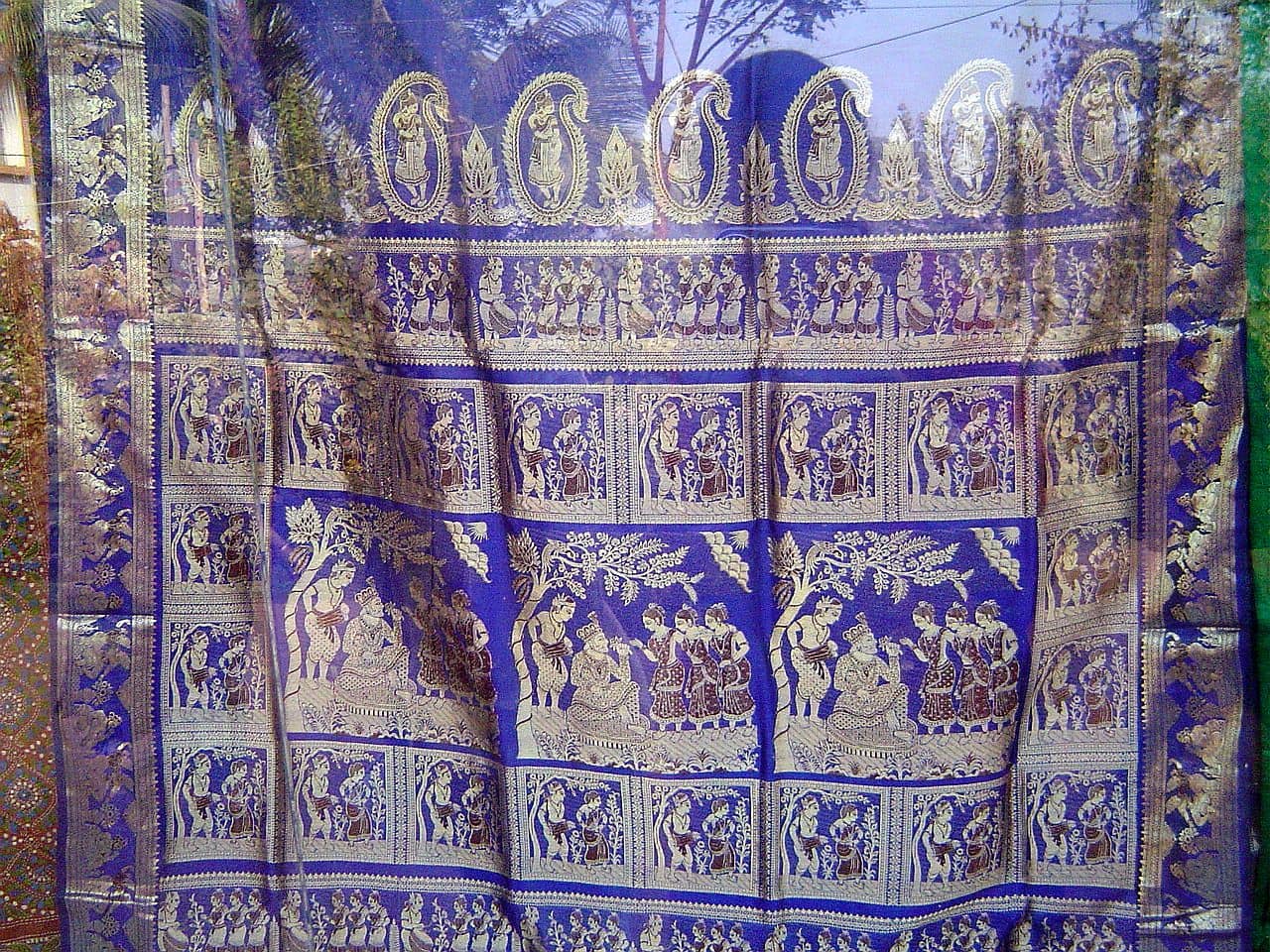
Bishnupur is also a crafts town — terracotta handicrafts and the Baluchari silk sarees woven with narrative panels in the same spirit as the temple walls. The artisans' quarter and the cooperative stores are the natural end of the trail, and the pair of temple-and-saree tells the whole Malla story in one day.
Allow a relaxed half-day for the trail itself — the temples are close together, but each rewards standing still: the Ras-chakra panels of the Shyam Rai, the living worship at Madan Mohan, and the quiet of Jor Bangla's porch in morning light. Most visitors walk or take a cycle-rickshaw between them, and the town's scale makes getting lost part of the pleasure. Carry water and sun protection — the trail is open ground, and from April to June the middle of the day is fierce — and give the exteriors slanting light for photographs.
📍 Getting there
Bishnupur, in Bankura district, is about 150 km from Kolkata, reached by road or by direct rail — the town has its own station, and the temples are a cycle-rickshaw ride from it. A day trip from Kolkata is feasible; an overnight gives you the trail at morning light, which the terracotta deserves.
Last verified: 2026. The 1655 founding by Raghunath Singha with the inscription on the facade, the do-chala pair with char-chala tower, the laterite-and-terracotta construction on a low platform, the named terracotta panels, the 1643 Shyam Rai temple, the ASI common ticket, the UNESCO tentative-list status of the Bishnupur group, and the 1600 Ras Mancha are documented.
Questions
Jor Bangla (Keshta Rai) Temple — FAQ
Who is Jor Bangla (Keshta Rai) Temple dedicated to?
Jor Bangla (Keshta Rai) Temple in Bishnupur is dedicated to Krishna.
Who can enter Jor Bangla (Keshta Rai) Temple?
ASI-ticketed, and one ticket covers several of the Bishnupur temples — buy it once rather than at each gate.
Checked, not remembered
Sources
Every rule and timing above traces back to one of these.