
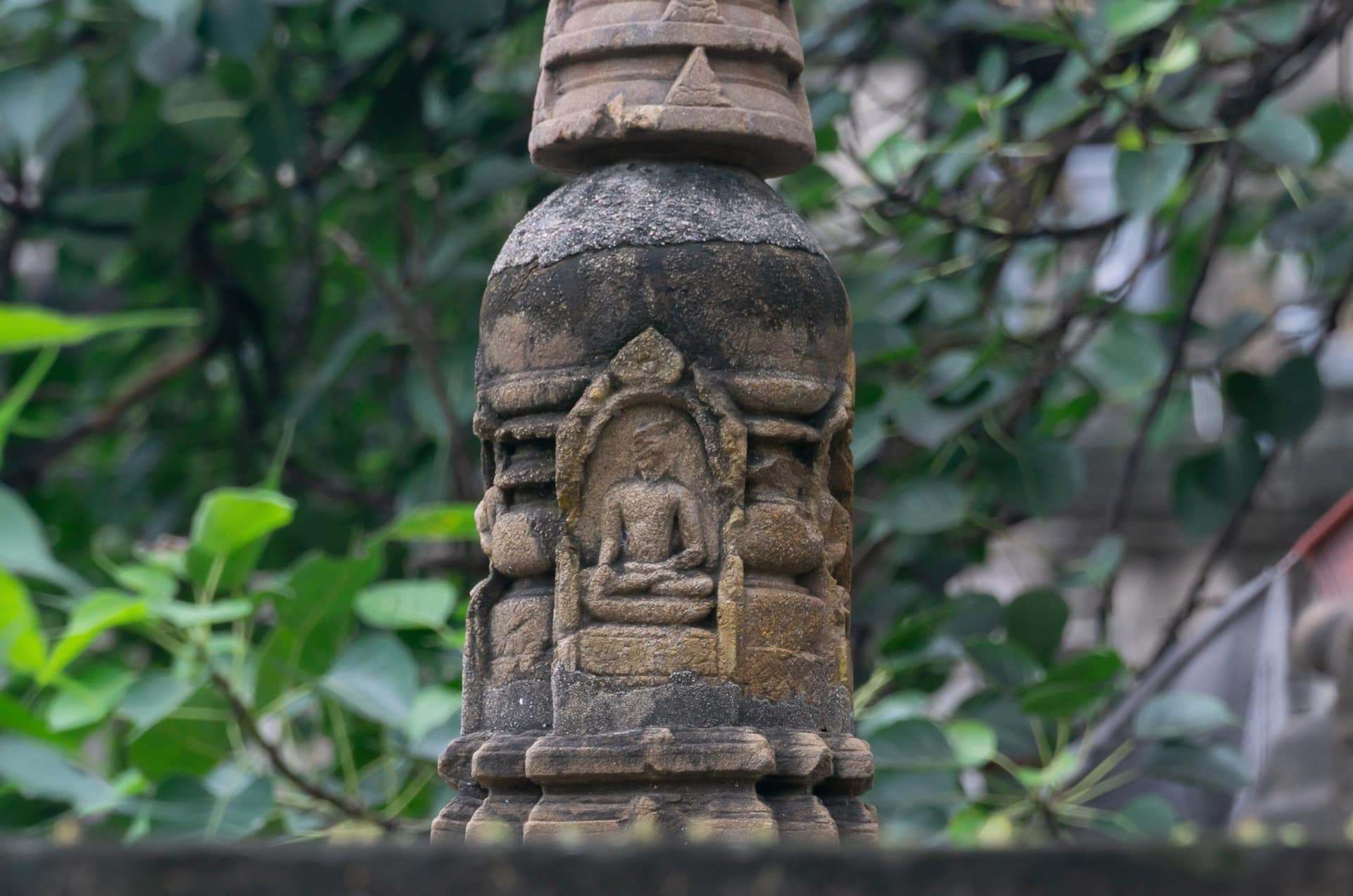
Temple in Bodh Gaya
Mahabodhi Temple
Bodh Gaya, Bihar
A UNESCO World Heritage Site built around a descendant of the tree the Buddha sat under, and the one place on this list where the point is to sit still rather than to file past a shrine.
Photo: Sumitsurai — CC BY-SA 4.0, via Wikimedia Commons
Overview
Who it's to, and what's expected
Deity
The Buddha
Tradition
Buddhist temple
- Entry
Visitors must dress modestly, remove their footwear before entering, maintain silence, and refrain from bringing mobile phones, cameras, or other electronic gadgets into the temple.
- Footwear
Visitors are required to remove their footwear before entering the temple premises.
- Access
The complex is largely flat and paved, with the principal circulation around the Bodhi Tree, the temple and the Seven Sacred Weeks sites at ground level. The main practical difficulty is the prohibition on footwear across a large open site in Bihar heat - paving and stone become very hot through the day, which is a further reason for the dawn visit. Silence is required throughout, which affects visitors travelling in groups or with children more than the terrain does.
- Prasadam
Kheer, a rice pudding made with rice, milk, and sugar, is offered at the temple daily at 10:00 AM.
Usually visited with
Time your visit
The darshan clock
A single opening-hours line cannot express a midday closure or an evening ceremony.
5:00 AM
Opening hours
The Mahabodhi Temple is open daily from 5:00 AM to 9:00 PM.
Rules, timings and fees change — confirm locally before you rely on this.
How long this takes
Ways in
The difference between a twenty-minute visit and a three-hour one.
General entry
- Free for all visitors, with no ticket and no managed queue in the darshan sense
- Security screening applies because electronics are prohibited
- The complex is large enough that visitors disperse rather than queue
Dawn window
- 5:00 to 7:00 AM, when the complex is mostly monks and serious practitioners, the light is soft, the chanting is audible and the area around the Bodhi Tree is quiet enough to actually sit
- By 10:00 AM tour groups arrive and the atmosphere shifts
Winter monastic season
- Tens of thousands of monks, nuns and lay practitioners from Theravada, Mahayana and Vajrayana traditions converge under the Bodhi Tree for the International Tipitaka Chanting and the Tibetan Monlam
- The site is at its most alive and its most crowded
At the gate
Before you go in
What gets refused, and what you cannot take past the door.
What to wear
Visitors are expected to dress modestly when visiting the temple.
Phones and cameras
Mobile phones, cameras, and other electronic gadgets are prohibited within the temple premises.
Rules, timings and fees change — confirm locally before you rely on this.
When not to come — unless you mean to
Festival windows
These follow lunar calendars and move by weeks each year, so the windows are months, not dates.
Buddha Purnima (Vesak)
International Tipitaka Chanting
Tibetan Monlam Chenmo
Kathina and the monastic rains retreat
Practicalities
The things that go wrong
Book through official channels, and treat anyone promising a guaranteed slot as a warning sign.
What to watch for
- Charging for entry
- Mahabodhi is free for all visitors and no ticket exists - anyone collecting a fee at the gate is not authorised
- Offering to store your phone or camera for a high fee
- Electronics are prohibited within the temple premises; the correct answer is to leave them at your hotel or use the site's own deposit facility, not to pay a third party
- Guides claiming privileged access to the Bodhi Tree, the Vajrasana or a 'special meditation spot'. Access is managed by the Bodh Gaya Temple Management Committee and there is no paid private entry
- Selling saplings, leaves or relics 'from the Bodhi Tree' at the gates
- The tree is a protected descendant in a documented lineage, and nothing from it is sold
- Donation collectors presenting themselves as temple officials
- Give only at an identified temple office if you wish to give at all
- Being told silence or the footwear rule can be relaxed for a payment
- Both are enforced requirements of an active meditation site, not negotiable conditions
General guidance
Planning the visit
Customary practice and what Bodh Gaya's climate means for a barefoot visit — not rules posted at this temple. Anything specific to Mahabodhi Temple is above.
Walk clockwise, and mind the feet
Circumambulation is clockwise, and prayer wheels are turned the same way. Pointing your feet at an image of the Buddha — sitting with legs outstretched towards the shrine — is the commonest unintended offence, and sitting cross-legged or kneeling avoids it.
Come in winter
Winter is when Bodh Gaya is most comfortable to walk around, which matters here because a temple visit is done on foot and barefoot. Locally the window is given as october to march.
Stone gets hot — go early
You will be barefoot from the shoe rack onwards, often across an open courtyard. Between late morning and mid-afternoon in the hot months that stone is genuinely painful to stand on. Socks help, and are permitted almost everywhere shoes are not.
Arriving by train
Bodh Gaya has a railway station, and auto-rickshaws wait outside it. Agree the fare or use a meter before you set off, and expect to be dropped a short walk from the temple rather than at its door.
Outfit guide
What to wear at Mahabodhi Temple
Cover shoulders and knees — the rules above win over anything here.
Trending wear for this spot
Modern, camera-ready looks picked for Mahabodhi Temple.

Traditional wear for this spot
Timeless, cultural outfits worn across Bodh Gaya.
Mahabodhi Temple, Bodh Gaya
Mahabodhi is a UNESCO World Heritage Site built around a descendant of the tree the Buddha sat under, and it is the one place on this list where the point is to sit still rather than to file past a shrine.
This is where Siddhartha Gautama attained enlightenment, which makes it the most consequential single location in Buddhism — not a great monastery or a great relic, but the specific ground. Everything else about Bodh Gaya follows from that.
🌳 The Bodhi Tree, and the seven weeks
The present Bodhi Tree is a descendant of the original, propagated through a documented line of replantings — the most famous link being the sapling taken to Anuradhapura in Sri Lanka, itself said to derive from the original tree, from which the Bodh Gaya tree was later re-propagated. What you sit under is not the same tree but is the same lineage, and the distinction is handled carefully by the site rather than glossed over.
Beneath it is the Vajrasana — the "diamond throne", the stone platform marking the exact spot of the Buddha's enlightenment.
The Seven Sacred Weeks are marked around the complex: the tradition holds that the Buddha spent seven weeks at and near the tree after his enlightenment, each week at a different location, and each of those locations is now identified within the grounds. Walking them is the natural structure for a visit and takes considerably longer than most people allow.
🏛️ The spire
The temple's tower is a Gupta-period brick spire rising about 55 metres, which makes it one of the oldest surviving brick structures of its kind in India and a direct architectural link to the Gupta era.
The brick is the point. Most of India's great surviving temples are stone; Mahabodhi's antiquity is carried in brick, and the structure has been restored and re-faced repeatedly across its long history, including substantial nineteenth-century work under Burmese and British auspices. What stands is therefore genuinely ancient in plan and considerably younger in fabric — a distinction worth holding onto rather than assuming the surface is fifth-century.
🕒 Timings, and when to actually go
Open daily 5:00 AM to 9:00 PM. Entry is free for all visitors.
The best time is early morning, 5:00 to 7:00 AM, and the reason is specific rather than aesthetic:
- From 5:00 to 7:00 AM the complex is mostly monks and serious practitioners. The light is soft, the chanting is audible, and the area around the Bodhi Tree is quiet enough to actually sit.
- By 10:00 AM the tour groups arrive and the atmosphere shifts.
- Morning meditation chanting is at 5:30 AM; the evening light offering is at 6:30 PM, and the illuminated complex after 6:00 PM is the second-best window.
If you do one thing at Bodh Gaya, sit under the tree at dawn. That is what the site is for, and it is the one experience there that cannot be replicated at any other hour.
🍚 Kheer at 10:00 AM
Kheer — a rice pudding of rice, milk and sugar — is offered at the temple daily at 10:00 AM.
This is not an arbitrary prasad. It recalls Sujata's offering of milk-rice to the emaciated ascetic Gautama, which restored his strength immediately before he sat beneath the tree and attained enlightenment. The daily kheer offering is a re-enactment of the event that made the site, which is why it is timed and distributed as a ritual rather than sold as food.
🙏 A working monastic crossroads, not a museum
Mahabodhi is managed by the Bodh Gaya Temple Management Committee and functions as an active place of worship, with a continuous presence of monastics from many traditions.
Every winter, from October to March, tens of thousands of monks, nuns and lay practitioners from the Theravada, Mahayana and Vajrayana traditions converge under the Bodhi Tree, for the International Tipitaka Chanting and the Tibetan Monlam Chenmo. During those weeks the complex is at its most alive and its most crowded.
Visitors should understand what that means: this is a monastery-scale religious site with international monastic communities resident in it, and the etiquette is correspondingly real rather than nominal.
🛕 Rules — enforced, and stricter than they look
Visitors must dress modestly, remove footwear before entering, maintain silence, and refrain from bringing mobile phones, cameras or other electronic gadgets into the temple.
The silence requirement is the one that catches people out. This is not a monument where commentary continues at conversational volume; the complex is a meditation site and the expectation is genuine quiet, particularly around the tree.
Electronics being prohibited entirely — not just in the sanctum but within the temple premises — means plan to leave phones and cameras at your hotel or in the deposit facility rather than assuming you will photograph the tree.
♿ Access
The complex is largely flat and paved, with the principal circulation around the tree, the temple and the seven-weeks sites at ground level. The main practical difficulty is the prohibition on footwear across a large open site in Bihar heat — the stone and paving become very hot through the day, which is a further reason for the dawn visit.
Winter (October to March) is the comfortable season, and also the season of the great monastic gatherings.
📍 Bodh Gaya beyond the temple
The town holds the 80-foot Great Buddha statue and a remarkable concentration of national monasteries — Thai, Japanese, Tibetan, Chinese, Bhutanese and others, each built in its own tradition's architectural idiom. A two-day itinerary is the norm, with the Mahabodhi complex visited twice: once at dawn and once after 6:00 PM for the illuminations.
⚠️ Practical notes
- Arrive at 5:00 AM. Everything else about the visit is downstream of that decision.
- Leave electronics at your hotel. They are prohibited, and depositing them costs time.
- Walk the seven sacred weeks rather than only seeing the tree and the temple.
- Be quiet. Not as a courtesy — as a requirement.
- October to March for weather, and for the monastic season if you want the site at full strength.
Last verified: 2026. Opening 5:00 AM to 9:00 PM daily with free entry, morning meditation chanting at 5:30 AM and the evening light offering at 6:30 PM, the daily 10:00 AM kheer offering, and the prohibitions on electronics and on noise are all documented. The 55 m Gupta brick spire, the Vajrasana and the Seven Sacred Weeks are consistent across sources. The present Bodhi Tree is described as a descendant in a documented lineage rather than as the original.
Questions
Mahabodhi Temple — FAQ
Who is Mahabodhi Temple dedicated to?
Mahabodhi Temple in Bodh Gaya is dedicated to The Buddha.
Who can enter Mahabodhi Temple?
Visitors must dress modestly, remove their footwear before entering, maintain silence, and refrain from bringing mobile phones, cameras, or other electronic gadgets into the temple.
What is the dress code at Mahabodhi Temple?
Visitors are expected to dress modestly when visiting the temple.
Do I have to take my shoes off at Mahabodhi Temple?
Visitors are required to remove their footwear before entering the temple premises.
Can I take photos inside Mahabodhi Temple?
Mobile phones, cameras, and other electronic gadgets are prohibited within the temple premises.
What prasadam is offered at Mahabodhi Temple?
Kheer, a rice pudding made with rice, milk, and sugar, is offered at the temple daily at 10:00 AM.
Is Mahabodhi Temple wheelchair accessible?
The complex is largely flat and paved, with the principal circulation around the Bodhi Tree, the temple and the Seven Sacred Weeks sites at ground level. The main practical difficulty is the prohibition on footwear across a large open site in Bihar heat - paving and stone become very hot through the day, which is a further reason for the dawn visit. Silence is required throughout, which affects visitors travelling in groups or with children more than the terrain does.
Checked, not remembered
Sources
Every rule and timing above traces back to one of these.