
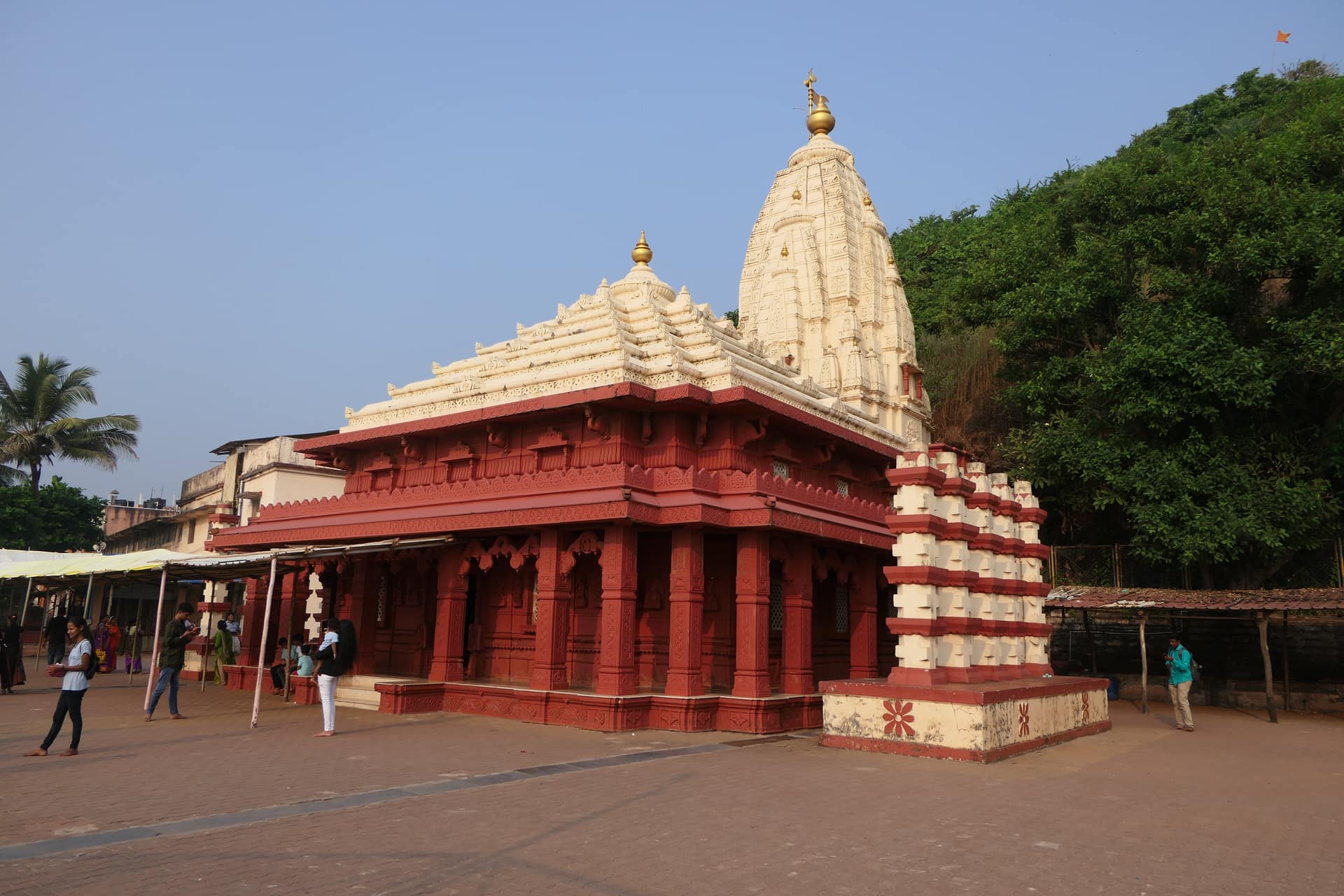
Temple in Ganpatipule
Swayambhu Ganpati Temple
Ganpatipule, Maharashtra
A 400-year-old temple at the foot of a Western Ghats spur, right on the beach — the image is swayambhu, held to have emerged from the earth rather than been carved or installed.
Photo: Dinesh Valke — CC BY-SA 2.0, via Wikimedia Commons
Overview
Who it's to, and what's expected
Deity
Ganesha
Tradition
Ganesha temple
- Entry
Visitors are expected to dress modestly, covering their upper arms and legs. While non-Hindus are welcome to visit the temple complex, access to the inner sanctum may be restricted.
- Prasadam
Khichdi prasad is available for devotees daily between 12:30 PM and 2:00 PM.
Usually visited with
Time your visit
The darshan clock
A single opening-hours line cannot express a midday closure or an evening ceremony.
Opening hours
The temple is open daily from 6 AM to 9 PM.
Rules, timings and fees change — confirm locally before you rely on this.
How long this takes
Ways in
The difference between a twenty-minute visit and a three-hour one.
General darshan
- Free, through the day per the temple's own schedule of about 6:00 AM to 9:00 PM; ordinary mornings move quickly, and the evening aarti is the fullest ordinary gathering
Sankranti Chaturthi
- The monthly Chaturthi of Sankranti, when the palkhi departs at about 4:00 PM for its pradakshina around the hill
Ganesh Chaturthi and Magh Chaturthi
- The two grand festivals, August or September and January or February, when the town fills with pilgrims and the queue runs long through the day
At the gate
Before you go in
What gets refused, and what you cannot take past the door.
What to wear
Visitors are advised to wear modest clothing that covers the upper arms and legs. Men should wear dhotis, pajamas, or formal trousers and shirts, while women should wear sarees, half sarees, or chudidhars, avoiding items like mini-skirts, shorts, and sleeveless tops.
Phones and cameras
The temple's beauty cannot be captured with cameras or recording instruments, but should be experienced with your own eyes.
Rules, timings and fees change — confirm locally before you rely on this.
When not to come — unless you mean to
Festival windows
These follow lunar calendars and move by weeks each year, so the windows are months, not dates.
Ganesh Chaturthi
Magh Shuddha Chaturthi
Sankranti Chaturthi
Practicalities
The things that go wrong
Book through official channels, and treat anyone promising a guaranteed slot as a warning sign.
What to watch for
- Charging for entry or for a darshan arrangement
- Entry is free; the temple makes its own arrangements and nothing of the kind is sold at the approach
- Selling prasad or khichdi tickets outside; the prasad is distributed by the temple between 12:30 and 2:00 PM
- Boat or water-sport operators on the beach quoting a fare only after the ride; agree everything on land first
- Pradakshina 'guides' offering to walk you around the hill and naming a fee at the end; the route needs no guide
- Peak-season auto and taxi fares quoted only on arrival; agree the fare before setting out
General guidance
Planning the visit
Customary practice and what Ganpatipule's climate means for a barefoot visit — not rules posted at this temple. Anything specific to Swayambhu Ganpati Temple is above.
Busiest on Tuesdays and Chaturthi
Ganesha shrines fill on Tuesdays and on Sankashti Chaturthi each lunar month, and overwhelmingly during Ganesh Chaturthi. A weekday morning outside those is the calm version of the same temple.
Come in winter and summer
Winter and summer is when Ganpatipule is most comfortable to walk around, which matters here because a temple visit is done on foot and barefoot. Locally the window is given as october to may (alphonso season apr–may).
Salt air and bare feet
Coastal temple courtyards stay damp and the stone can be slick underfoot, particularly near a tank or a sea-facing entrance. Take the steps slowly rather than the queue's pace.
No airport here
Ganpatipule has no airport of its own, so the last leg is by road or rail. Plan the return the same way — the last bus out is often earlier than visitors expect.
Outfit guide
What to wear at Swayambhu Ganpati Temple
Cover shoulders and knees — the rules above win over anything here.
Trending wear for this spot
Modern, camera-ready looks picked for Swayambhu Ganpati Temple.

Traditional wear for this spot
Timeless, cultural looks that suit Swayambhu Ganpati Temple.
Swayambhu Ganapati Temple, Ganpatipule
A four-century-old temple at the foot of a Western Ghats spur, standing right on the beach of the Konkan coast — and holding a Ganesha who is swayambhu, held to have emerged from the earth rather than been carved or installed.
🌊 The god who faces the sea
The presiding image faces west, out over the Arabian Sea — the reverse of the near-universal east-facing convention for Ganesha shrines. The temple's own tradition embraces the reversal: this Ganesha is called Paschim Dwar Devata, the sentinel of the western gate, standing guard over the Konkan coast and the hills behind it.
The setting sun seals the design: in the evening, a shaft of light from over the water reaches the sanctum and illuminates the deity. Devotees time the evening aarti for exactly this — the god and the sunset in one view — and it is the single most beautiful moment the temple offers.
🗿 The swayambhu image
The Ganapati here is self-originated — a stone emergence from the soil, in the temple's own understanding, not the work of human hands — which places Ganpatipule among the swayambhu Ganesha shrines revered above installed images. A copper image of Ganapati rides a lion in the sanctum beside the swayambhu stone, and a copper mooshak — the mouse, Ganesha's mount — stands outside.
The temple's built history is credited in stages: the inner chamber, the garbhagriha, to the age of Shivaji, and the sabha mandap, the assembly hall, to the Peshwa Madhavrao — the Maratha centuries written into the structure of a Konkan shrine, as they are across this coast.
🚶 The pradakshina around the hill
Ganpatipule's signature ritual is its circumambulation: the temple stands at the base of a hill, and the pradakshina route goes around the hill itself — a walk between the slope and the sea, with the waves on one side for much of the way.
This is the walk that defines a visit here. It takes the better part of an hour at devotional pace, it is best in the early morning or towards sunset, and it converts a temple stop into the day's structure: darshan, pradakshina, beach, in whatever order the tide and the heat suggest.
🕒 Timings and prasad
The temple's own schedule runs from about 6:00 AM to 9:00 PM, with some published listings opening earlier and splitting the day — confirm locally in season. Aartis are held morning, noon and evening, with the evening one the atmospheric catch. On Sankranti Chaturthi, the temple's palkhi — the palanquin — sets out at about 4:00 PM for its own pradakshina.
Khichdi prasad is served to devotees between 12:30 and 2:00 PM — a full, simple meal, and the correct way to break a Konkan morning.
🛕 The temple today
Direct puja for devotees, performed on symbolic images, is conducted from about 7:00 to 11:00 AM — the temple's own arrangement for those who wish to offer worship rather than receive darshan alone, and made at its counter inside. The administration — the Sansthan Shreedev Ganpatipule — keeps the complex spotless, which matters more than it sounds on a shore where sand and salt claim everything: the white of the structure against the green of the hill is the postcard of the Konkan.
🧭 One day at Ganpatipule
The shape of a good day here is fixed by the sun and the tide. Morning: darshan at opening, then the pradakshina around the hill while the air is cool. Midday: khichdi prasad between 12:30 and 2:00, then the shade of the casuarinas. Afternoon: the beach, or the coast road south. Evening: back for the aarti and the shaft of sunset light on the deity — the moment the whole day was arranged around.
🏖️ The beach
The temple fronts Ganpatipule Beach directly — white sand, casuarina, and a shoreline that is the town's other half. The two share everything: pilgrims walk the pradakshina and then the sand, and the evening aarti and the sunset happen in the same frame. The sea is at its gentlest from October to May and rough through the monsoon, when the coast keeps its own rules — swim within sight of the flags and the locals.
Wheelchair assistance and a doli service can be requested at the temple entrance for elderly visitors, and the temple-to-beach distance is a flat two hundred metres.
🌸 Festivals
Ganesh Chaturthi, in August or September, is the great festival — the Konkan's own festival at the Konkan's own Ganesha, with processions and the town full. Magh Shuddha Chaturthi, in January or February, is the second grand observance, and every Sankranti Chaturthi brings the palkhi's afternoon walk.
📍 The Konkan coast
Ganpatipule is in Ratnagiri district, on the coast road south of Mumbai — the beautiful, slow Konkan route, with the Aare-Ware cliffside stretch arriving right at the town. Ratnagiri town is the railhead of the region, and the coast's other stops — Guhagar, Hedvi, the creeks and the mango orchards — string together into as good a slow week as Indian travel offers. October to March is the season; the monsoon is dramatic and green, but the sea and the swimming belong to the dry months.
Last verified: 2026. The swayambhu west-facing image and the Paschim Dwar Devata tradition, the sunset illumination of the deity, the copper images, the Shivaji-age and Madhavrao Peshwa attributions for the garbhagriha and sabha mandap, the hill pradakshina, the roughly 6:00 AM to 9:00 PM schedule, the khichdi prasad window, the Sankranti Chaturthi palkhi, and the two grand festivals are documented. Published hours differ between sources and the temple's own schedule is authoritative.
Questions
Swayambhu Ganpati Temple — FAQ
Who is Swayambhu Ganpati Temple dedicated to?
Swayambhu Ganpati Temple in Ganpatipule is dedicated to Ganesha.
Who can enter Swayambhu Ganpati Temple?
Visitors are expected to dress modestly, covering their upper arms and legs. While non-Hindus are welcome to visit the temple complex, access to the inner sanctum may be restricted.
What is the dress code at Swayambhu Ganpati Temple?
Visitors are advised to wear modest clothing that covers the upper arms and legs. Men should wear dhotis, pajamas, or formal trousers and shirts, while women should wear sarees, half sarees, or chudidhars, avoiding items like mini-skirts, shorts, and sleeveless tops.
Can I take photos inside Swayambhu Ganpati Temple?
The temple's beauty cannot be captured with cameras or recording instruments, but should be experienced with your own eyes.
What prasadam is offered at Swayambhu Ganpati Temple?
Khichdi prasad is available for devotees daily between 12:30 PM and 2:00 PM.
Checked, not remembered
Sources
Every rule and timing above traces back to one of these.