
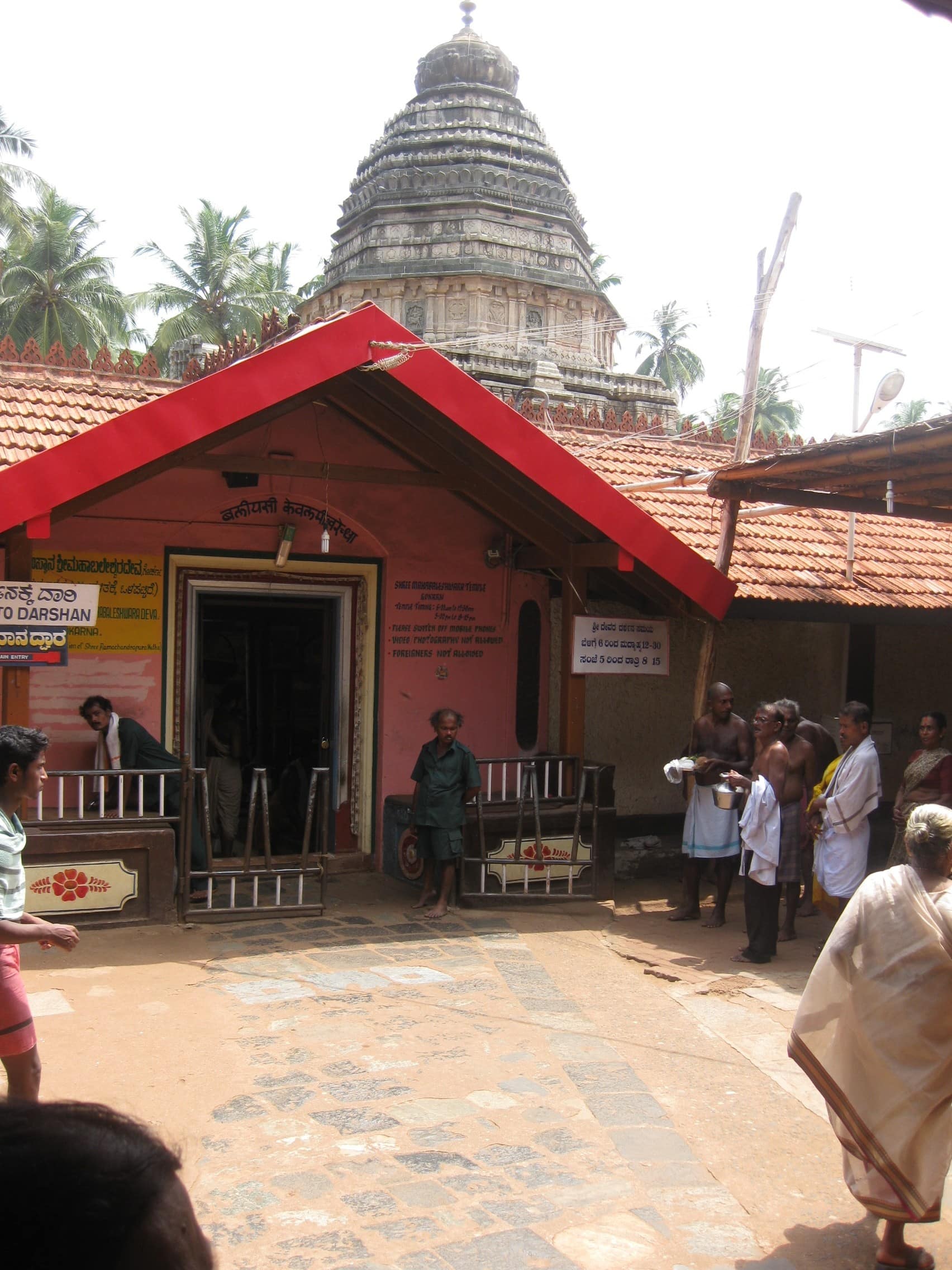
Temple in Gokarna
Mahabaleshwar Temple
Gokarna, Karnataka
One of very few major temples where a visitor may reach in and touch the lingam itself — the Atmalinga, which by legend Ravana was tricked into setting down here. It is a pilgrimage town first and a beach town second, whatever the buses suggest.
Photo: Nvvchar — CC BY-SA 3.0, via Wikimedia Commons
Overview
Who it's to, and what's expected
Deity
Shiva as the Atmalinga
Tradition
Shiva temple
- Entry
Visitors should wear traditional attire, and men are required to remove their shirts before entering the inner sanctum. Footwear is prohibited inside the temple premises, and photography is strictly forbidden.
- Footwear
Footwear is not permitted inside the temple premises.
- Prasadam
The temple provides free meals known as Amrutanna Prasad Bhojana to all devotees twice daily.
Usually visited with
Time your visit
The darshan clock
A single opening-hours line cannot express a midday closure or an evening ceremony.
6:00 AM
Opening hours
The temple is open for darshan from 6:00 AM to 12:30 PM and 5:00 PM to 8:00 PM, with a closure period in the afternoon. Daily rituals include the Ushakala Pooja at 6:30 AM, Panchamrutha Abhisheka at 7:00 AM, Sayankala Pooja at 6:30 PM, and Deepa Aradhane at 8:00 PM.
Rules, timings and fees change — confirm locally before you rely on this.
How long this takes
Ways in
The difference between a twenty-minute visit and a three-hour one.
General darshan
- Free through the two daily sessions; the morning abhisheka cycle is the fullest and most beautiful
Sparsha Darshana - the touch-darshan
- The temple's distinctive practice: reaching through the pedestal to touch the crown of the Atmalinga, within the ordinary free darshan; the queue moves steadily
Mahashivaratri
- The year's great gathering, with the ratha procession round the car street; the town's arrangements govern the day
At the gate
Before you go in
What gets refused, and what you cannot take past the door.
What to wear
Men must be bare-chested and wear a dhoti or pancha to enter the inner sanctum, while women are expected to wear a saree. Jeans, shorts, and beachwear are strictly prohibited throughout the temple premises.
Phones and cameras
Photography is strictly prohibited inside the temple. Mobile phones are permitted in the outer areas but are not allowed within the inner sanctum.
Rules, timings and fees change — confirm locally before you rely on this.
Practicalities
The things that go wrong
Book through official channels, and treat anyone promising a guaranteed slot as a warning sign.
What to watch for
- Shops at the gate insisting a paid pancha purchase is compulsory - rentals exist and the requirement is only the garment itself
- Self-styled guides selling 'linga story' tours of the car street - the temple's own tradition is freely told and the priests will answer questions
- Third parties offering arranged touch-darshan for a fee - Sparsha Darshana is part of ordinary free darshan
- Auto drivers quoting flat tourist rates for the beach circuit - agree fares in advance or walk; the beaches are close
- Beach-shack agents claiming the temple is 'closed' and steering visitors to shops instead - check the temple's own timings at the gate
General guidance
Planning the visit
Customary practice and what Gokarna's climate means for a barefoot visit — not rules posted at this temple. Anything specific to Mahabaleshwar Temple is above.
Circling the shrine
At most Shaiva temples the circuit around the sanctum is not completed in a full circle — the channel draining the abhishekam is not crossed. Walk to it, turn, and come back the way you came. Watching what the queue in front of you does is the reliable guide.
Come in winter
Winter is when Gokarna is most comfortable to walk around, which matters here because a temple visit is done on foot and barefoot. Locally the window is given as october to march.
Salt air and bare feet
Coastal temple courtyards stay damp and the stone can be slick underfoot, particularly near a tank or a sea-facing entrance. Take the steps slowly rather than the queue's pace.
Arriving by train
Gokarna has a railway station, and auto-rickshaws wait outside it. Agree the fare or use a meter before you set off, and expect to be dropped a short walk from the temple rather than at its door.
No airport here
Gokarna has no airport of its own, so the last leg is by road or rail. Plan the return the same way — the last bus out is often earlier than visitors expect.
Outfit guide
What to wear at Mahabaleshwar Temple
Cover shoulders and knees — the rules above win over anything here.
Trending wear for this spot
Popular modern looks travellers are wearing across Gokarna.

Traditional wear for this spot
Timeless, cultural looks that suit Mahabaleshwar Temple.
Gokarna's Mahabaleshwar Temple: The Atmalinga You Can Touch
In the sanctum of the Mahabaleshwar temple, behind the car street of a small Karnataka pilgrimage town, sits one of the holiest lingas in south India — and one of the very few that a devotee may reach out and touch. This is the Atmalinga, the soul-linga of Shiva, and the story of how it came to be rooted here is the founding legend of Gokarna itself.
📜 The legend of the Atmalinga
The tradition tells that Ravana, the king of Lanka, won the Atmalinga from Shiva after long penance, on the condition that it never touch the earth until he reached home. On the coast, as evening fell, the boy Ganesha appeared to him as a brahmin child and offered to hold the linga while Ravana performed his twilight rites — and set it down on the sand. It took root at once, and no power could move it again.
The town's very name holds the story: Gokarna, the ear of the cow, the shape tradition sees in the land. The temple that rose over the rooted linga became one of the seven Mukti Sthalas of Karnataka — the state's seven great shrines of liberation — and the destination of one of its oldest coastal pilgrimages.
✋ Sparsha Darshana: the touch
The full Atmalinga lies below the pedestal; what devotees see is its crown, and through the hole in the saligrama peetha they may place a hand upon it — the Sparsha Darshana, or touch-darshan, that gives this temple its singular intimacy. Elsewhere the linga is behind doors and beyond reach; here the worship is literally in your own hand.
By the temple's tradition the complete linga is revealed only at the Ashtabandana Kumbhabhishekam, the great reconsecration held once in roughly forty years — an event pilgrims describe in superlatives. On ordinary mornings, the touch is enough: the queue moves steadily, and each devotee takes their moment in silence.
🛕 The temple and the town
The Mahabaleshwar temple is Dravidian in style, ancient in foundation — traditionally dated to the fourth century — and built of stone around a six-foot linga of white granite. The classic pilgrimage sequence still orders the day: a bath at the main beach, darshan at the Maha Ganapathi temple nearby, and then the Atmalinga itself — the same route generations of pilgrims walked before the town grew its second life.
Because Gokarna is now two towns at once: the pilgrimage town of the car street and the temple tank, and the beach town of Kudle and Om a walk or ride away. The two coexist with some friction and a lot of charm — beachwear stops at the temple's street, and the temple's gravity pulls the whole town back to its purpose every morning at six.
🕒 Timings and the rituals
Darshan runs from about 6:00 AM to 12:30 PM and again from about 5:00 PM, with an afternoon closure; the ritual day opens with the bathing of the linga — sacred water, coconut water, milk, honey and bilva leaf — and continues through the Ushakala Pooja, the Panchamrutha Abhisheka and the evening worship. The morning session is the one to plan around: the abhishekas are at their fullest and the touch-darshan queue at its calmest.
The dress code is strict and traditional — men bare-chested in a dhoti for the inner sanctum, women in a saree; jeans, shorts and beachwear are barred from the premises, and the shops by the gate rent and sell panchas for exactly this reason. Photography inside is prohibited; phones stay outside the sanctum.
🍛 Amrutanna: the free kitchen
The temple's free kitchen, the Amrutanna Prasad Bhojana, serves meals twice daily to all devotees — and in Gokarna's small economy it is a serious operation, feeding pilgrims, priests and travellers alike. The annadanam centres near the temple run the midday service; take a plate, sit on the floor, and eat what the coast gives.
It is the other half of the temple's character: the Atmalinga draws a devotional crowd that expects — and receives — the full apparatus of an old pilgrimage town, kitchens included.
🌊 Shivaratri and the beaches
Mahashivaratri is Gokarna's great day: the town fills with pilgrims from across the coast and interior, and the deity goes in procession round the car street in the festival's ratha. Planning around it means booking early and accepting the crowds; the temple makes the week worth it.
The rest of the year, the standard Gokarna day writes itself - dawn at the temple, morning at Kudle, the walk to Om Beach, sunset back at the main beach where the sequence began. The Kotiteertha tank, the Maha Ganapathi shrine and the lanes of the car street fill the gaps; Mirjan Fort and the region's quieter beaches extend it. Come October to March for the weather; come any time for the one linga in the region you can reach out and touch. And when you leave the sanctum, turn back once at the doorway - the lamp-lit pedestal, the bent heads, the ancient stone - because the scene is the coast's whole religious history in a single frame.
Last verified: 2026. The Atmalinga legend of Ravana and the boy Ganesha, the Sparsha Darshana touch-darshan through the hole in the saligrama peetha, the roughly forty-year Ashtabandana Kumbhabhishekam tradition, the fourth-century traditional foundation and Dravidian style with the six-foot white-granite linga, the seven Mukti Sthalas standing, the 6:00 AM-12:30 PM and about 5:00 PM sessions with the abhisheka cycle, the Amrutanna Prasad Bhojana free meals twice daily, the strict dress code, and the Mahashivaratri ratha are documented. Session hours and the touch-darshan window shift; the temple's own schedule is authoritative.
Questions
Mahabaleshwar Temple — FAQ
Who is Mahabaleshwar Temple dedicated to?
Mahabaleshwar Temple in Gokarna is dedicated to Shiva as the Atmalinga.
Who can enter Mahabaleshwar Temple?
Visitors should wear traditional attire, and men are required to remove their shirts before entering the inner sanctum. Footwear is prohibited inside the temple premises, and photography is strictly forbidden.
What is the dress code at Mahabaleshwar Temple?
Men must be bare-chested and wear a dhoti or pancha to enter the inner sanctum, while women are expected to wear a saree. Jeans, shorts, and beachwear are strictly prohibited throughout the temple premises.
Do I have to take my shoes off at Mahabaleshwar Temple?
Footwear is not permitted inside the temple premises.
Can I take photos inside Mahabaleshwar Temple?
Photography is strictly prohibited inside the temple. Mobile phones are permitted in the outer areas but are not allowed within the inner sanctum.
What prasadam is offered at Mahabaleshwar Temple?
The temple provides free meals known as Amrutanna Prasad Bhojana to all devotees twice daily.
Checked, not remembered
Sources
Every rule and timing above traces back to one of these.