
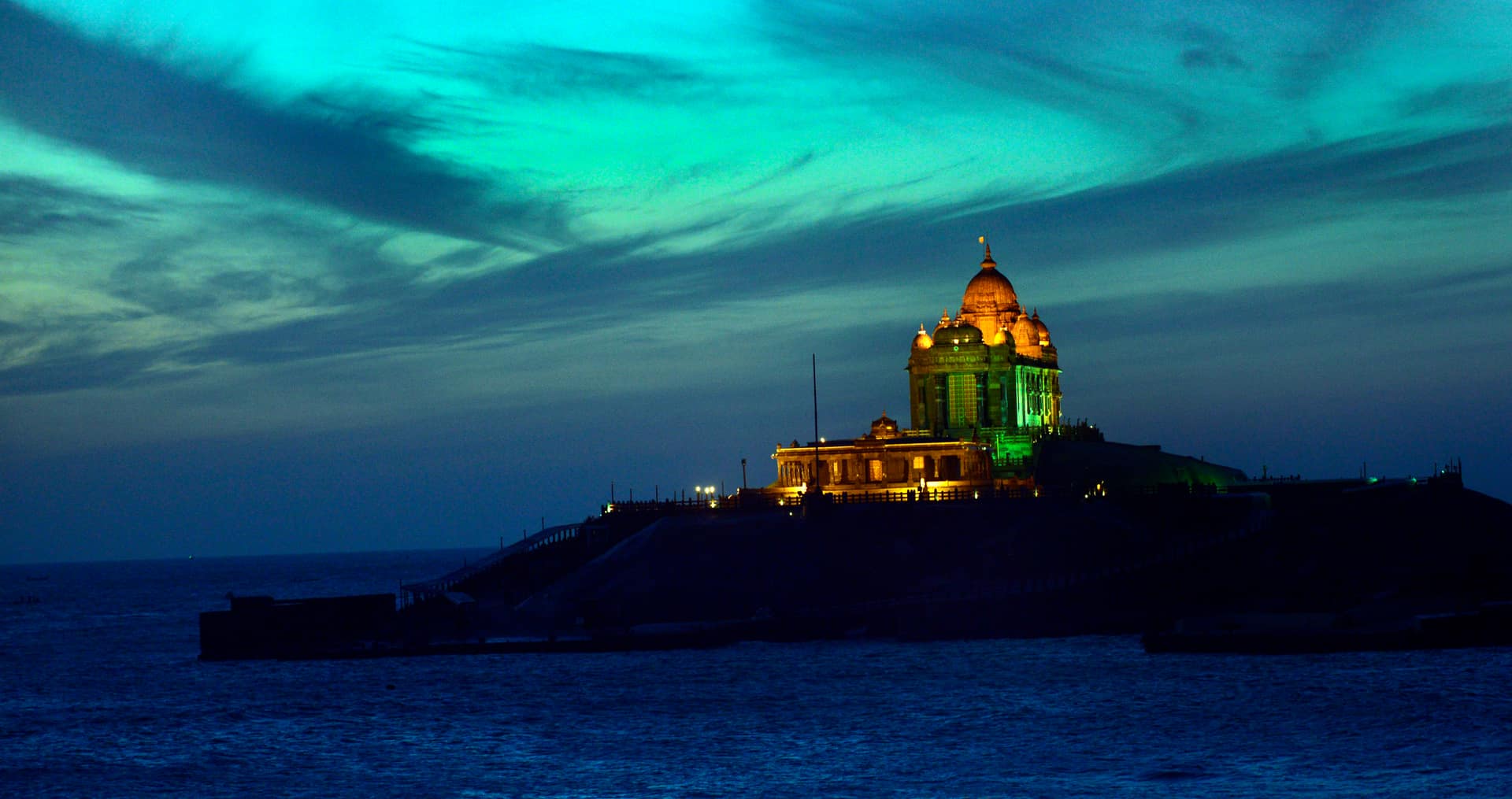
Temple in Kanyakumari
Bhagavathy Amman Temple
Kanyakumari, Tamil Nadu
At the tip of the peninsula, where three seas meet. The goddess wears a diamond nose stud whose shine, the story goes, was once mistaken by a sailor for a lighthouse — his ship struck the rocks, and the temple's eastern door has been kept shut ever since.
Photo: Prashant Kharote — CC BY 4.0, via Wikimedia Commons
Overview
Who it's to, and what's expected
Deity
Kanya Kumari (Parvati as a girl)
Tradition
Devi · Shakti temple
- Entry
The eastern door facing the sea is opened only on a handful of days a year — new-moon days in Thai and Aadi, during Navaratri, and in Kaartikai. On every other day you enter from the north.
Usually visited with
Time your visit
The darshan clock
A single opening-hours line cannot express a midday closure or an evening ceremony.
3:30 AM
Opening hours
The temple is open daily from 3:30 AM to 12:30 PM and from 4:00 PM to 8:00 PM.
Rules, timings and fees change — confirm locally before you rely on this.
How long this takes
Ways in
The difference between a twenty-minute visit and a three-hour one.
General darshan
- Free, through the northern entrance in two daily sessions
- Ordinary mornings are modest; sunrise brings the first crowds as pilgrims come up from the shore
- The temple's own darshan arrangements beyond general entry are made at its counters
Door-opening days
- The eastern sea-facing door opens only on new-moon days in Thai and Aadi, during Navaratri and in Kaartikai - and the temple is at its fullest on those days
Vaikasi Visakam
- The ten-day festival in May or June, with a boat festival - the busiest period of the temple year
At the gate
Before you go in
What gets refused, and what you cannot take past the door.
What to wear
Men remove shirts and vests before entering.
When not to come — unless you mean to
Festival windows
These follow lunar calendars and move by weeks each year, so the windows are months, not dates.
Vaikasi Visakam
Navaratri
Eastern door openings
Practicalities
The things that go wrong
Book through official channels, and treat anyone promising a guaranteed slot as a warning sign.
What to watch for
- Selling a darshan arrangement at the approach
- Darshan is free; anything beyond general entry is arranged at the temple's own counters, and nobody outside is authorised
- Charging for the ferry tickets to Vivekananda Rock at inflated prices; the ferry is run on a published schedule from the shore, and tickets are bought there
- Flower and garland sellers quoting first prices aimed at pilgrims in a hurry; the going rate is a fraction of the first ask
- Photographers at the sea-front quoting a price only after the pictures are taken; agree everything first
- Auto-rickshaw fares quoted only on arrival; the town is compact and walkable, and any ride should be agreed before setting out
General guidance
Planning the visit
Customary practice and what Kanyakumari's climate means for a barefoot visit — not rules posted at this temple. Anything specific to Bhagavathy Amman Temple is above.
Offerings differ here
Shakta shrines often accept offerings that other temples do not, and a few remain associated with animal sacrifice on particular days. What is sold at the stalls outside is the honest signal of what is expected inside.
Come in winter
Winter is when Kanyakumari is most comfortable to walk around, which matters here because a temple visit is done on foot and barefoot. Locally the window is given as october to march.
Salt air and bare feet
Coastal temple courtyards stay damp and the stone can be slick underfoot, particularly near a tank or a sea-facing entrance. Take the steps slowly rather than the queue's pace.
Arriving by train
Kanyakumari has a railway station, and auto-rickshaws wait outside it. Agree the fare or use a meter before you set off, and expect to be dropped a short walk from the temple rather than at its door.
No airport here
Kanyakumari has no airport of its own, so the last leg is by road or rail. Plan the return the same way — the last bus out is often earlier than visitors expect.
Outfit guide
What to wear at Bhagavathy Amman Temple
Cover shoulders and knees — the rules above win over anything here.
Trending wear for this spot
Popular modern looks travellers are wearing across Kanyakumari.

Traditional wear for this spot
Timeless, cultural looks that suit Bhagavathy Amman Temple.
Arulmigu Devi Kanyakumari Bhagavathy Amman Temple
At the southern tip of the Indian mainland, where three seas meet, the goddess is a girl — Kanya Kumari, the virgin goddess, an incarnation of Parvati — and her temple is the reason the town exists at all.
🌊 The goddess at the end of the land
The name is the theology: Kanya, virgin; Kumari, girl. In the best-known telling, the demon Banasura had won a blessing that only a virgin could kill him, and grew tyrannical across the three worlds — until Parvati appeared as a young girl to destroy him and stood at the land's end thereafter.
A gentler legend explains the shore itself: the goddess was to marry Shiva, and the wedding feast was prepared — but the rice and cereals remained uncooked when the groom did not arrive, and the grains turned to the sand and seashells that colour Kanyakumari's famous multi-hued sands. The goddess resumed her penance, a virgin forever, and the beach has carried the wedding's traces ever since.
The temple is counted among the Shakti Peethas, and the combination — a goddess at the meeting of Arabian Sea, Indian Ocean and Bay of Bengal — makes it one of the most felt pilgrimages in the south.
💎 The nose ring and the shut door
The deity wears a diamond nose stud — the mooguthi — whose gleam is the temple's signature. The story runs that its shine, glowing out over the water on festival nights, was once mistaken by a sailor for a lighthouse; his ship struck the rocks, and the eastern door facing the sea has been kept shut ever since — opened only on a handful of days a year: new-moon days in the Tamil months of Thai and Aadi, during Navaratri, and in Kaartikai. The nose ring itself is said in one tradition to have come from a king cobra.
On every other day you enter from the north, and the stud is best seen in the lamplight of the final pooja of the evening — devotees time the last darshan of the day just to catch it.
🕉️ The idol and the temple
The sanctum holds a black stone image of the goddess, carved the size of a young girl and garlanded like a Hindu nun. Vijayasundari and Balasundari, the friends of the goddess, stand nearby, and separate shrines hold Ganesha, Surya and Ayyappa. Three corridors ring the sanctum, and from the flag mast — the kodisthambam — the view of the goddess aligns with the sea behind her.
The temple faces the shoreline: the deity looks east over the water, and the northern entrance serves every ordinary day.
🕒 Timings
Two sessions daily — morning from about 3:30 or 4:30 AM to about 12:30 PM, and evening from about 4:00 PM to about 8:00 or 8:30 PM. Published hours differ between sources, so confirm locally, especially around festival dates.
Darshan is free, and the queue on ordinary mornings is modest; sunrise brings the day's first crowds, many of them coming straight from the shore. The temple publishes its own darshan arrangements at its counters — anything beyond free general darshan is arranged there, not at the approach.
👕 Rules
Men customarily remove shirts and vests before entering — the bare-shouldered tradition of Tamil temple worship, with no exception made for visitors. Women wear a saree, salwar or modest clothing covering shoulders and knees. Footwear is deposited outside; carry as little as possible, and photography inside the sanctum areas is not customary.
🌅 The tip itself — the complete visit
Kanyakumari is visited for the temple and the geography together, and the two are a single morning. The ferry to the Vivekananda Rock Memorial and the Thiruvalluvar Statue leaves from the shore in front of the temple, and the Gandhi Mandapam, where the Mahatma's ashes were kept before immersion, stands close by.
Sunrise here is the famous one — on Chitra Purnima in spring, the sun and moon are said to rise together over the same horizon — and the sea-front fills well before it. Kanyakumari is also one of the rare spots on the coast where you can watch the sun both rise and set from the same shore, which is why the town's day runs dawn to dusk.
The natural order: dawn at the tip, ferry to the rock, then the temple while the morning is still cool — with the sea on three sides the whole time, because at this tip it never leaves you. The streets between temple and shore fill with breakfast stalls from first light, and the town's small scale means everything is a walk.
🌸 Festivals
Vaikasi Visakam, in May or June, is the temple's own ten-day festival, with a boat festival on the waters it faces — the one period when the eastern shore fully belongs to the goddess. Navaratri brings the Navaratri mandapam in the outer corridor to life, and the new-moon door-openings are festivals in miniature.
📍 Getting there
Kanyakumari town is the end of the rail lines from both directions — trains arrive from Trivandrum, Madurai and beyond, and the temple is a short walk from the station and the sea-front. Allow a full morning for temple, rock and sunrise together; the town is compact and everything is within walking distance.
Last verified: 2026. The virgin-goddess identity and Banasura legend, the uncooked-wedding-feast tradition behind the shore's coloured sands, the nose-stud and shut eastern door with its opening days, the northern entrance, the two daily sessions, free darshan, and the Vaikasi Visakam boat festival are documented. Opening hours differ between published sources and the temple's own schedule is authoritative.
Questions
Bhagavathy Amman Temple — FAQ
Who is Bhagavathy Amman Temple dedicated to?
Bhagavathy Amman Temple in Kanyakumari is dedicated to Kanya Kumari (Parvati as a girl).
Who can enter Bhagavathy Amman Temple?
The eastern door facing the sea is opened only on a handful of days a year — new-moon days in Thai and Aadi, during Navaratri, and in Kaartikai. On every other day you enter from the north.
What is the dress code at Bhagavathy Amman Temple?
Men remove shirts and vests before entering.
Checked, not remembered
Sources
Every rule and timing above traces back to one of these.