
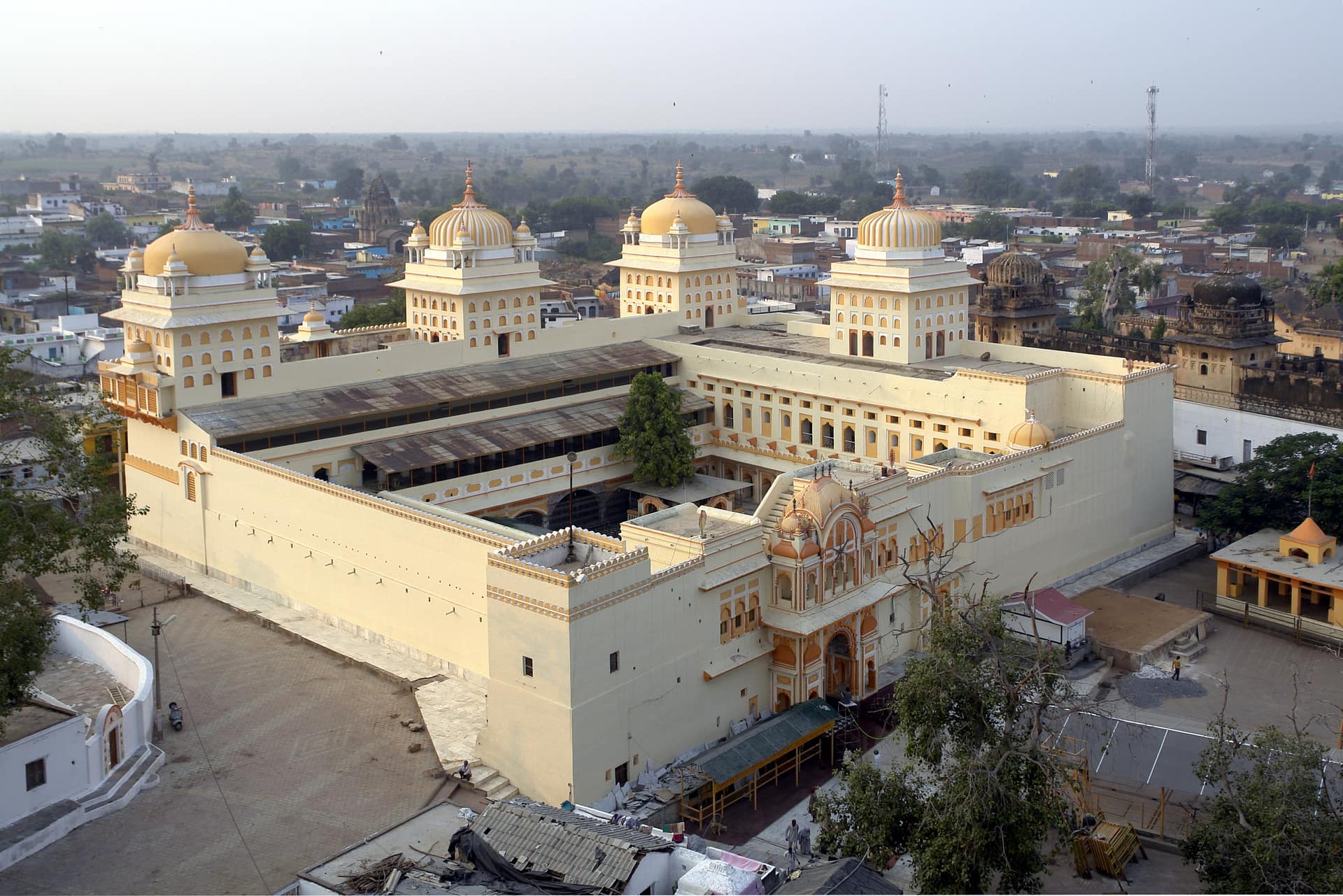
Temple in Orchha
Ram Raja Temple
Orchha, Madhya Pradesh
The only temple in India where Rama is worshipped as a reigning monarch rather than as a deity — and treated accordingly. It is a palace that became a temple by accident: the image was set down here overnight and could not afterwards be moved.
Photo: Yann Forget — CC BY-SA 4.0, via Wikimedia Commons
Overview
Who it's to, and what's expected
Deity
Rama, as king
Tradition
Vishnu · Krishna temple
- Entry
Free entry. Security screening applies at the gate as at a guarded state institution; follow the guards' instructions around the barricaded courtyard during aarti. The midday closure is long - plan around the two daily sessions.
- Footwear
Footwear is removed before entering the palace-temple; racks are available near the entrance.
- Access
The temple itself sits at palace level with no stairs to climb - a rarity in temple India - though the courtyard gets tightly packed before aarti. The wider fort complex involves stairs.
- Prasadam
Instead of the sweet prasad common at other temples, distinguished guests at the Ram Raja Temple are welcomed with paan (betel nut) and ittar (perfume).
Usually visited with
Time your visit
The darshan clock
A single opening-hours line cannot express a midday closure or an evening ceremony.
8:00 AM
Opening hours and royal aartis
The temple keeps a morning darshan from roughly 8:00 AM and an evening session anchored on the Sandhya aarti at about 7:00 PM, with a long midday closure. Four aartis structure the king's day - Mangala at waking, Rajbhog at the midday meal, Sandhya at dusk with the armed guard of honour, and Shayan at night. Hours shift with the seasons; the temple's own schedule is authoritative.
Rules, timings and fees change — confirm locally before you rely on this.
How long this takes
Ways in
The difference between a twenty-minute visit and a three-hour one.
General darshan
- Free, through the palace courtyard; the long midday closure splits the day into two sessions
The evening Sandhya aarti
- The day's set-piece - lamps, bhajan and the armed guard of honour; the courtyard fills well before it begins
Festival days
- Ram Navami and Vivah Panchami bring lakhs of pilgrims; the town's arrangements govern entry and timing
At the gate
Before you go in
What gets refused, and what you cannot take past the door.
What to wear
Modest attire covering shoulders and knees, as befits calling on a reigning monarch. Avoid shorts, sleeveless wear and very casual beach-style clothing.
Phones and cameras
Photography inside the temple is not permitted and mobile phones must remain put away; the notice at the gate requests this in Hindi. Carry nothing larger than a small bag.
Rules, timings and fees change — confirm locally before you rely on this.
When not to come — unless you mean to
Festival windows
These follow lunar calendars and move by weeks each year, so the windows are months, not dates.
Ram Navami
Vivah Panchami
Practicalities
The things that go wrong
Book through official channels, and treat anyone promising a guaranteed slot as a warning sign.
What to watch for
- Self-styled guides at the gate offering 'aarti passes' or guaranteed courtyard places - entry is free and places are first-come
- Third parties selling arranged close darshan with the king - no such arrangement exists at this temple
- Shopkeepers claiming prasad must be bought outside to enter - the temple's own paan and ittar prasad is distributed inside
- Cycle-rickshaw drivers quoting tourist rates by naming a 'temple tax' - agree the fare before setting off; town rides are short
- Misleading offers of paid parking 'inside the fort' - the public parking by the temple premises is ample
General guidance
Planning the visit
Customary practice and what Orchha's climate means for a barefoot visit — not rules posted at this temple. Anything specific to Ram Raja Temple is above.
The queue is the ritual
Vaishnava temples in India are usually organised around a moving darshan queue rather than time spent in front of the deity. Expect to keep walking, and expect the view of the sanctum to be brief — that is the intended experience, not a rushed one.
Come in winter
Winter is when Orchha is most comfortable to walk around, which matters here because a temple visit is done on foot and barefoot. Locally the window is given as october to march.
Stone gets hot — go early
You will be barefoot from the shoe rack onwards, often across an open courtyard. Between late morning and mid-afternoon in the hot months that stone is genuinely painful to stand on. Socks help, and are permitted almost everywhere shoes are not.
Arriving by train
Orchha has a railway station, and auto-rickshaws wait outside it. Agree the fare or use a meter before you set off, and expect to be dropped a short walk from the temple rather than at its door.
No airport here
Orchha has no airport of its own, so the last leg is by road or rail. Plan the return the same way — the last bus out is often earlier than visitors expect.
Outfit guide
What to wear at Ram Raja Temple
Cover shoulders and knees — the rules above win over anything here.
Trending wear for this spot
Popular modern looks travellers are wearing across Orchha.

Traditional wear for this spot
Timeless, cultural looks that suit Ram Raja Temple.
Ram Raja Temple, Orchha: The Palace Where Rama Is King
In Orchha, in Bundelkhand, Rama is not worshipped as a deity housed in a temple. He is the reigning king of the town - and the building he occupies is not a temple at all, but a queen's palace. Each day he receives a guard of honour from a uniformed armed contingent, the same ceremonial tribute a state accords its monarch; by local convention no other dignitary is saluted within the town, because the town already has its king.
🏛️ A palace that became a temple
The 16th-century story is told here as history: Raja Madhukar Shah's queen, Ganesh Kunwari, a devotee of Rama, brought his image from Ayodhya on the queen's own pilgrimage. The image was set down in her palace for the night, awaiting completion of the great Chaturbhuj temple being raised to receive it - and there it stayed.
The tradition holds that the deity indicated he would remain where he had been placed, as king of Orchha and not as an enshrined image - and the palace became his seat, while the Chaturbhuj temple, built for him, stands beside it holding Vishnu instead. Orchha has been called a second Ayodhya ever since.
👑 The court of Ram Raja
The darshan is accordingly royal. The image sits throne-like in the former palace hall; aarti is offered four times a day in the pattern of a king's court - Mangala at waking, Rajbhog at the royal meal, Sandhya at dusk with the gun salute by the ceremonial guard, and Shayan at retirement.
The evening aarti is the one travellers remember: lamps, conch, bhajan in the courtyard, and the armed salute cracking over the Betwa dusk. It is about forty-five minutes, and the courtyard fills well before it begins. Devotees receive paan and ittar as prasad - the welcome of a court, not the sweet of a shrine.
📜 Orchha: the Bundela capital
Orchha was the capital of the Bundela rajahs from the 16th century, and the Ram Raja sits inside a townscape of palaces, temples and cenotaphs along the Betwa. The Raja Mahal and Jahangir Mahal of the fort complex, the Chaturbhuj temple's vast empty sanctum raised for the image that never came, and the riverside chhatris of the dynasty make the town a single walkable ensemble.
The palace-turned-temple itself is a painting of the era - murals inside the Rani Mahal show the Rama legend in Bundela colours, and the building's domes carry the mixed Rajput and Mughal idiom of the age.
Choose your session by temperament. The morning court is the working temple: local families, the Rajbhog preparation, the courtyards in daylight and the murals at their best; you can hear the town around you and the palace feels lived-in. The evening is theatre: the lamps come out along the courtyard, the bhajan singers take their place, the crowd presses in happy and expectant, and the gun salute over the river ends the day in a way no other temple in India can match. Orchha regulars do both, on consecutive days, and call it the town's best two evenings. Either way, arrive early enough to settle somewhere in the shaded arcade at the edge - the sightlines, and the sound, are worth the wait. Festivals here are state occasions: Ram Navami brings lakhs to the town, and the anniversary of Rama and Sita's wedding - Vivah Panchami - is celebrated with a ceremonial marriage.
🕒 Timings and the visit
The temple keeps a morning darshan from roughly 8:00 AM and an evening session anchored on the Sandhya aarti around 7:00 PM, with a long midday closure; hours shift with the seasons. Arrive well before the evening aarti - the barricaded courtyard fills early, phones must stay put away, and the notice at the gate says it in Hindi: this is a court, and the court's etiquette applies.
Dress as you would to call on a king - shoulders and knees covered. Photography inside is not permitted; the courtyard, the fort and the chhatris will fill any camera. The town is small and everything is walkable or a short cycle-rickshaw ride.
🚣 The Betwa and around
Orchha's river is the other half of the visit: the chhatris of the Bundela kings stand in a line on the far bank, best at dawn, and the sandbanks and ghats make the slow evening Orchha does best. A morning at the fort, midday in the town's lanes, aarti at the palace, and the chhatris at dusk is a full and perfect Orchha day.
Gwalior and Khajuraho are the big neighbours; Jhansi, with its rail junction, is twenty minutes away and the usual gateway. Riverside heritage hotels in former palaces make an overnight worthwhile - the town at night, with the aarti over and the river running, is the Orchha people return for.
Last verified: 2026. The palace-to-temple tradition of the image brought from Ayodhya by Ganesh Kunwari and fixed in the Rani Mahal under Raja Madhukar Shah, the royal treatment with the four daily aartis and the armed guard of honour at the Sandhya aarti, the paan and ittar prasad, the roughly 8:00 AM morning and evening-about-7:00-PM sessions with the long midday closure, the Chaturbhuj temple built for the image and the chhatris of the Bundela dynasty, and the Ram Navami and Vivah Panchami festivals are documented. Seasonal aarti hours shift; the temple's own schedule is authoritative.
Questions
Ram Raja Temple — FAQ
Who is Ram Raja Temple dedicated to?
Ram Raja Temple in Orchha is dedicated to Rama, as king.
Who can enter Ram Raja Temple?
Free entry. Security screening applies at the gate as at a guarded state institution; follow the guards' instructions around the barricaded courtyard during aarti. The midday closure is long - plan around the two daily sessions.
What is the dress code at Ram Raja Temple?
Modest attire covering shoulders and knees, as befits calling on a reigning monarch. Avoid shorts, sleeveless wear and very casual beach-style clothing.
Do I have to take my shoes off at Ram Raja Temple?
Footwear is removed before entering the palace-temple; racks are available near the entrance.
Can I take photos inside Ram Raja Temple?
Photography inside the temple is not permitted and mobile phones must remain put away; the notice at the gate requests this in Hindi. Carry nothing larger than a small bag.
What prasadam is offered at Ram Raja Temple?
Instead of the sweet prasad common at other temples, distinguished guests at the Ram Raja Temple are welcomed with paan (betel nut) and ittar (perfume).
Is Ram Raja Temple wheelchair accessible?
The temple itself sits at palace level with no stairs to climb - a rarity in temple India - though the courtyard gets tightly packed before aarti. The wider fort complex involves stairs.
Checked, not remembered
Sources
Every rule and timing above traces back to one of these.