
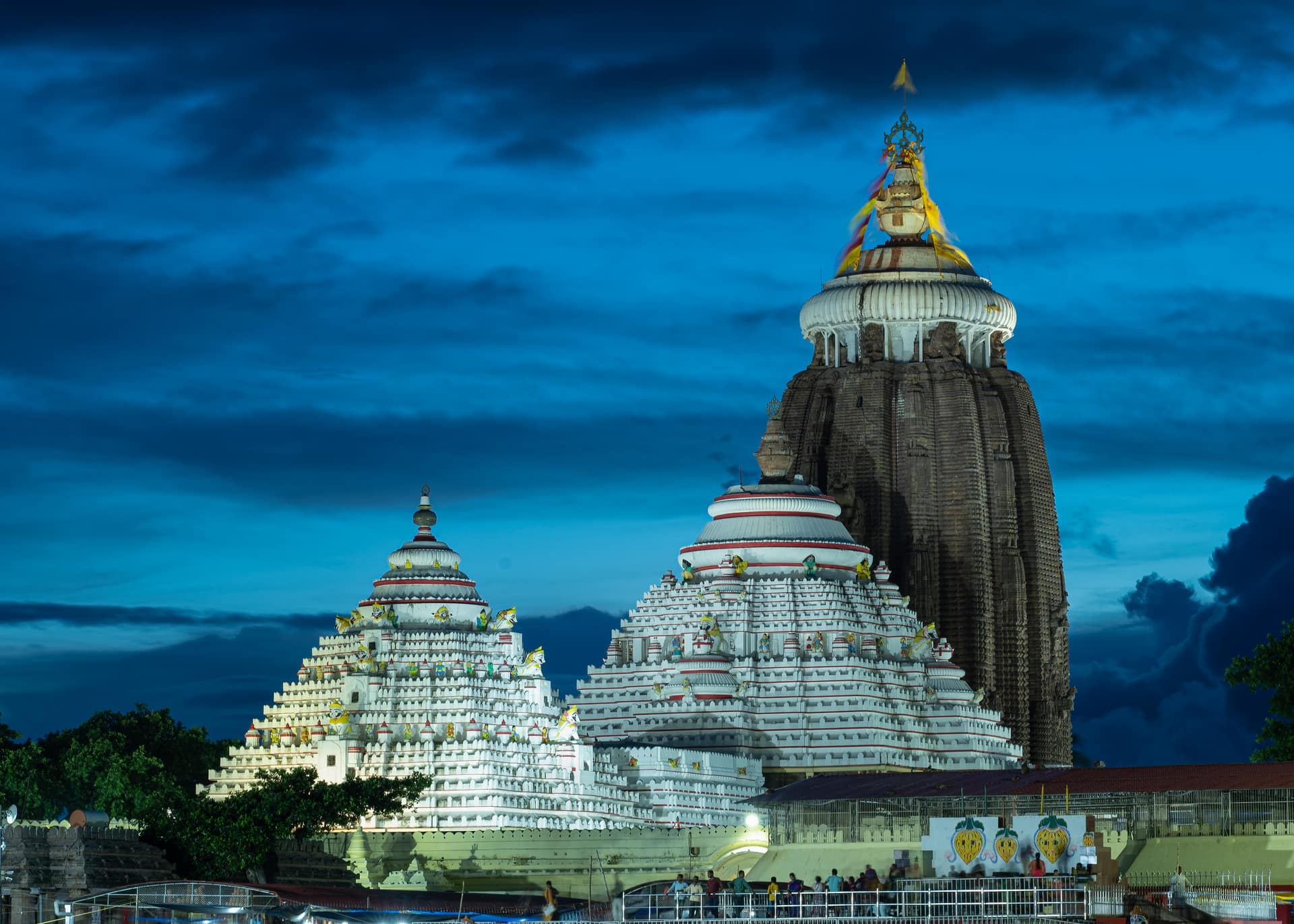
Temple in Puri
Shree Jagannath Temple
Puri, Odisha
The temple the town exists for, and the one on this site with the hardest entry rule: a sign at the Lion's Gate in five languages restricts entry to Hindus. That single fact decides how a large share of visitors plan their day here.
Photo: Kalyanpuranand — CC BY-SA 4.0, via Wikimedia Commons
Overview
Who it's to, and what's expected
Deity
Jagannath, Balabhadra and Subhadra
Tradition
Vishnu · Krishna temple
- Entry
Entry to the main shrine is restricted to Hindus only. Non-Hindus are not permitted to enter the temple, though they may view the tower from the Raghunandan Library rooftop or see the deities on their chariots during the Rath Yatra festival.
- Footwear
Footwear is not permitted inside the temple and must be removed before entering. Paid shoe-keeping stalls are available near the gates.
- Access
The temple requires standing for one to two hours in humid conditions, and those with health conditions should consult a doctor and consider visiting during the quieter afternoon hours.
- Prasadam
Mahaprasad is food prepared in the temple's great kitchen and offered to the deities and Goddess Bimala; it can be purchased by weight in clay pots at the Ananda Bazar inside the temple complex.
Usually visited with
Time your visit
The darshan clock
A single opening-hours line cannot express a midday closure or an evening ceremony.
5:00 AM
Opening hours
The temple opens around 5:00 AM for the Dwaraphita ritual and closes around 11:30 PM following the Khata Seja Lagi and Pahuda ceremonies. Throughout the day, darshan availability fluctuates based on a series of daily rituals (nitis), including lamp offerings, food offerings, and a short midday rest.
Rules, timings and fees change — confirm locally before you rely on this.
At the gate
Before you go in
What gets refused, and what you cannot take past the door.
What to wear
The temple discourages shorts, transparent or revealing clothing, and torn jeans. Recommended attire includes trousers, shirts, kurta-pyjama, or dhoti for men, and sarees or salwar kameez for women.
Phones and cameras
Mobile phones, cameras, and smartwatches are strictly prohibited inside the temple. You must leave these items, along with leather goods and umbrellas, at your hotel or in the provided cloakrooms.
Rules, timings and fees change — confirm locally before you rely on this.
When not to come — unless you mean to
Festival windows
These follow lunar calendars and move by weeks each year, so the windows are months, not dates.
Ashadha Shukla Dwitiya — June or July
Rath Yatra
The deities leave the temple on three chariots and are pulled through the town. This is the one time the entry restriction does not apply: the darshan happens in the street and is open to everyone. The town is at several times its capacity, so plan months ahead or not at all.
Practicalities
The things that go wrong
Book through official channels, and treat anyone promising a guaranteed slot as a warning sign.
What to watch for
- Offering non-Hindu visitors paid entry to the temple
- The restriction is enforced by a sign at the Lion's Gate in five languages and cannot be bought around
- The legitimate alternatives are the Raghunandan Library rooftop view and seeing the deities on their chariots during Rath Yatra
- Guides claiming the rooftop viewing requires a fee or a permit arranged through them
- Confirm the current arrangement independently rather than paying on the street
- Third parties near the gates offering to store your phone, camera, leather goods or umbrella for a high fee
- The temple provides cloakrooms - use them, or leave items at your hotel, since all four categories are prohibited inside
- Anyone selling 'Mahaprasad from the temple kitchen' outside the complex at a premium
- Mahaprasad is purchased by weight in clay pots at the Ananda Bazar inside, reached by turning right at the top of the twenty-two steps
- Paid shoe-keeping stalls near the gates quoting inflated rates, or footwear going missing when left unattended
- Use a designated stall and keep the token
General guidance
Planning the visit
Customary practice and what Puri's climate means for a barefoot visit — not rules posted at this temple. Anything specific to Shree Jagannath Temple is above.
The queue is the ritual
Vaishnava temples in India are usually organised around a moving darshan queue rather than time spent in front of the deity. Expect to keep walking, and expect the view of the sanctum to be brief — that is the intended experience, not a rushed one.
Come in winter
Winter is when Puri is most comfortable to walk around, which matters here because a temple visit is done on foot and barefoot. Locally the window is given as october to march (rath yatra jun–jul).
Salt air and bare feet
Coastal temple courtyards stay damp and the stone can be slick underfoot, particularly near a tank or a sea-facing entrance. Take the steps slowly rather than the queue's pace.
Arriving by train
Puri has a railway station, and auto-rickshaws wait outside it. Agree the fare or use a meter before you set off, and expect to be dropped a short walk from the temple rather than at its door.
No airport here
Puri has no airport of its own, so the last leg is by road or rail. Plan the return the same way — the last bus out is often earlier than visitors expect.
Outfit guide
What to wear at Shree Jagannath Temple
Cover shoulders and knees — the rules above win over anything here.
Trending wear for this spot
Modern, camera-ready looks picked for Shree Jagannath Temple.
Traditional wear for this spot
Timeless, cultural looks that suit Shree Jagannath Temple.
Shree Jagannath Temple, Puri
Puri's Jagannath Temple is one of the four Char Dham, and it has the hardest entry rule of any temple on this site: a sign at the Lion's Gate, written in five languages, restricts entry to Hindus.
That single fact decides how a large share of visitors plan their day in Puri, so it is stated first rather than buried. Non-Hindus may not enter the temple. They may view the tower from the Raghunandan Library rooftop, and — critically — they may see the deities on their chariots during the Rath Yatra, which is the one occasion each year when the gods leave the sanctum and are visible to everyone.
🛕 Wooden deities, and a ritual of renewal
Jagannath, Balabhadra and Subhadra are carved from wood, not stone or metal, which is exceptional among India's great temples and shapes everything about the temple's ritual life.
Wooden deities decay, so they are periodically renewed in the Nabakalebara rite — a complex ritual held when the calendar produces an extra lunar month in Ashadha, roughly every twelve to nineteen years, in which new images are carved and installed and the old ones ritually buried. Nabakalebara years are the biggest in the temple's calendar, drawing numbers beyond even a normal Rath Yatra.
The deities' form is also distinctive: large round eyes, no visible legs, and stubby arms, an iconography unlike any other major Indian deity. Jagannath means "Lord of the Universe", and the temple's theology is unusually inclusive within Hinduism — which makes the entry restriction at the door the more striking.
🍛 The largest temple kitchen in the world
Puri's temple kitchen is described as the largest in the world, and its workings are the temple's most-quoted marvel:
- Fifty-six traditional food items — chappan bhog — are cooked daily
- In earthenware pots stacked one above the other
- The food in the top pot is said to cook first, and whatever is cooked never goes to waste
The cooked food becomes Mahaprasad, offered to the deities and to Goddess Bimala, and it can be purchased by weight in clay pots at the Ananda Bazar inside the temple complex.
Eating Mahaprasad at the Ananda Bazar is one of the essential Puri experiences and, unlike darshan, it is available to anyone. Note the navigation: after climbing the twenty-two steps to the inner courtyard, a right turn leads to the Ananda Bazaar where Mahaprasad is sold, and a left turn leads to the Kalpavata, a thousand-year-old banyan tree.
🛞 Rath Yatra — the festival that opens the temple to everyone
The Rath Yatra is held on the second day (Dwitiya) of the bright fortnight of Ashadha, in June or July. In 2026 it runs from 16 to 24 July, spanning nine days and culminating in the deities' return journey.
Three massive, elaborately carved wooden chariots carry Jagannath, Balabhadra and Subhadra through the streets of Puri to the Gundicha Temple, pulled by crowds along the Grand Road.
Two things make it uniquely important for visitors:
- It is the only occasion when the deities are visible outside the sanctum. For non-Hindu visitors barred from the temple, the Rath Yatra is the one time they can see Jagannath — from the procession route rather than through a rooftop.
- People of all faiths and nationalities are welcome to watch from outside the temple and along the route. The restriction applies to the building, not to the festival.
Pulling the chariot ropes is believed to bring spiritual merit, which is why the crowd participation is so intense — and why the procession is genuinely dangerous in its density. Do not attempt to join the rope-pulling without understanding how compressed the crowd becomes.
🕒 Timings, and an entirely free darshan
The temple opens around 5:00 AM, with darshan running through the day around the temple's exceptionally elaborate ritual cycle — Puri's daily schedule includes numerous besha (ritual dressings) and bhoga (offerings) from before dawn until the deities are put to sleep at night.
Expect to wait between thirty minutes and several hours, depending on the day and season.
🚫 What you cannot bring
Mobile phones, cameras and smartwatches are strictly prohibited inside the temple. You must leave these items, along with leather goods and umbrellas, at your hotel or in the provided cloakrooms.
Leather goods and umbrellas being on the list is the detail that catches visitors out — most people expect a phone ban but not a ban on a belt, a wallet or a handbag. Travel to the temple with nothing you cannot deposit, and do not plan on carrying an umbrella even in monsoon.
👔 Dress
The temple discourages shorts, transparent or revealing clothing, and torn jeans. Recommended attire is trousers, shirts, kurta-pyjama or dhoti for men, and sarees or salwar kameez for women.
Torn jeans being specifically named is notable — it is a common traveller garment and is genuinely not acceptable here.
♿ Access, and the humidity
The temple requires standing for one to two hours in humid conditions. This is the real accessibility constraint at Puri, more than steps or crowds: the Odisha coast is hot and very humid for much of the year, the queue is long, and there is little relief inside the complex.
Visitors with health conditions should consult a doctor before planning the visit, and should consider the quieter afternoon hours rather than the morning rush.
Footwear is not permitted inside and must be removed before entering. Paid shoe-keeping stalls are available near the gates — use one and keep the token, since unattended footwear disappears at a site this busy.
🌸 Beyond Rath Yatra
- Nabakalebara — the periodic renewal of the wooden deities, the temple's largest occasion
- Bahuda Yatra — the return journey of the chariots, within the nine-day Rath Yatra period
- Suna Besha — the deities adorned in gold, on the chariots during the Rath Yatra period
- Chandan Yatra, Snana Yatra and Naba Anka follow the Odia calendar
- Dola Yatra (Holi) and Jhulana Yatra (the monsoon swing festival)
📍 Puri and its circuit
The temple is the reason Puri exists, and the town is organised around it. PairsWith for this record names the three standard companions: Gundicha Temple (the chariots' destination), Puri Beach, and the Konark Sun Temple — a UNESCO site about 35 km north, and the natural half-day addition.
The classic Odisha temple triangle is Puri–Konark–Bhubaneswar, with Bhubaneswar's Lingaraja and Rajarani completing it.
⚠️ Practical notes
- Non-Hindu visitors: plan for the rooftop view and, if your dates allow, the Rath Yatra. Those are your two options, and the second is far better.
- Deposit everything before queueing — phones, smartwatches, leather, umbrellas.
- Eat Mahaprasad at the Ananda Bazar. Right turn at the top of the twenty-two steps.
- Go in the afternoon if the humidity or standing is a concern.
- October to March for weather; the coast is punishing in summer and drenched in monsoon.
Last verified: 2026. Timings, entry arrangements and any charges are published by the temple itself and do change - confirm them with the temple's own official website or counter before travelling rather than relying on any third-party listing.
Questions
Shree Jagannath Temple — FAQ
Who is Shree Jagannath Temple dedicated to?
Shree Jagannath Temple in Puri is dedicated to Jagannath, Balabhadra and Subhadra.
Who can enter Shree Jagannath Temple?
Entry to the main shrine is restricted to Hindus only. Non-Hindus are not permitted to enter the temple, though they may view the tower from the Raghunandan Library rooftop or see the deities on their chariots during the Rath Yatra festival.
What is the dress code at Shree Jagannath Temple?
The temple discourages shorts, transparent or revealing clothing, and torn jeans. Recommended attire includes trousers, shirts, kurta-pyjama, or dhoti for men, and sarees or salwar kameez for women.
Do I have to take my shoes off at Shree Jagannath Temple?
Footwear is not permitted inside the temple and must be removed before entering. Paid shoe-keeping stalls are available near the gates.
Can I take photos inside Shree Jagannath Temple?
Mobile phones, cameras, and smartwatches are strictly prohibited inside the temple. You must leave these items, along with leather goods and umbrellas, at your hotel or in the provided cloakrooms.
What prasadam is offered at Shree Jagannath Temple?
Mahaprasad is food prepared in the temple's great kitchen and offered to the deities and Goddess Bimala; it can be purchased by weight in clay pots at the Ananda Bazar inside the temple complex.
Is Shree Jagannath Temple wheelchair accessible?
The temple requires standing for one to two hours in humid conditions, and those with health conditions should consult a doctor and consider visiting during the quieter afternoon hours.
Checked, not remembered
Sources
Every rule and timing above traces back to one of these.