
Temple in Shimla
Jakhoo Temple
Shimla, Himachal Pradesh
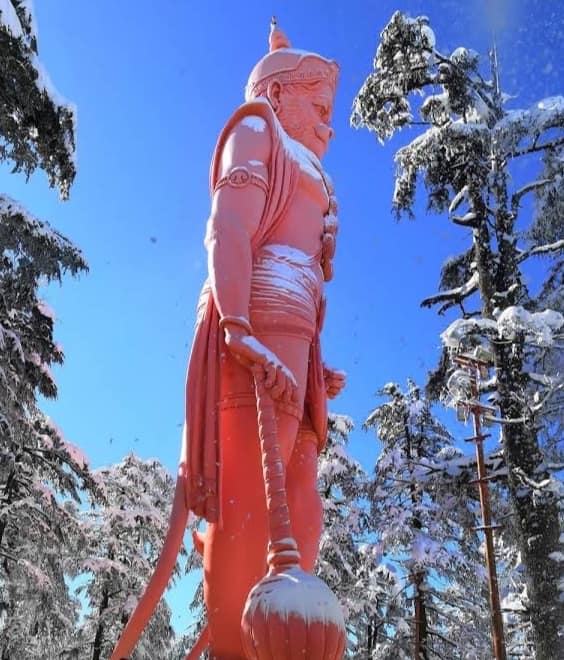
On the highest point in Shimla at about 2,455 m, under a 108-foot Hanuman unveiled in 2010 — visible from most of the town. Reached by a steep 2.5 km walk through deodar forest, by pony, or by the ropeway.
Photo: Iamritwikaryan — CC BY-SA 4.0, via Wikimedia Commons
Overview
Who this temple is to
Deity
Hanuman
Tradition
Vishnu · Krishna temple
Time your visit
The darshan clock
A single opening-hours line cannot express a midday closure or an evening ceremony.
Daylight hours
Opening hours
The temple keeps daylight hours - published timings vary between sources, roughly 6:00 AM to 8:00 PM, with darshan through the day and bhog in the early evening; the temple's own notice is the safe guide. The ropeway from near the Ridge runs about 9:30 AM to 6:00 PM.
Rules, timings and fees change — confirm locally before you rely on this.
How long this takes
Ways in
The difference between a twenty-minute visit and a three-hour one.
General darshan
- Free, through daylight hours
- Mornings are the calmest; Sundays and festival days fill the hilltop
Hanuman Jayanti
- The year's largest pilgrimage up the hill, in March or April, with processions through Shimla
The ropeway
- Not a queue for darshan but the practical bottleneck: rides from near the Ridge, about 9:30 AM to 6:00 PM, with waits building late morning in season - ride early, and check the last ride down against the fog
At the gate
Before you go in
What gets refused, and what you cannot take past the door.
What to wear
Visitors are advised to dress modestly when visiting the temple.
When not to come — unless you mean to
Festival windows
These follow lunar calendars and move by weeks each year, so the windows are months, not dates.
Hanuman Jayanti
Ram Navami
Vijayadashami
Practicalities
The things that go wrong
Book through official channels, and treat anyone promising a guaranteed slot as a warning sign.
What to watch for
- Charging for entry; the temple is free, and the ropeway charges only its own published fare at its counter
- Ropeway 'skip-the-line' offers sold by third parties around the Ridge; tickets are sold at the ropeway's own counter only
- Pony operators quoting a fare only at the top of the climb; agree the round trip and the waiting time before mounting
- Photo operators with monkeys on leads quoting a price only after the photograph; agree first, and do not hand over sunglasses or food for the photograph
- Guides attaching themselves on the walk up and producing a fee at the temple gate; the legend needs a placard, not a guide
General guidance
Planning the visit
Customary practice and what Shimla's climate means for a barefoot visit — not rules posted at this temple. Anything specific to Jakhoo Temple is above.
The queue is the ritual
Vaishnava temples in India are usually organised around a moving darshan queue rather than time spent in front of the deity. Expect to keep walking, and expect the view of the sanctum to be brief — that is the intended experience, not a rushed one.
Come in summer and winter
Summer and winter is when Shimla is most comfortable to walk around, which matters here because a temple visit is done on foot and barefoot. Locally the window is given as march to june, and december for snow.
Cold stone, early starts
Barefoot on stone at altitude before sunrise is colder than the air temperature suggests, and the first darshan of the day is usually the coldest hour. Socks are permitted almost everywhere shoes are not.
Arriving by train
Shimla has a railway station, and auto-rickshaws wait outside it. Agree the fare or use a meter before you set off, and expect to be dropped a short walk from the temple rather than at its door.
Outfit guide
What to wear at Jakhoo Temple
Cover shoulders and knees — the rules above win over anything here.
Trending wear for this spot
Popular modern looks travellers are wearing across Shimla.

Traditional wear for this spot
Timeless, cultural looks that suit Jakhoo Temple.
Jakhu Hanuman Temple, Shimla
On the highest point in Shimla at 2,455 metres, under a 108-foot Hanuman unveiled in 2010 and visible from most of the town — reached by a steep forest walk, by pony, or by the ropeway from the Ridge.
🐒 The Sanjeevani stop
The legend places Hanuman on this hill at the most famous moment of the Ramayana's final battle: flying with the Sanjeevani herb to save the wounded Lakshmana, he rested here, and the hill is said to carry the mark of his feet — the footprint preserved near the shrine is the temple's oldest object of worship.
The tradition adds its own sequel: Hanuman's monkey companions, left waiting on the hill while he flew on alone, are the ancestors of the macaques who live here still — which is why the monkeys of Jakhu are not a nuisance in the temple's own understanding but residents with a claim, and why the practical advice below matters so much.
The hill's name is older than the temple's fame — held to come from the sage Yak or Yaku, who is said to have blessed the site to Hanuman's worship for as long as the hill stands.
🗿 The temple and the statue
The sanctum holds a swayambhu idol of Hanuman — self-manifested, in the shrine's tradition, and ancient — in a modest stone-and-wood structure of the hill style, with bells donated by generations of devotees along its courts. The painted images of Hanuman on the outer walls give the shrine its colour.
Above it all stands the 108-foot statue, installed in 2010 — one of the tallest figures of Hanuman anywhere, orange and red against the deodars, visible from across Shimla and the surrounding hills, and the town's single most recognisable religious landmark. 108 is the sacred number of completion, and the statue has become the image of Shimla in a way the temple alone never was.
🌄 The views
Jakhu is the highest ground in Shimla, and on a clear morning the reward is the whole horizon: the snow ranges across the north, the town spilling below on every side, and the Ridge and its church recognisable from above. Sunrise from the summit path is the best free hour in the city; sunset turns the statue orange-on-orange, and the town lights come up while the forest goes dark. The deodars, oak and rhododendron of the climb are the third act — a proper hill walk inside a municipal sightseeing day.
🕒 Timings and the ropeway
The temple keeps daylight hours — published timings vary between sources, roughly 6:00 AM to 8:00 PM, with darshan through the day and bhog in the early evening; the temple's own notice is the safe guide. The ropeway runs from near the Ridge, 9:30 AM to 6:00 PM, in about six minutes over the forest — buy at its own counter, and ride before the fog closes the afternoon.
The walk up is 2.5 km and steep, 45 minutes through deodar, oak and rhododendron — the best version of the climb if the legs allow, and the ponies are the third option. Sunrise and the clear mornings of March to June give the Himalayan ranges across the whole horizon; winter puts the statue in snow, which is its own photograph.
🐵 The monkeys — the honest advice
The macaques are aggressive about food and shiny things, and they win. In practice:
- Everything zipped and held close — no open bags, no food in hand, no packets in pockets that show
- Sunglasses off the face and phones gripped, not dangled
- Do not feed them, and do not let photo operators put anything of yours in front of one
- Walk in company if the forest stretch is quiet Carry nothing loose: no visible food, no open bags, no sunglasses on the face or phone in the hand — everything zipped and held close, and do not feed them. This is the single most repeated advice about Jakhu for a reason; heed it and the hill is one of the great hours in Shimla, legend, forest, statue and ranges together.
🌸 Festivals
Hanuman Jayanti, in March or April, brings the year's largest pilgrimage up the hill; Ram Navami and Vijayadashami follow in the calendar, and Sundays through the year are the temple's own busy days.
📍 Getting there
2.5 km east of the Ridge — walk, pony, taxi, or the ropeway; from Shimla railway station about 7 km by road, and the airport about 20 km beyond the town. The walk down, knees permitting, gives the forest and the town views in the better light of the afternoon, and returns you to the Ridge in forty minutes. The ropeway suits elderly visitors and anyone avoiding the steep climb, and the last ride down closes with the fog and the season — check the counter on arrival. Allow 1 to 2 hours for the temple and the viewpoints, more if you walk both ways.
Last verified: 2026. The 2,455 m summit as Shimla's highest point, the 108-foot statue installed in 2010, the Sanjeevani-rest legend with the preserved footprint, the sage Yaku naming tradition, the swayambhu idol, the ropeway from near the Ridge running 9:30 AM to 6:00 PM, the 2.5 km steep walk, and the monkey advice are documented. Temple timings vary between sources and the temple's own notice is authoritative.
Questions
Jakhoo Temple — FAQ
Who is Jakhoo Temple dedicated to?
Jakhoo Temple in Shimla is dedicated to Hanuman.
What is the dress code at Jakhoo Temple?
Visitors are advised to dress modestly when visiting the temple.
Checked, not remembered
Sources
Every rule and timing above traces back to one of these.