
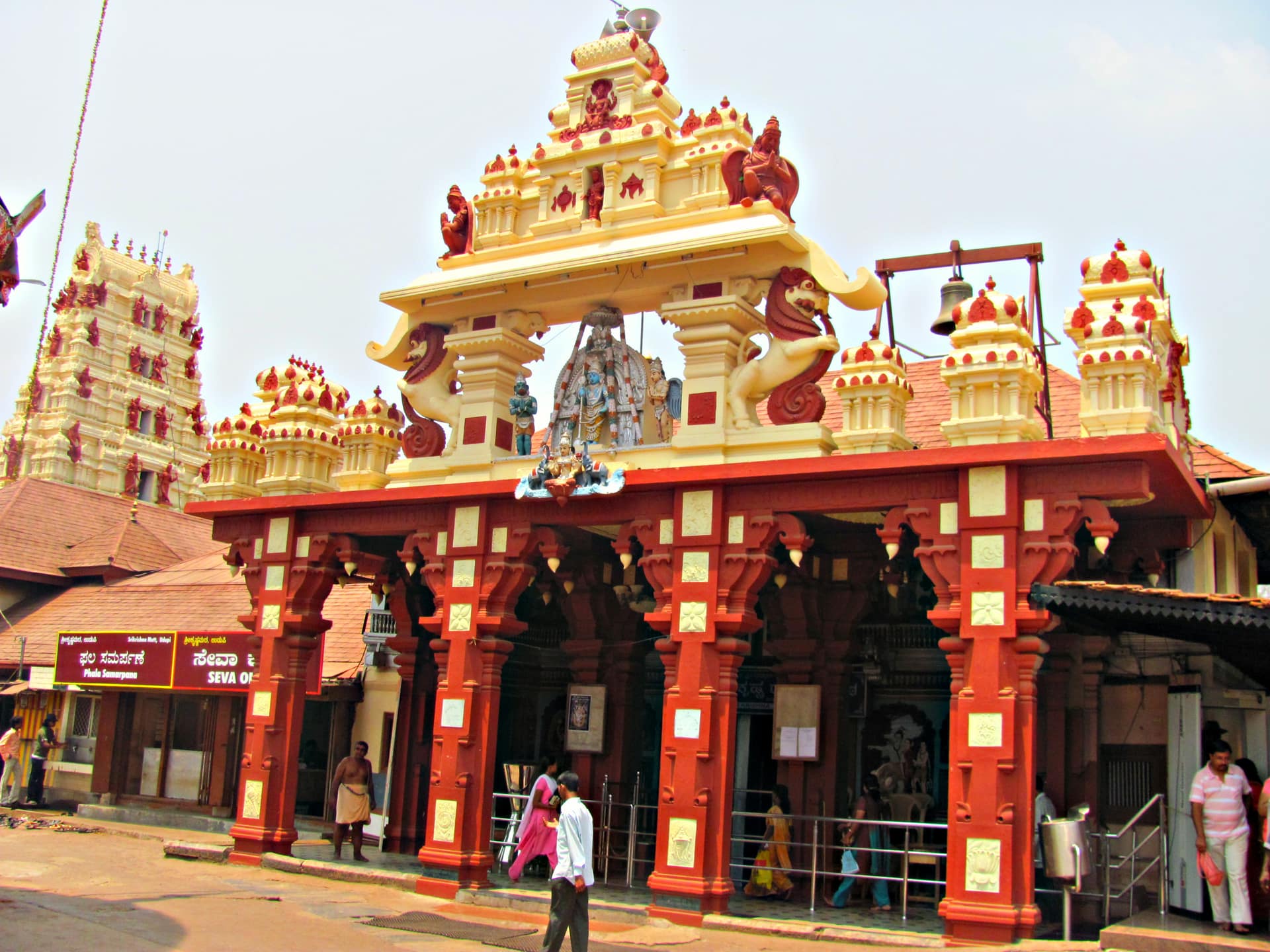
Temple in Udupi
Sri Krishna Matha
Udupi, Karnataka
The strangest darshan rule in India: you do not see the deity through a door. Krishna here is viewed through Kanakana Kindi — a small silver-plated window of nine holes in the west wall — because the image turned to face west for a devotee refused entry at the front. Everyone since has looked through the same window.
Photo: Ashok Prabhakaran — CC BY-SA 2.0, via Wikimedia Commons
Overview
Who it's to, and what's expected
Deity
Krishna as Bala Krishna
Tradition
Vishnu · Krishna temple
- Entry
Darshan is free for all visitors, and the temple enforces a specific dress code: men must wear a dhoti or full-length trousers with a shirt, while women must wear a saree, salwar-kameez, or a long skirt with a blouse. Shorts, lungis, and sleeveless clothing are not permitted.
- Footwear
Footwear is removed before entering the temple; racks are provided at the entrances. The temple street itself is walked in footwear.
- Access
The temple environment can be physically demanding, and elderly visitors or those with limited mobility should avoid peak times due to long periods of standing.
Usually visited with
Time your visit
The darshan clock
A single opening-hours line cannot express a midday closure or an evening ceremony.
4:00 AM
Opening hours
The temple is open daily from 4:00 AM to 1:00 PM and 3:00 PM to 9:30 PM, with a daily closure for rituals between 1:00 PM and 3:00 PM. Key ceremonies include the Mangala Aarti at 5:30 AM, Mahapuja at 7:30 PM, and Ekanta Seva at 8:30 PM.
Rules, timings and fees change — confirm locally before you rely on this.
How long this takes
Ways in
The difference between a twenty-minute visit and a three-hour one.
Kanakana Kindi darshan
- The principal darshan for everyone, through the nine-holed window on the west wall; free, with a short moving line on ordinary days
Anna Brahma dining
- Free sanctified meals served around midday and evening; queues form before each sitting and move quickly
Festival processions
- On Paryaya, Janmashtami and chariot-festival days the car street becomes the venue; follow the matha's arrangements and expect very large crowds
At the gate
Before you go in
What gets refused, and what you cannot take past the door.
What to wear
Men should wear a dhoti or full-length trousers with a shirt, while women should wear a saree, salwar-kameez, or a long skirt with a blouse. Shorts, lungis, and sleeveless clothing are not permitted.
Phones and cameras
Visitors are advised to follow posted signage and staff instructions regarding photography inside restricted zones.
Rules, timings and fees change — confirm locally before you rely on this.
When not to come — unless you mean to
Festival windows
These follow lunar calendars and move by weeks each year, so the windows are months, not dates.
Paryaya
Krishna Janmashtami
Practicalities
The things that go wrong
Book through official channels, and treat anyone promising a guaranteed slot as a warning sign.
What to watch for
- Guides offering paid darshan arrangements - darshan at Udupi is only through the Kanakana Kindi and needs no arrangement of any kind
- Third parties selling 'Paryaya passes' or festival access - all entry is free and the matha's own notices are the only reliable source
- Auto drivers recommending distant shops or 'temple offices' in exchange for your donation - walk the temple street on foot instead
- Anyone collecting money at the doorway for 'mandatory' offerings - the temple's donation counters are inside and clearly marked
- Misleading offers of paid meal coupons for the Anna Brahma kitchen - the meals are free to all
General guidance
Planning the visit
Customary practice and what Udupi's climate means for a barefoot visit — not rules posted at this temple. Anything specific to Sri Krishna Matha is above.
The queue is the ritual
Vaishnava temples in India are usually organised around a moving darshan queue rather than time spent in front of the deity. Expect to keep walking, and expect the view of the sanctum to be brief — that is the intended experience, not a rushed one.
Come in winter
Winter is when Udupi is most comfortable to walk around, which matters here because a temple visit is done on foot and barefoot. Locally the window is given as october to february.
Salt air and bare feet
Coastal temple courtyards stay damp and the stone can be slick underfoot, particularly near a tank or a sea-facing entrance. Take the steps slowly rather than the queue's pace.
Arriving by train
Udupi has a railway station, and auto-rickshaws wait outside it. Agree the fare or use a meter before you set off, and expect to be dropped a short walk from the temple rather than at its door.
No airport here
Udupi has no airport of its own, so the last leg is by road or rail. Plan the return the same way — the last bus out is often earlier than visitors expect.
Outfit guide
What to wear at Sri Krishna Matha
Cover shoulders and knees — the rules above win over anything here.
Trending wear for this spot
Popular modern looks travellers are wearing across Udupi.

Traditional wear for this spot
Timeless, cultural looks that suit Sri Krishna Matha.
Udupi Sri Krishna Matha: The Deity You See Through a Window
Udupi's Krishna is the only major deity in India whose principal darshan is not through a sanctum door but through a small silver-plated window of nine holes in the west wall — the Kanakana Kindi. Everyone — king or pilgrim, local or traveller — takes darshan the same way, and the reason is a story the temple tells with pride.
🕯️ The window of grace
The tradition of the temple holds that the 16th-century poet-saint Kanaka Dasa, refused entry at the front, sat outside the west wall and sang to Krishna for days. The image, which had faced east since Madhvacharya installed it, is said to have turned around to face west, toward the singer outside — and at that spot the wall opened into the window that is today the holiest viewing point in Udupi.
The temple draws the lesson plainly: the Lord's grace reaches every sincere heart regardless of birth, and the window is the proof. You will see devotees who have travelled a thousand kilometres stand at the Kindi longer than at any other spot in the complex — through nine silver openings, the small dark image of Bala Krishna, adorned and lamp-lit, looks back.
📜 Madhvacharya and the founding
The matha was founded in the 13th century by Sri Madhvacharya, the philosopher of the Dvaita school, and remains the spiritual seat of that tradition. The tradition holds that he recovered the image of the child Krishna — holding a churning rod and rope, the butter-thief of Gokula — from a mass of gopichandana clay, and installed it here himself.
Seven centuries later, the daily worship still follows his pattern: a fixed round of waking, bathing, dressing and adorning the Lord, with lamps offered several times a day. The temple's scholarship is equally alive — Udupi remains a working centre of Dvaita philosophy, Sanskrit study and debate.
👑 The Paryaya: eight mathas, one temple
Udupi's most distinctive institution is the Paryaya system: eight monasteries founded by Madhvacharya's disciples take turns administering the temple, two years at a time. The handover, every second January, is the biggest festival in the temple's calendar — a procession through the town, vast public feeding, and the incoming head taking his first darshan through the Kanakana Kindi like everyone else.
For a visitor, the Paryaya is a rare piece of living temple governance: no hereditary priest, no single administrator, but an unbroken rota that has run for centuries. The swamiji in charge during your visit belongs to whichever matha holds the current cycle, and his matha's flag flies over the temple.
🍛 Anna Brahma: the kitchen that never stops
The temple's free kitchen — the Anna Brahma — feeds thousands of pilgrims every single day, and eating there is part of the darshan, not an add-on. Sanctified meals are served around midday and again in the evening; queues move fast, seating is on the floor in traditional style, and the rice, sambar and vegetables of coastal Karnataka come in steady refills.
It is one of the great living annadana traditions of south India, running on donations and volunteer labour, and it turns a temple visit into a meal you will remember as long as the window. Leave your footwear at the racks, wash before you sit, and eat what is served with your hand — the dining hall is the most democratic room in a temple built on a radically equal window.
🛕 The older shrines next door
The Krishna Matha sits beside two temples older than itself: Anantheshwara and Chandramouleshwara, which most pilgrims visit in the same walk. The full Udupi circuit is all three — and the street outside, with its matha buildings, feeding halls and flower sellers, is a temple town at working pace rather than a tourist one.
Rathotsava, the temple's chariot festival, runs on festival days: the Utsava image is pulled around the car street in a wooden ratha, and the whole town turns out. Krishna Janmashtami in August-September is Udupi's loudest celebration, famous for the mosaru kudike — teams forming human towers to reach pots of curd hung high above the street, a Krishna leela performed by the whole town.
🕒 Timings and the day
The temple opens early, around 4:00 AM, closes for ritual from about 1:00 to 3:00 PM, and reopens into the evening until about 9:30 PM — with Mangala Aarti near dawn, Mahapuja in the evening and Ekanta Seva at night. The morning hours are the fullest; late afternoon is the quietest window for an unhurried Kindi darshan.
Dress modestly — the temple enforces its code — and be at the window, not the door: that is the instruction Udupi gives every first-time visitor.
🚶 Malpe and the coast
Udupi is a temple town with a beach attached: Malpe and its ferry to St. Mary's Island are a short ride away, and the matha's morning followed by the coast's afternoon is the classic local day. The town is compact, walkable between the three temples, and famous for its own style of vegetarian food — the Udupi hotels of the world began here, at the temple's kitchens.
Last verified: 2026. The Kanakana Kindi darshan with the nine-holed silver window and the Kanaka Dasa tradition, the 13th-century founding by Madhvacharya with the gopichandana recovery tradition, the Ashta Matha Paryaya system on its two-year January cycle, the daily Anna Brahma free feeding at midday and evening, the 4:00 AM to about 9:30 PM schedule with the 1:00-3:00 PM closure, the Anantheshwara and Chandramouleshwara circuit, and the Janmashtami mosaru kudike celebration are documented. Meal and aarti hours shift with the festival calendar; the temple's own schedule is authoritative.
Questions
Sri Krishna Matha — FAQ
Who is Sri Krishna Matha dedicated to?
Sri Krishna Matha in Udupi is dedicated to Krishna as Bala Krishna.
Who can enter Sri Krishna Matha?
Darshan is free for all visitors, and the temple enforces a specific dress code: men must wear a dhoti or full-length trousers with a shirt, while women must wear a saree, salwar-kameez, or a long skirt with a blouse. Shorts, lungis, and sleeveless clothing are not permitted.
What is the dress code at Sri Krishna Matha?
Men should wear a dhoti or full-length trousers with a shirt, while women should wear a saree, salwar-kameez, or a long skirt with a blouse. Shorts, lungis, and sleeveless clothing are not permitted.
Do I have to take my shoes off at Sri Krishna Matha?
Footwear is removed before entering the temple; racks are provided at the entrances. The temple street itself is walked in footwear.
Can I take photos inside Sri Krishna Matha?
Visitors are advised to follow posted signage and staff instructions regarding photography inside restricted zones.
Is Sri Krishna Matha wheelchair accessible?
The temple environment can be physically demanding, and elderly visitors or those with limited mobility should avoid peak times due to long periods of standing.
Checked, not remembered
Sources
Every rule and timing above traces back to one of these.