
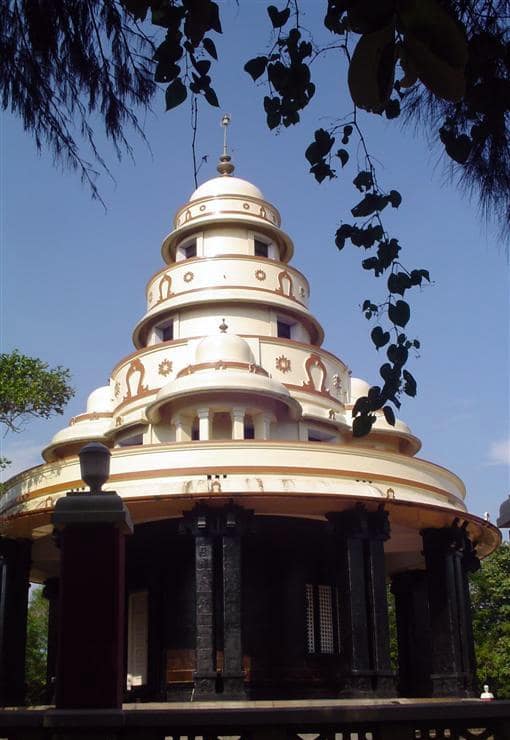
Temple in Varkala
Sivagiri Mutt
Varkala, Kerala
The hill where Sree Narayana Guru died in 1928, and the centre of the movement that broke temple entry open in Kerala. His samadhi is the object of the pilgrimage; the message on the gate is one caste, one religion, one god for humankind.
Photo: Pratheepps — public domain, via Wikimedia Commons
Overview
Who it's to, and what's expected
Deity
Sree Narayana Guru's samadhi
- Entry
The site is open to visitors of all backgrounds, regardless of their caste, creed, or religion.
- Prasadam
The temple does not follow the traditional practice of offering food (nivedyam) to the deity.
Usually visited with
Time your visit
The darshan clock
A single opening-hours line cannot express a midday closure or an evening ceremony.
5:30 AM
Opening hours
The Sivagiri Mutt is open daily from 5:30 AM to 7:30 PM.
Rules, timings and fees change — confirm locally before you rely on this.
How long this takes
Ways in
The difference between a twenty-minute visit and a three-hour one.
Visiting hours
- Free and open to all, about 5:30 AM to 7:30 PM; the samadhi receives visitors steadily through the day at a devotional, unhurried pace
The Sivagiri Pilgrimage
- 30 December to 1 January, when tens of thousands in yellow walk to the samadhi - the hill at its fullest, with public meetings and group weddings through the days
Jayanti and Samadhi Day
- The August-September birth anniversary and the September passing anniversary bring processions and gatherings
At the gate
Before you go in
What gets refused, and what you cannot take past the door.
What to wear
During the annual pilgrimage, pilgrims are expected to wear yellow, ideally using white cloth dyed with turmeric rather than purchasing new silk or fabric.
When not to come — unless you mean to
Festival windows
These follow lunar calendars and move by weeks each year, so the windows are months, not dates.
30 December – 1 January
ModerateSivagiri Pilgrimage
Tens of thousands arrive dressed in yellow over three days. If you are in Varkala for the beach at new year, the town is not quiet — and this is why.
Crowd levels are our reading of the notes above, not an official measure. Rules, timings and fees change — confirm locally before you rely on this.
General guidance
Planning the visit
Customary practice and what Varkala's climate means for a barefoot visit — not rules posted at this temple. Anything specific to Sivagiri Mutt is above.
Come in winter
Winter is when Varkala is most comfortable to walk around, which matters here because a temple visit is done on foot and barefoot. Locally the window is given as october to march.
Salt air and bare feet
Coastal temple courtyards stay damp and the stone can be slick underfoot, particularly near a tank or a sea-facing entrance. Take the steps slowly rather than the queue's pace.
Arriving by train
Varkala has a railway station, and auto-rickshaws wait outside it. Agree the fare or use a meter before you set off, and expect to be dropped a short walk from the temple rather than at its door.
No airport here
Varkala has no airport of its own, so the last leg is by road or rail. Plan the return the same way — the last bus out is often earlier than visitors expect.
Outfit guide
What to wear at Sivagiri Mutt
Cover shoulders and knees — the rules above win over anything here.
Trending wear for this spot
Popular modern looks travellers are wearing across Varkala.
Traditional wear for this spot
Timeless, cultural looks that suit Sivagiri Mutt.
Sivagiri Mutt, Varkala
The hill where Sree Narayana Guru died in 1928, and the centre of the movement that broke temple entry open in Kerala. His samadhi is the object of the pilgrimage; the message on the gate is one caste, one religion, one god for humankind.
🕉️ The reformer on the hill
Sree Narayana Guru (1856-1928) is the central figure of modern Kerala: a saint who took a society ordered by caste and made its temples answerable to a higher message — one caste, one religion, one god. He consecrated shrines open to all when none were, and the movement that grew around him changed what Kerala's temples were.
He came to Varkala in 1904 and chose the Sivagiri hill for his hermitage; when the Travancore state gifted the surrounding lands, the Mutt grew here — and the hill became the movement's home. The same hand built the Kudroli temple in Mangalore a decade later; the two shrines are the same argument in two states.
🛕 The hill today
The Mahasamadhi — the Guru's resting place — stands on its elevated platform and is the object of the pilgrimage: a white mutt above the red laterite of Varkala, quiet, tended, and visited by thousands every week.
The octagonal Sarada temple holds the goddess of learning at the centre of the complex — consecrated by the Guru himself, and carrying his reforms in its practice: no oil-bathing, no food offerings, none of the customs he set aside. The Guru's residence stands as it was, his belongings displayed. The Mutt is managed by the SNDP Yogam, the organisation he founded, on some two hundred acres of the hill.
💛 The yellow pilgrimage
Every 30 December to 1 January, tens of thousands walk to the samadhi in yellow — the Sivagiri Pilgrimage, one of the defining images of Kerala's religious life.
The yellow is the Guru's own instruction, and the instructions are the sermon: wear yellow, the colour of the Buddha's garments; buy no new silk; dye a white cloth in turmeric and wear it dried. The pilgrimage's first walkers, five young men from Elavumthitta in 1933, wore exactly that. During the days, public meetings and group weddings run on the hill — the community conducting its own affairs at the Guru's resting place.
If you are in Varkala for the beach at new year, the town is not quiet — and this is why.
📅 The year on the hill
Gurudeva Jayanti — the Guru's birth anniversary, on the Chathayam star in August or September — brings processions, debates and seminars. Samadhi Day in September keeps the anniversary of his passing. Outside these weeks the hill is at its working quiet: the mutt's daily routine, visitors at the samadhi, and the breeze off the cliff.
📜 The reforms, read close
The Sarada temple carries the Guru's message in its practice, and the details are worth knowing before you enter. He set aside the oil-bathing of images and the offering of food — the nivedyam that every other Kerala temple performs — because the worship he wanted was simpler, cleaner, and addressed to the deity rather than to custom. A century on, the temple still performs none of it: what you find is the quietest ritual floor in Kerala, and the difference is the teaching.
The same hand consecrated shrines across two states — Kudroli in Mangalore among them — always open, always simple, always the same argument. Sivagiri was his home; the others are his footprints.
🌄 The hill and the coast
Sivagiri's hill is the red laterite of the Varkala cliff, lifted inland — and the mutt stands in its gardens with the breeze that the coast sends up all day. The walk from the gate climbs gently; benches sit at intervals; the samadhi platform comes into view last, white against the green. It is a hill built for slow visiting, and the slow visit is the tribute.
🕒 Timings
Open daily about 5:30 AM to 7:30 PM — some listings give morning and evening sessions with an afternoon gap, so the Mutt's own notice is the safe guide. Entry is free, and the site is open to visitors of all backgrounds, caste, creed or religion — which is not a courtesy here but the founding rule.
📍 Varkala — the cliff, the beach and the temple
Sivagiri stands about 3 km east of Varkala town, on the hill behind the coast — and the pairing is the point: the Janardanaswamy temple on the cliff, Papanasam beach below it, and the Guru's hill behind — pilgrimage, sea and reform within one small town. Varkala's epithet in the tradition is the southern Kashi, and the epithet predates the beach crowd.
Autos run the 3 km from town through the day; allow an hour at the Mutt, longer if the Sarada temple's quiet takes you.
Last verified: 2026. The Guru's dates (1856-1928), the 1904 arrival and hermitage on Sivagiri, the Travancore land gift, the Sarada temple consecrated by the Guru with the abolished customs, the SNDP management and the two hundred acres, the 30 December to 1 January pilgrimage in yellow with the turmeric-dye instruction and the 1933 first walkers from Elavumthitta, the Jayanti and Samadhi Day observances, the about 5:30 AM to 7:30 PM hours, and the open-to-all rule are documented. Session times shift; the Mutt's own notice is authoritative.
Questions
Sivagiri Mutt — FAQ
Who is Sivagiri Mutt dedicated to?
Sivagiri Mutt in Varkala is dedicated to Sree Narayana Guru's samadhi.
Who can enter Sivagiri Mutt?
The site is open to visitors of all backgrounds, regardless of their caste, creed, or religion.
What is the dress code at Sivagiri Mutt?
During the annual pilgrimage, pilgrims are expected to wear yellow, ideally using white cloth dyed with turmeric rather than purchasing new silk or fabric.
What prasadam is offered at Sivagiri Mutt?
The temple does not follow the traditional practice of offering food (nivedyam) to the deity.
Checked, not remembered
Sources
Every rule and timing above traces back to one of these.