
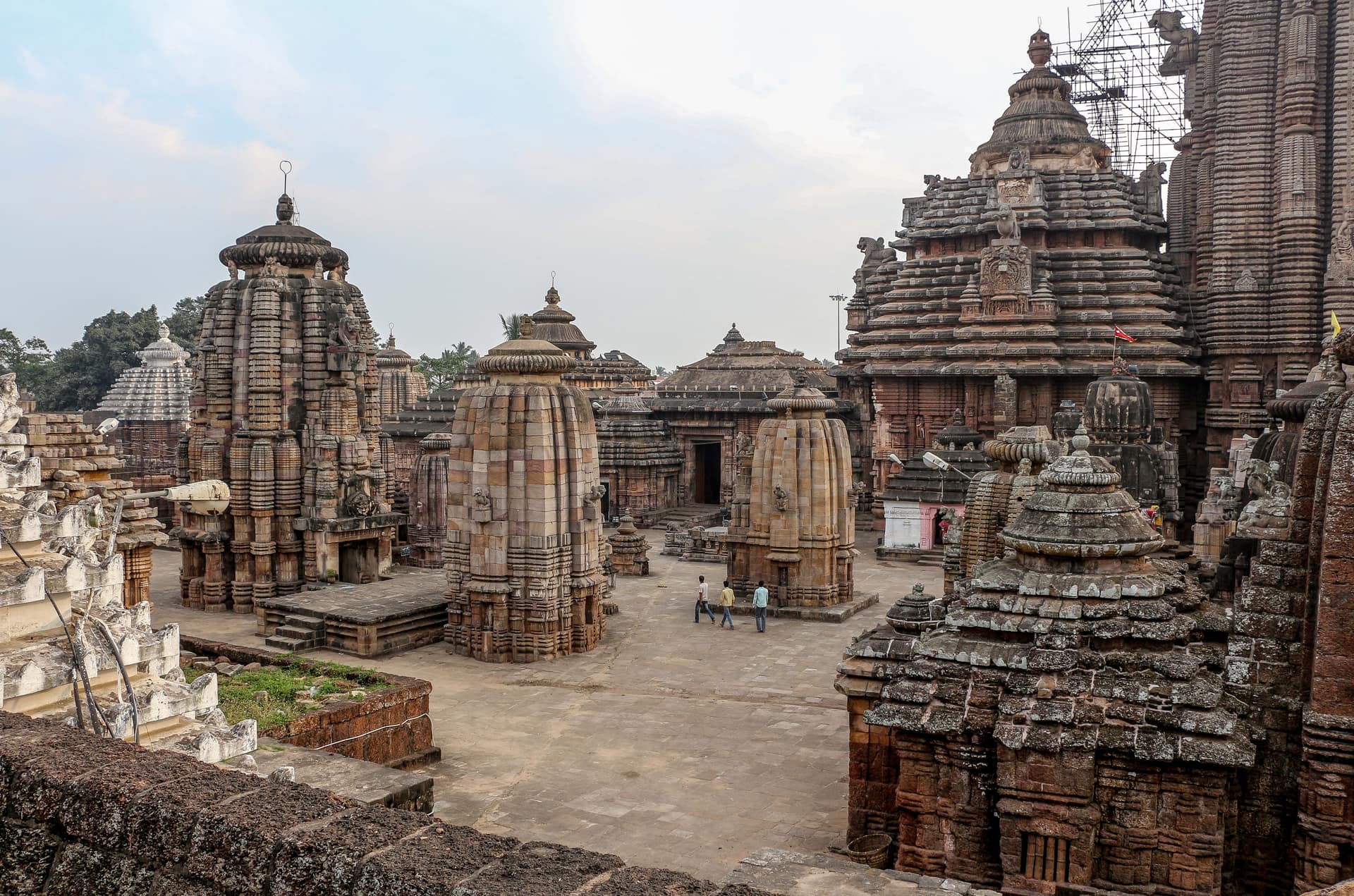
Temple in Bhubaneswar
Lingaraja Temple
Bhubaneswar, Odisha
The great 11th-century Kalinga temple the old town is built around, and still very much in worship — which is why, unlike Khajuraho, you cannot simply walk in.
Photo: Bernard Gagnon — CC BY-SA 3.0, via Wikimedia Commons
Overview
Who it's to, and what's expected
Deity
Shiva as Lingaraja
Tradition
Shiva temple
- Entry
Entry to the temple is restricted to Hindus; non-Hindu visitors may view the complex from a designated elevated platform.
- Footwear
Leather shoes are prohibited inside the temple.
- Access
The temple is restricted to Hindus, but a viewing platform is available for non-Hindus to observe the premises.
- Prasadam
Offerings of rice, sweets, and fruits are made to the deity in the Bhoga Mandapa and subsequently distributed to devotees.
Usually visited with
Time your visit
The darshan clock
A single opening-hours line cannot express a midday closure or an evening ceremony.
7:00 AM
Opening hours
The temple is open daily from 7:00 AM to 7:00 PM.
Rules, timings and fees change — confirm locally before you rely on this.
How long this takes
Ways in
The difference between a twenty-minute visit and a three-hour one.
General darshan (Hindus)
- Free entry with no ticket
- The morning puja window of 6:00 to 8:00 AM is when the temple is most alive and is also the calmest; the sanctum may close briefly in the afternoon for bhoga rituals
Curzon Viewing Platform (non-Hindus)
- The designated elevated platform on the north side, available during daylight hours
- It delivers the 180-foot deul in full and the outer carving, but not the sanctum, the Harihara Linga or the interior ritual
Maha Shivratri and Ashokashtami
- The heaviest periods of the year, with all-night worship at Shivratri and a chariot procession at Ashokashtami
- The platform becomes correspondingly crowded
At the gate
Before you go in
What gets refused, and what you cannot take past the door.
What to wear
Visitors are required to wear traditional, modest clothing and must avoid wearing shorts or sleeveless tops.
Phones and cameras
Mobile phones and cameras are strictly prohibited inside the temple. However, photography is permitted from the Curzon Viewing Platform located on the north side of the complex.
Rules, timings and fees change — confirm locally before you rely on this.
When not to come — unless you mean to
Festival windows
These follow lunar calendars and move by weeks each year, so the windows are months, not dates.
Maha Shivratri
Ashokashtami Rath Yatra
Kartik Purnima
Makar Sankranti
Practicalities
The things that go wrong
Book through official channels, and treat anyone promising a guaranteed slot as a warning sign.
What to watch for
- Offering to arrange entry for non-Hindu visitors, or claiming the restriction can be lifted for a payment
- Entry inside the main boundary walls is restricted to Hindus as a matter of religious practice and is enforced; the Curzon Viewing Platform on the north side is the provision for other visitors, and it is free
- Charging for the viewing platform
- It is a designated facility outside the main entrance gate, available during daylight hours at no cost
- Charging an entry fee
- Entry to Lingaraj is free; anyone collecting money at the gate is not authorised
- Anyone offering to carry a phone or camera inside for you
- Both are strictly prohibited inside the temple, and photography is permitted from the viewing platform instead
- Guides attaching themselves in the old town and producing a fee after a short explanation of Kalinga architecture
- Bhubaneswar's temples are close together and well signposted; if you want a guide, arrange one through your hotel at an agreed price
- Being told the temple is open late into the evening without qualification
- Published hours differ (6:00 AM-9:00 PM versus 6:30 AM-7:30 PM) and the sanctum may close briefly in the afternoon for bhoga rituals, so a morning visit is the reliable plan
One place, many temples
Other temples in Bhubaneswar
General guidance
Planning the visit
Customary practice and what Bhubaneswar's climate means for a barefoot visit — not rules posted at this temple. Anything specific to Lingaraja Temple is above.
Circling the shrine
At most Shaiva temples the circuit around the sanctum is not completed in a full circle — the channel draining the abhishekam is not crossed. Walk to it, turn, and come back the way you came. Watching what the queue in front of you does is the reliable guide.
Come in winter
Winter is when Bhubaneswar is most comfortable to walk around, which matters here because a temple visit is done on foot and barefoot. Locally the window is given as october to march.
Stone gets hot — go early
You will be barefoot from the shoe rack onwards, often across an open courtyard. Between late morning and mid-afternoon in the hot months that stone is genuinely painful to stand on. Socks help, and are permitted almost everywhere shoes are not.
Arriving by train
Bhubaneswar has a railway station, and auto-rickshaws wait outside it. Agree the fare or use a meter before you set off, and expect to be dropped a short walk from the temple rather than at its door.
Outfit guide
What to wear at Lingaraja Temple
Cover shoulders and knees — the rules above win over anything here.
Trending wear for this spot
Popular modern looks travellers are wearing across Bhubaneswar.


Traditional wear for this spot
Timeless, cultural looks that suit Lingaraja Temple.
Lingaraja Temple, Bhubaneswar
Lingaraja is the great eleventh-century Kalinga temple the old town of Bhubaneswar is built around, and it is still very much in worship — which is why, unlike Khajuraho's monuments, you cannot simply walk in.
Entry is restricted to Hindus. Non-Hindu visitors may view the complex from a designated elevated platform outside, and that platform — the Curzon Viewing Platform on the north side — is where most visitors to this page will actually spend their time. It is worth saying plainly at the start, because it determines what kind of visit this is.
🛕 Harihara: Shiva and Vishnu in one
The deity is Shiva worshipped as Harihara — a unified form of Shiva and Vishnu. The lingam is specifically the Harihara Linga, and it is believed to be Swayambhu, self-originated rather than installed.
That combined identity is unusual and consequential. A temple whose principal deity is Shiva-and-Vishnu together is a statement about sectarian reconciliation as much as a place of worship, and it is one of the reasons Lingaraj holds the position it does in Odia religious life. The temple finds mention in the Brahma Purana.
Bhubaneswar's older name for the area is Ekamra Kshetra — the mango-grove field — and the city's epithet, the "Temple City of India", rests substantially on this temple and the hundreds of others around it.
🏛️ The peak of Kalinga architecture
Built in the eleventh century by the Somavamshi dynasty, with major contribution and reconstruction under King Yayati II, Lingaraj represents the absolute peak of the Kalinga architectural style.
Its deul (tower) rises about 180 feet, making it the largest temple in Bhubaneswar and one of the tallest in eastern India. The style is composed of the three characteristic Kalinga elements — Rekha deula, Pidha deula and Khakhara deula — and the tower's vertical, curvilinear profile with its clustered subsidiary spires is the form that defines the whole school.
To see what that style looks like a century later and in a different key, Rajarani Temple is about a kilometre away — same dynasty, same period, and famously empty of any deity.
🚫 Who may enter, and the viewing platform
Entry inside the main temple boundary walls is restricted to Hindus, in common with the practice at Puri's Jagannath Temple.
Non-Hindu visitors can view the temple from the elevated viewing platform built outside the main entrance gate, during daylight hours. The platform is specifically the Curzon Viewing Platform, on the north side of the complex.
Two things make this more acceptable than it first sounds:
- The platform still delivers the tower in full. The 180-foot deul is the building's principal achievement and it is visible from outside better than from within the courtyards, where it is foreshortened.
- The exterior carving is what most visitors come for, and the outer walls are readable from the platform and the surrounding compound.
What you will not see from the platform is the sanctum, the Harihara Linga, or the interior ritual. Visitors wanting those should understand before travelling that they will not get them.
Do not attempt to enter, and do not pay anyone who offers to arrange it. The restriction is enforced and is a matter of religious practice rather than site management.
🕒 Timings — a real conflict
- Two sources give 6:00 AM to 9:00 PM
- One gives 6:30 AM to 7:30 PM
The ritual schedule is more consistently reported:
- Morning puja: 6:00 to 8:00 AM
- Madhyana Dhupa (the midday food offering): around 12:00 PM
- Evening aarti: 8:30 PM
The sanctum may close briefly in the afternoon for bhoga rituals, consistent with the midday offering. Entry is free, and the temple is open all days.
Plan for a morning visit — both for the light on the deul and because morning puja is when the temple is most alive.
🍛 Bhoga Mandapa, and the prasad
Offerings of rice, sweets and fruits are made to the deity in the Bhoga Mandapa and subsequently distributed to devotees. The Bhoga Mandapa is the hall of offerings, a distinct structure in the Kalinga temple plan sitting between the assembly hall and the sanctum.
The midday Madhyana Dhupa around 12:00 PM is the principal offering of the day, and prasad distribution follows it. This is one of the clearest markers of the temple's active life — it is a working shrine with a full daily offering cycle, not a monument with a ritual past.
🛕 Rules
Visitors are required to wear traditional, modest clothing and must avoid shorts or sleeveless tops. The expectation is real and is enforced for those entering.
Mobile phones and cameras are strictly prohibited inside the temple. However, photography is permitted from the Curzon Viewing Platform on the north side — so non-Hindu visitors can photograph the temple, and Hindu visitors should leave devices outside.
Leather shoes are prohibited inside the temple. Leather more broadly is treated as inappropriate in the precinct, so leave leather belts, bags and wallets with your footwear.
🌸 Festivals
- Maha Shivratri — the temple's great occasion, observed with all-night worship and the heaviest attendance of the year. Lingaraj's Shivratri is among the largest in eastern India.
- Ashokashtami Rath Yatra — the chariot procession, Lingaraj's most distinctive festival, when the deity is taken in procession; it is a major Odia occasion and much less known outside the state than Puri's Rath Yatra.
- Kartik Purnima — November, with the sacred tank and the temple both at their busiest
- Makar Sankranti — January
Chandrashekara and the temple's sacred tank feature in the Kartik observances, and the tank is part of the complex's ritual geography.
📍 Where it is, and the Temple City
Lingaraj sits in Bhubaneswar's old town (Ekamra Kshetra), which is dense with temples from the same period and later — the city's claim to be the "Temple City of India" rests on this concentration.
About 4.5 km from Biju Patnaik International Airport and a short drive from Bhubaneswar railway station. Rajarani Temple is roughly a kilometre away, Mukteshwara and Parashurameshwar are within the old town, and the Bindu Sagar tank sits beside Lingaraj itself.
A sensible old-town morning: Lingaraj (from the platform if you are not Hindu), then Rajarani, then Mukteshwara — all within walking distance, all Kalinga, all from a narrow span of centuries, and together the best single introduction to the style anywhere in India.
⚠️ Practical notes
- Non-Hindu visitors: go for the platform and the exterior. You will see the 180-foot deul in full and the outer carving, and you will not see the sanctum. Know that before you go.
- Do not pay anyone offering entry. The restriction is enforced and no payment lifts it.
- Leave phones, cameras and leather outside. All three are prohibited inside.
- Go in the morning for the light and for the 6:00–8:00 AM puja.
- Combine with Rajarani and Mukteshwara on foot — the old town's temples are close together.
- October to March is the comfortable season; Odisha's summer heat is severe and the complex is exposed.
Last verified: 2026. Timings, entry arrangements and any charges are published by the temple itself and do change - confirm them with the temple's own official website or counter before travelling rather than relying on any third-party listing.
Questions
Lingaraja Temple — FAQ
Who is Lingaraja Temple dedicated to?
Lingaraja Temple in Bhubaneswar is dedicated to Shiva as Lingaraja.
Who can enter Lingaraja Temple?
Entry to the temple is restricted to Hindus; non-Hindu visitors may view the complex from a designated elevated platform.
What is the dress code at Lingaraja Temple?
Visitors are required to wear traditional, modest clothing and must avoid wearing shorts or sleeveless tops.
Do I have to take my shoes off at Lingaraja Temple?
Leather shoes are prohibited inside the temple.
Can I take photos inside Lingaraja Temple?
Mobile phones and cameras are strictly prohibited inside the temple. However, photography is permitted from the Curzon Viewing Platform located on the north side of the complex.
What prasadam is offered at Lingaraja Temple?
Offerings of rice, sweets, and fruits are made to the deity in the Bhoga Mandapa and subsequently distributed to devotees.
Is Lingaraja Temple wheelchair accessible?
The temple is restricted to Hindus, but a viewing platform is available for non-Hindus to observe the premises.
Checked, not remembered
Sources
Every rule and timing above traces back to one of these.
- visit.bhubaneswar.mevisit.bhubaneswar.me
- Lingaraj templeincredibleindia.gov.in
- Lingaraj temple darshandarshansbooking.com
- Lingaraja temple bhubaneswar timings history aarti travel guidetusktravel.com
- Lingaraj temple bhubaneswar history timingstemplewalks.com
- Lingaraja temple bhubaneswarbhubaneswartourism.in
- Lingaraj templepuritaxi.in