
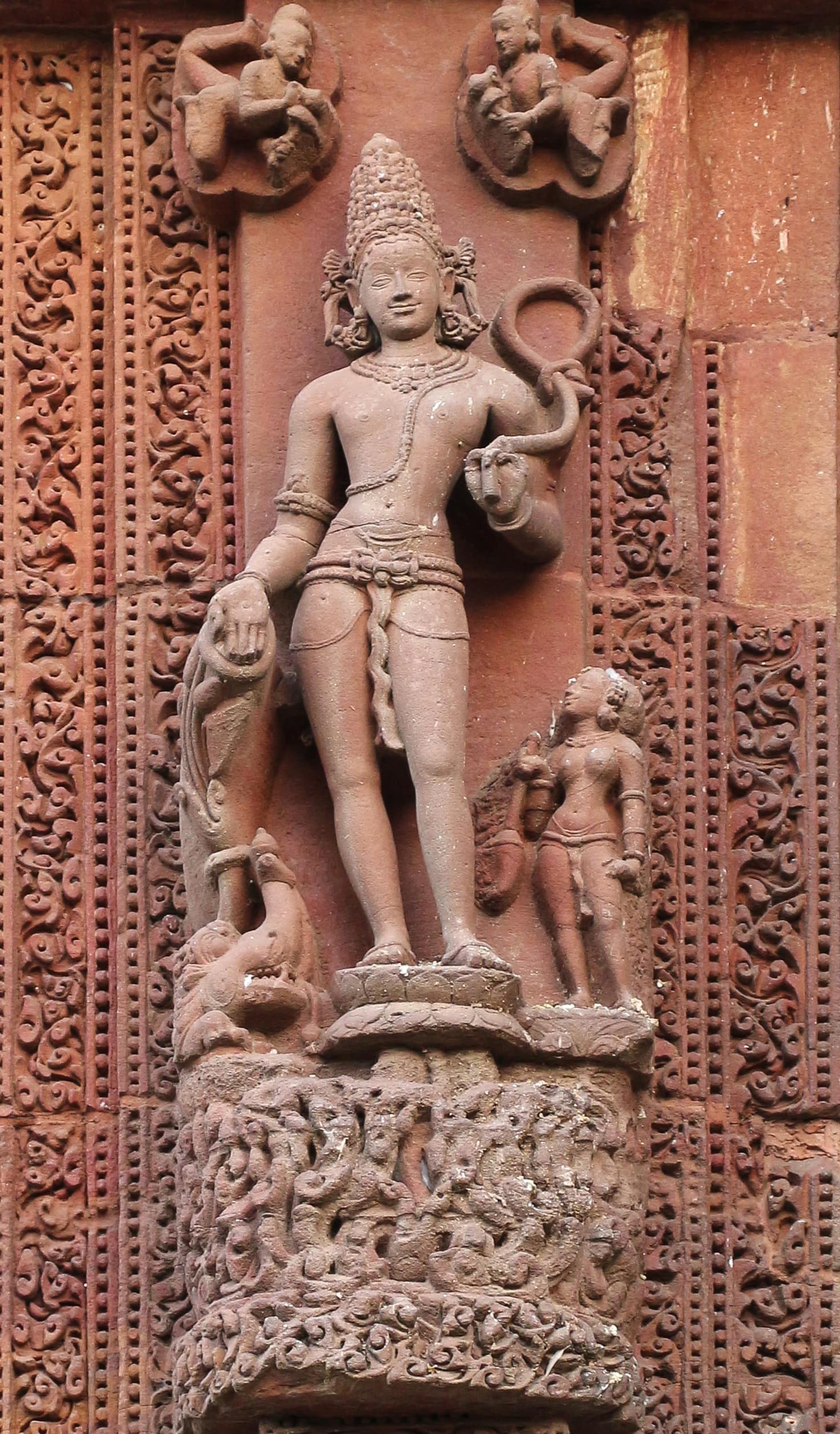
Temple in Bhubaneswar
Rajarani Temple
Bhubaneswar, Odisha
A temple with nothing in it. The original image was removed when the sanctum collapsed and was never replaced, so there is no deity and no worship — which is precisely why it is open to everyone regardless of religion, unlike Lingaraja a kilometre away. It is visited for the carving on the tower.
Photo: Bernard Gagnon — CC BY-SA 3.0, via Wikimedia Commons
Overview
Who it's to, and what's expected
Deity
None — the sanctum is empty
Tradition
Shiva temple
- Entry
The temple is maintained by the Archaeological Survey of India as a ticketed monument, and there are no images inside the sanctum.
- Footwear
Footwear comes off before the temple platform, as at ASI monument temples generally. Wear something easy to remove, and note the more important constraint here: the grounds have uneven surfaces and are not wheelchair-friendly, so footwear with grip and stability matters more than convenience.
- Access
The temple grounds have uneven surfaces and are not wheelchair-friendly.
- Prasadam
None, and none is expected. The temple has no deity and no worship - the original image was removed when the sanctum collapsed and was never replaced - so there is no ritual, no offering and no prasad distribution. It is an ASI monument open to all visitors rather than a shrine, which is the single most important thing to know before arriving, particularly if you are coming from Lingaraja where a full daily offering cycle continues.
Usually visited with
How long this takes
Ways in
The difference between a twenty-minute visit and a three-hour one.
ASI monument entry
- A ticketed archaeological site with no ritual timetable, no aarti and no darshan queue
- Buy the ASI ticket (Rs25 Indian and SAARC, Rs300 foreign, under-15s free) online or by cashless QR to avoid the counter; allow thirty to forty-five minutes for the visit."
Rajarani Music Festival
- The classical music festival held annually on the temple lawns with the illuminated building as its backdrop - one of Odisha's better-known cultural events and the reason to visit in January
- Confirm dates and tickets with Odisha tourism
At the gate
Before you go in
What gets refused, and what you cannot take past the door.
What to wear
No dress code is imposed by the ASI, since this is a ticketed monument with no deity and no worship rather than an active temple - a genuine contrast with Lingaraja a kilometre away, where traditional modest clothing is required and shorts or sleeveless tops are prohibited. Modest dress is still appropriate by local custom, and practical considerations dominate: the grounds are exposed, so light covering plus a hat and water outside the cooler months.
Phones and cameras
Photography is straightforward here in a way it is not at Bhubaneswar's active temples. As an ASI monument there is no camera prohibition of the kind at Lingaraja, where phones and cameras are strictly banned inside and photography is permitted only from an external viewing platform, and no camera fee of the kind charged at Khajuraho's Matangeshwar. The yellow-red stone, the clustered spires and the figural sculpture make it one of the most photographed temples in the city. Tripods and commercial filming require prior ASI permission.
Rules, timings and fees change — confirm locally before you rely on this.
When not to come — unless you mean to
Festival windows
These follow lunar calendars and move by weeks each year, so the windows are months, not dates.
Rajarani Music Festival
Best visiting season
Practicalities
The things that go wrong
Book through official channels, and treat anyone promising a guaranteed slot as a warning sign.
What to watch for
- Charging above the ASI ticket rate, or inventing a separate temple fee
- The ASI ticket is Rs25 for Indian and SAARC visitors and Rs300 for foreign nationals, with children below 15 free - and there is no additional charge, since this is a monument rather than a shrine
- Claiming there is a deity or worship inside, or that a puja can be arranged
- The sanctum has been empty since the original image was removed after a collapse and was never replaced; there is no ritual and no prasad
- Anyone implying non-Hindu visitors face restrictions here
- Rajarani is open to all visitors worldwide regardless of religion or nationality - the restriction applies at Lingaraja about a kilometre away, and the two are routinely confused
- Guides attaching themselves at the gate and producing a fee afterwards
- The site is small, well signposted and takes thirty to forty-five minutes; arrange a guide through your hotel at an agreed price if you want the Kalinga architecture explained properly
- Claims that tripods or drone photography can be permitted for a payment on the spot
- Both require prior ASI permission, as at every ASI site, and no one at the gate can grant it
- Charging for photography
- There is no camera fee at Rajarani, unlike at Khajuraho's Matangeshwar, and no prohibition of the kind at Lingaraja
One place, many temples
Other temples in Bhubaneswar
General guidance
Planning the visit
Customary practice and what Bhubaneswar's climate means for a barefoot visit — not rules posted at this temple. Anything specific to Rajarani Temple is above.
Circling the shrine
At most Shaiva temples the circuit around the sanctum is not completed in a full circle — the channel draining the abhishekam is not crossed. Walk to it, turn, and come back the way you came. Watching what the queue in front of you does is the reliable guide.
Come in winter
Winter is when Bhubaneswar is most comfortable to walk around, which matters here because a temple visit is done on foot and barefoot. Locally the window is given as october to march.
Stone gets hot — go early
You will be barefoot from the shoe rack onwards, often across an open courtyard. Between late morning and mid-afternoon in the hot months that stone is genuinely painful to stand on. Socks help, and are permitted almost everywhere shoes are not.
Arriving by train
Bhubaneswar has a railway station, and auto-rickshaws wait outside it. Agree the fare or use a meter before you set off, and expect to be dropped a short walk from the temple rather than at its door.
Outfit guide
What to wear at Rajarani Temple
Cover shoulders and knees — the rules above win over anything here.
Trending wear for this spot
Popular modern looks travellers are wearing across Bhubaneswar.


Traditional wear for this spot
Timeless, cultural outfits worn across Bhubaneswar.
Rajarani Temple, Bhubaneswar
Rajarani is a temple with nothing in it. The original image was removed when the sanctum collapsed and was never replaced, so there is no deity and no worship — and that is precisely why it is open to everyone regardless of religion, unlike Lingaraja about a kilometre away.
It is one of the few great Indian temples where no visitor is excluded, and one of the few where the architecture is the entire subject.
🪨 The stone that gives it its name
The temple is built of a distinctive yellowish-red, fine-grained sandstone locally called Rajarania stone, and that is where the name comes from — the temple is named after its material rather than after a deity, a ruler or a legend.
This is unusual and worth noticing, because it is a direct consequence of the temple having no god in it. **A temple with a deity gets the deity's name. A temple without one gets the name of its stone.
🛕 An older name, and who built it
The temple's historical name is Indreswara, and it was built by the Somavamshi king Indraratha in the **eleventh century CE, around 1000 to 1040. That places it within a few decades of Lingaraja, built by the same dynasty, and the two are best seen together for exactly that reason: same patrons, same period, same architectural school — and opposite fates. Lingaraja is the largest and most actively worshipped temple in the city with restricted entry; Rajarani is empty, ticketed by the ASI, and open to all.
🏛️ The architecture
Rajarani is a Kalinga Pancharatha Rekha deula with clustered angashikharas — a tower of the curvilinear Rekha type, organised on a five-fold (pancharatha) plan, **surrounded by clusters of smaller replica spires climbing the elevation. That clustered spire treatment is the building's signature. Like Kandariya Mahadeva at Khajuraho, whose subsidiary spires were meant to read as a Himalayan range, Rajarani's angashikharas give the tower a bristling, mountainous silhouette rather than a single clean cone. Two regional schools arriving independently at the same idea is one of the more interesting comparisons in Indian temple architecture.
The temple is also celebrated for its figural sculpture, particularly its graceful female figures and the guardian deities of the eight directions (dikpalas) carved around the tower's base — a sculptural programme that is the reason the temple is famous despite having nothing to worship in it.
🎟️ Entry, tickets and hours
Maintained by the Archaeological Survey of India (Bhubaneswar Circle) as a ticketed monument, and **open to all visitors worldwide regardless of religion or nationality.
- **ASI ticket: ₹25 for Indian and SAARC visitors
- **₹300 for foreign nationals
- **Free for children below 15 years
- **Cashless QR-code payment and online booking are available through the ASI
- Open 6:30 AM to 7:30 PM daily, 365 days a year, from sunrise to sunset
There are no images inside the sanctum, which is worth knowing before you arrive, since visitors coming from Lingaraja often expect a deity.
🎶 The Rajarani Music Festival
The temple hosts the Rajarani Music Festival every January on its lawns, a classical music festival with the illuminated temple as the backdrop.
It is one of Odisha's better-known cultural events and the obvious reason to visit in January. The setting is the appeal: an empty eleventh-century temple, floodlit, with classical music performed in front of it and no religious ceremony competing for attention — a combination few Indian monuments can offer precisely because most of them are active shrines.
Confirm dates and tickets with Odisha tourism for your year rather than assuming a fixed schedule.
📷 Photography
As an ASI monument rather than a working temple, photography is straightforward here. There is no camera prohibition of the kind at Lingaraja (where phones and cameras are strictly banned inside and photography is only permitted from an external platform) and **no camera fee of the kind at Khajuraho's Matangeshwar. The temple is one of the most photographed in Bhubaneswar precisely because it can be — the yellowish-red stone against a lawn, the clustered spires, and the figural sculpture at close range. Tripods and commercial filming require prior ASI permission, as at all ASI sites.
🚶 Access
The temple grounds have uneven surfaces and are not wheelchair-friendly. That is recorded plainly: this is a monument on original ground with no ramp or level access provision, so visitors with mobility limitations should expect difficulty and plan for the exterior rather than a full circuit.
The site is small and the visit is short, which partly offsets it — **but the ground is the constraint, not the distance.
📍 The old-town circuit
Rajarani sits on Tankapani Road in Bhubaneswar's old town (Ekamra Kshetra), about a kilometre from Lingaraja. The circuit that makes Bhubaneswar worth a day:
- Lingaraja — the eleventh-century peak of the Kalinga style, 180-foot deul, worship continuing, entry restricted to Hindus
- Rajarani — same dynasty and period, empty sanctum, open to all, named for its stone
- Mukteshwara — smaller, earlier and celebrated for its torana (ornamental arch)
- Parashurameshwar — among the oldest surviving temples in the city
- Bindu Sagar tank — the sacred water body beside Lingaraj
All are within walking distance of each other. Together they are the best single introduction to Kalinga architecture anywhere in India, and the reason Bhubaneswar is called the Temple City.
About 4 km from Biju Patnaik International Airport and 4.5 km from Bhubaneswar railway station (15 minutes via Tankapani Road).
⚠️ Practical notes
- See it alongside Lingaraja. Same dynasty, same century, opposite fate — the comparison is the point, and it is a kilometre apart.
- Go in the late afternoon for the best light on the yellowish-red stone, and stay if the temple is floodlit.
- January for the music festival, if you can time it.
- Allow thirty to forty-five minutes. It is a small site; the value is in looking closely at the spire clusters and the figural carving.
- Buy the ASI ticket in advance online if you want to avoid the counter, and note children under 15 are free.
- October to March for weather; the grounds are exposed and Odisha's summer is severe.
*Last verified: 2026. The Indreswara historical name, the Somavamshi king Indraratha attribution, the c. 1000-1040 CE date, the Rajarania sandstone that gives the temple its name, the ASI ticket bands (Rs25 Indian/SAARC, Rs300 foreign, under-15 free), the 6:30 AM-7:30 PM daily hours and the January music festival are all documented.
Last verified: 2026. Timings, entry arrangements and any charges are published by the temple itself and do change - confirm them with the temple's own official website or counter before travelling rather than relying on any third-party listing.
Questions
Rajarani Temple — FAQ
Who is Rajarani Temple dedicated to?
Rajarani Temple in Bhubaneswar is dedicated to None — the sanctum is empty.
Who can enter Rajarani Temple?
The temple is maintained by the Archaeological Survey of India as a ticketed monument, and there are no images inside the sanctum.
What is the dress code at Rajarani Temple?
No dress code is imposed by the ASI, since this is a ticketed monument with no deity and no worship rather than an active temple - a genuine contrast with Lingaraja a kilometre away, where traditional modest clothing is required and shorts or sleeveless tops are prohibited. Modest dress is still appropriate by local custom, and practical considerations dominate: the grounds are exposed, so light covering plus a hat and water outside the cooler months.
Do I have to take my shoes off at Rajarani Temple?
Footwear comes off before the temple platform, as at ASI monument temples generally. Wear something easy to remove, and note the more important constraint here: the grounds have uneven surfaces and are not wheelchair-friendly, so footwear with grip and stability matters more than convenience.
Can I take photos inside Rajarani Temple?
Photography is straightforward here in a way it is not at Bhubaneswar's active temples. As an ASI monument there is no camera prohibition of the kind at Lingaraja, where phones and cameras are strictly banned inside and photography is permitted only from an external viewing platform, and no camera fee of the kind charged at Khajuraho's Matangeshwar. The yellow-red stone, the clustered spires and the figural sculpture make it one of the most photographed temples in the city. Tripods and commercial filming require prior ASI permission.
What prasadam is offered at Rajarani Temple?
None, and none is expected. The temple has no deity and no worship - the original image was removed when the sanctum collapsed and was never replaced - so there is no ritual, no offering and no prasad distribution. It is an ASI monument open to all visitors rather than a shrine, which is the single most important thing to know before arriving, particularly if you are coming from Lingaraja where a full daily offering cycle continues.
Is Rajarani Temple wheelchair accessible?
The temple grounds have uneven surfaces and are not wheelchair-friendly.
Checked, not remembered
Sources
Every rule and timing above traces back to one of these.