
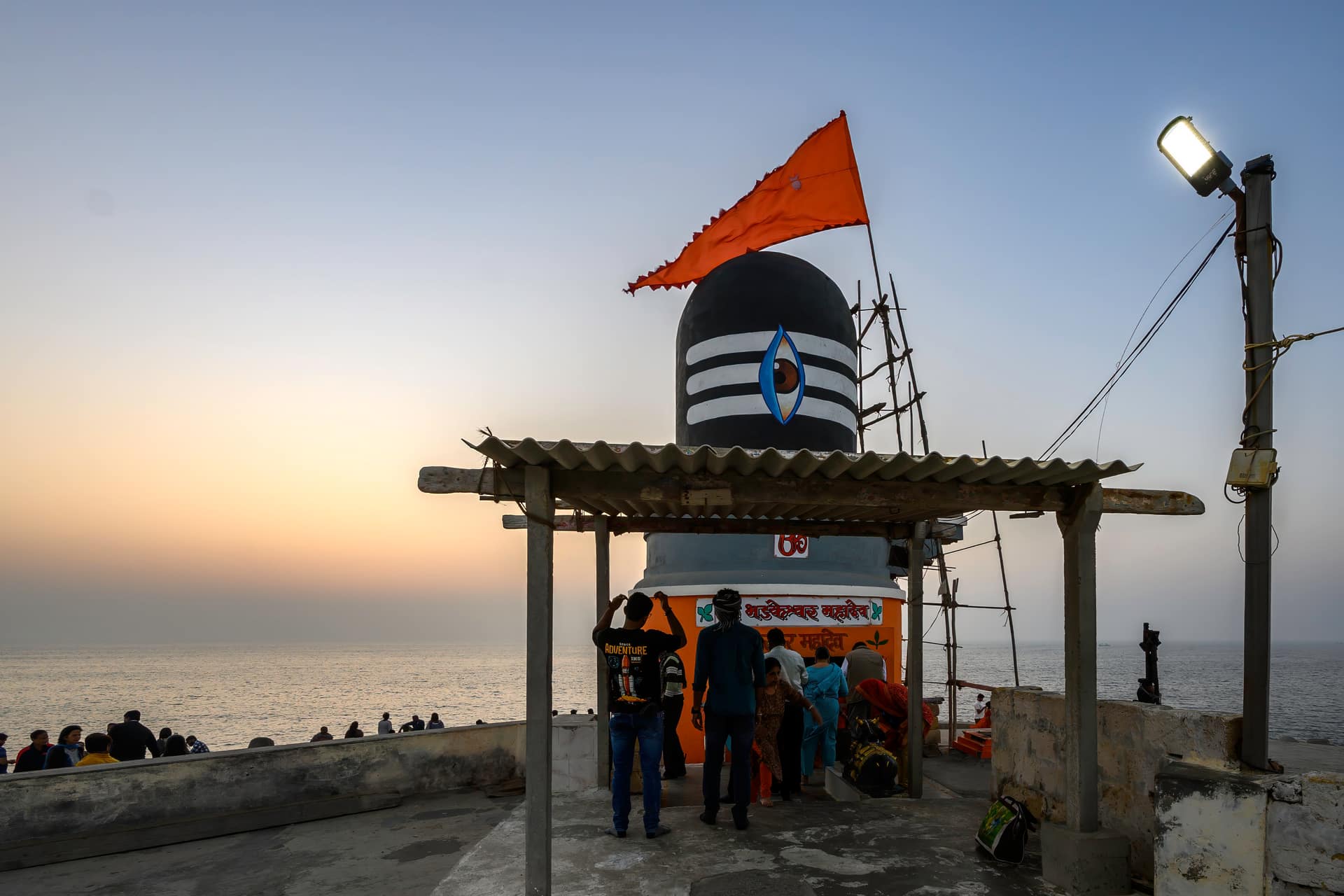
Temple in Dwarka
Bhadkeshwar Mahadev Temple
Dwarka, Gujarat
A small shrine on a limestone outcrop in the Arabian Sea, reached on foot from the shore — and only when the sea lets you.
Photo: Basavaraj M — CC BY-SA 4.0, via Wikimedia Commons
Overview
Who it's to, and what's expected
Deity
Shiva
Tradition
Shiva temple
- Entry
Free entry, with no ticket, booking or charge of any kind - and no facilities on the rock. The governing condition is the tide rather than the clock: at high tide the causeway from the shore is completely submerged and the temple is inaccessible, so you must check a Dwarka tide table and go only in a low-tide window. Published hours of roughly 6:00 AM to 7:00 PM are nominal. Avoid the monsoon from June to September, when seas are rough and access may be restricted entirely.
- Footwear
Footwear comes off before the shrine. Because the approach is a tidal causeway and the steps can have water running over them, wear footwear that is easy to slip off, can get wet and has grip on slippery stone - and leave anything you cannot afford to lose on shore, since there are no lockers on the rock.
- Access
The path to the temple includes steps that may have water swirling over them depending on the tide.
- Prasadam
As a Shiva shrine the offering register is Shaiva rather than the food offerings of Dwarka's Krishna temples - water and bilva leaves poured over the lingam in the standard abhishekam. There are no prasad counters or shops on the tidal rock itself; anything you wish to offer must be brought with you from town.
Usually visited with
Time your visit
The darshan clock
A single opening-hours line cannot express a midday closure or an evening ceremony.
5:00 AM
Opening hours
The temple is open daily from 5:00 AM to 7:00 PM.
Rules, timings and fees change — confirm locally before you rely on this.
How long this takes
Ways in
The difference between a twenty-minute visit and a three-hour one.
No queue
- There is no ticket, no queue management and no facilities
- Access is governed by the tide, so the number of people on the rock at any moment depends on the low-tide window rather than on any managed line
Maha Shivratri
- The one day of the year when this remote tidal rock is at its busiest: thousands gather and an amusement park and fair is held on the site
- Avoid it if you want the solitude the setting promises
At the gate
Before you go in
What gets refused, and what you cannot take past the door.
What to wear
No formal dress code is published for this small seaside shrine, but modest clothing covering shoulders and knees is expected at any active Hindu temple. Practical matters more here: wear something that can get wet at the ankles and dries quickly, since the steps can have water swirling over them.
Phones and cameras
Photography is welcome and this is one of the most photogenic sites in Dwarka - the sunset view of the Arabian Sea from the temple rock and the panoramic coastline are the reason many visitors come. Restrictions apply at the shrine itself; follow any posted signage. Do not let composing a shot keep you on the rock as the tide turns, which is the one real hazard here.
Rules, timings and fees change — confirm locally before you rely on this.
When not to come — unless you mean to
Festival windows
These follow lunar calendars and move by weeks each year, so the windows are months, not dates.
Maha Shivratri
Shravan (Sawan)
Evening low tide at sunset
Practicalities
The things that go wrong
Book through official channels, and treat anyone promising a guaranteed slot as a warning sign.
What to watch for
- Anyone charging for 'access' to the tidal rock or the causeway
- Entry is free and the causeway is public - a person charging you is charging for the tide, which nobody owns
- Being told the temple is open regardless of the tide, or that you can 'make it across quickly'. At high tide the causeway is completely submerged and the water returns fast; this is the one claim at Bhadkeshwar that can hurt you
- Guides offering to time the crossing for you for a fee
- Tide tables for Dwarka are free online and hotel staff and local fishermen know the day's tides without needing to look
- Vendors on the shore pressing flowers, coconuts or offerings at inflated prices on the grounds that nothing is available on the rock
- That part is true - bring what you want from town, at town prices
- Boat operators offering to take you out to the temple by sea when the causeway is submerged
- The temple is not open at high tide whatever the approach, and rough water around a tidal rock is a genuine hazard
One place, many temples
Other temples in Dwarka
General guidance
Planning the visit
Customary practice and what Dwarka's climate means for a barefoot visit — not rules posted at this temple. Anything specific to Bhadkeshwar Mahadev Temple is above.
Circling the shrine
At most Shaiva temples the circuit around the sanctum is not completed in a full circle — the channel draining the abhishekam is not crossed. Walk to it, turn, and come back the way you came. Watching what the queue in front of you does is the reliable guide.
Come in winter
Winter is when Dwarka is most comfortable to walk around, which matters here because a temple visit is done on foot and barefoot. Locally the window is given as october to march.
Salt air and bare feet
Coastal temple courtyards stay damp and the stone can be slick underfoot, particularly near a tank or a sea-facing entrance. Take the steps slowly rather than the queue's pace.
Arriving by train
Dwarka has a railway station, and auto-rickshaws wait outside it. Agree the fare or use a meter before you set off, and expect to be dropped a short walk from the temple rather than at its door.
No airport here
Dwarka has no airport of its own, so the last leg is by road or rail. Plan the return the same way — the last bus out is often earlier than visitors expect.
Outfit guide
What to wear at Bhadkeshwar Mahadev Temple
Cover shoulders and knees — the rules above win over anything here.
Trending wear for this spot
Popular modern looks travellers are wearing across Dwarka.


Traditional wear for this spot
Timeless, cultural outfits worn across Dwarka.

Bhadkeshwar Mahadev Temple
Bhadkeshwar Mahadev sits on a small limestone outcrop in the Arabian Sea, about a kilometre from Dwarka town, reached on foot from the shore by a causeway — and only when the sea lets you.
That single condition governs the entire visit. At high tide the causeway is completely submerged and the temple is inaccessible. Not difficult, not inconvenient — unreachable. Anyone planning a Dwarka day around this temple needs to plan around the tide, not around opening hours.
🌊 The tide is the timetable
- At high tide the causeway connecting the shore to the tidal rock is completely submerged. The temple cannot be reached.
- You must check tide tables for Dwarka and visit only during a low-tide window.
- Aarti is performed in the morning (approximately 6:00 to 7:00 AM) and in the evening (around sunset, 6:00 to 7:00 PM) — but aarti can only happen when the causeway is accessible at low tide. So the ritual schedule itself is tidal.
- Published opening hours of roughly 6:00 AM to 7:00 PM are therefore nominal; the operative constraint is the sea.
The best windows are a morning low tide falling between 6:00 and 10:00 AM, or an evening low tide around sunset. The second is the better one for most visitors, because the sunset view of the Arabian Sea from the temple rock is exceptional — and the rock gives panoramic views of the whole Dwarka coastline.
⚠️ Safety: the tide turns fast
This is the part that matters most, and it is the reason to read this section twice:
- Do not linger on the tidal rock as the tide turns.
- When the water begins returning, the causeway floods quickly — considerably faster than most visitors expect from watching a calm sea.
- Experienced visitors give themselves a clear thirty-minute buffer before the predicted high-tide time to be safely back on shore.
- Avoid the monsoon, June to September, when seas are rough and access may be restricted entirely.
- The steps can have water swirling over them depending on the tide, so they are slippery even when passable.
Build the buffer in. A thirty-minute margin is not caution for its own sake; it is what people who do this regularly allow themselves.
🔎 How to check the tide
Do not guess and do not rely on a temple's published hours. The reliable methods:
- Search "Dwarka tide table" on Google.
- Use the India Meteorological Department's tide prediction portal.
- Tide4fishing.com and Tides.net both publish daily tide charts for Dwarka.
- Ask local fishermen and your hotel staff — they usually know the day's tides without needing to look, and their answer is worth more than any website for the specific day you are going.
Checking the tide the evening before is the single best preparation for this temple.
🛕 What is there
A small shrine built on the rock overlooking the Arabian Sea, enshrining a Shiva lingam. It is modest in every way — this is not a temple you visit for architecture or for sculpture. The draw is the setting: a shrine on a tidal rock in open sea, with the coastline behind you and nothing but water around you at low tide.
Entry is free. There is no ticket, no queue management and no facilities to speak of, which is consistent with the site's character but worth knowing before you go.
Because it is a Shiva temple, the offering and ritual register is Shaiva — water, bilva leaves and the standard lingam abhishekam rather than the food offerings of Dwarka's Krishna temples.
🌸 Maha Shivratri — and an unexpected fair
Maha Shivratri is the temple's great occasion, and something unusual happens: an amusement park and fair is held on the site on that day, when thousands of people gather to pay homage to Lord Shiva.
So the one day of the year when this remote tidal rock is at its busiest is also the day it becomes a fairground. If you want the solitude the setting promises, avoid Maha Shivratri. If you want to see a Shiva shrine on a rock in the sea surrounded by a mela, that is exactly when to come.
📍 Fitting it into a Dwarka day
About 1 km from town, on the shore near Gomti Ghat. The natural local sequence for a first day in Dwarka is:
Dwarkadhish Mangala Aarti at 6:30 AM → the main temple complex and architecture → Gomti Ghat snan (bathing) → the 56 kunds → a walk on the Sudama Setu footbridge → Bhadkeshwar Mahadev at low tide before sunset → Gomti Ghat Sandhya Aarti around 6:30 PM.
That works because Bhadkeshwar's best window — an evening low tide around sunset — falls exactly between the town sightseeing and the ghat's evening aarti. If the tide does not cooperate on your evening, take it the following morning instead; do not force it.
Note the name trap: Sudama Setu is the pedestrian footbridge over the Gomti in Dwarka town. Sudarshan Setu is the 2.32 km road bridge to Bet Dwarka opened in 2024. They are different structures about 30 km apart.
⚠️ Practical notes
- Wear footwear you can take off easily and that can get wet, and expect slippery stone.
- Bring nothing you cannot afford to lose — there are no lockers on a tidal rock.
- Go with someone, or at least tell your hotel when you are going and when you expect to be back. This is a remote site with no facilities and a fast-turning tide.
- Do not pay anyone for "access" to the rock. Entry is free and the causeway is public; anyone charging is charging for the tide.
- Best months overall are the cooler season, and the site is at its worst in monsoon.
Last verified: 2026. The tidal access constraint, the 30-minute safety buffer, the aarti times being conditional on low tide, the tide-table sources and the Maha Shivratri fair are all documented. Published opening hours are nominal because access is governed by the tide rather than by the clock.
Questions
Bhadkeshwar Mahadev Temple — FAQ
Who is Bhadkeshwar Mahadev Temple dedicated to?
Bhadkeshwar Mahadev Temple in Dwarka is dedicated to Shiva.
Who can enter Bhadkeshwar Mahadev Temple?
Free entry, with no ticket, booking or charge of any kind - and no facilities on the rock. The governing condition is the tide rather than the clock: at high tide the causeway from the shore is completely submerged and the temple is inaccessible, so you must check a Dwarka tide table and go only in a low-tide window. Published hours of roughly 6:00 AM to 7:00 PM are nominal. Avoid the monsoon from June to September, when seas are rough and access may be restricted entirely.
What is the dress code at Bhadkeshwar Mahadev Temple?
No formal dress code is published for this small seaside shrine, but modest clothing covering shoulders and knees is expected at any active Hindu temple. Practical matters more here: wear something that can get wet at the ankles and dries quickly, since the steps can have water swirling over them.
Do I have to take my shoes off at Bhadkeshwar Mahadev Temple?
Footwear comes off before the shrine. Because the approach is a tidal causeway and the steps can have water running over them, wear footwear that is easy to slip off, can get wet and has grip on slippery stone - and leave anything you cannot afford to lose on shore, since there are no lockers on the rock.
Can I take photos inside Bhadkeshwar Mahadev Temple?
Photography is welcome and this is one of the most photogenic sites in Dwarka - the sunset view of the Arabian Sea from the temple rock and the panoramic coastline are the reason many visitors come. Restrictions apply at the shrine itself; follow any posted signage. Do not let composing a shot keep you on the rock as the tide turns, which is the one real hazard here.
What prasadam is offered at Bhadkeshwar Mahadev Temple?
As a Shiva shrine the offering register is Shaiva rather than the food offerings of Dwarka's Krishna temples - water and bilva leaves poured over the lingam in the standard abhishekam. There are no prasad counters or shops on the tidal rock itself; anything you wish to offer must be brought with you from town.
Is Bhadkeshwar Mahadev Temple wheelchair accessible?
The path to the temple includes steps that may have water swirling over them depending on the tide.
Checked, not remembered
Sources
Every rule and timing above traces back to one of these.