
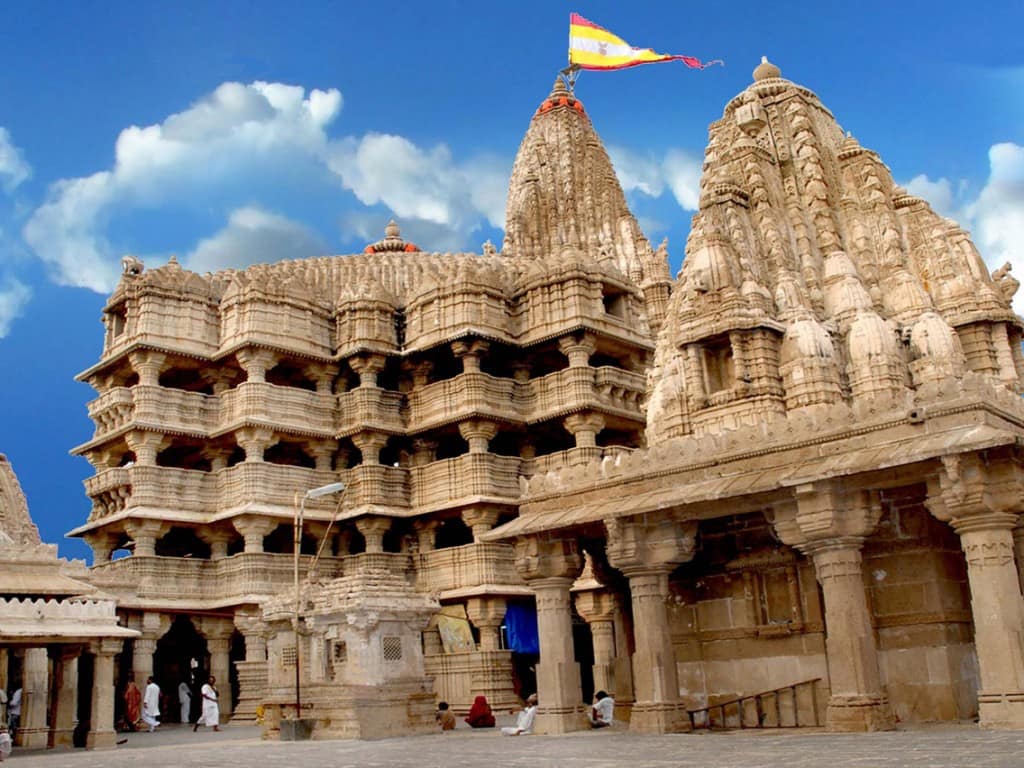
Temple in Dwarka
Dwarkadhish Temple
Dwarka, Gujarat
The Char Dham temple above the Gomti creek, and the reason the town exists. The flag on the spire is roughly 52 yards of cloth, hauled up by hand and changed several times a day — sponsored by families who process it to the temple first.
Photo: Vishnupranay.k — CC BY-SA 4.0, via Wikimedia Commons
Overview
Who it's to, and what's expected
Deity
Krishna as Dwarkadhish
Tradition
Vishnu · Krishna temple
- Entry
Entry to the temple is free for everyone, and visitors are required to wear any decent outfit.
- Footwear
The temple provides a free shoe keeping center for visitors.
- Access
The temple provides a free shoe-keeping centre and the main approach through the complex is managed for heavy pilgrimage traffic, but expect crowds, steps and a 30-to-60-minute wait that lengthens at festival times. The four-hour afternoon closure (1:00 to 5:00 PM) matters more than access for most visitors - arriving at 2:00 PM means finding the temple shut. Note that the Chalati Mata temple on the fourth floor is inaccessible to all visitors.
- Prasadam
Bhog - food offerings - run through the day at defined windows (Madhyanh Bhog around 11:05 AM, Raj Bhog around noon, Utthapan Bhog at 5:30 PM, Sandhya Bhog at 7:30 PM and Shayan Bhog at 8:05 PM), and prasad follows them. Arriving at a bhog window rather than between them is how visitors encounter it. Accept with the right hand.
Usually visited with
Time your visit
The darshan clock
A single opening-hours line cannot express a midday closure or an evening ceremony.
6:30 AM
Opening hours
The temple is open for morning darshan from 6:30 AM to 1:00 PM and evening darshan from 5:00 PM to 9:30 PM, though these times may change during festivals.
Rules, timings and fees change — confirm locally before you rely on this.
How long this takes
Ways in
The difference between a twenty-minute visit and a three-hour one.
Darshan options
- Darshan is free for all visitors, with typical wait times ranging from 30 to 60 minutes, though this can increase to 60 to 90 minutes on special days
At the gate
Before you go in
What gets refused, and what you cannot take past the door.
What to wear
Visitors are required to wear any decent outfit.
Phones and cameras
Photography is not permitted within the sanctum areas of the temple.
Rules, timings and fees change — confirm locally before you rely on this.
When not to come — unless you mean to
Festival windows
These follow lunar calendars and move by weeks each year, so the windows are months, not dates.
August–September
Janmashtami
Krishna's birthday in Krishna's city. The town is at capacity and the temple runs through the night; come for this deliberately or not that week.
Practicalities
The things that go wrong
Book through official channels, and treat anyone promising a guaranteed slot as a warning sign.
What to watch for
- Anyone offering to arrange a same-day flag-hoisting sponsorship
- Families buy a new flag and are allotted a time by the temple administration in advance - it cannot be improvised on the day, so treat any such offer as false
- Claiming you can be taken up to the Chalati Mata temple on the fourth floor for a fee
- It is inaccessible and there is no paid access
- Guides attaching themselves in the complex or at Gomti Ghat and producing a fee at the end
- Entry is free and the ritual sequence is published; hire only from an official counter
- Flower, prasad and puja-sample sellers at the gates quoting several times the local rate
- You are not required to bring an offering
- Being told the temple is closed when it is between bhog windows, and offered a detour
- The real closure is 1:00 to 5:00 PM; at other times check the published darshan schedule rather than following anyone
One place, many temples
Other temples in Dwarka
General guidance
Planning the visit
Customary practice and what Dwarka's climate means for a barefoot visit — not rules posted at this temple. Anything specific to Dwarkadhish Temple is above.
The queue is the ritual
Vaishnava temples in India are usually organised around a moving darshan queue rather than time spent in front of the deity. Expect to keep walking, and expect the view of the sanctum to be brief — that is the intended experience, not a rushed one.
Come in winter
Winter is when Dwarka is most comfortable to walk around, which matters here because a temple visit is done on foot and barefoot. Locally the window is given as october to march.
Salt air and bare feet
Coastal temple courtyards stay damp and the stone can be slick underfoot, particularly near a tank or a sea-facing entrance. Take the steps slowly rather than the queue's pace.
Arriving by train
Dwarka has a railway station, and auto-rickshaws wait outside it. Agree the fare or use a meter before you set off, and expect to be dropped a short walk from the temple rather than at its door.
No airport here
Dwarka has no airport of its own, so the last leg is by road or rail. Plan the return the same way — the last bus out is often earlier than visitors expect.
Outfit guide
What to wear at Dwarkadhish Temple
Cover shoulders and knees — the rules above win over anything here.
Trending wear for this spot
Modern, camera-ready looks picked for Dwarkadhish Temple.

Traditional wear for this spot
Timeless, cultural outfits worn across Dwarka.
Dwarkadhish Temple (Jagat Mandir)
Dwarkadhish is a Char Dham pilgrimage site and the reason the town of Dwarka exists. It stands above the Gomti creek where it meets the Arabian Sea, and everything else in Dwarka — Rukmini's temple, Nageshwar, the crossing to Bet Dwarka — is arranged around it as a starting point.
The temple is also called Jagat Mandir, after Raja Jagat Singh Rathore, who is said to have rebuilt it. It is built in limestone with heavy sculpting on the walls, and its history includes repeated destruction and rebuilding — which is why the structure you see is not the structure the site is famous for.
🚩 The flag: 52 yards, and two explanations
A massive flag of roughly 52 yards flaps atop the shikhara. It carries images of the sun and the moon, and is made in different colours — never black.
Why 52 yards is explained two different ways, and both are current:
- The 52 yards represent the clans of devotees who flourished under Lord Krishna's rule in Dwarka.
- 52 small flags are woven individually into each yard of cloth, and each yard symbolises an entrance to the ancient city of Dwarka. The flag is described as Aadhi Bhoutik in nature — belonging to the material world rather than being purely symbolic.
Neither account supersedes the other in any source; they are two readings of the same object.
The flag is changed several times a day — sources give four times daily, or five times (three in the day and two in the evening). The precise count varies, but the practice does not.
The flag-changing is sponsored by families, and it is the most distinctive thing you can participate in here. Devotees buy a new flag for hoisting, having been allotted a time by the temple administration, and process it to the temple first before it goes up. If you want to do this, arrange it with the temple office in advance — it is not something you can turn up and do on the day.
🕒 Timings, and the afternoon closure
Entry is free. The temple follows a split schedule:
- Morning: 6:30 AM to 1:00 PM
- CLOSED 1:00 PM to 5:00 PM
- Evening: 5:00 PM until 9:30 PM (one detailed schedule runs the final darshan to 9:40 PM, so treat the closing edge as approximate)
The four-hour afternoon closure is the practical fact that matters most. Arriving at 2:00 PM means finding the temple shut, and this is the most common mistake visitors make in Dwarka.
🪔 The daily ritual sequence
Dwarkadhish runs an unusually detailed published schedule of bhog (food offerings) and darshan windows through the day:
- 7:00–8:00 AM Mangal Darshan
- 10:30 AM Shringar Aarti
- 10:45 AM Aarti Darshan
- 10:55 AM Gwala Darshan
- 11:05–11:25 AM Madhyanh Bhog
- 12:00–12:25 PM Raj Bhog
- 1:00 PM Temple closes
- 5:00 PM Temple reopens
- 5:30–5:45 PM Utthapan Bhog
- 6:30 PM Mangal Aarti
- 7:30–7:45 PM Sandhya Bhog, followed by Aarti Darshan at 7:45 PM
- 8:05–8:25 PM Shayan Bhog
- 8:30 PM Shayan Aarti
- 8:35–9:00 PM Darshan
- 9:00–9:20 PM Shringar Darshan
- 9:20–9:40 PM Stuti Darshan
The pattern is the same as at other major Krishna temples: darshan is organised around offerings, and arriving between windows means a less complete visit. If you want to see the deity being adorned rather than simply present, aim for a Shringar window.
🛕 Inside, and one thing you cannot see
Photography is not permitted within the sanctum areas. The temple provides a free shoe-keeping centre, which is worth using rather than leaving footwear in the open.
One detail that surprises visitors: the temple of Chalati Mata is on the fourth floor and is inaccessible. It is present in the structure but not open, so do not ask to be taken up to it and do not pay anyone who offers.
🌊 Gomti Ghat and the wider circuit
The temple sits above the Gomti creek, and Gomti Ghat below it is where pilgrims bathe (snan) before darshan — a practice that shapes the morning rhythm of the whole precinct. The ghat holds a Sandhya Aarti around 6:30 PM, and the traditional circuit includes the 56 kunds and a walk on the Sudama Setu footbridge.
Do not confuse Sudama Setu with Sudarshan Setu. Sudama Setu is a pedestrian footbridge over the Gomti in Dwarka town. Sudarshan Setu is the 2.32 km road bridge to Bet Dwarka, opened in 2024. They are different structures in different places with confusingly similar names, and mixing them up will send you to the wrong end of the district.
🌸 Janmashtami
Janmashtami — Krishna's birth — is the biggest festival celebrated here, and the temple and town are at their fullest. Beyond it, the temple observes the standard Vaishnava calendar including Annakut after Diwali and the various Ekadashi days.
The best months to visit are March and October, avoiding both the peak summer heat and the monsoon.
⚠️ Practical notes
- Dwarkadhish is part of the Char Dham and of the Pancha Dwaraka circuit, so expect organised pilgrimage traffic rather than casual sightseeing.
- Go early. Mangal Darshan runs 7:00–8:00 AM and the morning is the comfortable window in a coastal town with little shade.
- The wait is typically 30 to 60 minutes, longer at festival times.
- A sensible Day 1 in Dwarka: Mangala Aarti at Dwarkadhish, the main complex, Gomti Ghat snan, the 56 kunds, the Sudama Setu walk, Bhadkeshwar Mahadev at low tide before sunset, then the Gomti Ghat Sandhya Aarti around 6:30 PM.
- Pair it with Rukmini Devi Temple (on the road out), Nageshwar and Bet Dwarka — the standard Dwarka yatra.
Last verified: 2026. Timings are consistent across sources except the final closing (9:30 vs 9:40 PM). The flag is changed four or five times daily depending on the source, and the 52 yards are explained two ways; both are given. Do not confuse Sudama Setu (a town footbridge) with Sudarshan Setu (the 2024 road bridge to Bet Dwarka).
Questions
Dwarkadhish Temple — FAQ
Who is Dwarkadhish Temple dedicated to?
Dwarkadhish Temple in Dwarka is dedicated to Krishna as Dwarkadhish.
Who can enter Dwarkadhish Temple?
Entry to the temple is free for everyone, and visitors are required to wear any decent outfit.
What is the dress code at Dwarkadhish Temple?
Visitors are required to wear any decent outfit.
Do I have to take my shoes off at Dwarkadhish Temple?
The temple provides a free shoe keeping center for visitors.
Can I take photos inside Dwarkadhish Temple?
Photography is not permitted within the sanctum areas of the temple.
What prasadam is offered at Dwarkadhish Temple?
Bhog - food offerings - run through the day at defined windows (Madhyanh Bhog around 11:05 AM, Raj Bhog around noon, Utthapan Bhog at 5:30 PM, Sandhya Bhog at 7:30 PM and Shayan Bhog at 8:05 PM), and prasad follows them. Arriving at a bhog window rather than between them is how visitors encounter it. Accept with the right hand.
Is Dwarkadhish Temple wheelchair accessible?
The temple provides a free shoe-keeping centre and the main approach through the complex is managed for heavy pilgrimage traffic, but expect crowds, steps and a 30-to-60-minute wait that lengthens at festival times. The four-hour afternoon closure (1:00 to 5:00 PM) matters more than access for most visitors - arriving at 2:00 PM means finding the temple shut. Note that the Chalati Mata temple on the fourth floor is inaccessible to all visitors.
Checked, not remembered
Sources
Every rule and timing above traces back to one of these.