

Temple in Kolkata
Dakshineswar Kali Temple
Kolkata, West Bengal
The riverside temple where Ramakrishna served as priest, with twelve identical Shiva shrines along the ghat. Larger, calmer and greener than Kalighat, and paired with Belur Math across the Hooghly.
Photo: Ravi Dwivedi — CC BY-SA 4.0, via Wikimedia Commons
Overview
Who it's to, and what's expected
Deity
Kali as Bhavatarini
Tradition
Devi · Shakti temple
- Entry
Visitors must wear modest clothing that covers their shoulders and knees, and they are required to remove their footwear before entering the temple.
- Footwear
You must remove your footwear before entering the temple.
- Access
Considerably easier than Kalighat. The complex is large, green and comparatively calm, with open riverfront space and room to move rather than dense lanes, and it is reachable by road on the eastern bank of the Hooghly. Allow two to three hours for the whole complex including the twelve Shiva temples and the Kuthi Bari. Early morning (6:00-8:00 AM) and late afternoon (3:00-5:00 PM) are the comfortable windows, and heat rather than crowding is the main difficulty in summer.
- Prasadam
Bhog is offered daily at around 12:00 PM and a Rs50 ticket applies to it - the only paid item at Dakshineswar, since entry to the temple itself is free. Prasad follows the offering, so arriving around the bhog window is how visitors encounter it. Do not pay anyone else at the gate for prasad or for entry.
Usually visited with
Time your visit
The darshan clock
A single opening-hours line cannot express a midday closure or an evening ceremony.
6:30 AM
Opening hours
The temple is open daily from 6:30 AM to 7:30 PM, and one of the Nahabat Khanas hosts daily aarti ceremonies accompanied by traditional music.
Rules, timings and fees change — confirm locally before you rely on this.
How long this takes
Ways in
The difference between a twenty-minute visit and a three-hour one.
General darshan
- Free, and the queue is far more manageable than Kalighat's because the complex is large and the crowds disperse across the riverfront, gardens and subsidiary shrines
- Allow two to three hours for the whole site
Morning and evening aarti
- Seasonal: October to March morning 5:00 AM and evening 6:30 PM; April to September morning 4:00 AM and evening 7:00 PM. The 6:00-8:00 AM window is the calmest and best-lit
Kali Puja
- The temple's great occasion, coinciding with Diwali - which in Bengal means Kali rather than Lakshmi
- Heavy attendance throughout
Ramakrishna's birth anniversary
- Observed with particular significance at the temple where he served as priest and attained enlightenment, and simultaneously at Belur Math across the river
At the gate
Before you go in
What gets refused, and what you cannot take past the door.
What to wear
Visitors are required to wear modest clothing that covers the shoulders and knees. Additionally, you must remove your footwear before entering the temple.
Phones and cameras
Photography is not permitted inside the main temple area.
Rules, timings and fees change — confirm locally before you rely on this.
When not to come — unless you mean to
Festival windows
These follow lunar calendars and move by weeks each year, so the windows are months, not dates.
Kali Puja
Durga Puja
Ramakrishna's birth anniversary
Navratri
Practicalities
The things that go wrong
Book through official channels, and treat anyone promising a guaranteed slot as a warning sign.
What to watch for
- Charging for entry to the temple
- Dakshineswar is free; the only legitimate charge is the Rs50 daily bhog ticket at around 12:00 PM
- Confusing Dakshineswar with Belur Math when arranging transport
- They are on opposite banks of the Hooghly in different cities - Dakshineswar in Kolkata, Belur Math in Howrah - and are connected by a road crossing some distance upstream, not a short hop across the water
- Published material conflates them constantly, including one site listing Dakshineswar's address as Belur Math, Howrah
- Boat operators offering a direct crossing to Belur Math at a premium
- Check whether the service is actually running and what it costs before boarding; the two sites are usually combined by road
- Guides attaching themselves at the ghat and producing a fee after a brief explanation
- The Kuthi Bari where Ramakrishna lived is signposted and open to visitors - you do not need anyone to find it
- Anyone charging for photography of the riverfront or the twelve Shiva temples, which are generally photographable
- Only the main temple area restricts it
- Claims that the complex is open through the afternoon
- It closes in both seasons - 11:30 AM to 3:30 PM in summer and 12:30 to 3:00 PM in winter
One place, many temples
Other temples in Kolkata
General guidance
Planning the visit
Customary practice and what Kolkata's climate means for a barefoot visit — not rules posted at this temple. Anything specific to Dakshineswar Kali Temple is above.
Offerings differ here
Shakta shrines often accept offerings that other temples do not, and a few remain associated with animal sacrifice on particular days. What is sold at the stalls outside is the honest signal of what is expected inside.
Come in winter
Winter is when Kolkata is most comfortable to walk around, which matters here because a temple visit is done on foot and barefoot. Locally the window is given as october to march.
Stone gets hot — go early
You will be barefoot from the shoe rack onwards, often across an open courtyard. Between late morning and mid-afternoon in the hot months that stone is genuinely painful to stand on. Socks help, and are permitted almost everywhere shoes are not.
Metro, then walk
Kolkata has a metro, and it is usually the fastest way to get near a busy temple — the streets immediately around one are often closed to vehicles or jammed with them.
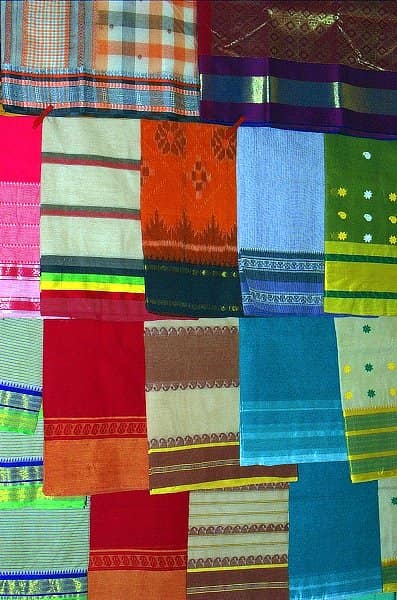
Outfit guide
What to wear at Dakshineswar Kali Temple
Cover shoulders and knees — the rules above win over anything here.
Trending wear for this spot
Popular modern looks travellers are wearing across Kolkata.

Traditional wear for this spot
Timeless, cultural looks that suit Dakshineswar Kali Temple.
Dakshineswar Kali Temple
Dakshineswar is the riverside Kali temple where Ramakrishna Paramahamsa served as priest and attained enlightenment — which makes it one of the most consequential religious sites in modern Hindu history rather than simply a large temple. It is bigger, calmer and greener than Kalighat, and it pairs with Belur Math directly across the Hooghly.
Built in 1855 by Rani Rashmoni, the temple is a navaratna — a nine-apex structure in typical Bengali architecture, and its nine spires over the Hooghly are among the most recognisable silhouettes in Bengal.
🛕 Rani Rashmoni, and how the temple came to be built
Rani Rashmoni commissioned the temple in 1855. She was a substantial landowner and patron, and the temple she built is on a scale that reflects it: a nine-apex main shrine, twelve Shiva temples along the riverfront, a Radha Kanta temple, gardens and a ghat, all on the eastern bank of the Hooghly.
The complex is dedicated to Kali as Bhavatarini — "she who liberates the world" — which is the specific form of the goddess worshipped here rather than the fiercer register associated with Kalighat. The deity's image stands on a lotus flower wrought in silver.
🧘 Ramakrishna, and the room you can still see
Sri Ramakrishna Paramahamsa spent a considerable part of his life at Dakshineswar and attained enlightenment here. His presence is the reason the temple matters beyond Bengal, and the reason Belur Math exists across the river at all — his disciples, and above all Swami Vivekananda, built the Ramakrishna movement out of what happened at this temple.
The specific place to see is the Kuthi Bari, also called Nanabat — the chamber in the north-western corner of the compound, just beyond the Shiva temples, where Ramakrishna lived. It is always visible and open to visitors. Most people walk past it on the way to the main shrine. Go and look at it: a small, plain room that produced one of the most influential religious lives of the nineteenth century.
🛕 The twelve Shiva temples
Twelve identical Shiva shrines stand in a row along the ghat, and they are the temple's most striking compositional feature — a repetitive riverfront line of small at chala style shrines that frames the main temple when viewed from the water.
They are open whenever the main temple is open and take about thirty minutes to walk. Together with the Radha Kanta temple in the compound — which adds a Vaishnava dedication to a Shakta site — the complex covers more of the Hindu pantheon than its name suggests.
🕒 Timings — a genuine seasonal schedule
Entry is free. Dakshineswar runs different hours in summer and winter, which is worth knowing because published tables often give only one:
- Summer (April to September): 5:30 AM to 11:30 AM, and 3:30 PM to 9:00 PM
- Winter (October to March): 6:00 AM to 12:30 PM, and 3:00 PM to 8:30 PM
Aarti times shift with the same seasonal split:
- October to March — morning aarti 5:00 AM, evening aarti 6:30 PM
- April to September — morning aarti 4:00 AM, evening aarti 7:00 PM
Bhog is offered daily at around 12:00 PM, and a ₹50 ticket applies to it. That is the one paid item here, and it is small and legitimate — but note that the main temple itself is free.
The afternoon closure is firm in both seasons (11:30 AM to 3:30 PM in summer; 12:30 to 3:00 PM in winter). Allow two to three hours for the whole complex, which is longer than most visitors budget.
The best windows are early morning, 6:00 to 8:00 AM, and late afternoon, 3:00 to 5:00 PM.
📍 Opposite Belur Math — and a warning about the two
Dakshineswar is on the eastern bank of the Hooghly in Kolkata; Belur Math is on the western bank in Howrah. They face each other across the river and are traditionally visited together, but they are different institutions in different cities, and sources routinely merge them.
Be explicit when arranging transport. Published material conflates them constantly — one travel site lists Dakshineswar's own address as "Belur Math, Belur, Howrah", which is simply the wrong bank and the wrong city. Say which one you mean, and confirm the driver knows the difference. The two are connected by road via a bridge crossing some distance upstream, not by a short hop across the water, so a mixed-up booking costs an hour.
Belur Math is the headquarters of the Ramakrishna Math and Mission; Dakshineswar is the temple where Ramakrishna served. Both are worth visiting and neither substitutes for the other.
🛕 Rules
Modest clothing covering shoulders and knees is required, and footwear must be removed before entering. Both are enforced.
Photography is not permitted inside the main temple area. The riverfront, the twelve Shiva temples and the gardens are generally photographable; the Kali shrine is not.
Silence is expected in the shrine areas, and the complex is large and green enough that quiet corners exist away from the main courtyard.
🌸 Festivals
Kali Puja (October or November, the new moon of Kartik) is the temple's great occasion and coincides with Diwali, which in Bengal means Kali rather than Lakshmi. Durga Puja (September–October) fills the city and brings heavy attendance here.
Two observances specific to this temple's history matter more than the general calendar:
- Ramakrishna's birth anniversary (February or March) — celebrated at the temple where he served, and at Belur Math across the river
- Kathamrita and the Ramakrishna movement's anniversaries — the temple's association with his life makes these occasions distinctive here rather than generic
⚠️ Practical notes
- Go early. The 6:00 to 8:00 AM window is calm, cool and the light on the nine spires from the ghat is at its best.
- Do not skip the Kuthi Bari. It is the reason Dakshineswar is historically important and it takes five minutes.
- Walk the twelve Shiva temples along the ghat — thirty minutes, and the most distinctive visual sequence in the complex.
- October to March is the comfortable season; the riverfront is exposed and summer heat is oppressive.
- Pair with Belur Math, but book the two separately and be explicit about which bank you mean.
- The ₹50 bhog ticket is the only charge — anyone asking for more at the gate is not authorised.
Last verified: 2026. The seasonal timings (summer 5:30-11:30 and 3:30-9:00; winter 6:00-12:30 and 3:00-8:30) and the seasonal aarti split are documented, as is the Rs50 daily bhog ticket at around 12:00 PM. Entry to the temple is free. Dakshineswar and Belur Math are on opposite banks of the Hooghly and are routinely conflated in published material.
Questions
Dakshineswar Kali Temple — FAQ
Who is Dakshineswar Kali Temple dedicated to?
Dakshineswar Kali Temple in Kolkata is dedicated to Kali as Bhavatarini.
Who can enter Dakshineswar Kali Temple?
Visitors must wear modest clothing that covers their shoulders and knees, and they are required to remove their footwear before entering the temple.
What is the dress code at Dakshineswar Kali Temple?
Visitors are required to wear modest clothing that covers the shoulders and knees. Additionally, you must remove your footwear before entering the temple.
Do I have to take my shoes off at Dakshineswar Kali Temple?
You must remove your footwear before entering the temple.
Can I take photos inside Dakshineswar Kali Temple?
Photography is not permitted inside the main temple area.
What prasadam is offered at Dakshineswar Kali Temple?
Bhog is offered daily at around 12:00 PM and a Rs50 ticket applies to it - the only paid item at Dakshineswar, since entry to the temple itself is free. Prasad follows the offering, so arriving around the bhog window is how visitors encounter it. Do not pay anyone else at the gate for prasad or for entry.
Is Dakshineswar Kali Temple wheelchair accessible?
Considerably easier than Kalighat. The complex is large, green and comparatively calm, with open riverfront space and room to move rather than dense lanes, and it is reachable by road on the eastern bank of the Hooghly. Allow two to three hours for the whole complex including the twelve Shiva temples and the Kuthi Bari. Early morning (6:00-8:00 AM) and late afternoon (3:00-5:00 PM) are the comfortable windows, and heat rather than crowding is the main difficulty in summer.
Checked, not remembered
Sources
Every rule and timing above traces back to one of these.