
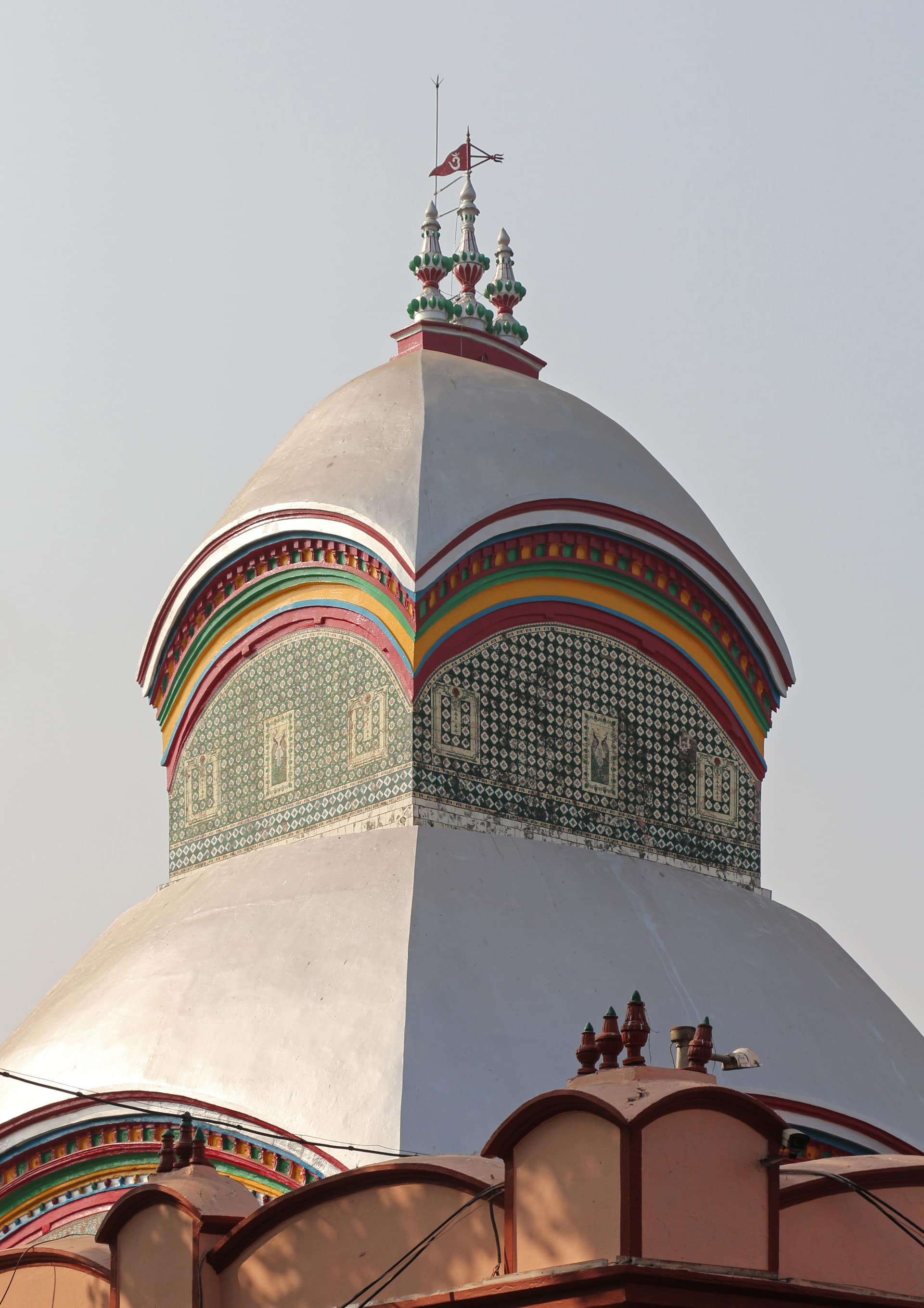
Temple in Kolkata
Kalighat Kali Temple
Kolkata, West Bengal
The Shakti Peetha the city is named after — Kalikata became Calcutta became Kolkata. Small, dense and very busy; the queue moves fast because it has to.
Photo: Bernard Gagnon — CC BY-SA 3.0, via Wikimedia Commons
Overview
Who it's to, and what's expected
Deity
Kali
Tradition
Devi · Shakti temple
- Entry
The Natmandir veranda provides an aerial view of the goddess's sanctum, and the Jor Bangla platform allows visitors to watch the sacred rituals conducted within the sanctum.
- Footwear
Remove footwear before entering and leave it in the designated area rather than in the open lane. The surrounding Kalighat neighbourhood is dense and crowded with shops and traffic, so keeping your shoes in the temple's facility rather than outside is worth the few rupees.
- Access
Difficult. The temple is small relative to its attendance, so the darshan line is dense and fast-moving rather than spacious, and it is reached through the crowded lanes of the old Kalighat neighbourhood on the Adi Ganga. Kalighat metro station on Line 2 makes it one of the easier major Indian temples to reach by rapid transit, which helps considerably. Visitors with mobility limitations should come in the early-morning window and should know that the Natmandir veranda offers an aerial view of the sanctum without joining the main line.
- Prasadam
Prasad is distributed at the temple, and the surrounding lanes are lined with flower, prasad and votive shops selling offerings for Kali worship. Buy inside or from established shops at local rates rather than accepting a tray pressed on you at the gate, and note that you are not required to bring an offering at all to have darshan.
Usually visited with
Time your visit
The darshan clock
A single opening-hours line cannot express a midday closure or an evening ceremony.
5:00 AM
Opening hours
The temple is open daily in two sessions: from 5:00 AM to 2:00 PM and from 5:00 PM to 10:30 PM.
Rules, timings and fees change — confirm locally before you rely on this.
How long this takes
Ways in
The difference between a twenty-minute visit and a three-hour one.
General darshan
- Free, and the queue moves fast because it has to - the temple is small relative to its attendance, so density is normal rather than a sign you are in the wrong line
- Early morning and after 7:30 PM are the calm windows
Mangala and Sandhya Aarti
- Restricted windows at the opening and in the evening
- Aarti times are published inconsistently, so treat them as approximate: Mangala around 4:00 or 5:00-5:30 AM, Sandhya around 6:30-7:30 PM
Kali Puja
- The temple's great occasion
- In Bengal Kali Puja rather than Lakshmi worship is what Diwali means, so the city and the shrine peak together and the surrounding area is at its most crowded
Durga Puja and Navratri
- Transforms the whole city and brings heavy attendance here throughout the festival period
At the gate
Before you go in
What gets refused, and what you cannot take past the door.
What to wear
Visitors are expected to wear modest traditional Indian clothing, such as a kurta-pyjama or dhoti for men, and a saree or salwar kameez for women.
Phones and cameras
Photography and videography are strictly prohibited inside the temple premises, though they are permitted in outside areas.
Rules, timings and fees change — confirm locally before you rely on this.
When not to come — unless you mean to
Festival windows
These follow lunar calendars and move by weeks each year, so the windows are months, not dates.
Kali Puja
Durga Puja
Navratri
Amavasya (new moon)
Tuesdays and Saturdays
Practicalities
The things that go wrong
Book through official channels, and treat anyone promising a guaranteed slot as a warning sign.
What to watch for
- Pressured purchases of flowers, prasad trays and votive items in the lanes at several times the local rate
- The surrounding shops are legitimate but prices for visitors are not - agree a price first, or buy inside the temple
- You are not required to bring an offering for darshan
- Anyone offering to photograph you inside the temple or arrange photography of the sanctum
- Photography and videography are strictly prohibited inside the premises and this is enforced; outside areas are permitted
- Sellers presenting souvenir paintings as genuine Kalighat patua work
- The area is the origin of the nineteenth-century Kalighat painting tradition, but what is sold around the temple today is mostly reproduction souvenir work rather than art in that tradition
- Guides attaching themselves in the lanes and producing a fee at the door
- The temple needs no guide; if you want context, the Natmandir veranda and Jor Bangla platform are the places to position yourself to see the sanctum and its rituals
- Being told the temple is open in the afternoon
- It closes from 2:00 to 5:00 PM for bhog and cleaning, and no payment changes that
One place, many temples
Other temples in Kolkata
General guidance
Planning the visit
Customary practice and what Kolkata's climate means for a barefoot visit — not rules posted at this temple. Anything specific to Kalighat Kali Temple is above.
Offerings differ here
Shakta shrines often accept offerings that other temples do not, and a few remain associated with animal sacrifice on particular days. What is sold at the stalls outside is the honest signal of what is expected inside.
Come in winter
Winter is when Kolkata is most comfortable to walk around, which matters here because a temple visit is done on foot and barefoot. Locally the window is given as october to march.
Stone gets hot — go early
You will be barefoot from the shoe rack onwards, often across an open courtyard. Between late morning and mid-afternoon in the hot months that stone is genuinely painful to stand on. Socks help, and are permitted almost everywhere shoes are not.
Metro, then walk
Kolkata has a metro, and it is usually the fastest way to get near a busy temple — the streets immediately around one are often closed to vehicles or jammed with them.
Outfit guide
What to wear at Kalighat Kali Temple
Cover shoulders and knees — the rules above win over anything here.
Trending wear for this spot
Popular modern looks travellers are wearing across Kolkata.

Traditional wear for this spot
Timeless, cultural outfits worn across Kolkata.

Kalighat Kali Temple
Kalighat is the Shakti Peetha the city of Kolkata is named after. Kalikata became Calcutta became Kolkata, and the name traces to this temple and its ghat on the Adi Ganga — a rare case of a modern metropolis taking its name from a shrine rather than the reverse.
It is one of the 51 Shakti Peethas, and is regarded by many devotees as the holiest of them. The specific claim: the right toe of Dakshayani (Sati) fell here when Shiva carried her body and it was dismembered — the tradition that qualifies a site as a Peetha.
The temple itself is small, dense and very busy, and the queue moves fast because it has to. That is the honest characterisation and it sets expectations better than any superlative: this is not a spacious monument but a working urban shrine compressed into a very old neighbourhood, serving a city of millions.
🩸 What a Shakti Peetha is, and why it matters here
The Shakti Peetha network comprises 51 sites (some counts give 52) across the subcontinent, each marking where a part of Sati's body is held to have fallen. The right toe at Kalighat is the local claim.
Peetha status is what makes Kalighat a pilgrimage destination of national scale rather than a neighbourhood temple — and it puts Kolkata in the same canonical category as Kamakshi Amman at Kanchipuram and Harsiddhi Mata at Ujjain. Visitors who come to Kolkata for the colonial architecture sometimes do not realise the city contains one of these.
🕒 Timings — including the afternoon closure
Entry is free. The temple is open in two sessions with a substantial midday closure:
- 5:00 to 5:30 AM — Mangala Aarti; the temple opens, and this window is restricted
- 5:30 AM to 2:00 PM — open for general public darshan
- 2:00 to 5:00 PM — CLOSED for Bhog (the food offering) and cleaning
- 5:00 to 7:00 PM — reopens for evening darshan
- 7:00 to 7:30 PM — Sandhya Aarti; restricted
- 7:30 to 10:30 PM — darshan continues until closing
The three-hour afternoon closure is the practical fact that matters most. Published summaries often simplify this to "5:00 AM to 10:30 PM", which is misleading precisely because of the 2:00 to 5:00 PM gap — arriving at 3:00 PM means finding the temple shut.
Aarti timings are published inconsistently. One source gives Mangal Aarti at 4:00 AM and Sandhya Aarti at 6:30 to 7:00 PM; the detailed ritual schedule gives Mangala Aarti at 5:00 to 5:30 AM and Sandhya Aarti at 7:00 to 7:30 PM. Treat the aarti times as approximate and the closure as firm.
Nitya Pooja runs from about 5:30 to 7:00 AM.
🏛️ Seeing the sanctum: Natmandir and Jor Bangla
Two structural features determine what you can actually see, and both are worth knowing before you queue:
- The Natmandir veranda provides an aerial view of the goddess's sanctum. This is where visitors get a sightline down into the shrine.
- The Jor Bangla platform allows visitors to watch the sacred rituals conducted within the sanctum.
Between them these are the places to position yourself, rather than trying to press into the main darshan line if what you want is to observe the ritual.
📷 Photography
Photography and videography are strictly prohibited inside the temple premises, though they are permitted in outside areas. This is enforced. Do not raise a camera inside — the surrounding lanes and the ghat outside are photographable, the temple is not.
🛕 Rules
Modest traditional Indian clothing is expected: a kurta-pyjama or dhoti for men, and a saree or salwar kameez for women. This is a stricter expectation than at many urban temples and is worth dressing for deliberately.
Footwear is removed before entering and left in the designated area.
🌸 Festivals
Kali Puja, on the new moon of Kartik (October or November, coinciding with Diwali), is the temple's great occasion — and in Bengal Kali Puja rather than Lakshmi worship is what Diwali means, so the city and the temple peak together. Thousands attend and the surrounding area is at its most crowded.
Beyond it: Navratri and Durga Puja (September–October) transform the whole city and bring heavy attendance here; Amavasya (new moon) days each month are significant at a Kali temple; and Tuesdays and Saturdays draw heavier local devotion.
📍 Getting there, and where it sits
About 9.1 km from Howrah Railway Station and 22.5 km from Netaji Subhas Chandra Bose International Airport. The temple is served by Kalighat metro station on Line 2, which makes it one of the easiest major temples in India to reach by rapid transit — a genuine advantage in a city this size.
It sits in the old Kalighat neighbourhood on the Adi Ganga, a former channel of the Hooghly. The lanes around the temple are dense, crowded and full of flower, prasad and votive shops, which is part of the experience and also the reason to keep your belongings close.
The area is also the origin of the Kalighat painting tradition — the nineteenth-century patua style of bold, swift brushwork depicting deities and Calcutta social life that became one of India's best-known folk art forms. The paintings sold around the temple today are mostly souvenir reproductions rather than work in that tradition, which is worth knowing before buying.
⚠️ Practical notes
- Come at 5:30 to 7:00 AM or after 7:30 PM. Morning is less crowded and more serene; the evening session after Sandhya Aarti is atmospheric.
- October to March is the best season; the temple and its lanes are punishing in summer heat and humidity.
- Avoid 2:00 to 5:00 PM — the temple is closed.
- Expect a fast-moving but packed queue. The temple is small relative to its attendance, so density is normal rather than a sign you are in the wrong line.
- Keep bags closed and valuables secure in the surrounding lanes.
- Pair it with Dakshineswar, the other great Kali temple of the city, and note that they are very different in character — Kalighat dense and urban, Dakshineswar riverside, large and comparatively calm.
Last verified: 2026. The 2:00 to 5:00 PM closure for bhog and cleaning is firm across sources, while the aarti times are published inconsistently (Mangala at 4:00 AM versus 5:00-5:30 AM; Sandhya at 6:30-7:00 PM versus 7:00-7:30 PM) and are given as approximate. Entry is free.
Questions
Kalighat Kali Temple — FAQ
Who is Kalighat Kali Temple dedicated to?
Kalighat Kali Temple in Kolkata is dedicated to Kali.
Who can enter Kalighat Kali Temple?
The Natmandir veranda provides an aerial view of the goddess's sanctum, and the Jor Bangla platform allows visitors to watch the sacred rituals conducted within the sanctum.
What is the dress code at Kalighat Kali Temple?
Visitors are expected to wear modest traditional Indian clothing, such as a kurta-pyjama or dhoti for men, and a saree or salwar kameez for women.
Do I have to take my shoes off at Kalighat Kali Temple?
Remove footwear before entering and leave it in the designated area rather than in the open lane. The surrounding Kalighat neighbourhood is dense and crowded with shops and traffic, so keeping your shoes in the temple's facility rather than outside is worth the few rupees.
Can I take photos inside Kalighat Kali Temple?
Photography and videography are strictly prohibited inside the temple premises, though they are permitted in outside areas.
What prasadam is offered at Kalighat Kali Temple?
Prasad is distributed at the temple, and the surrounding lanes are lined with flower, prasad and votive shops selling offerings for Kali worship. Buy inside or from established shops at local rates rather than accepting a tray pressed on you at the gate, and note that you are not required to bring an offering at all to have darshan.
Is Kalighat Kali Temple wheelchair accessible?
Difficult. The temple is small relative to its attendance, so the darshan line is dense and fast-moving rather than spacious, and it is reached through the crowded lanes of the old Kalighat neighbourhood on the Adi Ganga. Kalighat metro station on Line 2 makes it one of the easier major Indian temples to reach by rapid transit, which helps considerably. Visitors with mobility limitations should come in the early-morning window and should know that the Natmandir veranda offers an aerial view of the sanctum without joining the main line.
Checked, not remembered
Sources
Every rule and timing above traces back to one of these.