
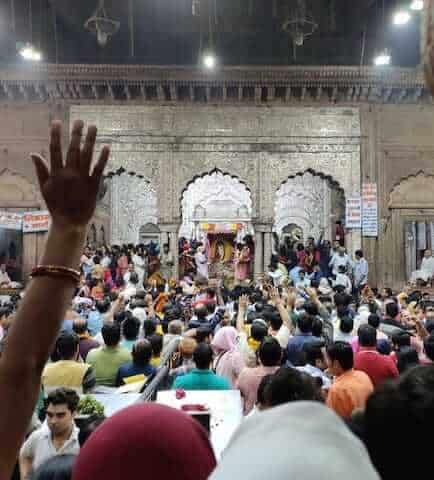
Temple in Mathura
Banke Bihari Temple
Mathura, Uttar Pradesh
The busiest temple in Vrindavan, and the one that behaves unlike any other: no bells and no conches, and a curtain drawn across the deity every minute or two rather than left open.
Photo: Aman Kumar — CC BY-SA 4.0, via Wikimedia Commons
Overview
Who it's to, and what's expected
Deity
Krishna as Banke Bihari
Tradition
Vishnu · Krishna temple
- Entry
The temple is open to all devotees daily. Elderly visitors and those with small children are advised to avoid visiting during major festivals because of the crowds. Darshan arrangements, including any closer-view option, are published by the temple itself - confirm them at the temple counter rather than arranging anything through a third party.
- Footwear
Visitors must remove their footwear before entering the temple, and a shoe counter is available outside for a small fee.
- Access
Difficult at busy times, and the temple's own guidance is explicit: elderly visitors and those with small children are advised to avoid visiting during major festivals because of the crowds. Morning sessions shortly after opening are by far the most manageable window, and weekdays other than Tuesday and Saturday are calmer than the temple's two auspicious days. The site is away from the ghats near the BHU road, with easy walking and no maze of lanes.
- Prasadam
Prasad is distributed at the temple following the offerings. As at other Braj temples devoted to Krishna, expect sweets rather than a meal. Note that there is no fixed aarti spectacle here - the jhanki darshan, with the curtain opening and closing, is the ritual experience rather than a set-piece ceremony.
Usually visited with
Time your visit
The darshan clock
A single opening-hours line cannot express a midday closure or an evening ceremony.
7:45 AM–12:00 PM
Opening hours
The temple operates on seasonal schedules with a daily afternoon closure. In summer (March–October), it is open 7:45 AM–12:00 PM and 5:30 PM–9:30 PM; in winter (November–February), it is open 8:45 AM–1:00 PM and 4:30 PM–8:30 PM. Daily ceremonies include the morning Shringar Aarti and evening Shayan Aarti, with a rare Mangla Aarti performed only on Janmashtami.
Rules, timings and fees change — confirm locally before you rely on this.
At the gate
Before you go in
What gets refused, and what you cannot take past the door.
What to wear
No strict published dress code, but modest clothing covering shoulders and knees is expected at an active temple of this intensity. Because the darshan hall becomes extremely densely packed at festival times, comfortable clothing that you do not mind being pressed in is the practical consideration rather than formality.
Phones and cameras
Photography is strictly prohibited inside the temple, including the use of mobile phones to take pictures of the deity or the darshan hall. You should keep your phones and cameras in your pockets or bags while inside.
Rules, timings and fees change — confirm locally before you rely on this.
When not to come — unless you mean to
Festival windows
These follow lunar calendars and move by weeks each year, so the windows are months, not dates.
February–March
BusyHoli
Braj Holi runs for days across Vrindavan, Barsana and Nandgaon, not one afternoon. Crowd density at this temple during it is extreme; it has a history of dangerous crushes.
Crowd levels are our reading of the notes above, not an official measure. Rules, timings and fees change — confirm locally before you rely on this.
Practicalities
The things that go wrong
Book through official channels, and treat anyone promising a guaranteed slot as a warning sign.
What to watch for
- Claiming photography can be permitted inside for a fee
- Photography is strictly prohibited, including by mobile phone, and no payment changes that
- Keep devices in pockets or bags before entering
- Guides and pandits attaching themselves in the lanes around the temple and producing a fee at the door
- The temple needs no guide and the jhanki darshan needs no explanation from a paid intermediary
- Flower, prasad and puja-sample sellers pressing trays on visitors at several times the local rate
- You are not required to bring an offering
- Anyone claiming the curtain will be held open for you, or that a longer darshan can be arranged for payment
- The brief darshan is the temple's foundational practice and exists precisely so that no one can gaze at the deity for long
One place, many temples
Other temples in Mathura
General guidance
Planning the visit
Customary practice and what Mathura's climate means for a barefoot visit — not rules posted at this temple. Anything specific to Banke Bihari Temple is above.
The queue is the ritual
Vaishnava temples in India are usually organised around a moving darshan queue rather than time spent in front of the deity. Expect to keep walking, and expect the view of the sanctum to be brief — that is the intended experience, not a rushed one.
Come in winter
Winter is when Mathura is most comfortable to walk around, which matters here because a temple visit is done on foot and barefoot. Locally the window is given as october to march (holi in march).
Stone gets hot — go early
You will be barefoot from the shoe rack onwards, often across an open courtyard. Between late morning and mid-afternoon in the hot months that stone is genuinely painful to stand on. Socks help, and are permitted almost everywhere shoes are not.
Arriving by train
Mathura has a railway station, and auto-rickshaws wait outside it. Agree the fare or use a meter before you set off, and expect to be dropped a short walk from the temple rather than at its door.
No airport here
Mathura has no airport of its own, so the last leg is by road or rail. Plan the return the same way — the last bus out is often earlier than visitors expect.
Outfit guide
What to wear at Banke Bihari Temple
Cover shoulders and knees — the rules above win over anything here.
Trending wear for this spot
Modern, camera-ready looks picked for Banke Bihari Temple.

Traditional wear for this spot
Timeless, cultural outfits worn across Mathura.
Banke Bihari Temple
Banke Bihari is the busiest temple in Vrindavan, and it behaves unlike any other temple in India. Two things define it: there are no bells and no conches, and a curtain is drawn across the deity every minute or two rather than being left open.
Both look like oddities until you know why. Both follow from a single theological premise — that the deity here is worshipped as a child.
🎭 The curtain: jhanki darshan
The curtain before the deity is drawn shut every few minutes, giving only a momentary glimpse. This practice is called jhanki darshan, and it is unique to Banke Bihari.
Three related explanations are given, and all three are current:
- Bihariji's gaze is believed to be so powerful and so full of love that continuous darshan could overwhelm the devotee. The curtain protects the worshipper.
- The curtain prevents the Lord from becoming charmed by the devotion of his bhaktas. It protects the deity.
- The story behind it: a devoted bhakta's love and focus were so intense that they drew the Lord's attention — and Banke Bihari followed him home to his village. When the goswamis discovered the deity was gone, they brought him back after much pleading, and introduced the brief-darshan tradition so that no one could gaze at him long enough for it to happen again.
The third version is the one told at the temple, and it is the reason the practice exists rather than merely a colourful gloss on it. Understanding that the curtain is a safeguard rather than a scheduling device completely changes what it feels like to stand there.
🔇 No bells, and no mangala aarti
There are no bells or conches in this temple — only soft devotional song. Two explanations are given: Swami Haridas, the saint-musician associated with the deity, preferred soft song, and the Lord is a small child whom loud noise might disturb.
More unusually, there is no mangala aarti — no early-morning waking ritual at all. This is genuinely rare in a major Hindu temple, where the dawn aarti is normally the most important service of the day. The goswamis' explanation: Banke Bihariji is worshipped as a child form of Krishna, and since the Lord spends his nights joyfully performing the rasa lila, he is tired and sleeps until late in the morning. Waking him early would disturb his rest.
That single belief explains the temple's whole daily rhythm — why it opens at 7:45 or 8:45 in the morning when comparable temples open before dawn, and why there is no pre-dawn service to attend.
🕉️ The deity, and where he came from
The idol stands in the Tribhanga posture — bent in three places (head, waist and knee), the classic stance of Krishna, and one of the reasons the image is so recognisable.
The deity was discovered in the nearby Nidhivan forest — the same Nidhivan that is one of Vrindavan's most charged and most talked-about sites, closed after dark under a set of persistent local beliefs. The idol was originally worshipped by Swami Haridas, the sixteenth-century saint-musician who is traditionally held to have been the guru of Tansen, the great musician at Akbar's court.
The present temple was built in 1864. Note the distinction, because sources get it wrong: Swami Haridas lived in the sixteenth century and could not have built a temple in 1864. The accurate framing is that the temple was constructed in 1864 to house the deity that Haridas had worshipped.
Unlike most Krishna temples there is no jhula (swing) and no fixed aarti spectacle here. The jhanki darshan — curtain opening and closing — is the experience.
🕒 Timings — and note the seasonal shift
- Summer: morning 7:45 AM to 12:00 PM; evening 5:30 PM to 9:00 PM
- Winter: morning 8:45 AM to 1:00 PM; evening 4:30 PM to 8:30 PM
The temple closes through the middle of the day. The winter opening an hour later than summer is a direct consequence of the child-deity belief above — the Lord wakes later in the cold.
Elderly visitors and those with small children are advised to avoid visiting during major festivals because of the crowds. That is the temple's own guidance rather than a general caution, and it should be taken seriously: Banke Bihari at festival time is one of the most densely packed religious spaces in North India.
📷 Photography
Photography is strictly prohibited inside the temple, including using mobile phones to photograph the deity or the darshan hall. Keep phones and cameras in your pockets or bags while inside — not in your hand, put away. This is enforced.
👟 Footwear
Footwear must be removed before entering, and a shoe counter is available outside for a small fee. Use the counter rather than leaving shoes in the open: this is an extremely crowded temple and footwear left unattended goes missing.
🌸 Holi at Banke Bihari
Holi is the temple's great occasion and the reason Vrindavan fills to capacity in March. Braj's Holi is famous across India, and the celebrations here include the flower-based phoolon wali Holi and the wider regional tradition of Lathmar Holi in nearby Barsana and Nandgaon.
If you come for Holi, expect the crowd guidance above to apply at its most severe. It is one of the great spectacles of the Indian religious calendar and one of the least comfortable.
⚠️ Practical notes
- Come in the morning session, ideally shortly after opening, when the darshan hall is least packed.
- Understand the curtain before you arrive. Visitors who expect continuous darshan are confused or disappointed by it; visitors who know it is a safeguard find it the most memorable thing in Vrindavan.
- There is no dawn aarti to attend. Do not plan a 5:00 AM visit.
- Put your phone away before you enter, not when someone tells you to.
- Pair it with Prem Mandir in the evening — the two are the standard Vrindavan combination and could not be more different.
Last verified: 2026. The seasonal timings, the absence of a mangala aarti and its explanation, the jhanki darshan and its three accounts, the no-bells tradition, the Tribhanga posture and the discovery of the deity in Nidhivan are all documented. One chronology is corrected here: the temple was built in 1864, but Swami Haridas was a sixteenth-century figure, so he cannot have built it - the temple houses the deity he worshipped.
Questions
Banke Bihari Temple — FAQ
Who is Banke Bihari Temple dedicated to?
Banke Bihari Temple in Mathura is dedicated to Krishna as Banke Bihari.
Who can enter Banke Bihari Temple?
The temple is open to all devotees daily. Elderly visitors and those with small children are advised to avoid visiting during major festivals because of the crowds. Darshan arrangements, including any closer-view option, are published by the temple itself - confirm them at the temple counter rather than arranging anything through a third party.
What is the dress code at Banke Bihari Temple?
No strict published dress code, but modest clothing covering shoulders and knees is expected at an active temple of this intensity. Because the darshan hall becomes extremely densely packed at festival times, comfortable clothing that you do not mind being pressed in is the practical consideration rather than formality.
Do I have to take my shoes off at Banke Bihari Temple?
Visitors must remove their footwear before entering the temple, and a shoe counter is available outside for a small fee.
Can I take photos inside Banke Bihari Temple?
Photography is strictly prohibited inside the temple, including the use of mobile phones to take pictures of the deity or the darshan hall. You should keep your phones and cameras in your pockets or bags while inside.
What prasadam is offered at Banke Bihari Temple?
Prasad is distributed at the temple following the offerings. As at other Braj temples devoted to Krishna, expect sweets rather than a meal. Note that there is no fixed aarti spectacle here - the jhanki darshan, with the curtain opening and closing, is the ritual experience rather than a set-piece ceremony.
Is Banke Bihari Temple wheelchair accessible?
Difficult at busy times, and the temple's own guidance is explicit: elderly visitors and those with small children are advised to avoid visiting during major festivals because of the crowds. Morning sessions shortly after opening are by far the most manageable window, and weekdays other than Tuesday and Saturday are calmer than the temple's two auspicious days. The site is away from the ghats near the BHU road, with easy walking and no maze of lanes.
Checked, not remembered
Sources
Every rule and timing above traces back to one of these.