
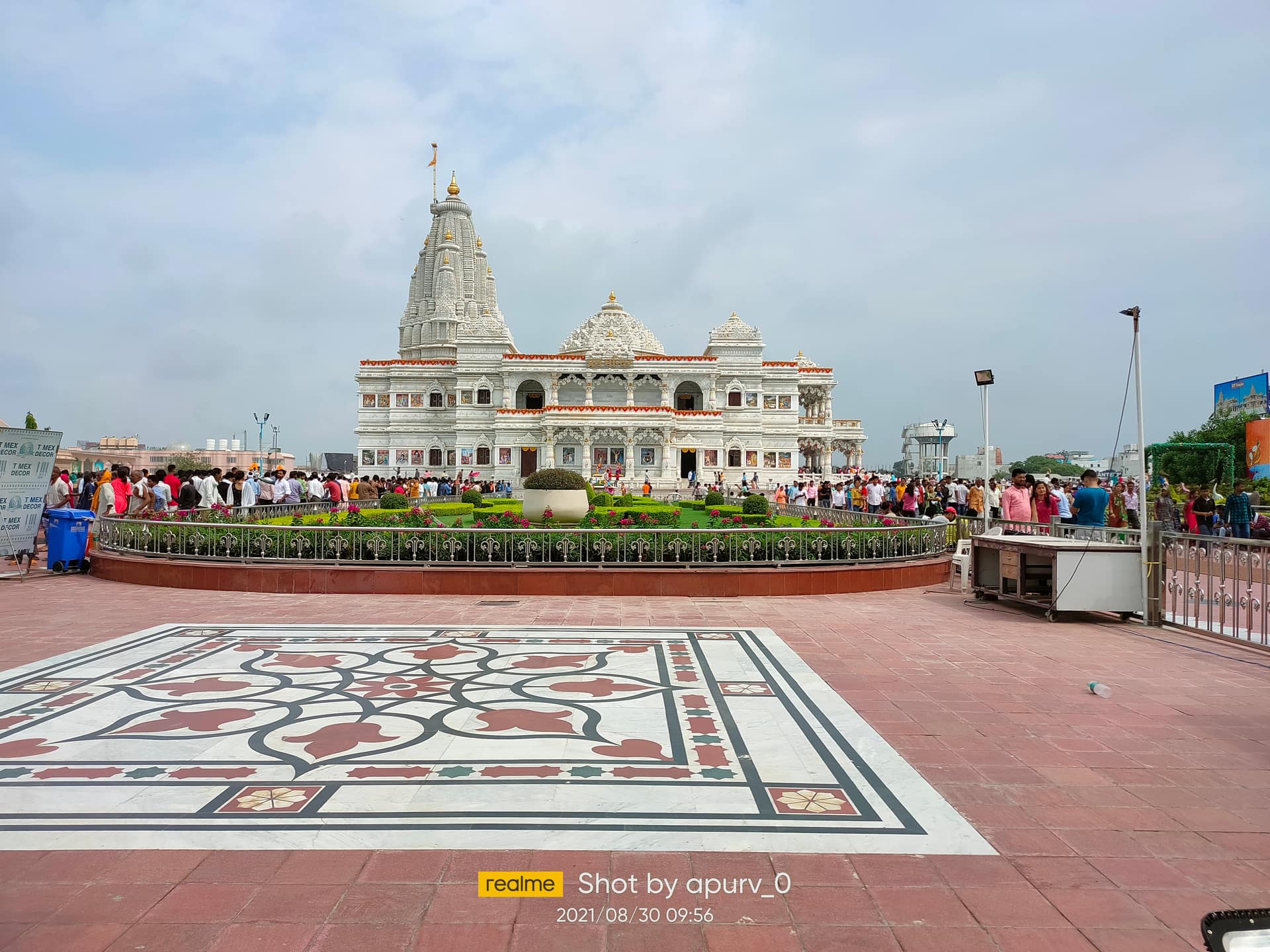
Temple in Mathura
Prem Mandir
Mathura, Uttar Pradesh
A modern white marble temple set in gardens on the edge of Vrindavan, finished in 2012. It is the one temple in Braj built to be visited in the evening — the whole structure is lit and cycles through colours after dark.
Photo: Apurba Biswas — CC BY-SA 4.0, via Wikimedia Commons
Overview
Who it's to, and what's expected
Deity
Radha Krishna
Tradition
Vishnu · Krishna temple
- Entry
Entry to the temple is completely free for everyone, with no tickets, passes, or bookings required. Visitors should be aware that they must remove their shoes to enter the temple.
- Footwear
You must remove your shoes before entering the temple. Wearing socks is recommended as the marble floors can become hot during the summer.
- Access
There is no seating available for the light show, so elderly visitors should plan to stand near a pillar or edge to lean.
- Prasadam
Vegetarian snacks and prasad counters are available for visitors outside the temple gates.
Usually visited with
Time your visit
The darshan clock
A single opening-hours line cannot express a midday closure or an evening ceremony.
8:30 AM
Opening hours
The temple is open daily from 8:30 AM to 12:00 PM and 4:30 PM to 8:30 PM, with a Morning Aarti held at 5:30 AM and regular Bajan Sandhya rituals.
Rules, timings and fees change — confirm locally before you rely on this.
How long this takes
Ways in
The difference between a twenty-minute visit and a three-hour one.
General darshan
- Free, with no ticket, pass or booking of any kind
- Manageable during the day; the crowds build sharply once the sky darkens for the light show
Light show
- Free and unbooked, but there is NO SEATING - the gardens fill and visitors stand for 30 to 45 minutes
- Arrive early for a position, and if standing is difficult plan to lean against a pillar or an edge
Janmashtami and Diwali
- The show extends to around 9:00 PM and the temple and town are at maximum capacity
- Come on an ordinary weekday evening instead if you want to see it comfortably
At the gate
Before you go in
What gets refused, and what you cannot take past the door.
What to wear
Visitors should wear modest, comfortable clothing and footwear that is easy to remove, as shoes must be taken off before entering. Wearing socks is recommended as the marble floors can become warm during the summer.
Phones and cameras
Mobile phone use and photography are strictly prohibited inside the inner sanctum, though photography is permitted in the temple gardens.
Rules, timings and fees change — confirm locally before you rely on this.
When not to come — unless you mean to
Festival windows
These follow lunar calendars and move by weeks each year, so the windows are months, not dates.
Janmashtami
Diwali
Holi
Radhashtami
Practicalities
The things that go wrong
Book through official channels, and treat anyone promising a guaranteed slot as a warning sign.
What to watch for
- Anyone charging for a place to sit or stand during the light show
- There is no seating and no reserved standing; arrive early instead
- Auto and e-rickshaw drivers quoting a fare only on arrival, or claiming a surcharge for the evening visit
- Agree the round-trip price before setting out from anywhere in Vrindavan
- Prasad and snack sellers inside the gates
- The counters are outside the temple gates - buy there at posted prices rather than from anyone operating within the complex
- Guides attaching themselves in the gardens and producing a fee after the light show
- The complex is self-explanatory and needs no guide
- Claims that photography inside the sanctum can be permitted for a fee
- It is strictly prohibited, along with mobile phone use, and no payment changes that; the gardens are photographable freely
One place, many temples
Other temples in Mathura
General guidance
Planning the visit
Customary practice and what Mathura's climate means for a barefoot visit — not rules posted at this temple. Anything specific to Prem Mandir is above.
The queue is the ritual
Vaishnava temples in India are usually organised around a moving darshan queue rather than time spent in front of the deity. Expect to keep walking, and expect the view of the sanctum to be brief — that is the intended experience, not a rushed one.
Come in winter
Winter is when Mathura is most comfortable to walk around, which matters here because a temple visit is done on foot and barefoot. Locally the window is given as october to march (holi in march).
Stone gets hot — go early
You will be barefoot from the shoe rack onwards, often across an open courtyard. Between late morning and mid-afternoon in the hot months that stone is genuinely painful to stand on. Socks help, and are permitted almost everywhere shoes are not.
Arriving by train
Mathura has a railway station, and auto-rickshaws wait outside it. Agree the fare or use a meter before you set off, and expect to be dropped a short walk from the temple rather than at its door.
No airport here
Mathura has no airport of its own, so the last leg is by road or rail. Plan the return the same way — the last bus out is often earlier than visitors expect.
Outfit guide
What to wear at Prem Mandir
Cover shoulders and knees — the rules above win over anything here.
Trending wear for this spot
Modern, camera-ready looks picked for Prem Mandir.

Traditional wear for this spot
Timeless, cultural outfits worn across Mathura.
Prem Mandir, Vrindavan
Prem Mandir is the one temple in Braj built to be visited in the evening. A modern white marble temple set in gardens on the edge of Vrindavan, finished in 2012, it is designed around a single idea: after dark the whole structure is lit and cycles through colours, and the marble that is merely impressive by day becomes something else entirely.
Every other temple in Vrindavan is a morning-and-evening darshan destination. Prem Mandir is a light-show destination that also has a temple in it — which is not a criticism, it is what it was built to be, and knowing that is how you plan the visit.
🌆 The light show — timings that actually vary
- It starts every evening around 7:00 PM.
- In winter (November to January) it begins earlier, around 6:30 PM.
- During major festivals — Janmashtami and Diwali — it continues until around 9:00 PM.
- It lasts about 30 to 45 minutes, with one source giving up to an hour.
- The show is free. There is no entry fee and no ticket to book.
The temple itself stays open until 8:30 PM, and the show runs until closing. Sunset to 8:30 PM is the ideal window for both photography and the temple, and the consistent local advice is to arrive early for a good position — the crowds build sharply once the sky darkens.
One practical detail the existing guidance on this page gets right and that most visitor accounts omit: there is no seating for the light show. The gardens fill and people stand. Elderly visitors should plan to stand near a pillar or an edge where they can lean, and anyone who cannot stand for forty minutes should treat the show as optional and take the evening darshan instead.
🕒 Timings
Open every day, Monday to Sunday:
- Morning: 8:30 AM to 12:00 PM
- Evening: 4:30 PM to 8:30 PM
There is a midday closure between the two sessions, so a 1:00 PM arrival finds the temple shut — a common mistake given that the temple is on the main Vrindavan circuit and people assume it is open all day.
🛕 The building
White marble throughout, set in landscaped gardens, with the temple proper raised on a substantial plinth and the gardens laid out around it. The scale is deliberately grand and the effect is closer to a monument than to Braj's older, denser temples.
Photography is permitted in the temple gardens — which is where the light show happens, and where most of the photography anyone does here takes place. Mobile phone use and photography are strictly prohibited inside the inner sanctum. So the rule is clean: gardens yes, sanctum no.
👟 Shoes, socks, and hot marble
Shoes must be removed before entering the temple. The practical consequence is specific and worth acting on: wear socks, because the marble floors become warm — and in summer, hot — during the day.
Wear footwear that is easy to take off and put back on, since you will do it at least once and possibly several times across the complex. This is genuinely one of the temples in Vrindavan where the floor surface matters more than the dress code.
Dress should be modest and comfortable. There is no strict published code, but this is an active place of worship with heavy family and pilgrim attendance.
🍬 Prasad and food
Vegetarian snacks and prasad counters are available outside the temple gates. Note that they are outside, not inside — so if you want prasad, buy it on the way in or out rather than expecting it within the complex.
Vrindavan and the wider Braj region are strictly vegetarian, and Prem Mandir is no exception. Do not bring non-vegetarian food, alcohol, or tobacco into the complex.
🌸 Janmashtami, and why this temple matters then
Janmashtami — Krishna's birth, in August or September — is Vrindavan's defining festival, and nowhere more so than at a temple dedicated to Radha Krishna on the edge of the town where Krishna is held to have spent his childhood. The light show runs until around 9:00 PM on Janmashtami and Diwali, the crowds are at their maximum, and the whole town is at capacity.
If you want the spectacle, Janmashtami is when Prem Mandir is at its most itself. If you want to see it comfortably, come on an ordinary weekday evening. Both are legitimate choices and they are quite different visits.
📍 Fitting it into Vrindavan
Prem Mandir is on the edge of Vrindavan, set back from the town's dense older centre with gardens and parking around it — which is precisely why it works as an evening destination and why it does not feel like Banke Bihari.
The natural Vrindavan day:
- Morning: Banke Bihari, the busiest and most distinctive temple in town (open from 7:45 AM in summer, 8:45 AM in winter)
- Midday: closure at most temples, including this one
- Afternoon: ISKCON Vrindavan and the older temples
- Evening: Prem Mandir from about 5:00 PM, darshan, gardens, then the light show after sunset
Pairing Prem Mandir with Banke Bihari is the standard Vrindavan combination and the two could not be more different — one a modern marble complex built for evening light, the other an 1864 temple with no bells and a curtain drawn across the deity every minute or two.
⚠️ Practical notes
- Come in the evening, and come early. The show is the reason the temple exists as a destination.
- Wear socks. Hot marble is the most common complaint.
- No seating for the show — plan for standing, and position accordingly if that is difficult.
- Do not pay anyone for entry. It is free, with no tickets and no passes.
- Photograph the gardens, not the sanctum.
Last verified: 2026. The light show start varies by season (7:00 PM generally, 6:30 PM in winter from November to January, running to about 9:00 PM at Janmashtami and Diwali) and its duration is given as both 30-40 and 45-60 minutes. Temple hours and free entry with no booking are consistent across sources.
Questions
Prem Mandir — FAQ
Who is Prem Mandir dedicated to?
Prem Mandir in Mathura is dedicated to Radha Krishna.
Who can enter Prem Mandir?
Entry to the temple is completely free for everyone, with no tickets, passes, or bookings required. Visitors should be aware that they must remove their shoes to enter the temple.
What is the dress code at Prem Mandir?
Visitors should wear modest, comfortable clothing and footwear that is easy to remove, as shoes must be taken off before entering. Wearing socks is recommended as the marble floors can become warm during the summer.
Do I have to take my shoes off at Prem Mandir?
You must remove your shoes before entering the temple. Wearing socks is recommended as the marble floors can become hot during the summer.
Can I take photos inside Prem Mandir?
Mobile phone use and photography are strictly prohibited inside the inner sanctum, though photography is permitted in the temple gardens.
What prasadam is offered at Prem Mandir?
Vegetarian snacks and prasad counters are available for visitors outside the temple gates.
Is Prem Mandir wheelchair accessible?
There is no seating available for the light show, so elderly visitors should plan to stand near a pillar or edge to lean.
Checked, not remembered
Sources
Every rule and timing above traces back to one of these.