
Temples in Sanchi
Sanchi is a Buddhist site rather than a temple town, but alongside its stupas the hill holds some of the oldest surviving temples in India. Most are ruins protected by the Archaeological Survey of India, and one of them, Temple 17, is among the earliest stone temples in the country.
Sanchi is still a living place of worship. Buddhist monks and pilgrims visit throughout the year, and in large numbers for the relic festival at the Chetiyagiri Vihara in late November. Dress modestly, keep your voice low and follow the rules at each site.
Famous Temples in Sanchi
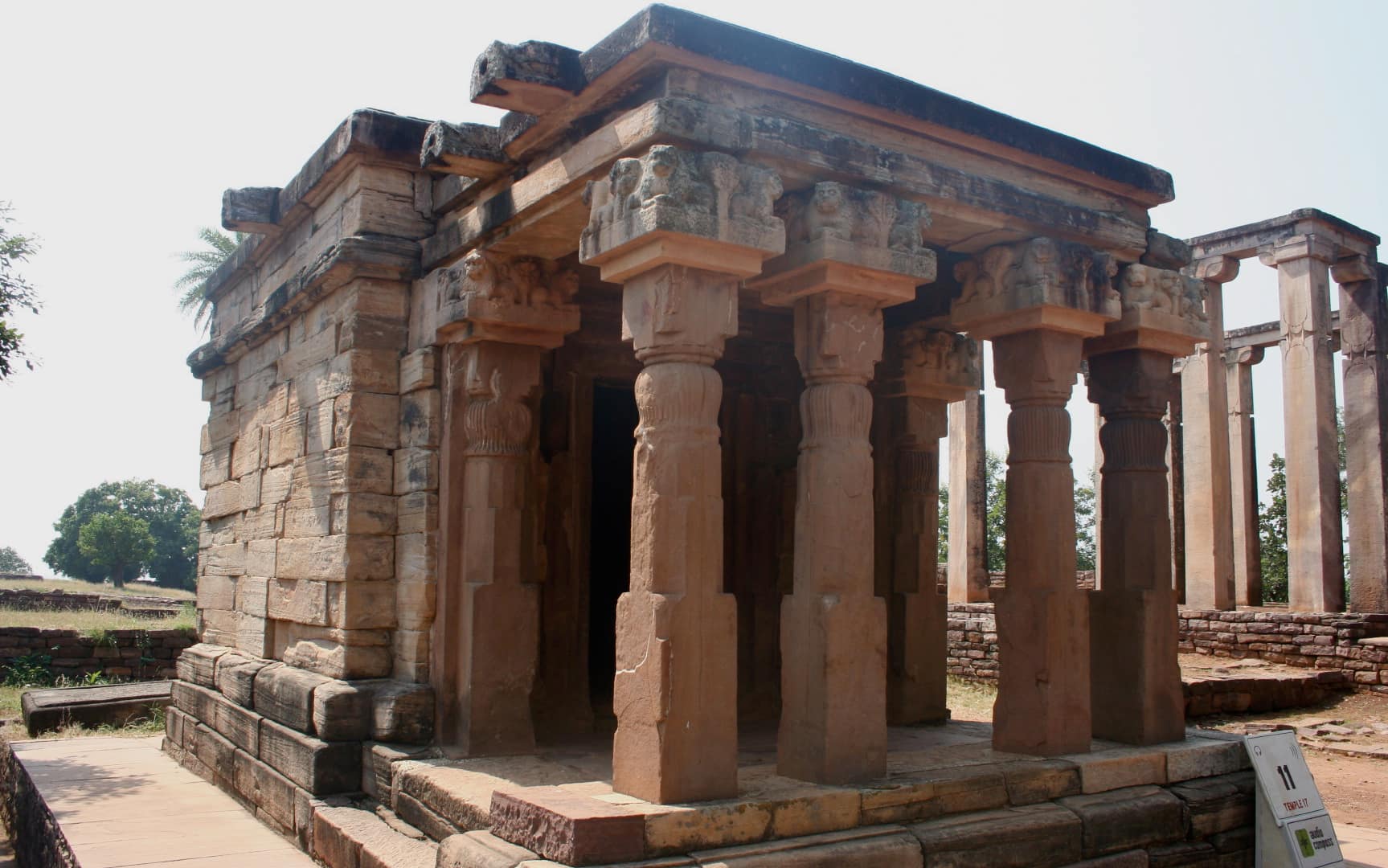
Temple 17 stands just behind the South Gateway of the Great Stupa. Built in the Gupta period, around the early 5th century CE, it is a small shrine with a flat roof and a porch of four carved pillars. It is one of the earliest surviving stone temples in India, and its simple, balanced design shaped later temple building. The image it once held has been lost.
The Chetiyagiri Vihara is a modern Buddhist temple built by the Maha Bodhi Society. Since 1952 it has held relics of Sariputta and Mahamoggallana, two of the Buddha's chief disciples, which were found in Stupa 3 in the 19th century. The relics are shown to the public once a year at a festival, usually on the last weekend of November. See events and festivals in Sanchi for what to expect.
Stupa 3, a short walk from the Great Stupa, is the smaller stupa where those relics were found. It has a single carved gateway facing south.
The Udayagiri Caves, about 13 km away near Vidisha, are rock-cut Hindu shrines from the Gupta period, with one Jain cave. Cave 5 holds the giant carving of Vishnu as Varaha, the boar, lifting the earth goddess from the waters.
The Heliodorus Pillar in Besnagar, near Vidisha, was set up around 113 BCE by Heliodorus, a Greek envoy, in honour of Vasudeva (Krishna). Locals call it Khamba Baba.
Tips for Visiting Temples in Sanchi
- Walk around stupas clockwise, keeping them on your right, as Buddhist pilgrims do.
- Cover your shoulders and knees, especially in the vihara and when monks are present.
- Take off your shoes before entering the Chetiyagiri Vihara or any active shrine.
- Do not climb on the stupas, railings or ruins, and do not touch the carvings.
- Ask before photographing monks or pilgrims, and never during prayers.
- Go early in the morning, when the hill is at its quietest.
- Expect big crowds and full rooms on the festival weekend in late November.
Questions
Sanchi — FAQ
Are there temples in Sanchi?
Yes. The hill has ancient Buddhist shrines such as Temple 17, one of the oldest surviving stone temples in India, and the modern Chetiyagiri Vihara. The Hindu Udayagiri Caves are about 13 km away near Vidisha.
What is Temple 17 at Sanchi?
Temple 17 is a small Gupta-period shrine from around the early 5th century CE, just behind the South Gateway of the Great Stupa. Its flat roof and pillared porch make it one of the earliest surviving stone temples in India.
Where are the relics kept at Sanchi?
Relics of Sariputta and Mahamoggallana, two of the Buddha's chief disciples, are kept in the Chetiyagiri Vihara. They are shown to the public once a year, at a festival usually held on the last weekend of November.
Which way should I walk around a stupa at Sanchi?
Walk clockwise, keeping the stupa on your right. This is the traditional Buddhist way to circle a stupa, and pilgrims at Sanchi follow it.