
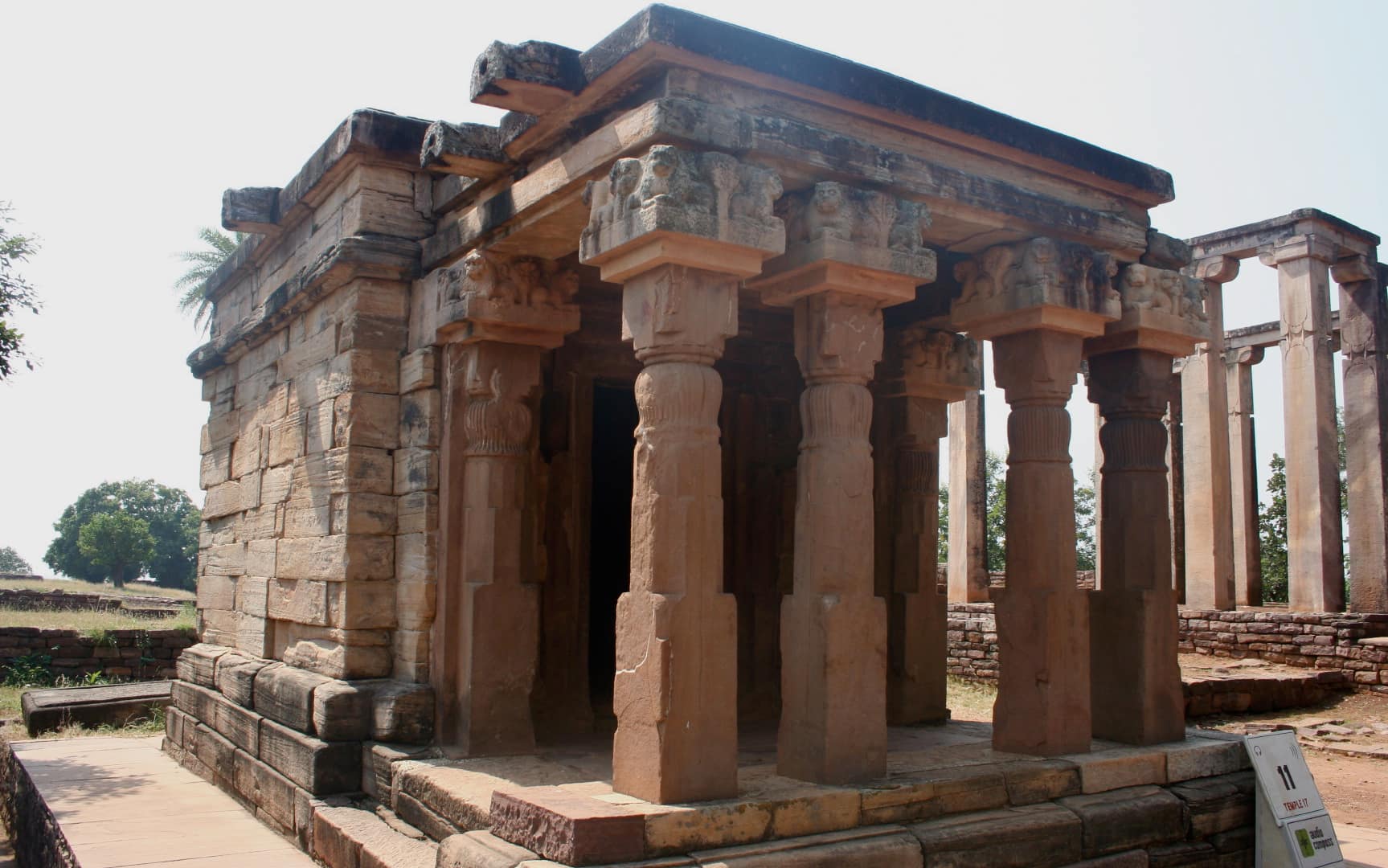
Temple in Sanchi
Temple 17
Sanchi, Madhya Pradesh
A small flat-roofed building beside the Great Stupa, and far more important than its size suggests: dated to the early 5th century, it is among the earliest free-standing stone temples in India, and the plan every later Hindu temple grew out of — a square sanctum with a pillared porch, and nothing else.
Photo: Nagarjun Kandukuru — CC BY 2.0, via Wikimedia Commons
Overview
Who it's to, and what's expected
Deity
Unknown — the image is long gone
Tradition
Buddhist temple
- Entry
Inside the ASI-ticketed Sanchi complex, on the same ticket as the Great Stupa.
- Access
The site involves walking on gentle slopes and stone stairways, which may be challenging for some visitors. Older individuals, young children, and those with heart or knee conditions should proceed slowly and rest as needed.
Usually visited with
How long this takes
Ways in
The difference between a twenty-minute visit and a three-hour one.
ASI ticketed entry
- "note": "One ticket covers the whole Sanchi complex - the Great Stupa and its toranas, Temple 17, the monasteries, the votive stupas and the Ashokan pillar - at the standard ASI bands of Rs40 for Indian nationals and Rs600 for foreign nationals, with children under 15 free
- Book online through the ASI e-ticketing portal in peak season
When not to come — unless you mean to
Festival windows
These follow lunar calendars and move by weeks each year, so the windows are months, not dates.
Buddha Purnima (Vesak)
Sanchi Festival
Best visiting season
Practicalities
The things that go wrong
Book through official channels, and treat anyone promising a guaranteed slot as a warning sign.
What to watch for
- Selling a separate ticket for Temple 17 or for the Great Stupa
- Temple 17 is inside the ASI-ticketed Sanchi complex on the same ticket as the Great Stupa, at Rs40 for Indian nationals and Rs600 for foreign nationals with under-15s free
- Unlicensed guides at the site entrance
- Sanchi genuinely rewards a guide because the torana narrative reliefs and the Gupta-period dating are hard to read unaided - but arrange one at the official counter rather than accepting whoever appears
- Charging for access to the hilltop or to individual monuments within the complex
- One ASI ticket covers the whole site
- Anyone offering to take you up onto the Great Stupa or to touch the torana reliefs for a fee
- Climbing the stupa and touching the carvings are both prohibited, and no payment authorises either
- Transport operators inflating fares from Bhopal by claiming Sanchi is remote
- It is about 46 km away and has its own railway station on the Bhopal-Itarsi line, making it one of central India's more accessible major sites - agree a rate before travelling
- Claims that Temple 17 is closed or restricted
- It is part of the open ASI complex and needs no special permission, though it is small and easy to walk past
General guidance
Planning the visit
Customary practice and what Sanchi's climate means for a barefoot visit — not rules posted at this temple. Anything specific to Temple 17 is above.
Walk clockwise, and mind the feet
Circumambulation is clockwise, and prayer wheels are turned the same way. Pointing your feet at an image of the Buddha — sitting with legs outstretched towards the shrine — is the commonest unintended offence, and sitting cross-legged or kneeling avoids it.
Come in winter
Winter is when Sanchi is most comfortable to walk around, which matters here because a temple visit is done on foot and barefoot. Locally the window is given as october to march.
Stone gets hot — go early
You will be barefoot from the shoe rack onwards, often across an open courtyard. Between late morning and mid-afternoon in the hot months that stone is genuinely painful to stand on. Socks help, and are permitted almost everywhere shoes are not.
Arriving by train
Sanchi has a railway station, and auto-rickshaws wait outside it. Agree the fare or use a meter before you set off, and expect to be dropped a short walk from the temple rather than at its door.
No airport here
Sanchi has no airport of its own, so the last leg is by road or rail. Plan the return the same way — the last bus out is often earlier than visitors expect.
Outfit guide
What to wear at Temple 17
Cover shoulders and knees — the rules above win over anything here.
Trending wear for this spot
Popular modern looks travellers are wearing across Sanchi.


Traditional wear for this spot
Timeless, cultural outfits worn across Sanchi.
Temple 17, Sanchi
Temple 17 is a small flat-roofed building beside the Great Stupa, and it is far more important than its size suggests.
Dated to the early fifth century, it is among the earliest free-standing stone temples in India, and its plan is the one every later Hindu temple grew out of: a square sanctum with a pillared porch, and nothing else.
If you want to know where the Indian temple begins, this is the building. Everything from Konark's chariot to Kandariya Mahadeva's mountain of spires is a development of the idea set out here in four walls and a porch.
🏛️ The plan that became a tradition
Temple 17 is a sanctum-plus-porch temple — a plain, cube-like garbhagriha with a doorway, fronted by a pillared portico (mandapa), and a flat roof. No tower, no corridor, no subsidiary shrines, no enclosure.
That austerity is the point. The elements that later Indian temple architecture elaborated — the towering shikhara, the processional corridor, the gateways, the stacked subsidiary spires — do not exist here yet. What exists is the irreducible minimum:
- A dark square cell for the image
- A doorway facing outward
- A covered porch for those who come
- A platform to stand on
Every subsequent development is an answer to a question this building poses. A visitor who understands Temple 17 understands why a Chola vimana, a Khajuraho shikhara cluster and a Hoysala star-plan platform are all recognisably the same idea at different stages.
🪨 Gupta-period work, and why that matters
Temple 17 belongs to the Gupta period, the era conventionally regarded as classical India's artistic peak, and its proportions are the clearest demonstration of why.
The building's mouldings are simple, its pillars plain and slightly tapering with square bases and bracket capitals, and its doorway carries a decorated lintel and pilasters. There is no excess. The Gupta aesthetic is restraint — which is precisely what makes Temple 17 legible as a prototype rather than as an ornament.
Compare it with what came later at the same site and nearby: the Great Stupa's elaborately carved toranas (gateways), the monolithic Ashokan pillar, and the later temples and monasteries spread across the hill. Temple 17 is the quietest building at Sanchi and the most consequential.
🕉️ Sanchi itself
Sanchi is a Buddhist complex, and its centre is the Great Stupa, traditionally founded under Ashoka in the third century BCE and enlarged in the Shunga period, with its four carved toranas added around the first century BCE to the first century CE.
The toranas are among the masterpieces of Indian sculpture — dense narrative reliefs of the Jataka tales, of courtly and village life, and of the symbols used to represent the Buddha before figural images of him became standard (the wheel, the Bodhi tree, the empty throne, the footprints).
So Temple 17 sits inside a Buddhist complex and is itself usually read as a Buddhist shrine, even though its plan is the ancestor of the Hindu temple. That is not a contradiction: the sanctum-and-porch form was shared, and it was Hindu temple architecture that developed it into the monumental tradition.
The site also holds monasteries, votive stupas, and the monolithic Ashokan pillar with its lion capital — and the whole hill is a UNESCO World Heritage Site.
🎟️ Tickets, and one ticket for everything
Temple 17 is inside the ASI-ticketed Sanchi complex, on the same ticket as the Great Stupa. There is no separate charge for it.
The standard ASI bands apply: ₹40 for Indian nationals, ₹600 for foreign nationals, with children under 15 free, and online booking through the ASI e-ticketing portal.
One ticket therefore covers the Great Stupa, the toranas, Temple 17, the monasteries, the votive stupas and the Ashokan pillar — which is why the value here is unusually high relative to the price.
🕒 Hours
The complex follows the standard ASI monument pattern, open from morning to evening, with sunrise-to-sunset as the operative framing.
There is no ritual timetable, no aarti and no darshan — all recorded as genuinely absent on this page. It is an archaeological site, and you visit it as one.
♿ Access
The site involves walking on gentle slopes and stone stairways, which may be challenging for some visitors. Older individuals, young children, and those with heart or knee conditions should proceed slowly and rest as needed.
Sanchi is on a hill, which is the source of both the walking and the views — the complex is arranged across the hilltop with the Great Stupa at its centre, and reaching Temple 17 means negotiating the site's slopes.
There is no ramp or lift provision, so visitors with significant mobility limitations should plan for the slopes before travelling.
📍 Getting there, and combining it
Sanchi is in Madhya Pradesh, about 46 km from Bhopal, and is reached easily from there by road or rail — Sanchi has its own railway station on the Bhopal–Itarsi line, which makes it one of the more accessible major archaeological sites in central India.
The natural combination is Bhopal as a base, with Sanchi as a half-day excursion. Bhimbetka, the rock-shelter site with prehistoric paintings and a second UNESCO listing, is further south and is often paired with Sanchi on a longer Madhya Pradesh itinerary.
Allow two to three hours at Sanchi, with the Great Stupa's toranas and Temple 17 as the two priorities.
⚠️ Practical notes
- Go to Temple 17 deliberately. It is small, unadorned and easy to walk past, and most visitors do — which means missing the most important building on the hill.
- Stand at the porch and look at what is not there. No tower, no corridor, no gateway. That absence is the lesson.
- Then walk the Great Stupa's toranas clockwise, in the direction the architecture assumes, and read the narrative reliefs.
- Go in the morning or late afternoon; the hill is exposed and central Indian heat is severe from March.
- October to March for the season.
- No flash, no touching, no climbing the stupa.
Last verified: 2026. The early fifth-century date, the sanctum-with-pillared-porch plan and its status as among the earliest free-standing stone temples in India are retained from the existing record and are consistent with the standard scholarly account of Gupta-period architecture. The ASI ticket bands (Rs40 Indian, Rs600 foreign, under-15 free) match those verified at Ajanta, Ellora and Konark this run. Temple 17 is inside a Buddhist complex and is read as a Buddhist shrine, while its plan is the ancestor of the Hindu temple - both are stated rather than one being preferred.
Questions
Temple 17 — FAQ
Who is Temple 17 dedicated to?
Temple 17 in Sanchi is dedicated to Unknown — the image is long gone.
Who can enter Temple 17?
Inside the ASI-ticketed Sanchi complex, on the same ticket as the Great Stupa.
Is Temple 17 wheelchair accessible?
The site involves walking on gentle slopes and stone stairways, which may be challenging for some visitors. Older individuals, young children, and those with heart or knee conditions should proceed slowly and rest as needed.
Checked, not remembered
Sources
Every rule and timing above traces back to one of these.