
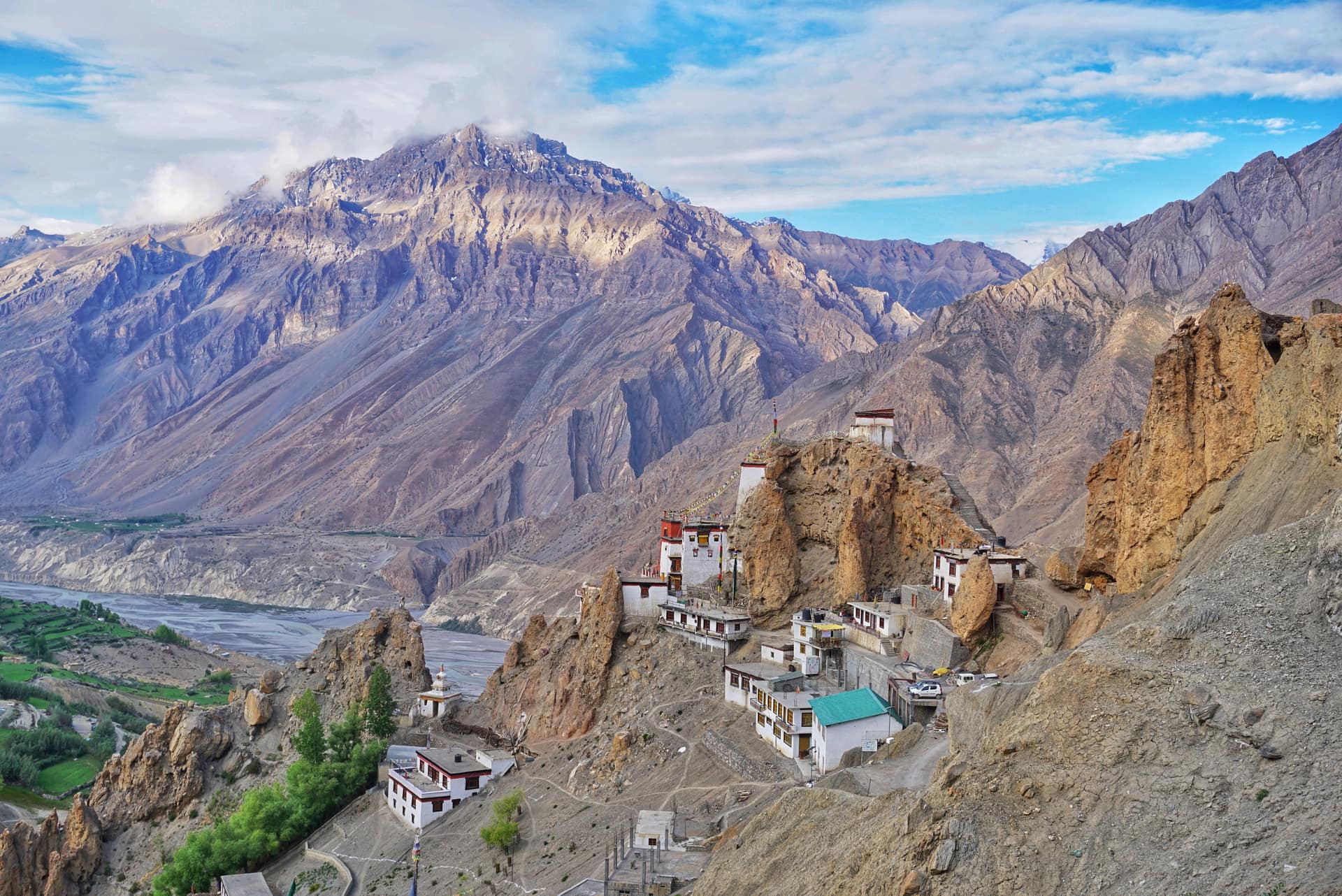
Temple in Spiti Valley
Dhankar Gompa
Spiti Valley, Himachal Pradesh
The name means fort on a cliff, and it is exactly that — a monastery built onto a spur of crumbling rock above the meeting of the Spiti and Pin rivers, at over 3,800 m. It was the seat of the local ruler before it was a monastery.
Photo: Deepank Ranka — CC BY-SA 4.0, via Wikimedia Commons
Overview
Who it's to, and what's expected
Deity
Gelugpa lineage
Tradition
Buddhist temple
- Entry
Free entry, with donations welcome. Nobody on the approach is authorised to collect an entrance fee or sell a photography permit - invented charges are a known problem at Spiti's monasteries. Published timings give both roughly 6:00 AM to 6:00 PM and a 9:00 AM opening, so a mid-morning arrival before dusk is the safe plan. Note that access to parts of the old building is restricted because it is structurally fragile, and a newer monastery below takes most visitors.
- Footwear
Remove your shoes before entering the prayer halls or prayer rooms. Beyond that, wear proper footwear with grip for the visit itself: the site is on a crumbling rock spur reached by uneven paths, and the 2 km climb to Dhankar Lake above the gompa is steep and loose underfoot.
- Access
The old building is structurally fragile and access to parts of it is restricted; a newer monastery below takes most visitors. The lake walk above is another hour of climbing at altitude.
- Prasadam
There is no prasad in the Hindu sense at a Tibetan Buddhist monastery. Butter tea is the traditional offering of hospitality and you may be offered it. Donations are appreciated rather than required, and are the appropriate contribution given entry is free.
Usually visited with
Time your visit
The darshan clock
A single opening-hours line cannot express a midday closure or an evening ceremony.
9:00 am
Opening hours
Dhankar Monastery is open daily from 09:00 to 18:00.
Rules, timings and fees change — confirm locally before you rely on this.
How long this takes
Ways in
The difference between a twenty-minute visit and a three-hour one.
No queue
- Free entry with no ticket and no managed line
- Dhankar is considerably less visited than Key Monastery, so you are likely to have parts of it largely to yourself - which also makes visitors more conspicuous in a working monastery
Dhankar Lake trek
- About 2 km and roughly an hour of climbing at altitude above the gompa, free and open all day
- Steep, loose underfoot, with no water, shade or shelter on the route - do not attempt it unless properly acclimatised
At the gate
Before you go in
What gets refused, and what you cannot take past the door.
What to wear
Modest dress covering shoulders and knees. This is a working monastery and a restricted-access fragile structure, so the expectation is real rather than nominal. Layer warmly - at over 3,800 m it is cold even in the May to October season, and the lake climb above is exposed.
Phones and cameras
Photography is welcome from a distance and from the terraces - the view of the monastery growing out of the cliff is the reason most people come, and the approach road gives the best of it. Avoid flash inside the prayer halls, keep your phone away entirely if you are permitted to sit in on prayers, and do not enter restricted areas of the fragile old building to get a photograph.
Rules, timings and fees change — confirm locally before you rely on this.
When not to come — unless you mean to
Festival windows
These follow lunar calendars and move by weeks each year, so the windows are months, not dates.
Best visiting season
Chaam / mask dances
Losar
Practicalities
The things that go wrong
Book through official channels, and treat anyone promising a guaranteed slot as a warning sign.
What to watch for
- Invented entrance fees and photography permits collected on the approach
- Entry to Dhankar Gompa is free and no permit exists - a known problem across Spiti's monasteries
- Offers of a 'mandatory local guide'. No guide is required; arrange one through a Kaza guesthouse at an agreed price if you want context
- Drivers quoting a fare only on arrival from Kaza, or adding a surcharge for the lake trek
- Agree a round-trip price before setting out
- Anyone encouraging you into restricted areas of the old building for a better photograph
- The structure is fragile and parts are closed for that reason - this is the one 'help' at Dhankar that can genuinely hurt you or the monument
- Porters or guides being pressed on you for the Dhankar Lake climb at inflated rates
- The trek is a marked 2 km route; if you are acclimatised and equipped you do not need one
One place, many temples
Other temples in Spiti Valley
General guidance
Planning the visit
Customary practice and what Spiti Valley's climate means for a barefoot visit — not rules posted at this temple. Anything specific to Dhankar Gompa is above.
Walk clockwise, and mind the feet
Circumambulation is clockwise, and prayer wheels are turned the same way. Pointing your feet at an image of the Buddha — sitting with legs outstretched towards the shrine — is the commonest unintended offence, and sitting cross-legged or kneeling avoids it.
Come in monsoon
Monsoon is when Spiti Valley is most comfortable to walk around, which matters here because a temple visit is done on foot and barefoot. Locally the window is given as june to september (roads open).
Cold stone, early starts
Barefoot on stone at altitude before sunrise is colder than the air temperature suggests, and the first darshan of the day is usually the coldest hour. Socks are permitted almost everywhere shoes are not.
No airport here
Spiti Valley has no airport of its own, so the last leg is by road or rail. Plan the return the same way — the last bus out is often earlier than visitors expect.
Outfit guide
What to wear at Dhankar Gompa
Cover shoulders and knees — the rules above win over anything here.
Trending wear for this spot
Popular modern looks travellers are wearing across Spiti Valley.

Traditional wear for this spot
Timeless, cultural looks that suit Dhankar Gompa.
Dhankar Gompa
The name means "fort on a cliff", and the monastery is exactly that — built onto a spur of crumbling rock above the confluence of the Spiti and Pin rivers, at over 3,800 metres. It was the seat of the local ruler before it was a monastery, which explains why it looks like a fortification rather than a religious complex: it was one first.
The result is one of the most dramatic settings of any monastery in India. The old buildings appear to grow out of the rock itself, and from a distance it is genuinely hard to tell where the cliff stops and the monastery begins.
🏰 Fort first, monastery second
Dhankar served as the seat of the local ruler and as a fort before becoming a gompa, and the Gelugpa monastic community inherited the structure. That history is legible in the architecture — defensive position, thick walls, a layout that follows the rock rather than a planned monastery plan.
It is smaller and far less visited than Key Monastery, and the two are usually combined in one day from Kaza. The difference in character is the reason to do both: Key is large, active and stacked; Dhankar is precarious, quiet and perched.
⚠️ The old building is fragile — read this
The old monastery building is structurally fragile and access to parts of it is restricted. This is not a caution to be waved away:
- A newer monastery below now takes most visitors, and it is where you should expect to spend your time.
- Do not climb into restricted areas of the old structure, go onto unstable edges, or push past barriers for a photograph. The rock is crumbling and the building is genuinely at risk.
- The dramatic photographs of Dhankar are taken from a distance or from the new monastery's terraces — you do not need to enter the fragile fabric to get them.
Dhankar's precariousness is the whole point of it, and it is also why parts of it are closed. Respect the closures rather than treating them as an obstacle to the visit.
🥾 Dhankar Lake: another hour at altitude
Above the monastery is Dhankar Lake, roughly a 2 km trek up from the gompa. It is a high-altitude lake in a bowl above the valley and is one of Spiti's better short walks.
Be realistic about it:
- It is about an hour of climbing, at altitude, above 3,800 m. The existing guidance on this page is correct — that is the figure to plan around.
- The climb is steep in places and the ground is loose.
- There is no water, shade or shelter on the route.
- Do not attempt it unless you are properly acclimatised. If you came up from Kaza the same day and have not spent time at altitude, the lake is not for you on this visit.
- Allow for the descent and the light. Starting the lake walk late in the afternoon is how people get caught out.
Entry to the lake is free and it is open all day.
🕒 Timings and entry
The same warning as at Key applies: entry is free, and nobody on the approach is authorised to collect a fee. Spiti's monasteries are a known spot for invented "entrance fees" and "photography permits."
🙏 Etiquette
- Remove your shoes before entering prayer halls and prayer rooms.
- Dress modestly, shoulders and knees covered.
- Speak softly and move slowly — this is a working monastery, and the small number of visitors means you are more conspicuous here than at Key.
- No flash photography.
- Walk clockwise around shrines and stupas.
- If you sit in on prayers, keep your phone away entirely.
🏔️ Altitude and logistics
At over 3,800 m, altitude governs the visit. Dhankar is lower than Key (4,166 m), but both are high enough that the same rules apply:
- Acclimatise in Kaza for at least a day before visiting either monastery.
- Carry cash — ATMs are rare in Spiti and often out of service. If you run out, there may be no way to get more for days.
- Carry water and sun protection. The valley is high, dry and exposed, and the sun is intense at altitude.
- Check road conditions, particularly close to the start or end of the season.
May to October is the visiting window, when roads are accessible and the weather is manageable.
📍 Combining it
Dhankar and Key are the standard Spiti monastery pair, both reachable from Kaza. A sensible acclimatised day is Key in the morning and Dhankar in the afternoon, or the reverse — but do not attempt both plus the Dhankar Lake trek on the same day at altitude.
The Pin Valley beyond Dhankar is the reason the confluence matters: Dhankar sits where the Pin meets the Spiti, and the Pin valley road continues from here toward Mud, the gateway to Pin Valley National Park (snow leopard country). Dhankar is the natural staging point for that.
⚠️ Practical notes
- The view of the monastery from the road on approach is the best one. Stop and photograph it from a distance before you climb.
- The new monastery, not the old, is where visitors go. Plan your time accordingly rather than being disappointed.
- Sunset from Dhankar's terraces over the Spiti-Pin confluence is the reward for the climb, but leaves you driving mountain roads in the dark — weigh that deliberately.
- Do not pay invented fees. Free entry, voluntary donations.
Last verified: 2026. Entry is free with donations welcome; published timings give both 6:00 AM-6:00 PM and a 9:00 AM opening, so a mid-morning arrival is advised. The structural fragility of the old building, the newer monastery below taking most visitors, and the roughly one-hour climb to the lake at about 2 km above the gompa are all retained from the existing record's own guidance.
Questions
Dhankar Gompa — FAQ
Who is Dhankar Gompa dedicated to?
Dhankar Gompa in Spiti Valley is dedicated to Gelugpa lineage.
Who can enter Dhankar Gompa?
Free entry, with donations welcome. Nobody on the approach is authorised to collect an entrance fee or sell a photography permit - invented charges are a known problem at Spiti's monasteries. Published timings give both roughly 6:00 AM to 6:00 PM and a 9:00 AM opening, so a mid-morning arrival before dusk is the safe plan. Note that access to parts of the old building is restricted because it is structurally fragile, and a newer monastery below takes most visitors.
What is the dress code at Dhankar Gompa?
Modest dress covering shoulders and knees. This is a working monastery and a restricted-access fragile structure, so the expectation is real rather than nominal. Layer warmly - at over 3,800 m it is cold even in the May to October season, and the lake climb above is exposed.
Do I have to take my shoes off at Dhankar Gompa?
Remove your shoes before entering the prayer halls or prayer rooms. Beyond that, wear proper footwear with grip for the visit itself: the site is on a crumbling rock spur reached by uneven paths, and the 2 km climb to Dhankar Lake above the gompa is steep and loose underfoot.
Can I take photos inside Dhankar Gompa?
Photography is welcome from a distance and from the terraces - the view of the monastery growing out of the cliff is the reason most people come, and the approach road gives the best of it. Avoid flash inside the prayer halls, keep your phone away entirely if you are permitted to sit in on prayers, and do not enter restricted areas of the fragile old building to get a photograph.
What prasadam is offered at Dhankar Gompa?
There is no prasad in the Hindu sense at a Tibetan Buddhist monastery. Butter tea is the traditional offering of hospitality and you may be offered it. Donations are appreciated rather than required, and are the appropriate contribution given entry is free.
Is Dhankar Gompa wheelchair accessible?
The old building is structurally fragile and access to parts of it is restricted; a newer monastery below takes most visitors. The lake walk above is another hour of climbing at altitude.
Checked, not remembered
Sources
Every rule and timing above traces back to one of these.