
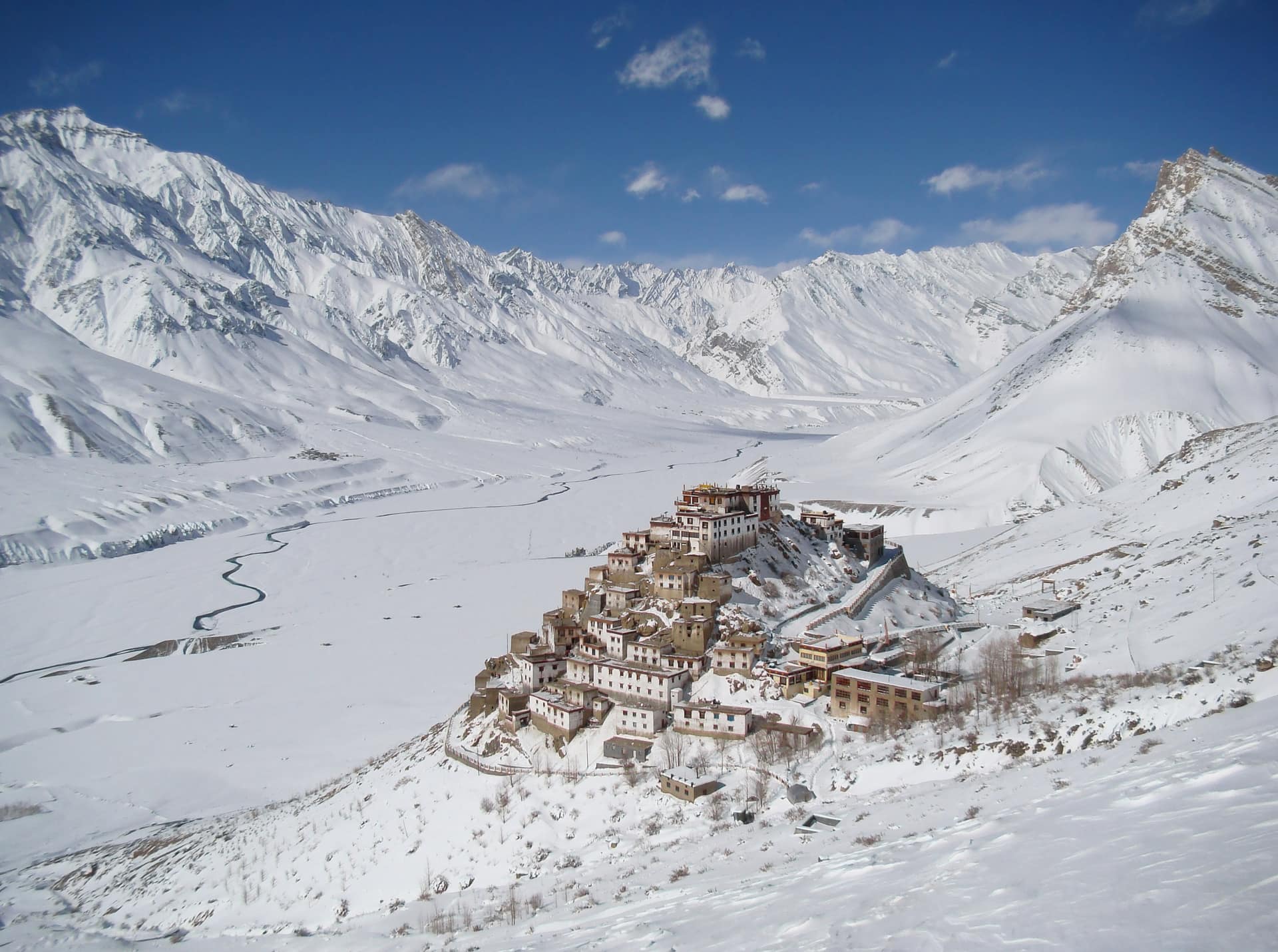
Temple in Spiti Valley
Key Monastery
Spiti Valley, Himachal Pradesh
The largest monastery in Spiti, stacked up a conical hill at about 4,166 m - buildings piled on buildings over roughly a thousand years, partly because it was destroyed and rebuilt so often. Monks still live and study here; it is not a museum.
Photo: Kulbhushaan Raghuvanshi — CC BY-SA 4.0, via Wikimedia Commons
Overview
Who it's to, and what's expected
Deity
Gelugpa lineage
Tradition
Buddhist temple
- Entry
Entry to the Key Monastery is free of charge, and visitors are advised not to pay anyone claiming to collect entrance fees.
- Footwear
You must remove your shoes before entering the prayer halls or prayer rooms.
- Access
The monastery is accessed via stone steps and narrow alleys, requiring visitors to be prepared for uneven terrain.
- Prasadam
There is no prasad in the Hindu sense at a Tibetan Buddhist monastery. Butter tea is the traditional offering of hospitality and you may be offered it; donations to the monastery are the appropriate contribution given entry is free, and are appreciated rather than required.
Usually visited with
Time your visit
The darshan clock
A single opening-hours line cannot express a midday closure or an evening ceremony.
6:00 am
Opening hours
The monastery is open to visitors daily from 6:00 am to 6:00 pm.
Rules, timings and fees change — confirm locally before you rely on this.
How long this takes
Ways in
The difference between a twenty-minute visit and a three-hour one.
No queue
- Free entry with no ticket and no managed line
- Visitors move through the complex at their own pace, constrained by the stone steps, narrow alleys and the altitude rather than by any queue
Morning prayers
- If you are permitted to sit in, arrive early and keep your phone away entirely
- This is monastic life rather than a performance, and the number of visitors allowed in is limited
At the gate
Before you go in
What gets refused, and what you cannot take past the door.
What to wear
Modest dress covering shoulders and knees. This is a working monastery at 4,166 m where monks live and study year-round, not a monument, and the expectation is correspondingly real. Layer warmly - temperatures are low even in the May to October season and the complex is exposed on the hillside.
Phones and cameras
You must keep your phone away if you are permitted to sit in on morning prayers.
Rules, timings and fees change — confirm locally before you rely on this.
When not to come — unless you mean to
Festival windows
These follow lunar calendars and move by weeks each year, so the windows are months, not dates.
Chaam / mask dances
Best visiting season
Losar
Practicalities
The things that go wrong
Book through official channels, and treat anyone promising a guaranteed slot as a warning sign.
What to watch for
- Someone on the approach collecting an 'entrance fee' or selling a 'ticket'. Entry to Key Monastery is free and no ticket exists - this is the most common way visitors lose money at Spiti's monasteries
- Walk past them
- Offers of a 'mandatory local guide' at the gate
- No guide is required; if you want one, arrange it through your guesthouse in Kaza at an agreed price
- Photography permits being sold for the monastery
- Photography restrictions here concern flash and the prayer halls, and are a matter of etiquette rather than a paid permit
- Donations being demanded rather than invited
- Donations are appreciated and are the right way to support the monastery, but they are voluntary - a demand is not a donation
- Drivers quoting a fare only on arrival from Kaza
- The monastery is about 6 km from town; agree the round-trip price before setting out, and remember ATMs in Spiti are rare and often out of service so you must carry cash
One place, many temples
Other temples in Spiti Valley
General guidance
Planning the visit
Customary practice and what Spiti Valley's climate means for a barefoot visit — not rules posted at this temple. Anything specific to Key Monastery is above.
Walk clockwise, and mind the feet
Circumambulation is clockwise, and prayer wheels are turned the same way. Pointing your feet at an image of the Buddha — sitting with legs outstretched towards the shrine — is the commonest unintended offence, and sitting cross-legged or kneeling avoids it.
Come in monsoon
Monsoon is when Spiti Valley is most comfortable to walk around, which matters here because a temple visit is done on foot and barefoot. Locally the window is given as june to september (roads open).
Cold stone, early starts
Barefoot on stone at altitude before sunrise is colder than the air temperature suggests, and the first darshan of the day is usually the coldest hour. Socks are permitted almost everywhere shoes are not.
No airport here
Spiti Valley has no airport of its own, so the last leg is by road or rail. Plan the return the same way — the last bus out is often earlier than visitors expect.
Outfit guide
What to wear at Key Monastery
Cover shoulders and knees — the rules above win over anything here.
Trending wear for this spot
Modern, camera-ready looks picked for Key Monastery.

Traditional wear for this spot
Timeless, cultural outfits worn across Spiti Valley.
Key Monastery (Kye Gompa)
Monks still live and study here. That is the single most important thing to understand before visiting: this is not a museum with a monastery attached, it is a working monastic institution that also receives visitors.
🏔️ What it is
Also called Kye Gompa or Ki Gompa, it belongs to the Gelugpa lineage of Tibetan Buddhism and holds over a thousand years of uninterrupted practice, which makes it a cornerstone of Buddhism in the Trans-Himalaya rather than a regional curiosity.
The location is the other half of the reason people come. At 4,166 m the monastery commands panoramic views of the Spiti valley and the Spiti river, and the approach road gives the classic view of the whole complex stacked against the hillside. It is consistently described as one of the best landscape-photography spots in the valley.
The monastery is about 6 km from Kaza, the valley's main town, and is reached by road from there.
🕒 Timings, entry, and an important warning
Entry is free. Donations are appreciated and are the appropriate way to contribute.
Published timings are genuinely inconsistent, which matters at altitude where you cannot afford to make a wasted trip:
- One source gives 6:00 AM to 6:00 PM daily
- Another gives 8:00 AM to 7:00 PM
- Two describe it as having no fixed timing, best visited between sunrise and sunset
The safe plan is to arrive mid-morning and leave well before dusk. Roads in Spiti are mountain roads and driving them after dark is a poor idea; the "sunrise to sunset" framing is more useful than any specific hour.
A warning that is specific to this monastery and worth taking seriously: the existing guidance on this page is that entry is free and visitors should not pay anyone claiming to collect an entrance fee. That is correct, and it is the most common way visitors lose money at Spiti's monasteries — someone at the approach collects a "ticket" that does not exist. There is no ticket. Walk past them.
🥾 Altitude — the real constraint
At 4,166 m this is not a casual visit. Altitude is the governing factor, not opening hours:
- Acclimatise properly. Spend at least a day in Kaza before coming up to Key. Arriving from the lowlands and climbing straight to 4,166 m is how people get altitude sickness, and the monastery involves walking and stairs on top of it.
- The site is reached by stone steps and narrow alleys on uneven terrain. Expect climbing within the complex, not just to it.
- Go slowly and deliberately. This is not a place to rush, both for your body and for the monastic life around you.
- Carry water. There is very little at altitude.
💵 Cash, and why it matters
ATMs are rare in Spiti and often out of service. This is not a minor inconvenience — if you run out of cash in the valley, there may be no way to get more for days. Carry enough for your whole Spiti itinerary before you leave Kaza, Manali or Shimla, and do not rely on card payment anywhere.
🙏 Monastic etiquette
The guidance here is simple and applies at every monastery in the valley:
- Dress modestly. Shoulders and knees covered; this is a religious site at altitude where the monks live year-round.
- Speak softly. Silence in and around the prayer halls.
- Avoid flash photography.
- Remove your shoes before entering the prayer halls or prayer rooms. This is enforced and there is nowhere to leave them securely on the steps, so manage them deliberately.
- If you are permitted to sit in on morning prayers, keep your phone away entirely — not on silent in your hand, away.
- Walk clockwise around shrines and stupas, as is customary in Tibetan Buddhism.
- Do not point your feet at the altar or at monks, and do not sit with your back to the shrine.
🌸 When to go
May to October is the best window. During these months the weather is pleasant, the roads are accessible, and the valley is in bloom, with temperatures roughly 10°C to 25°C.
Outside that window the road access is the problem rather than the cold: Spiti's roads close or become unreliable in winter, and late-season travel near the monsoon carries its own risk. Check road conditions if you are travelling close to either end of the season.
⚠️ Practical notes
- Stay in Kaza and use it as your base — it is the valley's town with the most accommodation, and Key is a short drive.
- Combine Key with Dhankar Gompa on the same day if you are acclimatised, but do not attempt both on an arrival day.
- Donations are the right way to support the monastery, given entry is free.
- Do not pay a "monastery fee", a "photography permit" or a "guide fee" to anyone on the approach unless you arranged a guide through your guesthouse in Kaza.
- Photograph the complex from the road on the way up — the full stacked-hillside view is best from a distance, not from inside.
Last verified: 2026. Entry is free and the "do not pay anyone collecting an entrance fee" warning is retained from the existing record. Published timings range from 6:00 AM-6:00 PM to 8:00 AM-7:00 PM to simply sunrise-to-sunset, so a mid-morning arrival is advised. Altitude guidance (acclimatise in Kaza first) and the cash warning are specific to Spiti rather than generic travel advice.
Questions
Key Monastery — FAQ
Who is Key Monastery dedicated to?
Key Monastery in Spiti Valley is dedicated to Gelugpa lineage.
Who can enter Key Monastery?
Entry to the Key Monastery is free of charge, and visitors are advised not to pay anyone claiming to collect entrance fees.
What is the dress code at Key Monastery?
Modest dress covering shoulders and knees. This is a working monastery at 4,166 m where monks live and study year-round, not a monument, and the expectation is correspondingly real. Layer warmly - temperatures are low even in the May to October season and the complex is exposed on the hillside.
Do I have to take my shoes off at Key Monastery?
You must remove your shoes before entering the prayer halls or prayer rooms.
Can I take photos inside Key Monastery?
You must keep your phone away if you are permitted to sit in on morning prayers.
What prasadam is offered at Key Monastery?
There is no prasad in the Hindu sense at a Tibetan Buddhist monastery. Butter tea is the traditional offering of hospitality and you may be offered it; donations to the monastery are the appropriate contribution given entry is free, and are appreciated rather than required.
Is Key Monastery wheelchair accessible?
The monastery is accessed via stone steps and narrow alleys, requiring visitors to be prepared for uneven terrain.
Checked, not remembered
Sources
Every rule and timing above traces back to one of these.