

Temple in Kanchipuram
Kailasanathar Temple
Kanchipuram, Tamil Nadu
The oldest temple in Kanchipuram, built under the Pallava king Rajasimha around 685–705 CE — sandstone rather than granite, low, and largely free of the later additions that cover the bigger temples. It is the one to come to for architecture rather than for darshan.
Photo: Pinakpani — CC BY 4.0, via Wikimedia Commons
Overview
Who it's to, and what's expected
Deity
Shiva as Kailasanathar
Tradition
Shiva temple
- Entry
Free entry, with no ticket or registration. Published hours vary: most sources give the town's standard 6:00 AM to 12:00 PM and 4:00 PM to 8:00 PM, while a 12:30 PM figure also circulates, which corresponds to Kanchipuram's midday closing rather than to an opening. Plan a morning visit between 6:00 AM and 12:00 PM, or an evening visit from 4:00 PM, and confirm locally if you are making a special trip.
- Footwear
Remove footwear before entering the temple. The sandstone courtyard and the circumambulatory path become very hot outside the cooler months, so a morning visit is considerably more comfortable underfoot, and the slow walk around the walls that the sculpture deserves is easier before midday.
- Access
The temple is low, compact and largely flat, with a circumambulatory path around the sanctum inside the structure, which makes it physically easier than Kanchipuram's larger complexes with their towering gateways and multiple courtyards. Steps and thresholds do exist at the sanctum. The main constraint is heat rather than access - the sandstone courtyard is exposed and punishing in summer midday.
- Prasadam
Worship continues at the temple, so prasad is distributed as at any active Shiva shrine, but there is no prasad counter or organised distribution of the kind at Kanchipuram's larger pilgrimage temples. Visitors come principally for the architecture rather than for ritual, and should not expect the facilities of Ekambareswarar or Kamakshi.
Usually visited with
Time your visit
The darshan clock
A single opening-hours line cannot express a midday closure or an evening ceremony.
6:00 AM – 12:00 PM
Morning session
The published morning session. Best light on the sandstone and the quietest time to walk the walls closely, which is what this temple is for.
4:00 PM – 8:00 PM
Evening session
The published evening session. Entry is free at both sessions.
Rules, timings and fees change — confirm locally before you rely on this.
How long this takes
Ways in
The difference between a twenty-minute visit and a three-hour one.
No meaningful queue
- Kailasanathar draws a fraction of the visitors of Ekambareswarar or Kamakshi
- Most are architecture students, photographers and travellers who have read about it, so you can usually walk straight in - and midday is the quietest time if you want the temple to yourself
Maha Shivratri and Panguni Uthiram
- Heavier attendance, though still far smaller than at Ekambareswarar, which remains Kanchipuram's dominant Shiva temple for active worship
At the gate
Before you go in
What gets refused, and what you cannot take past the door.
What to wear
Modest dress covering shoulders and knees, as for any active Hindu temple. Because the visit is mostly about walking the exterior walls closely, comfortable clothing suited to heat matters more here than at the town's pilgrimage temples - the sandstone courtyard is exposed.
Phones and cameras
This is the most photographable of Kanchipuram's temples because it is an architectural monument rather than a crowded active shrine - the sandstone panels, the stepped vimana and the low light across the courtyard are what visitors come for. Restrictions where they apply concern the sanctum; follow posted signage and ask before photographing anyone at worship.
Rules, timings and fees change — confirm locally before you rely on this.
When not to come — unless you mean to
Festival windows
These follow lunar calendars and move by weeks each year, so the windows are months, not dates.
Maha Shivratri
Panguni Uthiram
Vaikasi Visakam
Practicalities
The things that go wrong
Book through official channels, and treat anyone promising a guaranteed slot as a warning sign.
What to watch for
- Charging an entry fee or a camera fee
- Entry is free and the exterior structure is generally photographable - restrictions concern the sanctum
- Guides attaching themselves and producing a fee after a short explanation of the Pallava period
- This is the one temple in Kanchipuram where a knowledgeable guide genuinely adds value, so if you want one, arrange and price it in advance rather than accepting whoever appears
- Claims that a restricted area of the sanctum can be opened for a payment
- Worship continues here but there is no paid access beyond normal darshan
- Auto drivers substituting this temple for Ekambareswarar or vice versa, since both are Shiva temples in the same town
- Kailasanathar is the small Pallava sandstone one; Ekambareswarar is the large one with the towering gopuram and the mango tree
One place, many temples
Other temples in Kanchipuram
General guidance
Planning the visit
Customary practice and what Kanchipuram's climate means for a barefoot visit — not rules posted at this temple. Anything specific to Kailasanathar Temple is above.
Circling the shrine
At most Shaiva temples the circuit around the sanctum is not completed in a full circle — the channel draining the abhishekam is not crossed. Walk to it, turn, and come back the way you came. Watching what the queue in front of you does is the reliable guide.
Come in winter
Winter is when Kanchipuram is most comfortable to walk around, which matters here because a temple visit is done on foot and barefoot. Locally the window is given as december to february.
Stone gets hot — go early
You will be barefoot from the shoe rack onwards, often across an open courtyard. Between late morning and mid-afternoon in the hot months that stone is genuinely painful to stand on. Socks help, and are permitted almost everywhere shoes are not.
Arriving by train
Kanchipuram has a railway station, and auto-rickshaws wait outside it. Agree the fare or use a meter before you set off, and expect to be dropped a short walk from the temple rather than at its door.
No airport here
Kanchipuram has no airport of its own, so the last leg is by road or rail. Plan the return the same way — the last bus out is often earlier than visitors expect.
Outfit guide
What to wear at Kailasanathar Temple
Cover shoulders and knees — the rules above win over anything here.
Trending wear for this spot
Modern, camera-ready looks picked for Kailasanathar Temple.

Traditional wear for this spot
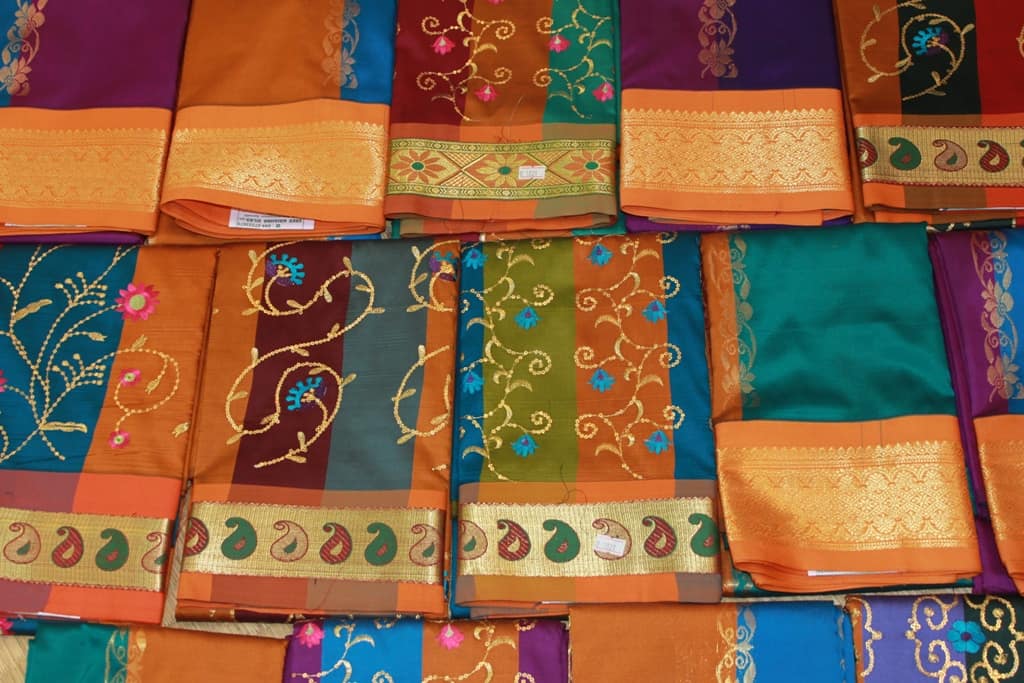
Timeless, cultural outfits worn across Kanchipuram.
Kailasanathar Temple
Kailasanathar is the oldest temple in Kanchipuram, and the one to come to for architecture rather than for worship. It was built under the Pallava king Rajasimha around 685 to 705 CE, and it is constructed in sandstone rather than granite — which is precisely why it survives in a form so different from the temples around it.
It is low, compact and largely free of the later additions that cover Kanchipuram's bigger temples. Where Ekambareswarar and Varadaraja accumulated gopurams, halls and shrines across a thousand years of patronage, Kailasanathar was essentially finished and then left alone. For anyone interested in how South Indian temple architecture began, that is the entire value of the place.
🏛️ Why sandstone matters
Almost every later South Indian temple is built in granite, because granite survives. Kailasanathar is sandstone, which is far softer and weathers badly — so the temple has needed protection and has lost surface detail over thirteen centuries.
That trade-off is what makes it historically important rather than merely old. Sandstone is easier to carve than granite, and the Pallavas exploited it: the temple carries some of the earliest and most finely executed Dravidian sculptural work in existence, at a moment when the style was being invented rather than repeated. The weathering is part of what you are looking at, not a defect in it.
📐 What it established
Kailasanathar is a structural temple — built up from stone rather than cut down into rock, unlike the Pallava cave and monolithic rathas at Mamallapuram on the coast. It represents the moment the Pallavas moved from rock-cut to free-standing construction, and it set the template for what followed:
- A sanctum with a stepped pyramidal vimana (tower) over it — the early form of the South Indian temple tower, deliberately modest beside the gopurams that came later
- A circumambulatory path around the sanctum, so the ritual walk is inside the structure
- Niches carrying sculpted panels across the outer walls, each with a deity figure
- A separate Nandi facing the sanctum
- An entrance gopuram on a modest scale — at this period the gateway tower had not yet become the dominant element it later was
The proportions are the point. Visitors coming from Ekambareswarar's towering gateway often find Kailasanathar unexpectedly small. It is meant to be read closely, not from a distance — the sculpture is at a scale that rewards walking slowly around the walls rather than standing in a courtyard.
🕒 Timings — and a published-hours problem
Published hours for this temple are inconsistent, and one widely-circulated figure is almost certainly wrong.
- Most sources give the town's standard pattern: 6:00 AM to 12:00 PM and 4:00 PM to 8:00 PM.
Entry is free.
📷 Photography, and why this temple rewards a camera
This is the most photographable of Kanchipuram's temples, precisely because it is an architectural monument rather than a crowded active shrine. The sandstone panels, the vimana's stepped profile and the low morning or late-afternoon light across the courtyard are what people come for.
Photography restrictions, where they apply, concern the sanctum. Follow posted signage and ask before photographing anyone at worship — but unlike the town's busy Devi and Vishnu temples, the outer structure here is generally a comfortable subject.
🛕 Rules and atmosphere
Modest dress covering shoulders and knees, as for any active Hindu temple, and footwear is removed before entering.
The atmosphere is quiet. Kailasanathar draws a fraction of the visitors of Ekambareswarar or Kamakshi, and most are architecture students, photographers and travellers who have read about it. That is the reason to come in the middle of the day if you want it to yourself — the crowd profile here is the opposite of the town's pilgrimage temples.
Worship does continue, so it is a temple and not a museum; treat it as a working shrine that happens to be exceptionally old.
🌸 Festivals
Maha Shivratri (February–March) is the principal observance at a Shiva temple of this standing, and Panguni Uthiram (March–April) and Vaikasi Visakam (May–June) are the major Tamil-month festivals observed across Kanchipuram. Attendance here is far smaller than at Ekambareswarar, which remains the town's dominant Shiva temple for active worship.
📍 Fitting it into Kanchipuram
Kailasanathar is the fourth of the town's major temples and the one most often skipped — which is a mistake if architecture is why you came to Kanchipuram at all.
The sensible circuit:
- Morning session: Ekambareswarar for the Earth lingam and the 3,500-year-old mango tree, then Kailasanathar while the light is good on the sandstone
- Midday closure (12:00/12:30 to 4:00 PM) — lunch
- Evening session: Kamakshi Amman for the Shakti Peetha and its lamps, then Varadaraja Perumal for the Divya Desam
Kailasanathar needs 45 minutes to an hour if you walk the walls properly — longer than most visitors allow, shorter than the pilgrimage temples take.
⚠️ Practical notes
- Come for the stone, not the spectacle. If you want crowds, lamps and devotional intensity, go to Kamakshi or Ekambareswarar. If you want to see where Dravidian temple architecture starts, this is it.
- Morning light is best on the sandstone, and the temple is quietest then.
- Compare it deliberately with Mamallapuram's rock-cut rathas on the coast if your itinerary allows — same dynasty, same century, the other construction technique.
- October to March is the comfortable season; sandstone courtyards are punishing in summer heat.
- Do not accept a claim that the temple opens at 12:30 PM. That is the town's closing time, not an opening.
Last verified: 2026. Timings, entry arrangements and any charges are published by the temple itself and do change - confirm them with the temple's own official website or counter before travelling rather than relying on any third-party listing.
Questions
Kailasanathar Temple — FAQ
Who is Kailasanathar Temple dedicated to?
Kailasanathar Temple in Kanchipuram is dedicated to Shiva as Kailasanathar.
Who can enter Kailasanathar Temple?
Free entry, with no ticket or registration. Published hours vary: most sources give the town's standard 6:00 AM to 12:00 PM and 4:00 PM to 8:00 PM, while a 12:30 PM figure also circulates, which corresponds to Kanchipuram's midday closing rather than to an opening. Plan a morning visit between 6:00 AM and 12:00 PM, or an evening visit from 4:00 PM, and confirm locally if you are making a special trip.
What is the dress code at Kailasanathar Temple?
Modest dress covering shoulders and knees, as for any active Hindu temple. Because the visit is mostly about walking the exterior walls closely, comfortable clothing suited to heat matters more here than at the town's pilgrimage temples - the sandstone courtyard is exposed.
Do I have to take my shoes off at Kailasanathar Temple?
Remove footwear before entering the temple. The sandstone courtyard and the circumambulatory path become very hot outside the cooler months, so a morning visit is considerably more comfortable underfoot, and the slow walk around the walls that the sculpture deserves is easier before midday.
Can I take photos inside Kailasanathar Temple?
This is the most photographable of Kanchipuram's temples because it is an architectural monument rather than a crowded active shrine - the sandstone panels, the stepped vimana and the low light across the courtyard are what visitors come for. Restrictions where they apply concern the sanctum; follow posted signage and ask before photographing anyone at worship.
What prasadam is offered at Kailasanathar Temple?
Worship continues at the temple, so prasad is distributed as at any active Shiva shrine, but there is no prasad counter or organised distribution of the kind at Kanchipuram's larger pilgrimage temples. Visitors come principally for the architecture rather than for ritual, and should not expect the facilities of Ekambareswarar or Kamakshi.
Is Kailasanathar Temple wheelchair accessible?
The temple is low, compact and largely flat, with a circumambulatory path around the sanctum inside the structure, which makes it physically easier than Kanchipuram's larger complexes with their towering gateways and multiple courtyards. Steps and thresholds do exist at the sanctum. The main constraint is heat rather than access - the sandstone courtyard is exposed and punishing in summer midday.
Checked, not remembered
Sources
Every rule and timing above traces back to one of these.