
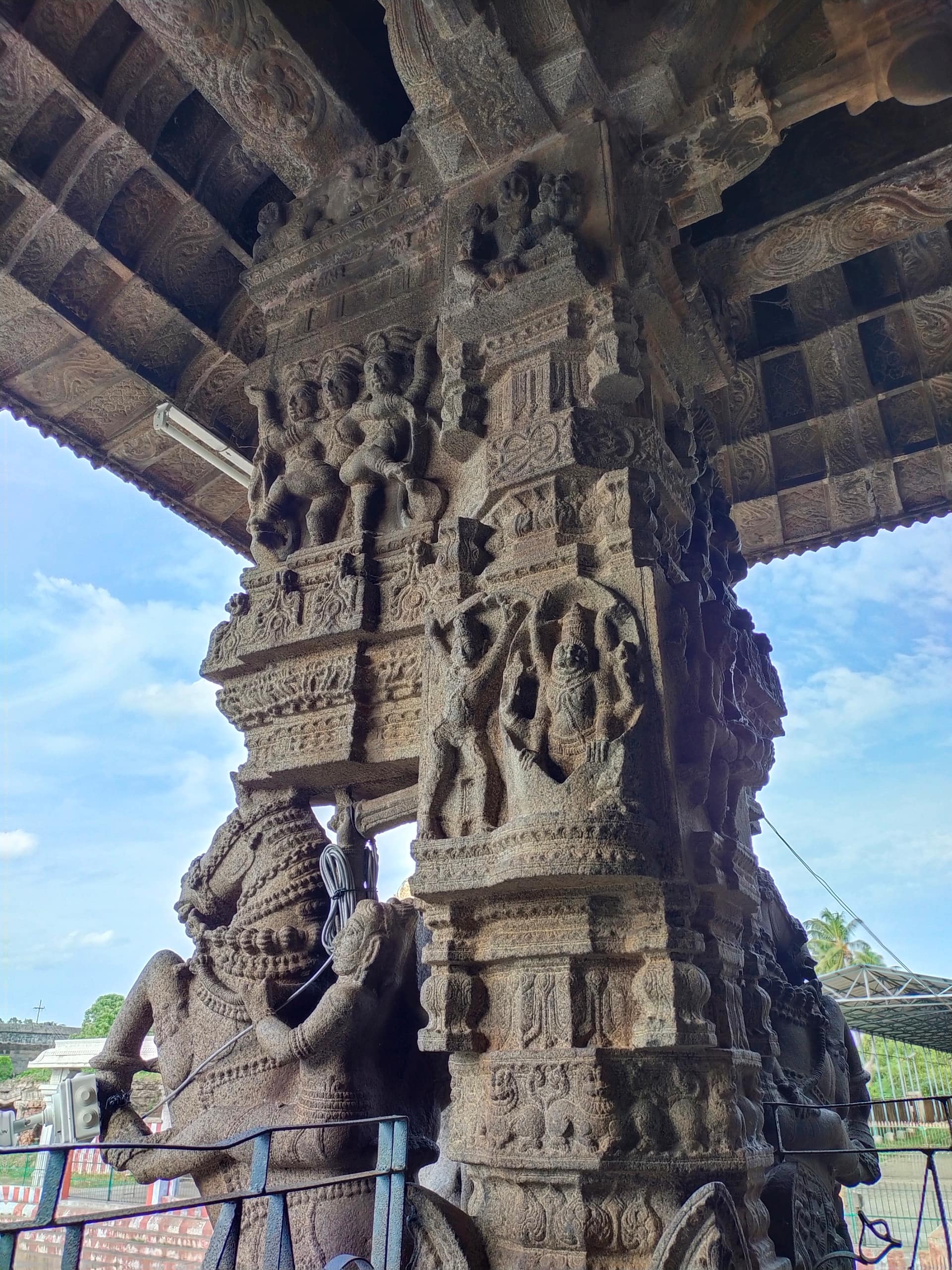
Temple in Kanchipuram
Varadaraja Perumal Temple
Kanchipuram, Tamil Nadu
A Divya Desam in Vishnu Kanchi, and the temple with the longest wait in India: a second, older deity carved in fig wood — Athi Varadar — is kept submerged in the temple tank and raised for public darshan only once every forty years.
Photo: Luistxo — CC BY-SA 4.0, via Wikimedia Commons
Overview
Who it's to, and what's expected
Deity
Vishnu as Varadaraja
Tradition
Vishnu · Krishna temple
- Entry
Visitors are required to wear modest clothing, with traditional South Indian attire preferred. Additionally, all footwear must be removed before entering the temple premises.
- Footwear
Visitors are required to remove their footwear before entering the temple.
- Access
The temple is wheelchair accessible in its main areas, though the lizard darshan area may involve steps.
- Prasadam
The temple offers Thulasi Theertham (sacred basil water) for free and sells Prasad packets containing temple sweets.
Usually visited with
Time your visit
The darshan clock
A single opening-hours line cannot express a midday closure or an evening ceremony.
6:00 AM
Opening hours
The temple is open daily from 6:00 AM to 12:00 PM and 4:00 PM to 8:00 PM, with a midday closure for rituals and cleaning. Daily rituals include Thiruvanandal at 6:00 AM, Kalasanthi at 8:00 AM, Uchikala Pooja at 12:00 PM, Sayaraksha at 6:00 PM, and Ardhajama at 7:30 PM.
Rules, timings and fees change — confirm locally before you rely on this.
At the gate
Before you go in
What gets refused, and what you cannot take past the door.
What to wear
Visitors are expected to wear modest clothing, with traditional South Indian attire being preferred. Additionally, footwear must be removed before entering the temple.
Phones and cameras
Photography is prohibited within the sanctums of the temple.
Rules, timings and fees change — confirm locally before you rely on this.
When not to come — unless you mean to
Festival windows
These follow lunar calendars and move by weeks each year, so the windows are months, not dates.
Once every 40 years — last in 2019, next due in 2059
BusyAthi Varadar darshan
The wooden deity is raised from the tank and shown for about 48 days. In 2019 it drew crowds the town could not absorb. Unless you are reading this in 2059, plan around the temple as it normally is.
Crowd levels are our reading of the notes above, not an official measure. Rules, timings and fees change — confirm locally before you rely on this.
Practicalities
The things that go wrong
Book through official channels, and treat anyone promising a guaranteed slot as a warning sign.
What to watch for
- Charging for Thulasi Theertham (sacred basil water), which the temple offers free
- Only the prasad packets of temple sweets carry a small legitimate fee
- Claiming Athi Varadar can be seen on request, or that a special puja will reveal it
- The fig-wood deity is submerged in the Ananthasaras tank and is raised only once every forty years for 48 days - the last was 2019 and the next is July 2059
- No payment changes this
- Guides attaching themselves at the entrance and producing a fee at the lizard sculptures
- Ask at the temple office if you want context; the site is well signed
- Being told the temple is open through the middle of the day
- Kanchipuram's temples follow a shared midday closure of roughly 12:30 to 4:00 PM
One place, many temples
Other temples in Kanchipuram
General guidance
Planning the visit
Customary practice and what Kanchipuram's climate means for a barefoot visit — not rules posted at this temple. Anything specific to Varadaraja Perumal Temple is above.
The queue is the ritual
Vaishnava temples in India are usually organised around a moving darshan queue rather than time spent in front of the deity. Expect to keep walking, and expect the view of the sanctum to be brief — that is the intended experience, not a rushed one.
Come in winter
Winter is when Kanchipuram is most comfortable to walk around, which matters here because a temple visit is done on foot and barefoot. Locally the window is given as december to february.
Stone gets hot — go early
You will be barefoot from the shoe rack onwards, often across an open courtyard. Between late morning and mid-afternoon in the hot months that stone is genuinely painful to stand on. Socks help, and are permitted almost everywhere shoes are not.
Arriving by train
Kanchipuram has a railway station, and auto-rickshaws wait outside it. Agree the fare or use a meter before you set off, and expect to be dropped a short walk from the temple rather than at its door.
No airport here
Kanchipuram has no airport of its own, so the last leg is by road or rail. Plan the return the same way — the last bus out is often earlier than visitors expect.
Outfit guide
What to wear at Varadaraja Perumal Temple
Cover shoulders and knees — the rules above win over anything here.
Trending wear for this spot
Popular modern looks travellers are wearing across Kanchipuram.

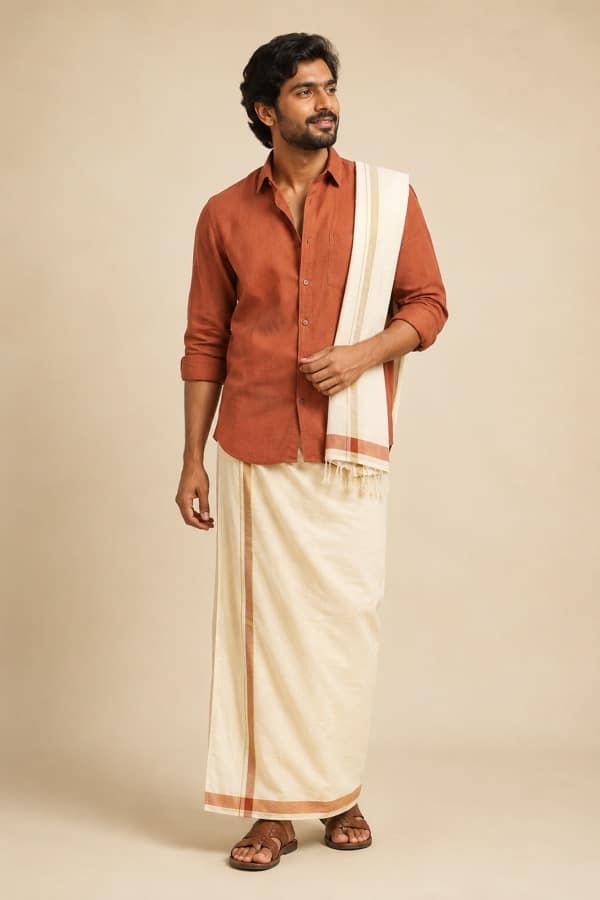
Traditional wear for this spot
Timeless, cultural looks that suit Varadaraja Perumal Temple.
Varadaraja Perumal Temple
Varadaraja Perumal is a Divya Desam in Vishnu Kanchi — one of the 108 temples revered in the Alvar hymns — and it holds the longest wait of any temple in India. Not the longest queue. The longest interval: a second, older deity carved in fig wood, Athi Varadar, is kept submerged in the temple tank and raised for public darshan only once every forty years.
The last time it happened, more than a crore of devotees came to Kanchipuram. The next is in 2059.
🌳 Athi Varadar: the forty-year deity
The legend is specific. Kanchipuram was once said to be filled with fig trees — athi is the fig. Brahma performed a yaga here, and continued it with an idol made of fig wood. The heat from the sacrificial fire became so intense that the idol began to sweat. Vishnu asked Brahma to immerse him in the tank beside the yagna, known as the Anantha Saras — and instructed that the idol be worshipped once every forty years, for forty-eight days, then buried back under the temple tank.
That is the practice, and it has been kept:
- Raised 1 July 2019, immersed again at 10:00 PM on 17 August 2019 — a 48-day darshan.
- The previous raising was in July 1979.
- The next will be July 2059.
- Over a crore (ten million+) devotees visited during the 2019 festival. Demand was so high that a petition was filed in the Madras High Court to extend the darshan by a further 48 days — and the court dismissed it.
- On immersion, a special thailam (oil mixture) was applied to the statue before it was lowered back into the Ananthasaras tank.
One thing worth knowing about that festival, because it inverts expectations: during the 2019 Athi Varadar darshan, visitors could not see the temple tank, the main sanctum (Moolavar sannidhi), or the famous gold and silver lizard sculptures. Darshan was directed only towards Athi Varadar, and Varadaraja Perumal himself was off-limits. The rarest event at the temple closes the temple's normal attractions.
If you are reading this before 2059, you will not see Athi Varadar. What you will see is a major Divya Desam with a tank, a hundred-pillared hall and one of South India's finest sculptural programmes. That is worth the visit on its own terms — but come knowing the forty-year deity is under water.
🦎 The gold and silver lizards
Two lizard sculptures — one gold, one silver — are positioned in the temple, and devotees look at them during darshan as a remedy for doshas. The practice is widely known locally and the sculptures are a specific thing visitors ask for.
The lizard darshan area may involve steps, so it is not fully step-free even though the temple's main areas are wheelchair accessible.
🕒 Timings, and the two darshan options
The temple opens around 6:00 AM, following the standard Kanchipuram pattern of a morning session to about 12:30 PM and an evening session from about 4:00 PM to 8:30 PM, with a midday closure.
Two darshan options operate:
- General Darshan — free, with a wait of roughly 20 to 60 minutes.
🛕 Rules
Modest clothing is expected, with traditional South Indian attire preferred. All footwear must be removed before entering the temple premises.
Photography is prohibited within the sanctums. The outer courtyards, the tank and the pillared halls are generally photographable, but follow posted signage.
🍃 Prasad
The temple offers Thulasi Theertham — sacred basil water — free, and sells prasad packets containing temple sweets. Note the distinction: the theertham is free, the sweet packets are not, and the charge is small and legitimate.
♿ Access
The temple is wheelchair accessible in its main areas, which is better than most of Kanchipuram's large temple complexes. The exception is the lizard darshan area, which may involve steps.
🌸 Festivals
The temple's defining observance is the Athi Varadar darshan — once every forty years, for 48 days, next in July 2059. Beyond it, the standard Vaishnava calendar applies, with Brahmotsavam the principal annual festival at a Divya Desam of this rank, alongside Vaikuntha Ekadashi in December or January, when the temple's gateway to Vaikuntha is opened, and Panguni Uthiram in March or April.
📍 Vishnu Kanchi, and the town's triangle
Kanchipuram is traditionally divided into Shiva Kanchi and Vishnu Kanchi, and this temple is the centre of the Vishnu half. Together with Ekambareswarar (Shiva) and Kamakshi Amman (Shakti) it forms the town's three-point circuit, and the three are conventionally covered in a single day.
All three follow broadly the same hours — roughly 6:00 AM to 12:30 PM and 4:00 PM to 8:30 PM — so the midday closure is a shared constraint across the whole town. Plan a morning temple, a long lunch, and an evening temple rather than trying to do all three in sequence.
⚠️ Practical notes
- Come in the morning session. The 12:30 PM to 4:00 PM closure applies across Kanchipuram's temples and wastes a midday start.
- October to March is the comfortable season; the stone courtyards are brutal in the summer heat.
- Do the three-temple triangle — Varadaraja, Ekambareswarar, Kamakshi — but split it morning and evening.
- Kailasanathar is the fourth site worth adding, and it is the architectural one rather than the devotional one.
- Ask about the lizard darshan if dosha remedy matters to you; it is a specific, local practice and easy to miss.
Last verified: 2026. Timings, entry arrangements and any charges are published by the temple itself and do change - confirm them with the temple's own official website or counter before travelling rather than relying on any third-party listing.
Questions
Varadaraja Perumal Temple — FAQ
Who is Varadaraja Perumal Temple dedicated to?
Varadaraja Perumal Temple in Kanchipuram is dedicated to Vishnu as Varadaraja.
Who can enter Varadaraja Perumal Temple?
Visitors are required to wear modest clothing, with traditional South Indian attire preferred. Additionally, all footwear must be removed before entering the temple premises.
What is the dress code at Varadaraja Perumal Temple?
Visitors are expected to wear modest clothing, with traditional South Indian attire being preferred. Additionally, footwear must be removed before entering the temple.
Do I have to take my shoes off at Varadaraja Perumal Temple?
Visitors are required to remove their footwear before entering the temple.
Can I take photos inside Varadaraja Perumal Temple?
Photography is prohibited within the sanctums of the temple.
What prasadam is offered at Varadaraja Perumal Temple?
The temple offers Thulasi Theertham (sacred basil water) for free and sells Prasad packets containing temple sweets.
Is Varadaraja Perumal Temple wheelchair accessible?
The temple is wheelchair accessible in its main areas, though the lizard darshan area may involve steps.
Checked, not remembered
Sources
Every rule and timing above traces back to one of these.