
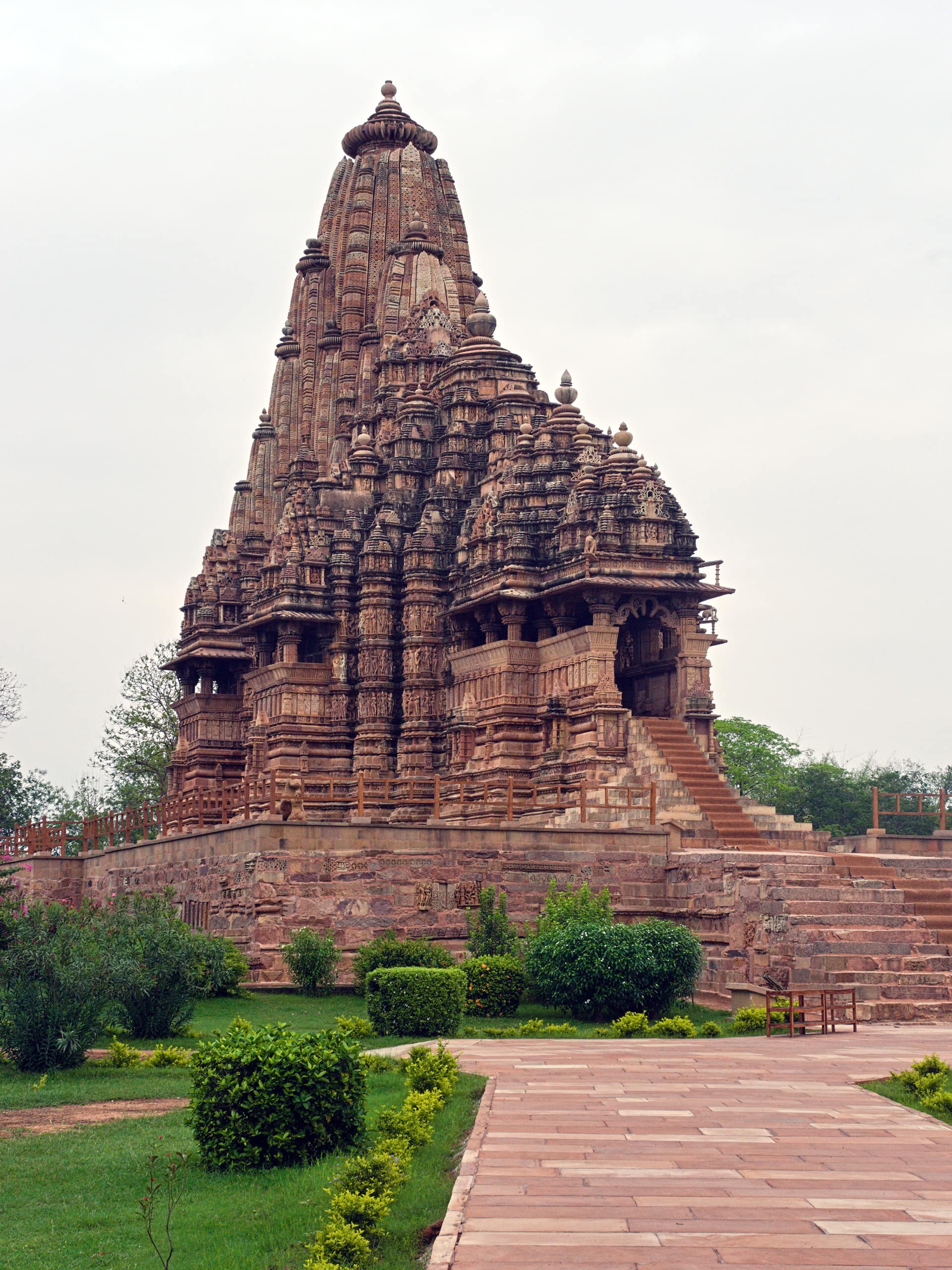
Temple in Khajuraho
Kandariya Mahadeva Temple
Khajuraho, Madhya Pradesh
The largest and most elaborate of the Chandela temples, around 1030 CE — a rising sequence of roofs meant to read as a Himalayan range. it is administered as a protected monument: there is no darshan here, and the sculpture is the point.
Photo: Rohit Sharma — CC BY-SA 4.0, via Wikimedia Commons
Overview
Who it's to, and what's expected
Deity
Shiva
Tradition
Shiva temple
- Entry
Inside the Western Group, which is the only one of Khajuraho's three groups that is ticketed by the ASI. The Eastern and Southern groups are free.
- Footwear
Footwear comes off before the temple platform. Wear something with grip that is easy to remove, because the platform is reached by steep steps and the stone is worn smooth by a thousand years of footfall and can be slippery - particularly after rain or in early morning dew.
- Access
The temple is accessible, but visitors should be aware that the platform is reached by steep steps and the stone surfaces can be uneven or slippery. Elderly or less mobile visitors are advised to climb slowly, use available handrails, and take rests as needed.
Usually visited with
How long this takes
Ways in
The difference between a twenty-minute visit and a three-hour one.
ASI monument entry
- A ticketed archaeological site with no ritual timetable, no midday closure and no aarti to plan around, so there is no managed queue in the temple sense
- Buy the ASI ticket for the Western Group; the Eastern and Southern Groups are free
Dance festival evenings
- The Khajuraho Festival of Dance draws substantial ticketed audiences against the illuminated temples, typically in February or March
At the gate
Before you go in
What gets refused, and what you cannot take past the door.
What to wear
No dress code is imposed by the ASI for the monument, but modest clothing covering shoulders and knees is appropriate at a Shiva temple of this significance and is expected by local custom. Practical matters more here: the complex is fully exposed with almost no shade, so light covering plus a hat and water is the sensible combination, and footwear with grip is needed for the steep, worn stone steps.
Phones and cameras
General photography is permitted throughout the open complex, though the use of tripods, drones, or commercial filming requires prior permission from the Archaeological Survey of India (ASI). Flash photography is discouraged near the temple's delicate carvings.
Rules, timings and fees change — confirm locally before you rely on this.
When not to come — unless you mean to
Festival windows
These follow lunar calendars and move by weeks each year, so the windows are months, not dates.
Khajuraho Festival of Dance
Maha Shivratri
Best visiting season
Practicalities
The things that go wrong
Book through official channels, and treat anyone promising a guaranteed slot as a warning sign.
What to watch for
- Selling a ticket for Kandariya Mahadeva specifically, or claiming a separate charge beyond the ASI Western Group ticket
- One ASI ticket covers the whole enclosed group; the Eastern and Southern Groups need no ticket at all
- Confusing the ASI ticket with Matangeshwar Temple's charges
- Matangeshwar stands just outside the fence, is free to enter, and charges Rs50 per camera separately - neither payment covers the other
- Anyone offering to take you into restricted areas, onto the platform outside hours, or up the shikhara for a fee
- Access is governed by the ASI and no payment opens it
- Claims that a camera fee is due at the Western Group
- Still cameras are permitted at no additional cost; only tripods, drones and commercial filming need prior ASI permission
- Third parties offering 'special puja' at Kandariya
- There is no worship here at all - it is a protected monument, and the living temple is Matangeshwar fifty metres outside the fence
One place, many temples
Other temples in Khajuraho
General guidance
Planning the visit
Customary practice and what Khajuraho's climate means for a barefoot visit — not rules posted at this temple. Anything specific to Kandariya Mahadeva Temple is above.
Circling the shrine
At most Shaiva temples the circuit around the sanctum is not completed in a full circle — the channel draining the abhishekam is not crossed. Walk to it, turn, and come back the way you came. Watching what the queue in front of you does is the reliable guide.
Come in winter
Winter is when Khajuraho is most comfortable to walk around, which matters here because a temple visit is done on foot and barefoot. Locally the window is given as october to march.
Stone gets hot — go early
You will be barefoot from the shoe rack onwards, often across an open courtyard. Between late morning and mid-afternoon in the hot months that stone is genuinely painful to stand on. Socks help, and are permitted almost everywhere shoes are not.
Arriving by train
Khajuraho has a railway station, and auto-rickshaws wait outside it. Agree the fare or use a meter before you set off, and expect to be dropped a short walk from the temple rather than at its door.
Outfit guide
What to wear at Kandariya Mahadeva Temple
Cover shoulders and knees — the rules above win over anything here.
Trending wear for this spot
Modern, camera-ready looks picked for Kandariya Mahadeva Temple.

Traditional wear for this spot
Timeless, cultural looks that suit Kandariya Mahadeva Temple.
Kandariya Mahadeva Temple
Kandariya Mahadeva is the largest and most elaborate of the Chandela temples at Khajuraho, built around 1030 CE. Its form is the idea made physical: a rising sequence of roofs and subsidiary spires climbing to a single summit, meant to read as a Himalayan range — and specifically as **Mount Kailasa, Shiva's mountain. **It is a monument rather than a working temple. There is no darshan here, and the sculpture is the point.
⛰️ The shikhara as a mountain range
The temple's tower is not one spire but a cluster. Smaller urushringa (subsidiary spires) rise around and below the central shikhara, each repeating its form at a smaller scale, so the whole elevation reads as a mountain range with one peak above the rest rather than as a single tower.
That is a deliberate theological statement in stone. Kailasa is not a solitary peak but a massif, and the Chandela builders rendered the massif rather than the summit. **The effect from a distance — the temple appearing to bristle with replicated peaks — is what makes Kandariya the defining image of Khajuraho. The name itself carries the idea: Kandara means cave, and Kandariya Mahadeva is "the Great Lord of the Cave", Shiva as he dwells in the mountain. The temple is an artificial cave-mountain.
🗿 The sculpture
Khajuraho is famous for its figural carving, and Kandariya carries the finest and the most abundant of it. The exterior walls are covered in tiered rows of sculptures — deities, apsaras (celestial women), mithuna (amorous couples), attendants, animals and guardians — arranged in horizontal bands that follow the temple's rising profile.
Three things are worth knowing before you walk around it:
- The erotic panels are a small minority of the total carving. They are what Khajuraho is known for and what most visitors look for, but the overwhelming majority of the sculpture is devotional, celestial and narrative. Coming only for the erotic panels means seeing a fraction of the building.
- The figures are carved almost fully in the round, projecting far from the wall, which is why the temple reads as sculptural mass rather than as decorated surface.
- The bands rise with the architecture, so the sculptural programme follows the ascent toward the summit rather than being distributed evenly.
Several interpretations of the erotic panels are offered — tantric practice, a test of the devotee's detachment, a manual of kama alongside dharma and moksha, guild craftsmanship, or simply a celebration of worldly life within a sacred building. **Guides at Khajuraho offer different readings, and the temple supports more than one.
🎟️ The ASI ticket, and the three groups
Kandariya Mahadeva is inside the Western Group, which is the only one of Khajuraho's three groups ticketed by the Archaeological Survey of India. The Eastern and Southern Groups are free.
- Western Group — ticketed by the ASI; contains Kandariya Mahadeva and the other principal Chandela temples
- Eastern Group — free
- Southern Group — free
Buy the ASI ticket for the Western Group; you do not need one for the other two. Note that the fees differ for Indian citizens, visitors from SAARC and BIMSTEC countries, and other international visitors, and that children up to 15 years old are free across ASI monuments.
Matangeshwar Temple, the only Khajuraho temple still in daily worship, stands just outside the Western Group's fence and is not covered by the ASI ticket — it is free to enter and charges ₹50 per camera separately. Two adjacent temples, two different payment systems, which is the most common source of confusion at the site.
📷 Photography
General photography is permitted throughout the open complex. The restrictions are specific and worth knowing:
- **Tripods, drones and commercial filming require prior permission from the ASI.
- Flash photography is discouraged near the delicate carvings — and given how much of the surface is fine figural work over a thousand years old, the discouragement should be treated as a rule.
Still cameras are permitted at no additional cost across the monument groups, unlike at Matangeshwar next door where a camera fee applies.
🕒 Hours and the best light
The Western Group is open from early morning until evening, on the standard ASI monument pattern, and unlike a working temple there is no ritual timetable, no midday closure and no aarti to plan around. **You can come at any point in the opening day. That freedom has one clear best answer: come early. The complex is fully exposed, central Indian summer heat is severe, and the sculpture is at its most legible in low raking light — early morning or late afternoon. Midday sun flattens the deeply cut figures and makes the stone platform uncomfortably hot.
October to March is the comfortable season. March to May is punishing, with limited shade across the site.
🚶 Access — steep steps and slippery stone
The temple is accessible, but the platform is reached by steep steps and the stone surfaces can be uneven or slippery. This is the practical warning that matters here:
- **Elderly and less mobile visitors should climb slowly, use the available handrails, and take rests as needed.
- The stone is worn smooth in places by a thousand years of footfall and is genuinely slippery, particularly after rain or in early morning dew.
- Wear footwear with grip that you can remove easily, since shoes come off before the platform.
- There is no lift or ramp to the platform. Anyone for whom steep stone steps are not feasible should view the exterior from the lawns, which still gives the full shikhara composition.
🛕 No worship, no prasad
Kandariya Mahadeva is a protected monument and there is no active worship, no darshan, no prasad and no ritual schedule. This is recorded explicitly on the page rather than left to be discovered: **if you come expecting to worship here, the temple to go to is Matangeshwar, fifty metres outside the fence. That is not a deficiency in the monument — it is what makes it legible as architecture. A temple still in daily use cannot be walked around, studied and photographed the way Kandariya can. **The two adjacent sites give you both halves of what Khajuraho is.
🌸 The Khajuraho Dance Festival
The Khajuraho Festival of Dance is held annually against the illuminated backdrop of the Western Group temples, with Kandariya Mahadeva as the usual setting — **classical Indian dance performed in front of the monument, typically in February or March. It is one of India's better-known dance festivals and the obvious reason to time a visit. Tickets and dates are published by the Madhya Pradesh tourism authorities; confirm for your year rather than assuming the pattern holds.
⚠️ Practical notes
- Walk the temple clockwise and look up as well as out. The shikhara cluster is the composition's point and is easy to miss while studying the wall bands.
- Allow at least an hour for Kandariya alone; the whole Western Group needs a morning.
- Do both adjacent temples. Kandariya for the architecture and sculpture, Matangeshwar for the living worship — the contrast is the site.
- Bring water and a hat. There is very little shade on the lawns.
- **Do not use flash, and do not climb on the sculpture. *Last verified: 2026. The c. 1030 CE date, the Himalayan-range shikhara reading, the ASI ticketing of the Western Group only, the photography permissions and restrictions, and the steep-steps access warning are all retained from or consistent with the existing record.
Last verified: 2026. Timings, entry arrangements and any charges are published by the temple itself and do change - confirm them with the temple's own official website or counter before travelling rather than relying on any third-party listing.
Questions
Kandariya Mahadeva Temple — FAQ
Who is Kandariya Mahadeva Temple dedicated to?
Kandariya Mahadeva Temple in Khajuraho is dedicated to Shiva.
Who can enter Kandariya Mahadeva Temple?
Inside the Western Group, which is the only one of Khajuraho's three groups that is ticketed by the ASI. The Eastern and Southern groups are free.
What is the dress code at Kandariya Mahadeva Temple?
No dress code is imposed by the ASI for the monument, but modest clothing covering shoulders and knees is appropriate at a Shiva temple of this significance and is expected by local custom. Practical matters more here: the complex is fully exposed with almost no shade, so light covering plus a hat and water is the sensible combination, and footwear with grip is needed for the steep, worn stone steps.
Do I have to take my shoes off at Kandariya Mahadeva Temple?
Footwear comes off before the temple platform. Wear something with grip that is easy to remove, because the platform is reached by steep steps and the stone is worn smooth by a thousand years of footfall and can be slippery - particularly after rain or in early morning dew.
Can I take photos inside Kandariya Mahadeva Temple?
General photography is permitted throughout the open complex, though the use of tripods, drones, or commercial filming requires prior permission from the Archaeological Survey of India (ASI). Flash photography is discouraged near the temple's delicate carvings.
Is Kandariya Mahadeva Temple wheelchair accessible?
The temple is accessible, but visitors should be aware that the platform is reached by steep steps and the stone surfaces can be uneven or slippery. Elderly or less mobile visitors are advised to climb slowly, use available handrails, and take rests as needed.
Checked, not remembered
Sources
Every rule and timing above traces back to one of these.