
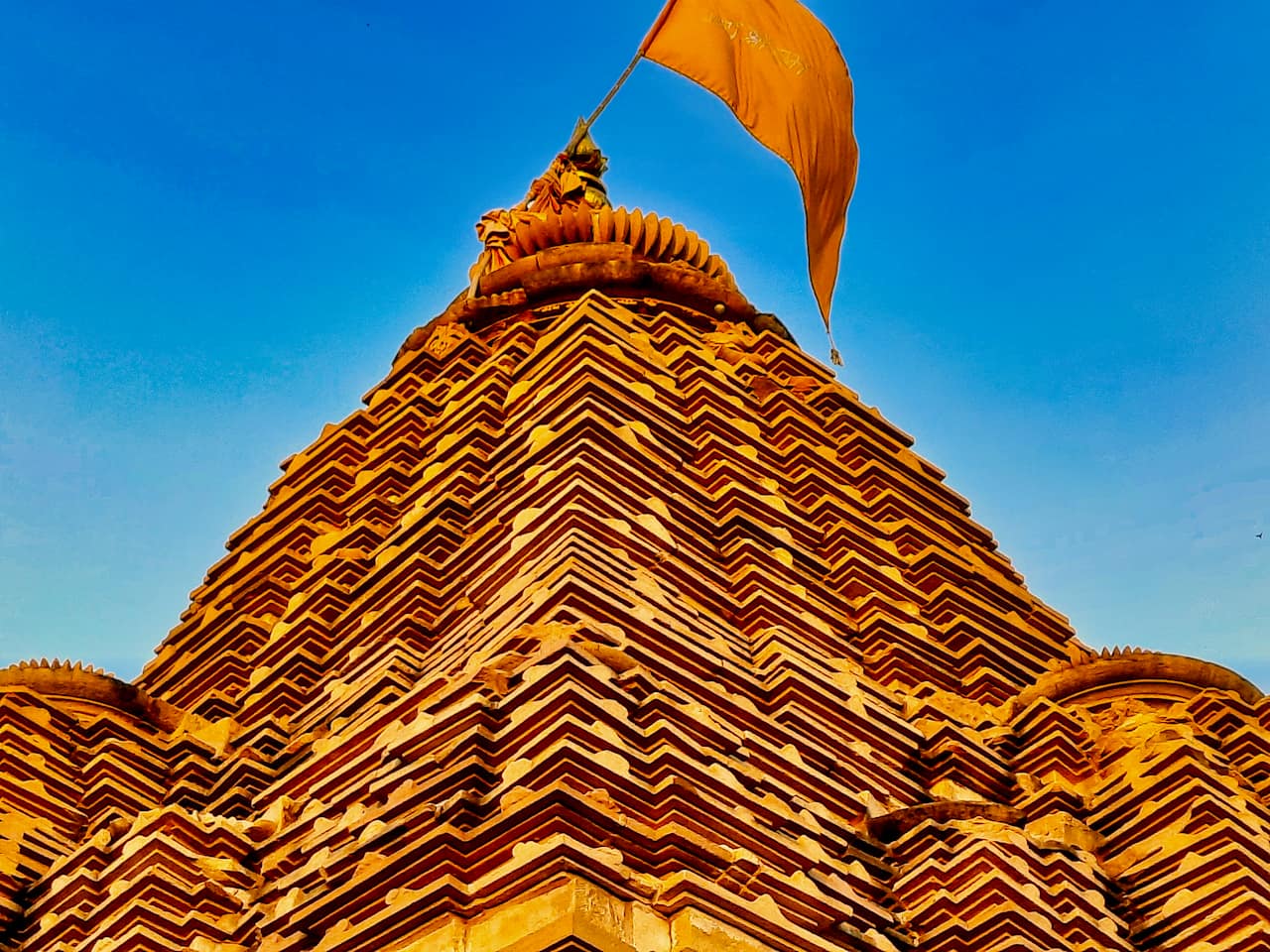
Temple in Khajuraho
Matangeshwar Temple
Khajuraho, Madhya Pradesh
The one Khajuraho temple that never became a monument. Of all the Chandela-era buildings here, this is the only one still in daily worship — which is also why it stands just outside the ticketed enclosure while its neighbours stand inside it. The lingam is about eight feet of pale limestone.
Photo: Ms Sarah Welch — CC0, via Wikimedia Commons
Overview
Who it's to, and what's expected
Deity
Shiva
Tradition
Shiva temple
- Entry
The temple is open to all visitors without an entry fee.
- Footwear
You must remove your footwear before entering the temple.
- Access
The temple premises are well-maintained and feature clean, accessible restrooms.
- Prasadam
Prasad is distributed at the temple daily between 1 PM and 2 PM.
Usually visited with
Time your visit
The darshan clock
A single opening-hours line cannot express a midday closure or an evening ceremony.
6:00 AM – 10:00 PM
Opening hours
A notably long day that reflects the temple's status as a working shrine rather than a ticketed ASI monument with standard monument hours. Entry is free and open to all visitors.
1:00 PM – 2:00 PM daily
Prasad distribution
A fixed daily window rather than continuous distribution - this is the hour to be there if you want prasad.
Through the day
Daily abhishekam
The lingam is bathed daily with milk, bilwa leaves and flowers. On Maha Shivratri it is additionally dressed and decorated like a human bridegroom for a marriage ceremony.
Rules, timings and fees change — confirm locally before you rely on this.
How long this takes
Ways in
The difference between a twenty-minute visit and a three-hour one.
No queue
- Free entry, open to all visitors, with no ticket and no managed line
- The temple is well maintained and takes fifteen to twenty minutes; crowds build only at Maha Shivratri and through Shravan
Prasad distribution
- A fixed daily window rather than a queue - prasad is distributed between 1:00 and 2:00 PM, which is the hour to be there if you want it
At the gate
Before you go in
What gets refused, and what you cannot take past the door.
What to wear
Visitors are required to dress modestly, ensuring that both shoulders and knees are covered.
Phones and cameras
Visitors are required to pay a fee of INR 50 per camera to use photography equipment at the temple.
Rules, timings and fees change — confirm locally before you rely on this.
When not to come — unless you mean to
Festival windows
These follow lunar calendars and move by weeks each year, so the windows are months, not dates.
Maha Shivratri
Shravan (Sawan)
Best visiting season
Practicalities
The things that go wrong
Book through official channels, and treat anyone promising a guaranteed slot as a warning sign.
What to watch for
- Confusing the ASI ticket with the temple's own charges, or being told a single payment covers both
- The ASI ticket is for the fenced Western Group enclosure; Matangeshwar is a separate working temple with free entry and its own Rs50 camera fee
- Anyone claiming an entry fee is required for Matangeshwar
- Entry is free and open to all visitors - only the camera fee applies, and only if you are carrying photography equipment
- Guides insisting the temple is inside the ticketed enclosure and that your ticket covers it, then producing a separate fee
- It stands outside the fence precisely because it is not an ASI monument
- Third parties at the Khajuraho site offering 'special puja' or expedited darshan at Matangeshwar
- There is no queue and Darshan arrangements are published by the temple itself
- Pressured prasad or flower purchases outside the gate
- Prasad is distributed by the temple itself daily between 1:00 and 2:00 PM, and you are not required to bring an offering
One place, many temples
Other temples in Khajuraho
General guidance
Planning the visit
Customary practice and what Khajuraho's climate means for a barefoot visit — not rules posted at this temple. Anything specific to Matangeshwar Temple is above.
Circling the shrine
At most Shaiva temples the circuit around the sanctum is not completed in a full circle — the channel draining the abhishekam is not crossed. Walk to it, turn, and come back the way you came. Watching what the queue in front of you does is the reliable guide.
Come in winter
Winter is when Khajuraho is most comfortable to walk around, which matters here because a temple visit is done on foot and barefoot. Locally the window is given as october to march.
Stone gets hot — go early
You will be barefoot from the shoe rack onwards, often across an open courtyard. Between late morning and mid-afternoon in the hot months that stone is genuinely painful to stand on. Socks help, and are permitted almost everywhere shoes are not.
Arriving by train
Khajuraho has a railway station, and auto-rickshaws wait outside it. Agree the fare or use a meter before you set off, and expect to be dropped a short walk from the temple rather than at its door.
Outfit guide
What to wear at Matangeshwar Temple
Cover shoulders and knees — the rules above win over anything here.
Trending wear for this spot
Popular modern looks travellers are wearing across Khajuraho.


Traditional wear for this spot
Timeless, cultural outfits worn across Khajuraho.
Matangeshwar Temple, Khajuraho
Matangeshwar is the one Khajuraho temple that never became a monument. Of all the Chandela-era buildings here — and Khajuraho is defined by them — this is the only Hindu temple still in daily worship.
That single fact explains its position. It stands just outside the fenced, ticketed enclosure of the Western Group, while its neighbours stand inside it. The Archaeological Survey of India protects monuments; this is a functioning temple, so it is not inside the fence. Visitors who come for the famous sculpture often walk past it entirely, and visitors who come to worship walk past the sculpture.
🪔 A living temple in a museum landscape
Khajuraho's Western Group is a protected archaeological site — you buy an ASI ticket, walk through lawns, and look at temples. Matangeshwar is the counterexample. It is open to worship, it has a ritual calendar, it distributes prasad, and it charges a camera fee rather than an entry fee, because it is run as a temple rather than as a monument.
This is why the visit feels different. Inside the enclosure the temples are silent and empty of ritual. At Matangeshwar there are priests, offerings, bells and devotees, and the lingam is bathed every day. For many visitors that contrast — one working temple amid a field of monuments — is the most memorable thing at Khajuraho.
🗿 The lingam: eight feet of yellow limestone
The temple houses one of the largest Shiva lingams in India. It is about eight feet in height and made of sparkling yellow limestone, which is unusual both in size and in material — most large lingams are granite or black stone.
The daily ritual is the bathing of the lingam with milk, bilwa (bilva) leaves and flowers — the standard Shaiva abhishekam, performed here at a scale few temples can match because of the lingam's size.
🛕 History and name
Built by the Chandela ruler Chandra Deva in the early tenth century AD, the king being an ardent devotee of Shiva. That makes it one of the oldest temples in Madhya Pradesh, and older than the celebrated Kandariya Mahadeva next door, which dates to around 1030 CE.
The name comes from the sage Matang. Lord Shiva is venerated here in the form of the sage Matang, hence Matangeshwar — Shiva as Matangeshwara. The identification of Shiva with an ascetic sage rather than with a royal or cosmic form is characteristic of early Chandela Shaiva worship.
🌸 Maha Shivratri: the lingam as bridegroom
Maha Shivratri is observed here with great fervour, and the ritual is specific and remarkable: the lingam is bathed, dressed and decorated like a human bridegroom for a marriage ceremony.
People gather from distant regions to offer prayers on that night. If you want to see Matangeshwar as a living temple rather than a large old lingam, Maha Shivratri (February or March) is when to come — and it is the one occasion when the crowd inside the enclosure is comparable to the crowd outside it.
🕒 Timings
Entry is free and open to all visitors. There is no ticket for the temple itself.
📷 Camera fee
A fee of ₹50 per camera applies for using photography equipment at the temple. This is distinct from the ASI ticket for the Western Group enclosure and is a temple charge, not a monument charge — do not assume your ASI ticket covers it, and do not assume the camera fee covers the enclosure.
Two separate payments for two separate things is the most common source of confusion at Khajuraho, since Matangeshwar sits physically adjacent to the ticketed site while being administratively separate from it.
🍛 Prasad
Prasad is distributed at the temple daily between 1:00 and 2:00 PM. A fixed daily distribution window is unusual and is a further marker of the temple's active ritual life — if you want prasad, that is the hour to be there.
🛕 Rules
Dress modestly, with shoulders and knees covered. This is an active temple with daily worship, so the expectation is real rather than nominal — more so than at the monument temples inside the fence, where visitors are tourists rather than worshippers.
Remove your footwear before entering the temple.
The premises are well maintained, with clean and accessible restrooms — a genuine practical advantage, and one that matters at a site where visitors spend a full day.
📍 Fitting it into Khajuraho
Khajuraho has three groups of temples, and only one is ticketed:
- The Western Group — the famous cluster including Kandariya Mahadeva, the largest and most elaborate, ticketed by the ASI
- The Eastern Group — free
- The Southern Group — free
Matangeshwar sits immediately outside the Western Group's fence, so you will pass it on the way in or out. The sensible order is to see Matangeshwar first or last — either before buying your ASI ticket, or after leaving the enclosure — rather than trying to fit it into the monument visit, since it is not part of it.
Pair it with Kandariya Mahadeva inside the fence for the contrast: one working temple with a priest and an eight-foot lingam, one empty monument with the finest Chandela sculpture in India, fifty metres apart and administratively unrelated.
⚠️ Practical notes
- Do not confuse the two payments. ASI ticket for the enclosure; ₹50 camera fee at the temple.
- Come at Maha Shivratri if you want the temple at full devotional strength.
- Come between 1:00 and 2:00 PM if you want prasad.
- October to March is the comfortable season; the site is fully exposed and central Indian summer heat is severe.
- Give it fifteen to twenty minutes. It is not a large visit — the lingam, the ritual, and the contrast with the monuments around it.
Last verified: 2026. Opening hours of 6:00 AM to 10:00 PM are now recorded; the previous entry on this page had no time value at all. The eight-foot yellow-limestone lingam, the daily milk-and-bilwa bathing, the Chandra Deva attribution to the early tenth century, the bridegroom dressing at Maha Shivratri, the Rs50 camera fee and the 1-2 PM prasad distribution are all documented.
Questions
Matangeshwar Temple — FAQ
Who is Matangeshwar Temple dedicated to?
Matangeshwar Temple in Khajuraho is dedicated to Shiva.
Who can enter Matangeshwar Temple?
The temple is open to all visitors without an entry fee.
What is the dress code at Matangeshwar Temple?
Visitors are required to dress modestly, ensuring that both shoulders and knees are covered.
Do I have to take my shoes off at Matangeshwar Temple?
You must remove your footwear before entering the temple.
Can I take photos inside Matangeshwar Temple?
Visitors are required to pay a fee of INR 50 per camera to use photography equipment at the temple.
What prasadam is offered at Matangeshwar Temple?
Prasad is distributed at the temple daily between 1 PM and 2 PM.
Is Matangeshwar Temple wheelchair accessible?
The temple premises are well-maintained and feature clean, accessible restrooms.
Checked, not remembered
Sources
Every rule and timing above traces back to one of these.