
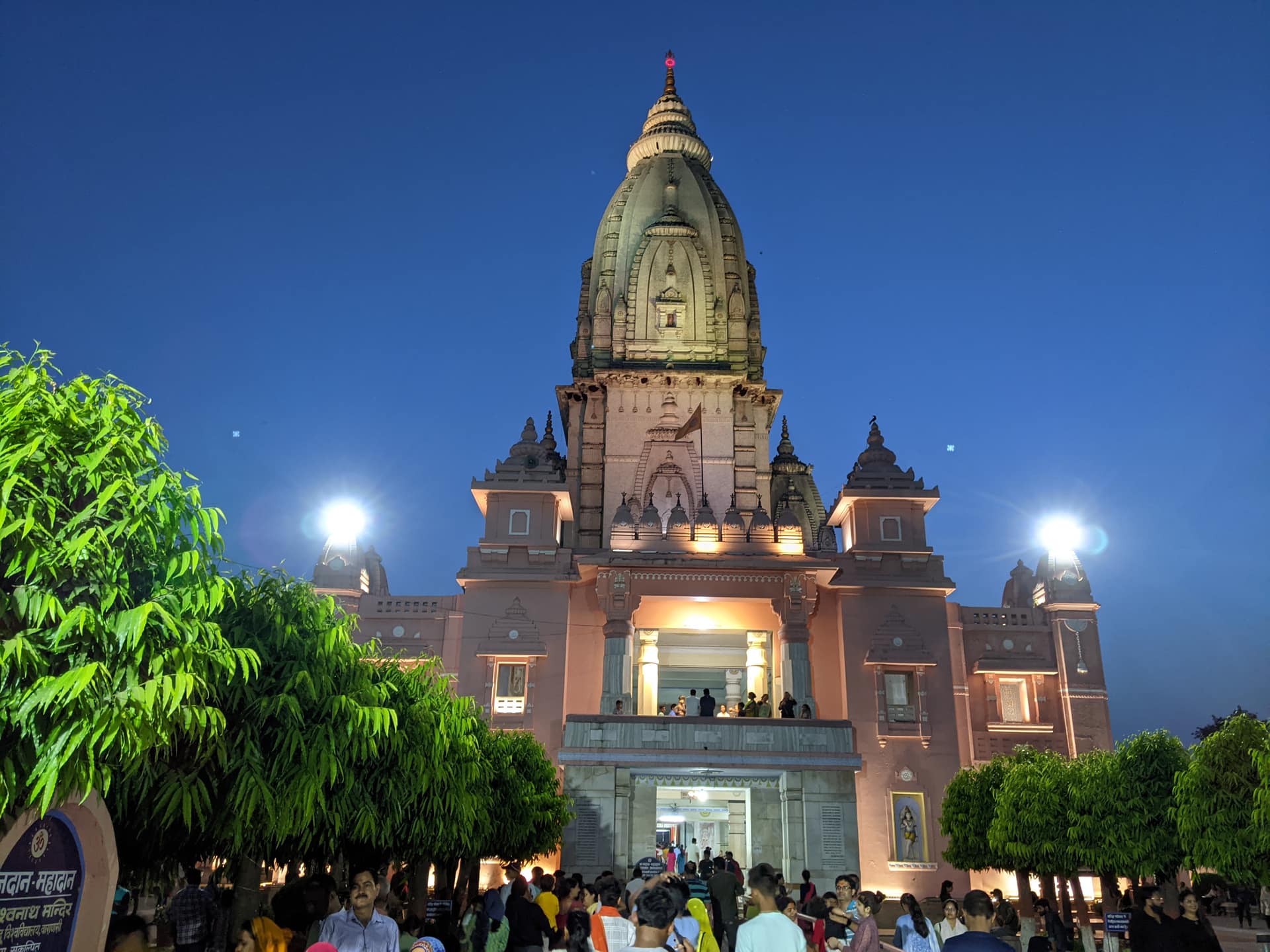
Temple in Varanasi
New Vishwanath Temple (BHU)
Varanasi, Uttar Pradesh
The marble temple on the Banaras Hindu University campus, planned by Madan Mohan Malaviya. The practical difference from the original is the one worth knowing: it is open to visitors of every religion, so it is where a non-Hindu traveller can actually see a Vishwanath temple from the inside.
Photo: Heliophilous — CC BY-SA 4.0, via Wikimedia Commons
Overview
Who it's to, and what's expected
Deity
Shiva as Vishwanath
Tradition
Shiva temple
- Entry
General entry is free, with no ticket and no booking. Open to people of all religions and castes, which is the practical difference that matters: the original Kashi Vishwanath does not admit non-Hindus to its sanctum, so this is where a non-Hindu traveller can see a Vishwanath temple from the inside. Darshan arrangements are published by the original temple and are not shared with this one, so do not assume they apply. Access is through the BHU campus gate, so allow for the walk or rickshaw ride inside. Allow one to two hours.
- Footwear
You must remove your footwear and leave it at the designated area outside the temple. Additionally, leather items such as belts, wallets, and bags are prohibited inside the premises.
- Access
Far easier than the original Kashi Vishwanath. The temple sits on the flat, paved, green BHU campus with road access to the gate, and there is no lane maze or corridor crowd to negotiate - the absence of a long queue is the main practical advantage for older visitors and anyone with limited mobility. Footwear must be removed and the marble floors become very hot in summer afternoons.
- Prasadam
Prasad is distributed at the temple following the offering rituals. As at other Vishwanath temples, expect a small sweet rather than a meal. Accept it with the right hand.
Usually visited with
Time your visit
The darshan clock
A single opening-hours line cannot express a midday closure or an evening ceremony.
4:00 am
Opening hours
The temple is open daily from 4:00 am to 12:00 pm and again from 1:00 pm to 9:00 pm.
Rules, timings and fees change — confirm locally before you rely on this.
How long this takes
Ways in
The difference between a twenty-minute visit and a three-hour one.
Mahashivratri and Shravan
- Heavier attendance and decoration, but crowds never approach those at the original Kashi Vishwanath
At the gate
Before you go in
What gets refused, and what you cannot take past the door.
What to wear
Modest dress covering shoulders and knees is expected, as for any active Hindu temple. There is no dhoti/saree requirement here and no western-clothing prohibition - unlike the original Kashi Vishwanath, this temple is open to visitors of every religion and is straightforward to enter. Footwear must be removed, and because the temple is entirely marble the floors get very hot in summer afternoons.
Phones and cameras
Photography restrictions apply inside the temple; follow the posted signage and the attendants rather than assuming. Note that this temple is on the Banaras Hindu University campus, several kilometres from Kashi Vishwanath - there is no corridor here and no locker facility at Godowlia Chowk, which belong to the original temple. Campus rules apply in addition to temple rules, since BHU is a working university.
Rules, timings and fees change — confirm locally before you rely on this.
When not to come — unless you mean to
Festival windows
These follow lunar calendars and move by weeks each year, so the windows are months, not dates.
Mahashivratri
Shravan (Sawan)
Practicalities
The things that go wrong
Book through official channels, and treat anyone promising a guaranteed slot as a warning sign.
What to watch for
- Anyone charging for entry
- The temple is free and open to all; a person asking for money at the gate is not authorised
- Auto and taxi drivers substituting this temple for the original Kashi Vishwanath, or vice versa, because the fares differ
- Be explicit about which one you want - they are separate buildings a few kilometres apart
- Confusion with Birla Mandir in other Indian cities
- The Birla family built a series of marble temples across India and they are unrelated buildings; confirm the driver knows this is the BHU campus temple
- Guides attaching themselves on the campus and producing a fee at the end
- The temple needs no guide; if you want context, the campus and temple signage are adequate
One place, many temples
Other temples in Varanasi
Annapurna Devi Mandir
Devi · Shakti templeAnnapurna
Kaal Bhairav Temple
Shiva templeKaal Bhairav
Ratneshwar Mahadev Temple
Shiva templeShiva
Sankat Mochan Hanuman Temple
Vishnu · Krishna templeHanuman
Shri Kashi Vishwanath Temple
Shiva templeShiva as Vishwanath
General guidance
Planning the visit
Customary practice and what Varanasi's climate means for a barefoot visit — not rules posted at this temple. Anything specific to New Vishwanath Temple (BHU) is above.
Circling the shrine
At most Shaiva temples the circuit around the sanctum is not completed in a full circle — the channel draining the abhishekam is not crossed. Walk to it, turn, and come back the way you came. Watching what the queue in front of you does is the reliable guide.
Come in winter
Winter is when Varanasi is most comfortable to walk around, which matters here because a temple visit is done on foot and barefoot. Locally the window is given as october to march.
Stone gets hot — go early
You will be barefoot from the shoe rack onwards, often across an open courtyard. Between late morning and mid-afternoon in the hot months that stone is genuinely painful to stand on. Socks help, and are permitted almost everywhere shoes are not.
Arriving by train
Varanasi has a railway station, and auto-rickshaws wait outside it. Agree the fare or use a meter before you set off, and expect to be dropped a short walk from the temple rather than at its door.
Outfit guide
What to wear at New Vishwanath Temple (BHU)
Cover shoulders and knees — the rules above win over anything here.
Trending wear for this spot
Popular modern looks travellers are wearing across Varanasi.


Traditional wear for this spot
Timeless, cultural outfits worn across Varanasi.
New Vishwanath Temple (BHU)
This is the temple to visit if you are not Hindu and you want to see a Vishwanath temple from the inside. That sentence is the whole practical reason it exists as a separate entry, and it is not a small thing: the original Kashi Vishwanath does not admit non-Hindus to its sanctum, and the New Vishwanath Temple is open to people of all religions and castes.
It is also called the Birla Temple or Birla Mandir, because it was built by the Birla family. It stands on the Banaras Hindu University campus, in white marble, and it is the second temple in Varanasi whose scale surprises visitors.
🏛️ Malaviya's idea
The temple was planned by Pandit Madan Mohan Malaviya, the founder of Banaras Hindu University, and constructed by the Birla family. Malaviya's intention was specific and unusual for a temple commission: he wanted a majestic temple inside a university to spread moral values and entwine the ethos of Indian value systems with modern education.
So this is not a replica built for tourism or for merit. It is part of an argument about what a modern Indian university should contain — a working place of worship at the centre of a campus devoted to secular higher learning. The Birla family built it, hence the alternate name.
📐 The tallest temple tower in the world
The temple is built entirely of white marble, with marble mosaics, in an architectural style deliberately similar to that of Sri Kashi Vishwanath — it is effectively a replica of the original.
Its shikhara stands about 252 to 253 feet high, which is claimed as the tallest temple tower in the world — taller than the Qutub Minar in Delhi (about 240 feet). The towers dominate Varanasi's skyline and are visible from a long way across the city, which is how most visitors first notice the temple exists.
Published heights vary by a foot between sources (252 and 253 both appear), which is the kind of discrepancy that matters only if you are writing about it — but the comparison to the Qutub Minar is the memorable version and is consistently reported.
🚪 Open to everyone — the difference that matters
Unlike the original Kashi Vishwanath Temple, the New Vishwanath Temple is open to people of all religions, and unlike many other temples in Varanasi it is open to all irrespective of caste or creed.
For a traveller this changes the visit completely. At the original you may be stopped at the sanctum; here you can go inside, see the marble interior, and understand what a Vishwanath temple is. Many visitors find this the more rewarding of the two precisely because they can actually enter — and because there is no queue remotely comparable to Kashi Vishwanath's one-to-four-hour wait.
It is worth being clear about what that means, though: the Jyotirlinga is at the original temple, not here. This is a replica with a genuine devotional life and a genuine purpose, and it is not a substitute for Kashi Vishwanath in religious terms. Visit it for access, architecture and the campus — not expecting the same sanctity.
🕒 Timings
Entry is free. The temple is open all year round, on all days:
- Morning: 4:00 AM to 12:00 PM
- Afternoon and evening: 1:00 PM to 9:00 PM — one source gives 8:00 PM as the closing instead, so treat the evening edge as approximate and avoid arriving near it.
There is a short closure between the two sessions around midday, consistent with the bhog-and-rest pattern followed across Varanasi's temples.
Aarti timings published for this temple — Mangala around 3:00 AM, Bhog around 11:30 AM, Sapta Rishi around 7:00 PM, Shringar around 9:00 PM and Shayan around 10:30 PM — mirror the Kashi Vishwanath schedule closely, and several fall after the stated closing time. They appear to have been copied from the original temple's timetable rather than verified for this one, so treat them as unreliable and confirm locally if a specific aarti matters to you.
Allow one to two hours, which is longer than most visitors expect — the campus setting and the marble interior both reward time.
🛕 Rules
Modest dress covering shoulders and knees, as for any active Hindu temple. Remove footwear before entering — this is enforced, and because the temple is entirely marble the floors get very hot in summer afternoons, so go early or late rather than at midday if you will be standing barefoot on it.
Photography restrictions apply inside; follow the posted signage and the attendants rather than assuming. Because the temple is on a university campus, there are additional campus rules to respect — it is a working institution, not a monument precinct.
🎓 Being on the BHU campus
The location is the reason this visit is easy to combine. Banaras Hindu University is one of India's largest residential universities, with a large, green, gated campus that is pleasant to walk in a way the old city is not. The temple's white towers are its most visible landmark.
Access is through the campus, so allow for the gate and for the walk or rickshaw ride inside. The campus is a contrast worth experiencing after the ghats: wide roads, trees, and far fewer third parties.
🌸 Festivals
As a Vishwanath temple it follows the Shaiva calendar, so Mahashivratri and the Shravan (Sawan) month of July to August are its significant periods, with decoration and heavier attendance — though crowds here never approach those at the original Kashi Vishwanath, which is part of its appeal.
⚠️ Practical notes
- Go to Kashi Vishwanath for the Jyotirlinga and come here for access and architecture. Doing both in one day is entirely feasible, since they are a few kilometres apart.
- Best light for the marble is early morning or late afternoon; midday sun flattens it and heats the floors.
- The campus is close to Sankat Mochan Hanuman Temple, also near the BHU road, and to Assi Ghat — the three make a natural half-day away from the old city.
- Nobody should charge you for entry. The temple is free; anyone asking for money at the gate is not authorised.
- It is sometimes confused with Birla Mandir in Jaipur and with other Birla-family temples across India, which are unrelated buildings by the same industrial house. Confirm you are being taken to the BHU temple.
Last verified: 2026. Evening closing is published as both 8:00 and 9:00 PM. The listed aarti timings are flagged as unreliable because they mirror the Kashi Vishwanath schedule and several fall after the stated closing. Tower height appears as both 252 and 253 feet.
Questions
New Vishwanath Temple (BHU) — FAQ
Who is New Vishwanath Temple (BHU) dedicated to?
New Vishwanath Temple (BHU) in Varanasi is dedicated to Shiva as Vishwanath.
Who can enter New Vishwanath Temple (BHU)?
General entry is free, with no ticket and no booking. Open to people of all religions and castes, which is the practical difference that matters: the original Kashi Vishwanath does not admit non-Hindus to its sanctum, so this is where a non-Hindu traveller can see a Vishwanath temple from the inside. Darshan arrangements are published by the original temple and are not shared with this one, so do not assume they apply. Access is through the BHU campus gate, so allow for the walk or rickshaw ride inside. Allow one to two hours.
What is the dress code at New Vishwanath Temple (BHU)?
Modest dress covering shoulders and knees is expected, as for any active Hindu temple. There is no dhoti/saree requirement here and no western-clothing prohibition - unlike the original Kashi Vishwanath, this temple is open to visitors of every religion and is straightforward to enter. Footwear must be removed, and because the temple is entirely marble the floors get very hot in summer afternoons.
Do I have to take my shoes off at New Vishwanath Temple (BHU)?
You must remove your footwear and leave it at the designated area outside the temple. Additionally, leather items such as belts, wallets, and bags are prohibited inside the premises.
Can I take photos inside New Vishwanath Temple (BHU)?
Photography restrictions apply inside the temple; follow the posted signage and the attendants rather than assuming. Note that this temple is on the Banaras Hindu University campus, several kilometres from Kashi Vishwanath - there is no corridor here and no locker facility at Godowlia Chowk, which belong to the original temple. Campus rules apply in addition to temple rules, since BHU is a working university.
What prasadam is offered at New Vishwanath Temple (BHU)?
Prasad is distributed at the temple following the offering rituals. As at other Vishwanath temples, expect a small sweet rather than a meal. Accept it with the right hand.
Is New Vishwanath Temple (BHU) wheelchair accessible?
Far easier than the original Kashi Vishwanath. The temple sits on the flat, paved, green BHU campus with road access to the gate, and there is no lane maze or corridor crowd to negotiate - the absence of a long queue is the main practical advantage for older visitors and anyone with limited mobility. Footwear must be removed and the marble floors become very hot in summer afternoons.
Checked, not remembered
Sources
Every rule and timing above traces back to one of these.