
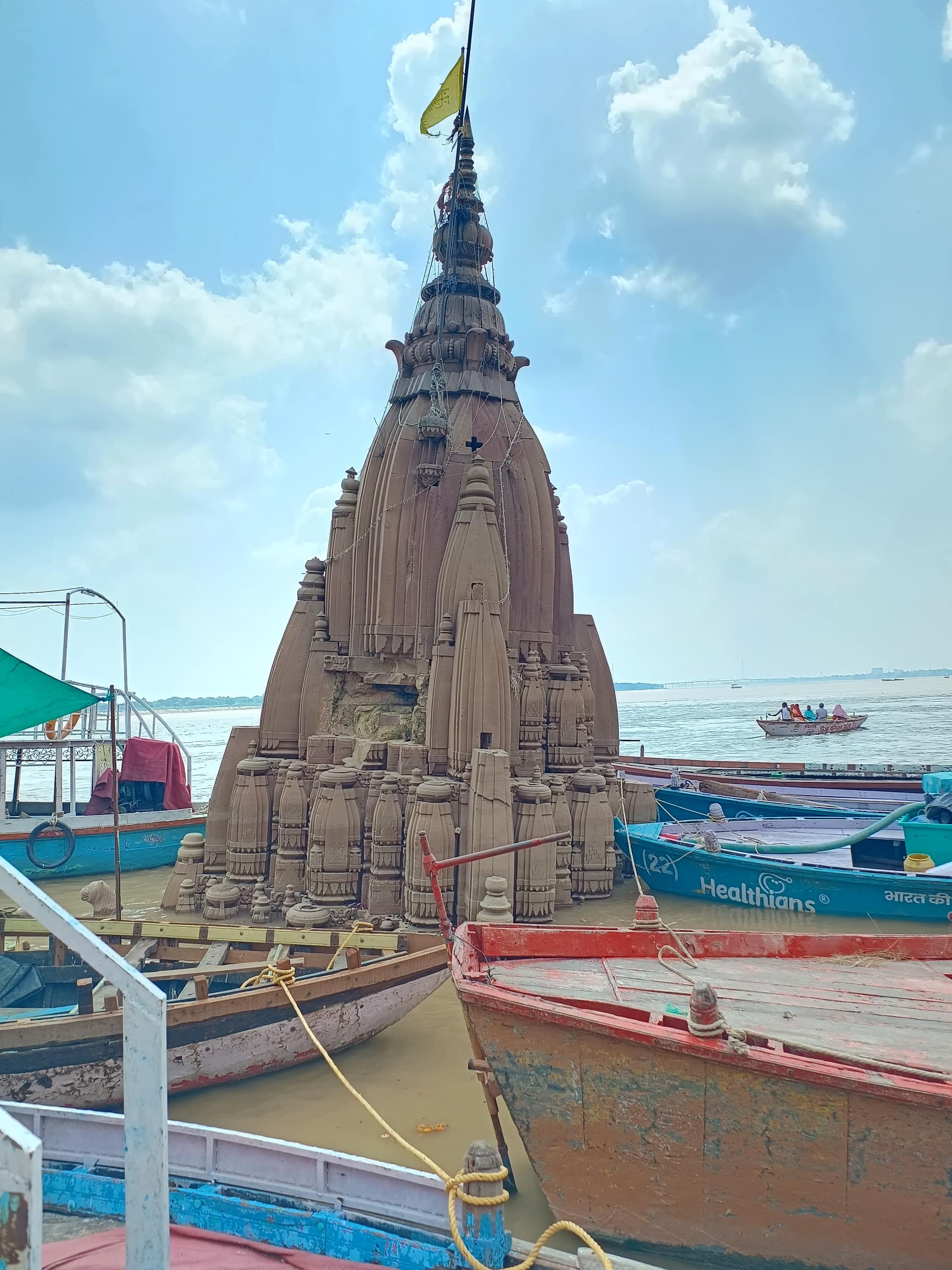
Temple in Varanasi
Ratneshwar Mahadev Temple
Varanasi, Uttar Pradesh
The leaning temple at Manikarnika, and the most photographed structure on the river — it tilts about nine degrees, roughly twice the lean of the tower at Pisa. It is a photograph rather than a darshan: the sanctum sits below the waterline for most of the year and only emerges for a few months in summer, when the Ganga is at its lowest before the monsoon.
Photo: Thenerdatul — CC BY 4.0, via Wikimedia Commons
Overview
Who it's to, and what's expected
Deity
Shiva
Tradition
Shiva temple
- Entry
Free and open - there is no ticket, gate or timed entry, because this is a landmark on the open riverfront rather than an enclosed shrine. Access is on foot along the ghats or by boat. The sanctum is below the waterline for most of the year, emerging only for a few summer months, so regular worship is not practical and no darshan, aarti or prasad schedule applies.
- Footwear
There is no temple building to remove footwear for, since the site is approached along the open ghats. If you step into any ghat-side shrine, footwear comes off there and is left in the designated area. Expect uneven, often wet stone steps throughout, so wear shoes with grip that are easy to slip off.
- Access
Poor. The temple is reached on foot along the ghats over uneven, frequently wet stone steps, with no vehicle access to the riverfront and no ramp or lift. The site itself is viewed from the open ghat rather than entered, and the sanctum is below the waterline for most of the year. Visitors with mobility limitations should view it from a boat rather than attempting the ghat steps, and should avoid the monsoon when the stone is slippery and the water is high.
- Prasadam
No prasad is distributed, because the sanctum is submerged for most of the year and the temple does not run the daily ritual life of Varanasi's working shrines. Offerings are occasional and individual rather than scheduled.
Usually visited with
Time your visit
The darshan clock
A single opening-hours line cannot express a midday closure or an evening ceremony.
Daylight hours, accessed along the ghats
Open site
This is a landmark rather than a working shrine. With the sanctum below the waterline for most of the year there are no regular darshan timings, aartis or prasad distribution. Do not expect the infrastructure of Varanasi's active temples.
A few months in summer, before the monsoon
Sanctum emerges
When the Ganga is at its lowest, the garbhagriha emerges from the water - the only period in which the temple can be seen as its builders would have known it.
Late afternoon and sunset
Best light
The riverfront faces west, so low sun gives the best light on the stone and the lean reads most dramatically. Sunrise boats pass it but the stone is flat-lit then.
Rules, timings and fees change — confirm locally before you rely on this.
How long this takes
Ways in
The difference between a twenty-minute visit and a three-hour one.
No queue
- There is no darshan queue, ticket or timed entry
- Visitors come to see and photograph the structure from the ghat or from a boat, and spend fifteen to thirty minutes including the walk
At the gate
Before you go in
What gets refused, and what you cannot take past the door.
What to wear
No formal dress code applies to the outdoor site, but Manikarnika is a working cremation ghat and conservative dress is expected out of respect for the families present. Cover shoulders and knees. Leather items are best left elsewhere on this ghat.
Phones and cameras
Photographing the leaning temple itself is normal and expected - it is a structure and the most photographed on the riverfront. But Manikarnika is an active cremation ghat: DO NOT photograph cremations, pyres, bodies or mourners, including with a long lens from a boat. There is no legitimate paid photography of cremations here, and paying anyone who offers it encourages a trade in other people's grief. Frame the temple as architecture and keep mourners out of the shot.
Rules, timings and fees change — confirm locally before you rely on this.
When not to come — unless you mean to
Festival windows
These follow lunar calendars and move by weeks each year, so the windows are months, not dates.
Dry summer months
Mahashivratri
Dev Deepawali
Practicalities
The things that go wrong
Book through official channels, and treat anyone promising a guaranteed slot as a warning sign.
What to watch for
- People at Manikarnika asking for money to photograph the cremations, or claiming authority to permit it
- There is no legitimate paid photography of cremations at this ghat, and paying encourages a trade in grieving families
- Offers to arrange a 'special viewing spot' or a closer view of the pyres for a fee
- Decline - this is the same trade dressed differently, and it puts you where you should not be
- Self-appointed guides on the ghat producing a charge afterwards for what they call guidance
- The leaning temple needs no guide and nothing here is ticketed
- Donation collectors claiming to raise money for the ghat or for the temple's restoration
- Give only at an identified temple office if you wish to give at all
- Boatmen extending a ride to pass close to the cremation ghat at a premium, presented as a highlight
- The lean reads clearly from well offshore, so the closer pass buys nothing but intrusion
- Anyone insisting the sanctum can be entered for a fee
- It is below the waterline for most of the year and cannot be
One place, many temples
Other temples in Varanasi
Annapurna Devi Mandir
Devi · Shakti templeAnnapurna
Kaal Bhairav Temple
Shiva templeKaal Bhairav
New Vishwanath Temple (BHU)
Shiva templeShiva as Vishwanath
Sankat Mochan Hanuman Temple
Vishnu · Krishna templeHanuman
3.6 km away
View guideShri Kashi Vishwanath Temple
Shiva templeShiva as Vishwanath
0.4 km · 5 min walk
View guideGeneral guidance
Planning the visit
Customary practice and what Varanasi's climate means for a barefoot visit — not rules posted at this temple. Anything specific to Ratneshwar Mahadev Temple is above.
Circling the shrine
At most Shaiva temples the circuit around the sanctum is not completed in a full circle — the channel draining the abhishekam is not crossed. Walk to it, turn, and come back the way you came. Watching what the queue in front of you does is the reliable guide.
Come in winter
Winter is when Varanasi is most comfortable to walk around, which matters here because a temple visit is done on foot and barefoot. Locally the window is given as october to march.
Stone gets hot — go early
You will be barefoot from the shoe rack onwards, often across an open courtyard. Between late morning and mid-afternoon in the hot months that stone is genuinely painful to stand on. Socks help, and are permitted almost everywhere shoes are not.
Arriving by train
Varanasi has a railway station, and auto-rickshaws wait outside it. Agree the fare or use a meter before you set off, and expect to be dropped a short walk from the temple rather than at its door.
Outfit guide
What to wear at Ratneshwar Mahadev Temple
Cover shoulders and knees — the rules above win over anything here.
Trending wear for this spot
Popular modern looks travellers are wearing across Varanasi.


Traditional wear for this spot
Timeless, cultural outfits worn across Varanasi.
Ratneshwar Mahadev Temple — the leaning temple
Ratneshwar Mahadev is the most photographed structure on the Varanasi riverfront, and it leans. Built around 1825 near Manikarnika Ghat, it tilts backwards at about nine degrees — roughly twice the incline of the Leaning Tower of Pisa, which sits at about four degrees, or five degrees more by the way Indian sources usually put it.
It is known locally as "Kashi Karvat": Kashi is the ancient name of Varanasi and karvat means "lean" in Hindi. It also carries the name "Matru-rin", mother's debt, from the legend that explains the tilt.
Be clear about what this visit is. It is a photograph rather than a darshan — the sanctum sits below the waterline for most of the year and the temple does not function as a working shrine in the way Kashi Vishwanath or Sankat Mochan do.
📐 Why does it lean? Four accounts, none conclusive
This is the question every visitor asks, and the honest answer is that nobody knows. Four explanations circulate:
The mother's curse. The most-told version. A mother's debt can never be repaid, and she is said to have cursed the temple — after which it began to lean. This is where the alternative name Matru-rin comes from. A variant attributes the curse specifically to Ahilyabai Holkar, whose reprimand turned the stone into "a testament of pride and penance."
Structural failure. A weak or defective foundation, combined with the pressure of the river's currents, may simply have caused the tilting. This is the engineering explanation and is the most likely one.
The ghat gave way. One account holds that the ghat collapsed and leaned backwards after failing to withstand the temple's weight.
It has always been like this. Against all of the above, there is evidence that the builders made a conscious decision to construct the temple where it would be partially underwater for many months of the year, rather than at a higher level protected from the Ganga's monsoon floods. That suggests the river relationship was intended, whatever the tilt's cause.
🌊 Underwater for most of the year
The garbhagriha — the sanctum — is generally below the water for much of the year, emerging only for a few months during the summer, when the Ganga is at its lowest before the monsoon.
It leans significantly towards the back, to the north-west. Despite spending months submerged, the temple is apparently well preserved, and there is a genuinely interesting detail for anyone who looks closely: the carvings have remained in remarkably good condition considering how long the structure is underwater each year. It is worth the short exploration rather than being a photograph-and-leave site.
That the stone survives annual submersion so well is part of why the temple fascinates engineers as much as pilgrims.
📷 The awkward truth: famous and ignored at once
Despite being one of the most photographed temples in Varanasi, Ratneshwar Mahadev remains cloaked in relative obscurity, rarely celebrated in the way it deserves. Almost every Varanasi river panorama contains it, usually without being named. Most travellers have photographed it without knowing what it was.
That is worth knowing, because it means you will find it without effort and without crowds — it is part of the standard river view rather than a destination anyone queues for.
🔥 Manikarnika: read this before you raise a camera
The temple stands at Manikarnika Ghat, which is one of Varanasi's two principal cremation ghats and operates continuously. This is not a background detail — it determines how you should behave here.
- Cremations are ongoing, day and night. You will see them, and you will see grieving families at very close range.
- Do not photograph cremations, pyres, bodies or mourners. This is the single most important rule on this stretch of river, and breaking it causes real offence. Long-lens photography of the ghat from a boat is treated the same way.
- People will ask you for money to photograph. Some claim authority to permit it, or offer to "arrange" a closer view. There is no legitimate paid photography of cremations at Manikarnika, and paying encourages a trade in other people's grief.
- Photographing the leaning temple itself is normal and expected — it is a structure, not a rite. Frame it as architecture and keep mourners out of the shot.
- Keep a respectful distance, dress conservatively, and stay quiet. Leather items are best left elsewhere on this ghat.
- Expect to be approached by people offering "guidance", "special viewing spots" or donations for the ghat. Decline politely and keep walking.
If you want the temple without the ethical weight of the ghat, photograph it from a distance along the riverfront or from a boat passing well offshore — the lean reads clearly from far away, which is how most images of it are taken anyway.
🕉️ The deity and the shrine
The temple is dedicated to Lord Shiva, and the name Ratneshwar means Lord of Jewels. Its religious use is limited by the waterline: with the sanctum submerged for most of the year, regular worship is not practical, which is why the site functions primarily as a landmark and a place of occasional devotion rather than as a daily temple.
Do not expect darshan timings, aartis, prasad or a queue — none of the infrastructure of Varanasi's working temples applies here. Come for the structure, the legend and the river.
📍 Where it is, and when to go
At Manikarnika Ghat on the banks of the Ganga, in the old-city riverfront area, roughly 300 metres north of Kashi Vishwanath and a short walk from Dashashwamedh Ghat. It is reached on foot along the ghats or seen from a boat.
The best time to see it properly is the dry summer months, before the monsoon, when the river is lowest and the sanctum emerges — for a few months each year you can see the temple as its builders would have, rather than half-drowned. Outside that window it is still the most striking structure on the riverfront, but you are looking at a tower above waterline with its base submerged.
Light: the riverfront faces west, so late afternoon and sunset give the best light on the temple, and the lean reads most dramatically against a low sun. Sunrise boats pass it too, but the stone is flat-lit at that hour.
⚠️ Practical notes
- Allow fifteen to thirty minutes, including the walk along the ghat. There is nothing to queue for.
- Pair it with the rest of the riverfront — Manikarnika, Dashashwamedh, and the ghats north and south. It is a stop on a ghat walk, not a separate trip.
- Combine with Kashi Vishwanath, which is a few minutes inland, and with Annapurna Devi Mandir and Kaal Bhairav in Visheshwarganj.
- Wear shoes you can take off easily if you intend to enter any ghat-side shrine, and expect uneven, wet stone steps.
- The ghats are slippery in monsoon and the water is high; the temple is least rewarding and least safe to approach closely at that season.
Last verified: 2026. Timings, entry arrangements and any charges are published by the temple itself and do change - confirm them with the temple's own official website or counter before travelling rather than relying on any third-party listing.
Questions
Ratneshwar Mahadev Temple — FAQ
Who is Ratneshwar Mahadev Temple dedicated to?
Ratneshwar Mahadev Temple in Varanasi is dedicated to Shiva.
Who can enter Ratneshwar Mahadev Temple?
Free and open - there is no ticket, gate or timed entry, because this is a landmark on the open riverfront rather than an enclosed shrine. Access is on foot along the ghats or by boat. The sanctum is below the waterline for most of the year, emerging only for a few summer months, so regular worship is not practical and no darshan, aarti or prasad schedule applies.
What is the dress code at Ratneshwar Mahadev Temple?
No formal dress code applies to the outdoor site, but Manikarnika is a working cremation ghat and conservative dress is expected out of respect for the families present. Cover shoulders and knees. Leather items are best left elsewhere on this ghat.
Do I have to take my shoes off at Ratneshwar Mahadev Temple?
There is no temple building to remove footwear for, since the site is approached along the open ghats. If you step into any ghat-side shrine, footwear comes off there and is left in the designated area. Expect uneven, often wet stone steps throughout, so wear shoes with grip that are easy to slip off.
Can I take photos inside Ratneshwar Mahadev Temple?
Photographing the leaning temple itself is normal and expected - it is a structure and the most photographed on the riverfront. But Manikarnika is an active cremation ghat: DO NOT photograph cremations, pyres, bodies or mourners, including with a long lens from a boat. There is no legitimate paid photography of cremations here, and paying anyone who offers it encourages a trade in other people's grief. Frame the temple as architecture and keep mourners out of the shot.
What prasadam is offered at Ratneshwar Mahadev Temple?
No prasad is distributed, because the sanctum is submerged for most of the year and the temple does not run the daily ritual life of Varanasi's working shrines. Offerings are occasional and individual rather than scheduled.
Is Ratneshwar Mahadev Temple wheelchair accessible?
Poor. The temple is reached on foot along the ghats over uneven, frequently wet stone steps, with no vehicle access to the riverfront and no ramp or lift. The site itself is viewed from the open ghat rather than entered, and the sanctum is below the waterline for most of the year. Visitors with mobility limitations should view it from a boat rather than attempting the ghat steps, and should avoid the monsoon when the stone is slippery and the water is high.
Checked, not remembered
Sources
Every rule and timing above traces back to one of these.