
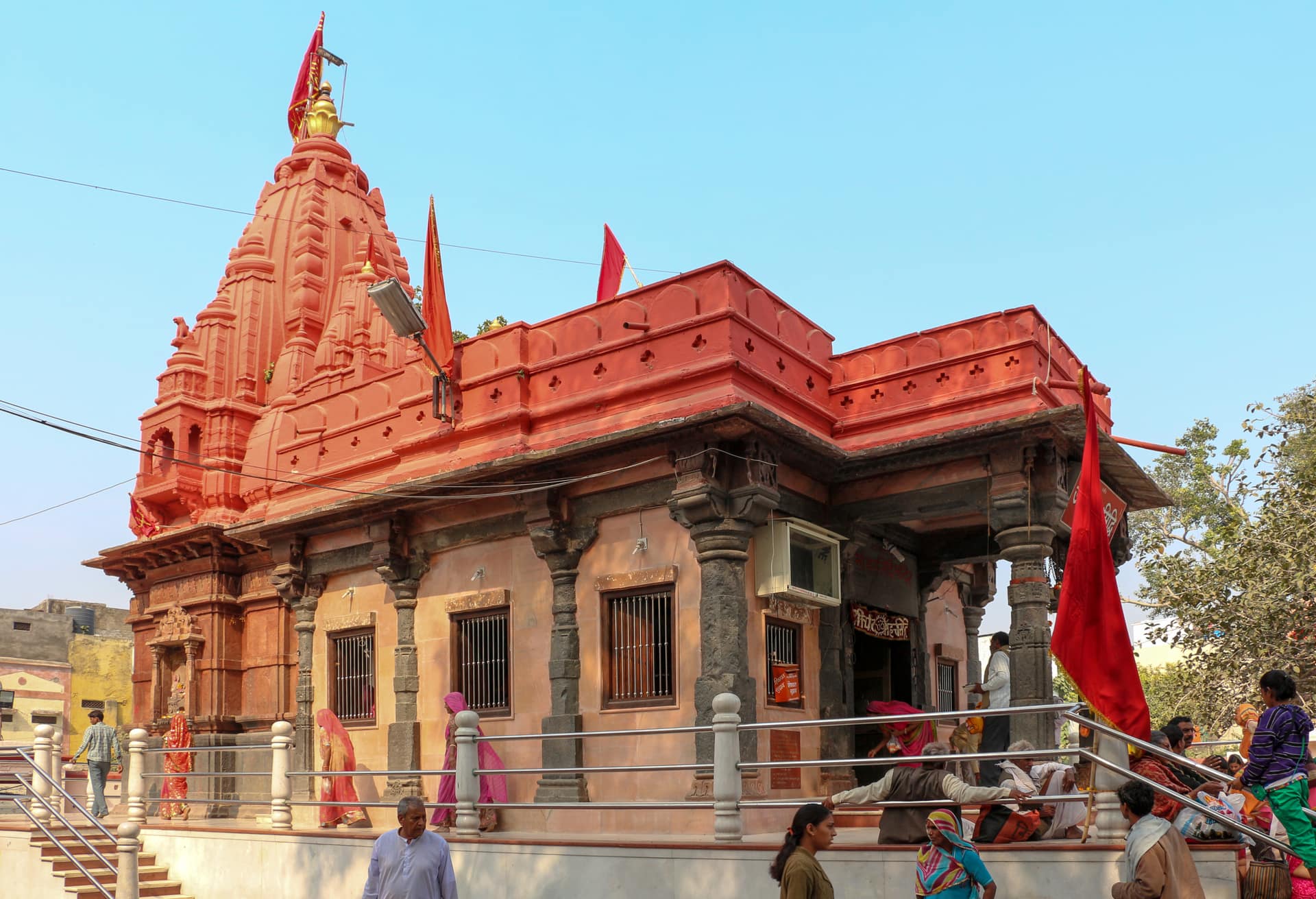
Temple in Ujjain
Harsiddhi Mata Temple
Ujjain, Madhya Pradesh
A Shakti Peetha a short walk from Mahakaleshwar, and the one temple in Ujjain worth timing to the evening: two free-standing stone lamp towers in the courtyard are lit with rows of oil lamps on festival nights.
Photo: Bernard Gagnon — CC BY-SA 3.0, via Wikimedia Commons
Overview
Who it's to, and what's expected
Deity
Harsiddhi Mata
Tradition
Devi · Shakti temple
- Entry
Free entry with no ticket, booking or pass, open daily from early morning to late evening (around 5:00 AM opening). A short walk from Mahakaleshwar in the central Mahakal zone, so no auto circuit is needed. During Navratri expect published wait times of two to three hours in line, and the lamp towers lit after dark. The small Mahamaya shrine within the premises is closed to visitors and no paid access to it exists.
- Footwear
You must remove your footwear before entering the temple premises.
- Access
Easier than Ujjain's outlying temples because it sits in the central Mahakal zone a short walk from Mahakaleshwar, so no auto circuit is needed. The main difficulty is crowds rather than access: published Navratri wait times are two to three hours in line. An evening visit outside Navratri is the calm option.
- Prasadam
Prasad is distributed during the Navratri festival as part of the temple's special celebrations.
Usually visited with
Time your visit
The darshan clock
A single opening-hours line cannot express a midday closure or an evening ceremony.
5:00 AM
Opening hours
The temple is open daily from 5:00 AM to 9:00 PM, with morning and evening aartis recommended for visitors.
Rules, timings and fees change — confirm locally before you rely on this.
How long this takes
Ways in
The difference between a twenty-minute visit and a three-hour one.
Darshan options
- During Navratri, expect significantly larger crowds with wait times of 2 to 3 hours in line
At the gate
Before you go in
What gets refused, and what you cannot take past the door.
What to wear
Visitors are expected to dress modestly, with shoulders and knees covered; traditional attire is preferred.
Phones and cameras
Photography is permitted in the outer areas of the temple, but it is strictly prohibited inside the main sanctum.
Rules, timings and fees change — confirm locally before you rely on this.
When not to come — unless you mean to
Festival windows
These follow lunar calendars and move by weeks each year, so the windows are months, not dates.
September–October, and again March–April
Navratri
The two deep-stambhs — lamp towers — are lit with thousands of lamps. This is the reason to come to this temple specifically rather than treat it as a stop between Mahakaleshwar and the ghats.
Practicalities
The things that go wrong
Book through official channels, and treat anyone promising a guaranteed slot as a warning sign.
What to watch for
- Third parties near the Mahakal zone claiming Harsiddhi requires a ticket or a special Navratri pass
- Entry is free and there is no pass - the only cost is time in the queue during Navratri
- Anyone offering to take you inside the closed Mahamaya shrine, or to arrange a private viewing of it, for a fee
- It is closed to visitors by design and no paid access exists
- Claims that the lamp towers are lit every evening
- They are lit on festival nights, above all during Navratri - on an ordinary evening you will see unlit stone pillars, and no payment changes that
- Flower, diya and prasad sellers at the entrance quoting inflated prices to visitors
- Agree a price before accepting anything; diyas are inexpensive locally
- Guides attaching themselves on the short walk from Mahakaleshwar and producing a fee at the door
- The two temples are close and the visit needs no guide
One place, many temples
Other temples in Ujjain
General guidance
Planning the visit
Customary practice and what Ujjain's climate means for a barefoot visit — not rules posted at this temple. Anything specific to Harsiddhi Mata Temple is above.
Offerings differ here
Shakta shrines often accept offerings that other temples do not, and a few remain associated with animal sacrifice on particular days. What is sold at the stalls outside is the honest signal of what is expected inside.
Come in winter
Winter is when Ujjain is most comfortable to walk around, which matters here because a temple visit is done on foot and barefoot. Locally the window is given as october to march.
Stone gets hot — go early
You will be barefoot from the shoe rack onwards, often across an open courtyard. Between late morning and mid-afternoon in the hot months that stone is genuinely painful to stand on. Socks help, and are permitted almost everywhere shoes are not.
Arriving by train
Ujjain has a railway station, and auto-rickshaws wait outside it. Agree the fare or use a meter before you set off, and expect to be dropped a short walk from the temple rather than at its door.
No airport here
Ujjain has no airport of its own, so the last leg is by road or rail. Plan the return the same way — the last bus out is often earlier than visitors expect.
Outfit guide
What to wear at Harsiddhi Mata Temple
Cover shoulders and knees — the rules above win over anything here.
Trending wear for this spot
Popular modern looks travellers are wearing across Ujjain.


Traditional wear for this spot
Timeless, cultural outfits worn across Ujjain.
Harsiddhi Mata Temple
Harsiddhi is the one temple in Ujjain worth timing to the evening. It is a Shakti Peetha a short walk from Mahakaleshwar, and its signature is architectural rather than ritual: two free-standing stone lamp towers — deep stambhs — stand in the courtyard, and on festival nights they are lit with rows of oil lamps from base to finial.
When they are lit during Navratri they illuminate the temple complex and the surrounding streets, and the glow is described as visible across the city. It is one of the most striking single images in Madhya Pradesh temple architecture, and almost nobody outside Ujjain has heard of it.
🪔 The twin deep stambhs
The two tall lamp towers are the temple's most iconic feature. They are Maratha work — the Marathi decorative idiom is visible on the pillars — and they are lit with hundreds of diyas during Navratri and other major festivals.
The towers are not incidental ornament. A deep stambha is a pillar built specifically to carry lamps, and the pair at Harsiddhi is what makes this temple photographable in a way Ujjain's other shrines are not. If you come at the wrong time of year you will see two fine carved stone pillars in a courtyard. If you come during Navratri you will see them on fire with light.
To see the temple in its full glory, come during Navratri. That is the consistent advice across every account of it.
🩸 Sati's elbow — the Shakti Peetha claim
Harsiddhi is one of the 51 Shakti Peethas. The tradition behind the network is that when Shiva carried Sati's body and it was dismembered, each place a part fell became a seat of the Goddess. At Harsiddhi, the belief is that Sati's elbow fell.
That specificity is what qualifies a temple as a Shakti Peetha, and it is worth knowing because it explains the temple's status: this is not a locally important Devi shrine that has been promoted, but one of a fixed canonical set of 51 across the subcontinent.
The Goddess here is Harsiddhi, a powerful form of Parvati, also known as Harshad Mata. She is believed to fulfil wishes, remove obstacles and bring prosperity to devotees. A Shri Yantra — the geometric symbol of Shakti — is also present in the temple.
🕉️ The older Krishna legend
A second and considerably older account competes with the Sati tradition, and both are told:
Lord Krishna is believed to have worshipped the Goddess here as Amba Mata, praying for the power to eliminate the asuras. After he defeated them, he built the temple, and all the Yadavas gathered at this spot to celebrate the demise of the asura Jarasandha. The name Harshad Mata — and from it Harsiddhi — is said to come from that gathering of joy.
The two legends are not reconciled in any source, and the temple holds both. The Krishna-Jarasandha account explains the name; the Sati account explains the Shakti Peetha status. Treat them as two layers of a very old site rather than as rival claims to be settled.
🏛️ Maratha rebuilding
The temple was renovated and rebuilt during the Maratha period, under Rani Ahilyabai Holkar. The Maratha hand is what gives the lamp pillars their decorative character, and the structure today reflects that phase rather than whatever preceded it.
Ahilyabai Holkar's name recurs across central India's temples — she is also associated with rebuilding Varanasi's Kaal Bhairav temple and with the legend of the leaning temple at Manikarnika. Harsiddhi is one of her documented restorations.
The temple's shikhara is described as ancient and red-painted, which is the other visual marker after the lamp towers.
🔥 The closed Mahamaya shrine
One detail that most visitor accounts omit and that is worth knowing: within the temple premises there is a small shrine of Goddess Mahamaya which is closed to tourists, and in it a diya that has been burning for a very long time — devotees say for years on end.
You will not be admitted to it, and it should not be pushed for. It is mentioned here because a continuously burning lamp in a closed shrine is part of how the temple understands itself, and because visitors sometimes ask about the small locked structure in the courtyard and get no answer.
🕒 Timings, and the evening aarti
The temple is open daily from early morning to late evening, around 5:00 AM opening. Entry is free.
The aarti performed with hundreds of lamps is the thing to see, and it is the reason to come in the evening rather than fitting the temple into a morning circuit. The two towers lit, the courtyard crowded, the chanting running — this is the temple at its proper pitch, and it is a materially different experience from a daytime visit.
🌸 Navratri — the festival that defines the visit
The nine-day Navratri festival is the major celebration here, falling twice yearly in the Hindu calendar but observed at its greatest scale in Sharad Navratri, September to October.
- Thousands of devotees come from across India to seek the Devi's blessings.
- Expect wait times of two to three hours in line during Navratri — the temple's own visitor guidance gives that figure.
- The lamp towers are lit, the complex and surrounding streets are illuminated, and prasad is distributed as part of the special celebrations.
- Best time to visit: the Navratri festival, September to October.
The trade-off is explicit and worth making deliberately: Navratri gives you the lit towers and the full devotional atmosphere at the cost of a two-to-three-hour queue. Outside Navratri you get a calm, short visit to a handsome Maratha-period Shakti Peetha without its defining spectacle. If you can only manage one, and you are within reach in September or October, come for Navratri.
🛕 Rules
Dress modestly with shoulders and knees covered; traditional attire is preferred.
Photography is permitted in the outer areas of the temple but strictly prohibited inside the main sanctum. That means the courtyard and the lamp towers can be photographed — which matters, since the towers are the reason most people bring a camera — while the shrine itself cannot.
Remove your footwear before entering the temple premises.
📍 Where it is
Close to Mahakaleshwar Jyotirlinga — a short walk — which makes it a key stop on the Ujjain pilgrimage circuit and the natural second temple after the Jyotirlinga. Unlike Mangalnath, Kal Bhairav and Chintaman Ganesh, it does not require the half-day auto circuit; it is in the central Mahakal zone.
⚠️ Practical notes
- Come in the evening, and come during Navratri if your dates allow. Both are what this temple is for.
- Pair it with Mahakaleshwar on the same visit, since they are a short walk apart. If you have a Bhasma Aarti pass at 4:00 AM, Harsiddhi is the sensible late-afternoon or evening companion to it.
- Allow for the queue at Navratri — two to three hours is the published expectation, not a worst case.
- Do not ask to enter the Mahamaya shrine. It is closed to visitors by design.
- Do not consume non-vegetarian food or alcohol in Ujjain, which observes the religious codes of Avantika.
Last verified: 2026. The Sati's-elbow Shakti Peetha tradition and the Krishna-Jarasandha naming legend are both reported and neither is presented as superseding the other, since no source reconciles them. Navratri wait times of two to three hours come from the temple's own visitor guidance.
Questions
Harsiddhi Mata Temple — FAQ
Who is Harsiddhi Mata Temple dedicated to?
Harsiddhi Mata Temple in Ujjain is dedicated to Harsiddhi Mata.
Who can enter Harsiddhi Mata Temple?
Free entry with no ticket, booking or pass, open daily from early morning to late evening (around 5:00 AM opening). A short walk from Mahakaleshwar in the central Mahakal zone, so no auto circuit is needed. During Navratri expect published wait times of two to three hours in line, and the lamp towers lit after dark. The small Mahamaya shrine within the premises is closed to visitors and no paid access to it exists.
What is the dress code at Harsiddhi Mata Temple?
Visitors are expected to dress modestly, with shoulders and knees covered; traditional attire is preferred.
Do I have to take my shoes off at Harsiddhi Mata Temple?
You must remove your footwear before entering the temple premises.
Can I take photos inside Harsiddhi Mata Temple?
Photography is permitted in the outer areas of the temple, but it is strictly prohibited inside the main sanctum.
What prasadam is offered at Harsiddhi Mata Temple?
Prasad is distributed during the Navratri festival as part of the temple's special celebrations.
Is Harsiddhi Mata Temple wheelchair accessible?
Easier than Ujjain's outlying temples because it sits in the central Mahakal zone a short walk from Mahakaleshwar, so no auto circuit is needed. The main difficulty is crowds rather than access: published Navratri wait times are two to three hours in line. An evening visit outside Navratri is the calm option.
Checked, not remembered
Sources
Every rule and timing above traces back to one of these.