
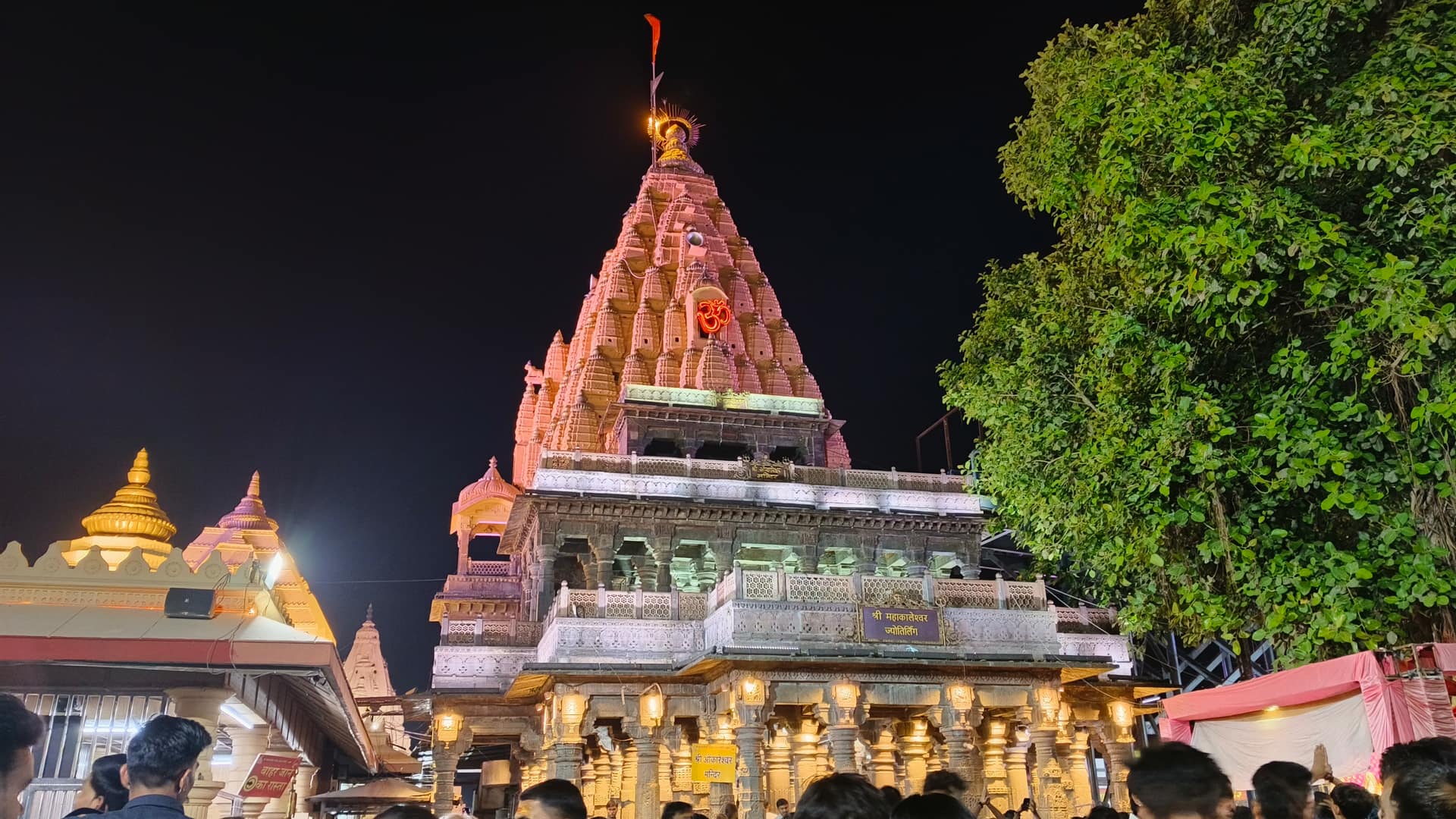
Temple in Ujjain
Mahakaleshwar Jyotirlinga
Ujjain, Madhya Pradesh
One of the twelve Jyotirlingas, and the temple the rest of Ujjain is arranged around. The pre-dawn Bhasma Aarti is what most people travel here for, and it is the one part of the visit you cannot simply turn up for.
Photo: Ashverse — CC BY-SA 4.0, via Wikimedia Commons
Overview
Who it's to, and what's expected
Deity
Shiva as Mahakala
Tradition
Shiva temple
- Entry
Visitors must adhere to a strict dress code, with men required to wear a traditional dhoti and women a saree or modest traditional attire. Mobile phones are strictly prohibited inside the temple, and direct touching of the Jyotirlinga is restricted to priests during specific rituals.
- Footwear
Footwear is not permitted inside the temple; you should use the provided locker facilities to store your shoes before entering.
- Access
Difficult, and hardest at the Bhasma Aarti. Reporting is between roughly 1:00 and 3:00 AM with security screening and dress-code verification before entry, and the aarti runs 1.5 to 2 hours in a seated hall. The Mahakal Lok Corridor approach is broad and paved, which helps, but standing and queuing before dawn is the main obstacle. The temple publishes its own arrangements for visitors needing assistance - confirm them directly with the temple office in advance rather than through a third party.
- Prasadam
Devotees can collect blessed offerings from designated prasad counters located within the temple complex.
Usually visited with
Time your visit
The darshan clock
A single opening-hours line cannot express a midday closure or an evening ceremony.
4:00 AM
Opening hours
The temple opens daily around 4:00 AM following the Bhasma Aarti and closes at 11:00 PM after the Shayan Aarti. Key daily rituals include the Bhasma Aarti (approx. 4:00 AM), Bal Bhog Aarti, Mid-Morning Bhog Aarti, Sandhya Aarti (6:30 PM), Shringar Aarti (9:30 PM), and Shayan Aarti (10:30 PM).
Rules, timings and fees change — confirm locally before you rely on this.
How long this takes
Ways in
The difference between a twenty-minute visit and a three-hour one.
General darshan
- Free, with the temple opening around 4:00 AM. This is the ordinary queue for darshan outside the pre-dawn Bhasma Aarti
Bhasma Aarti (advance pass only)
- "note": "Not a queue but a booked, seated ritual: ₹200 per person, authorised advance passes only from shrimahakaleshwar.com, slots opening 30 days and 1 day ahead and vanishing within two to three minutes
- Report between roughly 1:00 and 3:00 AM at Gate No. 4 with the original ID used to book - names are matched strictly and a mismatch means refusal
Sawan Mondays and Mahashivratri
- The heaviest periods of the year
- Sawan Monday Bhasma Aarti slots are described as critical to obtain, and March-April demand as extreme
At the gate
Before you go in
What gets refused, and what you cannot take past the door.
What to wear
Men are required to wear a traditional dhoti, while women must wear a saree or other modest traditional attire.
Phones and cameras
Mobile phones are strictly prohibited inside the temple premises, and photography is not allowed near the sanctum.
Rules, timings and fees change — confirm locally before you rely on this.
When not to come — unless you mean to
Festival windows
These follow lunar calendars and move by weeks each year, so the windows are months, not dates.
February–March
Extreme crowdsMahashivratri
The single busiest night of the year at a Jyotirlinga. Expect queues measured in hours and the city full; come deliberately or avoid the week.
July–August
Very busyShravan (Sawan)
The holy month for Shiva, with royal processions through the city on Mondays. Mondays in Shravan are the worst possible day for a quick darshan and the best one to see the town at full tilt.
Crowd levels are our reading of the notes above, not an official measure. Rules, timings and fees change — confirm locally before you rely on this.
One place, many temples
Other temples in Ujjain
General guidance
Planning the visit
Customary practice and what Ujjain's climate means for a barefoot visit — not rules posted at this temple. Anything specific to Mahakaleshwar Jyotirlinga is above.
Circling the shrine
At most Shaiva temples the circuit around the sanctum is not completed in a full circle — the channel draining the abhishekam is not crossed. Walk to it, turn, and come back the way you came. Watching what the queue in front of you does is the reliable guide.
Come in winter
Winter is when Ujjain is most comfortable to walk around, which matters here because a temple visit is done on foot and barefoot. Locally the window is given as october to march.
Stone gets hot — go early
You will be barefoot from the shoe rack onwards, often across an open courtyard. Between late morning and mid-afternoon in the hot months that stone is genuinely painful to stand on. Socks help, and are permitted almost everywhere shoes are not.
Arriving by train
Ujjain has a railway station, and auto-rickshaws wait outside it. Agree the fare or use a meter before you set off, and expect to be dropped a short walk from the temple rather than at its door.
No airport here
Ujjain has no airport of its own, so the last leg is by road or rail. Plan the return the same way — the last bus out is often earlier than visitors expect.
Outfit guide
What to wear at Mahakaleshwar Jyotirlinga
Cover shoulders and knees — the rules above win over anything here.
Trending wear for this spot
Modern, camera-ready looks picked for Mahakaleshwar Jyotirlinga.

Traditional wear for this spot
Timeless, cultural outfits worn across Ujjain.
Mahakaleshwar Jyotirlinga
Mahakaleshwar is one of the twelve Jyotirlingas and the temple the rest of Ujjain is arranged around. Everything else in the city — Harsiddhi, Kal Bhairav, Mangalnath, Chintaman Ganesh, the ghats — sits in relation to it, and the Mahakal Lok Corridor that now approaches it has reordered the whole precinct.
For most travellers there is exactly one reason to be here: the pre-dawn Bhasma Aarti. It is the ritual the city is famous for, and it is the one part of the visit you cannot simply turn up for.
🔥 The Bhasma Aarti
Every morning between 4:00 and 6:00 AM, the Jyotirlinga is bathed, adorned and offered sacred bhasma (ash) while the sanctum resounds with mantras. Mahakaleshwar is described as the only Jyotirlinga where the Lord is worshipped with sacred ash at pre-dawn, which is what makes the ritual singular rather than merely early.
The aarti itself runs about 1.5 to 2 hours, and photography is strictly prohibited inside the Nandi Hall during it.
🎟️ Booking — read this before anything else
Entry to the Bhasma Aarti is by authorised advance pass only. There is no general queue for it, no walk-in, and no same-day improvisation.
- Official fee: ₹200 per person. Every current source agrees on this figure.
- Booking is exclusively through the official temple trust website,
shrimahakaleshwar.com. - Slots open 30 days in advance, and again 1 day before. Sources differ on the exact release hour — one gives midnight (00:00 IST), another gives 8:00 AM — so check both and be ready early.
- Slots vanish within two to three minutes. For Sawan Mondays (the Mondays of Shravan) demand is described as critical, and regulars report needing multiple devices. March–April around Mahashivratri is likewise extreme. Mid-week slots in May–June are the realistic window for anyone without a local's persistence.
- You must register with an Indian mobile number, upload a clear photo, and provide government ID (Aadhaar, Voter ID or Passport) for every devotee.
- Carry the exact same original physical ID to the temple. Names are matched strictly at entry and a mismatch means you are turned away regardless of your ticket. This is the most common way a valid booking is wasted.
Whether an offline counter exists is genuinely unclear, and one site contradicts itself. One page states plainly that the offline counter facility is closed now; another page on the same domain says a limited offline counter opens at 7:00 AM daily near the temple for next-day passes, subject to availability. Plan on online booking only, and treat any counter as a bonus rather than a fallback.
🕒 Reporting time, and the gates
Sources disagree about when to arrive, and the spread is wide enough to matter:
- One guide says report between 1:00 and 2:30 AM at the designated gate for security and dress verification.
- Another says the premises open for queuing at 2:30 AM, with reporting at 3:00 AM and arrival at least 30–45 minutes early.
- A third says entry closes well before the aarti begins, so be at the barricades by around 3:00 AM.
The safe reading is that gates open somewhere between 1:00 and 2:30 AM and entry closes well before 4:00 AM. Queue at Gate No. 4 or your designated gate. Reach at least an hour to an hour and a half early, carry minimal belongings, and prefer weekdays for a slightly lighter crowd.
👘 Dress code — strict, and enforced
Men must wear a traditional unstitched dhoti and sola, bare-chested inside the sanctum. Shirts, trousers, jeans and any stitched clothing are strictly forbidden in the Garbhagriha area. Entry may be denied if the dress code is not followed, so this is not advisory.
Women must wear a saree. One source permits a salwar suit with dupatta and another specifically says salwar suits are not permitted for Garbhagriha ritual seating — a real conflict. If your participation depends on it, wear a saree; that is the requirement no source disputes.
One rule is unique to this ritual and worth knowing in advance: at the moment fresh bhasma is applied to the Shivalinga, women are required to cover their faces with a veil (ghoonghat). Bring one.
🚫 What you cannot carry
Mobile phones, smartwatches, cameras, leather belts, wallets and bags are all strictly prohibited inside the hall and must be deposited in external lockers. Use the temple cloakrooms before joining the line — not after, since you will lose your place. Mobile phones are prohibited across the temple premises generally, and photography is not allowed near the sanctum.
🥾 General darshan, and the rest of the day
Prasad can be collected from designated counters within the temple complex.
The rule is simple and worth memorising: nobody can legitimately sell you a "guaranteed" Bhasma Aarti ticket — not your hotel, not a travel agent, not a website that looks official. If a seat did not come from shrimahakaleshwar.com or the temple's own counter, it does not exist. Look-alike domains are the specific vector here, so type the address rather than following a link.
There is also a 3D/5D virtual-reality experience of the 4:00 AM Bhasma Aarti staged just outside the Mahakal Lok Corridor, sold as an alternative for the thousands who miss official passes each day. It is a commercial product, not the ritual, and it is worth knowing it exists so you are not confused by people selling "Bhasma Aarti tickets" near the corridor — but nobody should present it to you as the real thing.
🌸 Festivals
Mahashivratri is the peak of the year, when Bhasma Aarti demand is described as extreme and the city is at its fullest. Shravan (Sawan), July to August, brings sustained heavy crowds and Sawan Mondays are the single hardest slots to book.
🕉️ The city's rules
Do not consume non-vegetarian food or alcohol anywhere in Ujjain. It is understood locally as violating the religious codes of Avantika — the city's ancient name — and it will mark you out. Note the apparent exception that proves the rule: Kal Bhairav's temple does take a liquor offering, but that is a ritual act performed by a priest at a shrine outside the city, not drinking.
The other major temples sit 5–8 km outside the central Mahakal zone — Chintaman Ganesh, Mangalnath and Kal Bhairav among them. Hire a dedicated auto-rickshaw for a half-day circuit rather than trying to do them piecemeal, and aim for 6:00 AM to 12:00 PM to avoid the harsh afternoon sun and the crowds.
🛕 Practical notes
- Book the Bhasma Aarti 30 days out, at the release moment, with every devotee's ID details prepared in advance. That single preparation determines whether you see it.
- If you do not get a pass, do not chase one on the street. Take general darshan later in the morning and visit the other temples.
- Pair it with Harsiddhi Mata, a short walk away and the natural second stop, and with Kal Bhairav on the Shipra.
- Weekdays are meaningfully easier than Mondays and festival days.
Last verified: 2026. The ₹200 Bhasma Aarti fee is consistent across all current sources. Reporting time (1:00 AM vs 2:30 AM vs 3:00 AM), the slot release hour (midnight vs 8:00 AM), the women's dress allowance (saree only vs saree or salwar suit) and the existence of an offline counter all conflict and are stated rather than resolved. Confirm everything on shrimahakaleshwar.com for your date.
Questions
Mahakaleshwar Jyotirlinga — FAQ
Who is Mahakaleshwar Jyotirlinga dedicated to?
Mahakaleshwar Jyotirlinga in Ujjain is dedicated to Shiva as Mahakala.
Who can enter Mahakaleshwar Jyotirlinga?
Visitors must adhere to a strict dress code, with men required to wear a traditional dhoti and women a saree or modest traditional attire. Mobile phones are strictly prohibited inside the temple, and direct touching of the Jyotirlinga is restricted to priests during specific rituals.
What is the dress code at Mahakaleshwar Jyotirlinga?
Men are required to wear a traditional dhoti, while women must wear a saree or other modest traditional attire.
Do I have to take my shoes off at Mahakaleshwar Jyotirlinga?
Footwear is not permitted inside the temple; you should use the provided locker facilities to store your shoes before entering.
Can I take photos inside Mahakaleshwar Jyotirlinga?
Mobile phones are strictly prohibited inside the temple premises, and photography is not allowed near the sanctum.
What prasadam is offered at Mahakaleshwar Jyotirlinga?
Devotees can collect blessed offerings from designated prasad counters located within the temple complex.
Is Mahakaleshwar Jyotirlinga wheelchair accessible?
Difficult, and hardest at the Bhasma Aarti. Reporting is between roughly 1:00 and 3:00 AM with security screening and dress-code verification before entry, and the aarti runs 1.5 to 2 hours in a seated hall. The Mahakal Lok Corridor approach is broad and paved, which helps, but standing and queuing before dawn is the main obstacle. The temple publishes its own arrangements for visitors needing assistance - confirm them directly with the temple office in advance rather than through a third party.
Checked, not remembered
Sources
Every rule and timing above traces back to one of these.