
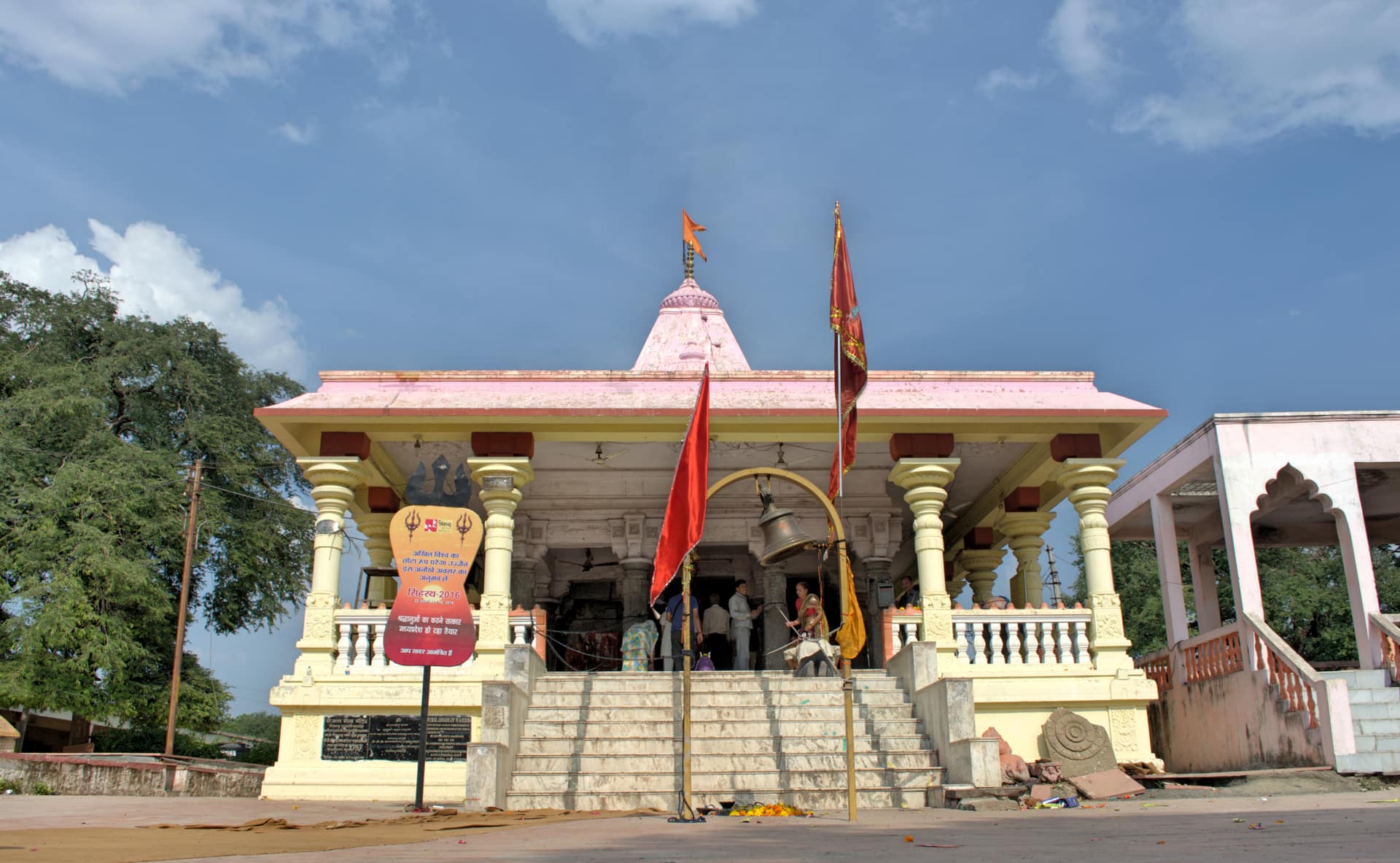
Temple in Ujjain
Kal Bhairav Temple
Ujjain, Madhya Pradesh
The temple where the offering is liquor. A priest holds a saucer to the deity's mouth and the liquid drains away — it is done in the open, all day, and it is the reason most visitors come here rather than for the architecture.
Photo: Utcursch — CC BY-SA 4.0, via Wikimedia Commons
Overview
Who it's to, and what's expected
Deity
Kal Bhairav
Tradition
Shiva temple
- Entry
Free entry, open to all visitors, with no ticket, booking or registration. The temple is open broadly from about 5:00 AM to 10:00 PM and the liquor offering runs continuously through the day rather than at fixed aarti times, so you can arrive at almost any hour and see it performed. Participation is optional - coconut and flowers are sold alongside for those who would rather not buy alcohol.
- Footwear
Remove footwear before entering the temple premises and leave it in the designated area, keeping any token issued. The site is busy throughout the day, so do not leave shoes unattended in the open.
- Access
Easier than Ujjain's outlying shrines in some respects - the temple is open broadly through the day with no ticket and no managed queue, and the offering ritual is performed in the open where it can be seen without pressing into a sanctum. The site is on the banks of the Shipra and is exposed, so heat is the main difficulty; mornings and late afternoons are the comfortable windows.
- Prasadam
Liquor is the offering here, bought sealed from the stalls outside and returned to you part-used after the priest offers it. Coconut and flowers are sold alongside for those who would rather not.
Usually visited with
Time your visit
The darshan clock
A single opening-hours line cannot express a midday closure or an evening ceremony.
05:00–22:00
Open through the day
Long hours and no midday closure, which makes this the easy one to fit around Mahakaleshwar's aarti timings.
Through the day
The liquor offering
Not a scheduled ceremony — it happens continuously as devotees arrive. Sealed bottles are sold by stalls at the approach and handed to the priest with the rest of the offering.
Rules, timings and fees change — confirm locally before you rely on this.
How long this takes
Ways in
The difference between a twenty-minute visit and a three-hour one.
General visit
- No formal queue and no ticket
- The offering runs continuously through the day, so wait time depends on how many devotees are ahead of you at the priest rather than on any managed line
Kal Bhairav Ashtami
- The monthly eighth-day observance draws substantially heavier crowds
- The annual Bhairav Ashtami in November-December is the busiest, with extended ritual
At the gate
Before you go in
What gets refused, and what you cannot take past the door.
What to wear
Modest dress with shoulders and knees covered, as for any active Hindu temple in a conservative religious city. There is no published formal code for this temple, but the liquor ritual draws attention to visitors and decorum is expected.
Phones and cameras
The ritual is performed in the open and is highly photogenic, which is why restraint matters. Ask before photographing any devotee taking part - many are here for a vow or a remedy rather than for a photograph. Do not photograph the priest's ritual at close range without asking, and follow any posted restriction near the sanctum.
Rules, timings and fees change — confirm locally before you rely on this.
When not to come — unless you mean to
Festival windows
These follow lunar calendars and move by weeks each year, so the windows are months, not dates.
Kal Bhairav Ashtami
Annual Bhairav Ashtami
Simhastha (Kumbh Mela)
Mahashivratri
Practicalities
The things that go wrong
Book through official channels, and treat anyone promising a guaranteed slot as a warning sign.
What to watch for
- Baskets of offerings pressed on you at a price you did not agree
- Coconuts, flowers and a bottle are sold as a set; ask the price before accepting anything
- Anyone offering to arrange a 'special' or private liquor offering for a fee
- The ritual is available to any devotee who buys a bottle - no intermediary is needed and no fee is charged for it
- Claiming the deity drinks a fixed large quantity or that the idol has no opening, then asking for a donation on the strength of it
- The documented account states the lips have a slit; the miraculous versions are devotional and unsourced
- Guides attaching themselves on the road from the Mahakal zone and producing a fee at the temple
- It is a short, simple visit that needs no guide
One place, many temples
Other temples in Ujjain
General guidance
Planning the visit
Customary practice and what Ujjain's climate means for a barefoot visit — not rules posted at this temple. Anything specific to Kal Bhairav Temple is above.
Circling the shrine
At most Shaiva temples the circuit around the sanctum is not completed in a full circle — the channel draining the abhishekam is not crossed. Walk to it, turn, and come back the way you came. Watching what the queue in front of you does is the reliable guide.
Come in winter
Winter is when Ujjain is most comfortable to walk around, which matters here because a temple visit is done on foot and barefoot. Locally the window is given as october to march.
Stone gets hot — go early
You will be barefoot from the shoe rack onwards, often across an open courtyard. Between late morning and mid-afternoon in the hot months that stone is genuinely painful to stand on. Socks help, and are permitted almost everywhere shoes are not.
Arriving by train
Ujjain has a railway station, and auto-rickshaws wait outside it. Agree the fare or use a meter before you set off, and expect to be dropped a short walk from the temple rather than at its door.
No airport here
Ujjain has no airport of its own, so the last leg is by road or rail. Plan the return the same way — the last bus out is often earlier than visitors expect.
Outfit guide
What to wear at Kal Bhairav Temple
Cover shoulders and knees — the rules above win over anything here.
Trending wear for this spot
Popular modern looks travellers are wearing across Ujjain.
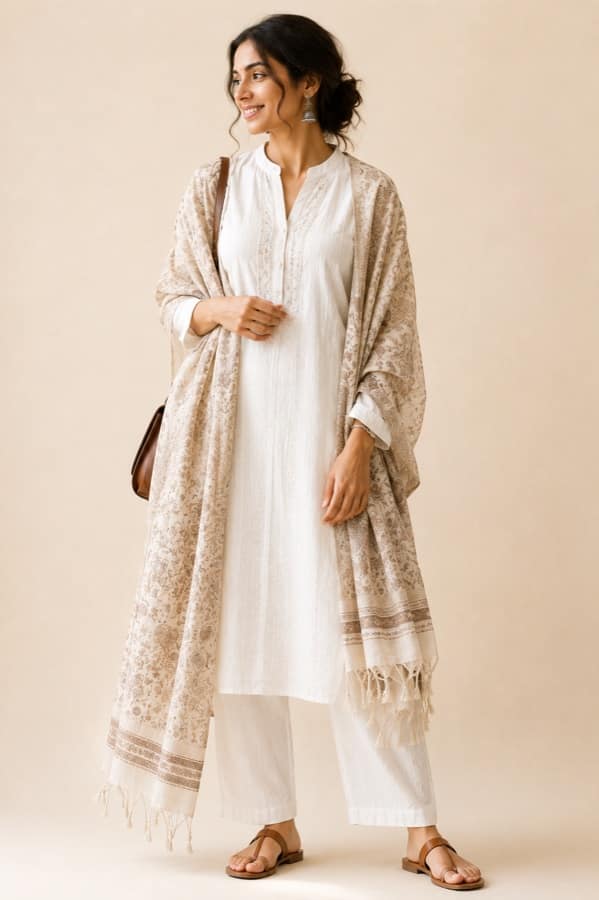

Traditional wear for this spot
Timeless, cultural looks that suit Kal Bhairav Temple.
Kal Bhairav Temple, Ujjain
This is the temple where the offering is liquor. A priest takes your sealed bottle, pours it into a saucer, says the prayers, holds the saucer to the deity's lips and tilts it — and the liquor disappears. About a third of the bottle comes back to you as prasad.
It is done in the open, all day, in front of everyone, and it is the reason most visitors come to this temple rather than for the architecture. It is also genuinely a religious practice with a documented theological basis, not a stunt, and understanding which changes the visit considerably.
🍶 Why alcohol, and what happened to the other four
Liquor is offered here as one of the five tantric ritual offerings known as the panchamakara: madya (alcohol), maansa (meat), meena or matsya (fish), mudra (gesture or parched grain) and maithuna (sexual union).
In older times all five were offered to the deity. Today only alcohol is offered; the other four survive as symbolic rituals. That is the whole explanation, and it is a much better one than the usual framing of the temple as merely eccentric. Kal Bhairav is a fierce form of Shiva worshipped in a tantric register, and the panchamakara is that register's liturgy.
The Paramara kings, who ruled Malwa, were ardent devotees of Kal Bhairav and offered liquor as prasad — so the practice has a documented royal pedigree in this region, not just a folk one. The temple is described in the Avanti Khanda of the Skanda Purana, and the site is also known as Bhairavgarh. Devotional accounts claim it is over 6,000 years old, which is a matter of faith rather than archaeology.
🔬 How the ritual actually works
The mechanics are consistent across accounts:
- Devotees hand the bottle to the priest, who pours the liquor into a saucer.
- He offers prayers, then takes the saucer to the deity's lips, which have a slit.
- He tilts the plate, and the liquor begins to disappear.
- About one-third of the bottle is returned to the devotee as prasad.
The slit in the lips is the physical explanation, and it is stated plainly by the most reliable account of the temple. Alongside it circulates a more dramatic version — that there are no visible openings, that the cup empties within two minutes, that the deity consumes around 2,000 bottles a day, and that a British officer excavated around the statue down to its base and found nothing. Those claims are devotional and unsourced, and the bottle figure in particular is implausible. Both versions are given here because both are told at the temple, but only the first is verifiable.
No official figure exists for the daily volume; reliable estimates put it at several hundred litres.
🛒 Buying the bottle — use the government counter
Vendors outside the temple sell baskets of offerings containing coconuts, flowers and a bottle of liquor. You buy sealed, and the bottle is returned part-used.
Buy from those counters. Unlicensed sellers around the temple have a documented history of overcharging visitors, and the state intervened for exactly that reason. Coconut and flowers are sold alongside for those who would rather not buy alcohol — nobody is obliged to participate, and the offering is entirely optional.
🕒 Timings and where it is
The temple is open broadly through the day, roughly 5:00 AM to 10:00 PM, and the liquor offering runs continuously rather than at fixed aarti times — which is unusual and is why you can arrive at almost any hour and see it happening.
It stands on the banks of the Shipra River and is one of the most active temples in Ujjain, visited by hundreds of devotees daily. It sits outside the central Mahakal zone, around 5–8 km from the main temple cluster, so combine it with the other outlying shrines rather than trying to fit it between visits to Mahakaleshwar and Harsiddhi.
🛡️ The guardian deity of the city
Kal Bhairav is the guardian deity of Ujjain. He is the fierce protector form of Shiva, and his role here parallels the Kotwal tradition at Varanasi's Kaal Bhairav temple — the city's watchman, without whose leave nothing properly happens. The two temples are entirely separate, in different states, and the liquor ritual is far more prominent and more systematically documented at Ujjain's.
🌸 Kal Bhairav Ashtami
The best time to visit for special rituals is Kal Bhairav Ashtami, the monthly eighth-day observance dedicated to Bhairav, which falls on the eighth tithi of each lunar fortnight. The annual Bhairav Ashtami in the Krishna paksha of the Margashirsha month (November–December) is the biggest, with heavier crowds and extended ritual.
Note a genuine local exception that shows how established the practice is: during the 2016 Ujjain Simhastha (Kumbh Mela), the state government banned liquor sales across Ujjain for a month — but allowed the shops in front of this temple to keep selling. A total city-wide prohibition was suspended for one temple's ritual supply.
🛕 Rules and conduct
Maintain decorum. This temple holds deep spiritual significance for devotees and it is a working shrine, not a curiosity. The ritual is done in the open and is highly photogenic, which is precisely why restraint matters:
- Ask before photographing any devotee participating in the offering. Many are here for a vow or a remedy, not for a photograph.
- Do not photograph the priest's ritual at close range without asking, and follow any posted restriction near the sanctum.
- Do not treat the returned prasad as a drink. It is prasad; devotees take it home or sip it as a blessing.
- Remove footwear before entering the temple premises.
- Dress modestly — shoulders and knees covered. This is a conservative city, and the temple sits in a religious precinct.
⚠️ Practical notes
- Buy your bottle at the government counter, sealed, and hand it over yourself rather than accepting one pressed on you.
- Do not consume alcohol in the city outside this ritual. Ujjain observes the religious codes of Avantika, and non-vegetarian food and alcohol elsewhere will mark you out.
- Go in the morning or late afternoon; the site is exposed and the afternoon heat is unpleasant.
- Combine it with Mangalnath and Chintaman Ganesh on a half-day auto circuit of the outlying temples, since all three sit outside the Mahakal zone.
- Anyone offering to arrange a "special" or private offering for a fee is not needed — the ritual is available to any devotee who buys a bottle.
Last verified: 2026. The panchamakara basis, the saucer-and-slit mechanics, the one-third returned as prasad, the 2015 government liquor counters and the 2016 Simhastha exemption are all documented. The "2,000 bottles a day" and "no visible opening" claims are devotional and unsourced and are labelled as such rather than repeated as fact.
Questions
Kal Bhairav Temple — FAQ
Who is Kal Bhairav Temple dedicated to?
Kal Bhairav Temple in Ujjain is dedicated to Kal Bhairav.
Who can enter Kal Bhairav Temple?
Free entry, open to all visitors, with no ticket, booking or registration. The temple is open broadly from about 5:00 AM to 10:00 PM and the liquor offering runs continuously through the day rather than at fixed aarti times, so you can arrive at almost any hour and see it performed. Participation is optional - coconut and flowers are sold alongside for those who would rather not buy alcohol.
What is the dress code at Kal Bhairav Temple?
Modest dress with shoulders and knees covered, as for any active Hindu temple in a conservative religious city. There is no published formal code for this temple, but the liquor ritual draws attention to visitors and decorum is expected.
Do I have to take my shoes off at Kal Bhairav Temple?
Remove footwear before entering the temple premises and leave it in the designated area, keeping any token issued. The site is busy throughout the day, so do not leave shoes unattended in the open.
Can I take photos inside Kal Bhairav Temple?
The ritual is performed in the open and is highly photogenic, which is why restraint matters. Ask before photographing any devotee taking part - many are here for a vow or a remedy rather than for a photograph. Do not photograph the priest's ritual at close range without asking, and follow any posted restriction near the sanctum.
What prasadam is offered at Kal Bhairav Temple?
Liquor is the offering here, bought sealed from the stalls outside and returned to you part-used after the priest offers it. Coconut and flowers are sold alongside for those who would rather not.
Is Kal Bhairav Temple wheelchair accessible?
Easier than Ujjain's outlying shrines in some respects - the temple is open broadly through the day with no ticket and no managed queue, and the offering ritual is performed in the open where it can be seen without pressing into a sanctum. The site is on the banks of the Shipra and is exposed, so heat is the main difficulty; mornings and late afternoons are the comfortable windows.
Checked, not remembered
Sources
Every rule and timing above traces back to one of these.