
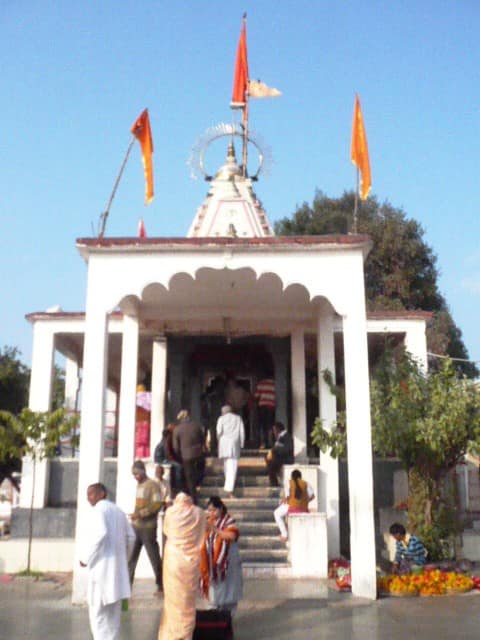
Temple in Ujjain
Mangalnath Temple
Ujjain, Madhya Pradesh
Traditionally held to be the birthplace of Mars, which is why most people here are not sightseeing — they have come for a specific remedial ritual and have arranged it in advance.
Photo: V.narsikar — CC BY-SA 3.0, via Wikimedia Commons
Overview
Who it's to, and what's expected
Deity
Shiva as Mangalnath
Tradition
Shiva temple
- Entry
Free entry via a general queue, with no booking required for darshan. The temple opens around 4:00 AM. Bookings apply only to the remedial pujas - Mangal Dosh Nivaran Mahapuja, Bhaat Puja and Shri Mangalnath Mahabhishek - and require kundali details: name, gotra, birth date, birth time and birth place. Tuesdays draw heavy crowds because the special rituals are concentrated on Mangal's day.
- Footwear
Visitors are required to remove their shoes before entering the temple premises.
- Access
Simpler than Ujjain's major shrines - free general queue, no advance pass required for darshan, and no pre-dawn reporting. The main difficulty is distance rather than access: it sits on the Shipra outside the central Mahakal zone, roughly 5-8 km from Mahakaleshwar, so a dedicated auto-rickshaw is the practical way to reach it. Tuesday crowds are heaviest.
- Prasadam
Visitors can purchase items such as peda, laddoos, dried fruits, rudraksha malas, and Mangal Yantras at the temple, and free anna-prasadam is provided during festivals.
Usually visited with
Time your visit
The darshan clock
A single opening-hours line cannot express a midday closure or an evening ceremony.
4:00 AM
Opening hours
The temple is open daily from 4:00 AM to 10:00 PM. Morning darshan and aarti occur from 4:00 AM to 6:00 AM, general pooja timings are from 7:00 AM to 3:00 PM, and evening darshan and aarti are held from 7:00 PM to 8:00 PM.
Rules, timings and fees change — confirm locally before you rely on this.
How long this takes
Ways in
The difference between a twenty-minute visit and a three-hour one.
Darshan options
- Entry to the temple is free via a general queue, though Tuesdays can experience heavy crowds for rituals
At the gate
Before you go in
What gets refused, and what you cannot take past the door.
What to wear
Men should wear a dhoti, gamcha, or kurta-pajama, and women should wear a saree or Punjabi dress. Avoid wearing black or green clothing during pujas.
Phones and cameras
Photography is permitted within the temple premises, but it is strictly forbidden inside the sanctum.
Rules, timings and fees change — confirm locally before you rely on this.
When not to come — unless you mean to
Festival windows
These follow lunar calendars and move by weeks each year, so the windows are months, not dates.
Every Tuesday
Shravan (Sawan)
Mahashivratri
Practicalities
The things that go wrong
Book through official channels, and treat anyone promising a guaranteed slot as a warning sign.
What to watch for
- Pandits and agents outside offering to arrange a Mangal dosha puja immediately at an inflated price, or claiming Tuesday slots are only obtainable through them
- Bookings are made with the temple and require your kundali details; arrive with them and go to the temple office
- Being told a puja cannot be performed without your birth time and being offered a 'substitute' ritual for a fee
- Without an accurate birth time the proper ritual genuinely cannot be done - the correct answer is to reschedule, not to pay for something else
- Pressured purchases of Mangal Yantras, rudraksha malas or prasad at marked-up prices
- All are sold at the temple and none is required for darshan
- Claims that wearing black or green is fine and that the restriction is a rumour used to sell clothing
- The dress guidance is the temple's own; respect it if you are attending a puja
- Auto drivers quoting a fare only on arrival at this or the other outlying temples
- Mangalnath, Kal Bhairav and Chintaman Ganesh are 5-8 km outside the Mahakal zone - agree a half-day circuit rate before setting out
One place, many temples
Other temples in Ujjain
General guidance
Planning the visit
Customary practice and what Ujjain's climate means for a barefoot visit — not rules posted at this temple. Anything specific to Mangalnath Temple is above.
Circling the shrine
At most Shaiva temples the circuit around the sanctum is not completed in a full circle — the channel draining the abhishekam is not crossed. Walk to it, turn, and come back the way you came. Watching what the queue in front of you does is the reliable guide.
Come in winter
Winter is when Ujjain is most comfortable to walk around, which matters here because a temple visit is done on foot and barefoot. Locally the window is given as october to march.
Stone gets hot — go early
You will be barefoot from the shoe rack onwards, often across an open courtyard. Between late morning and mid-afternoon in the hot months that stone is genuinely painful to stand on. Socks help, and are permitted almost everywhere shoes are not.
Arriving by train
Ujjain has a railway station, and auto-rickshaws wait outside it. Agree the fare or use a meter before you set off, and expect to be dropped a short walk from the temple rather than at its door.
No airport here
Ujjain has no airport of its own, so the last leg is by road or rail. Plan the return the same way — the last bus out is often earlier than visitors expect.
Outfit guide
What to wear at Mangalnath Temple
Cover shoulders and knees — the rules above win over anything here.
Trending wear for this spot
Popular modern looks travellers are wearing across Ujjain.


Traditional wear for this spot
Timeless, cultural outfits worn across Ujjain.
Mangalnath Temple
Mangalnath is not primarily a sightseeing stop, and it is worth being clear about that before you go. According to the Matsya Purana it is the birthplace of Mars (Mangal), and most of the people in the courtyard are not visiting a temple — they have come for a specific remedial ritual and arranged it in advance.
It sits on the banks of the Shipra River and is described as one of the most active temples in Ujjain, visited by hundreds of devotees daily. It is also held to be mokshadayani — bestowing liberation.
🔴 The birthplace of Mars
The tradition is layered rather than single:
- According to the Matsya Purana, this is the birthplace of Mars.
- In Hindu mythology, Mangala is believed to have been born from the melting of Lord Shiva — which is why a Mars temple is a Shiva temple, and why the deity here is Shiva as Mangalnath.
- The Puranas also describe Mars as the child of the Earth, a planet evolved from Earth itself.
- The temple's own authority gives "Ugra" as the natural name of the planet Mars.
Two further claims are specific to this site and worth knowing because they shape the practice: the temple is famous for its clear view of the planet, and the Tropic of Cancer passes through this place. Devotees hold that rays reflected from Mars fall here, which is the stated basis for the temple's central ritual.
🍚 Bhaat Puja, and what people actually come for
The ritual that matters here is bhaat puja (also spelled bhat puja) — an offering of rice, performed for the resolution of horoscope doshas related to Mangal.
Most visitors have come for Mangal Dosh Nivaran — the pacifying of Manglik Dosh, an astrological condition in Vedic astrology held to affect marriage, health and career. Performing Mangal Dosh Nivaran Mahapuja, Bhaat Puja and Shri Mangalnath Mahabhishek at this temple is regarded by devotees as the most powerful and authentic remedy available, and is believed to bring harmony in relationships and remove delays in marriage.
Three things follow from that, and they are the practical content of a visit:
- Tuesday is the day. Mangal's day, and when the special remedial rituals are performed. Tuesdays draw heavy crowds, which the temple's own guidance notes.
- Shravan Somvar — the Mondays of Shravan — is the other recommended window, July to August.
- Booking requires your birth details. Whether you arrange a puja online or in person, you must provide kundali details: name, gotra, birth date, birth time and birth place. Have them ready; without an accurate birth time the ritual cannot be performed properly.
A note on framing: these are the beliefs and purposes of the people who come here, and the temple's significance rests on them. Whether or not you share them, understanding that this is a working remedial-ritual centre rather than a monument is what makes the visit make sense — the queue is full of people with an appointment, not tourists with a camera.
🕒 Timings and entry
The temple opens around 4:00 AM. Entry is free via a general queue, and darshan does not require a booking — only the pujas do. Tuesdays can experience heavy crowds, so a weekday other than Tuesday is the calm option if you are coming to see rather than to participate.
🛕 Dress code — and an unusual prohibition
Men should wear a dhoti, gamcha or kurta-pajama; women should wear a saree or Punjabi dress.
Avoid wearing black or green clothing during pujas. That is a specific and unusual restriction, and it is worth respecting if you are attending a ritual rather than simply visiting — the colours are associated with inauspiciousness and with other planets in the ritual context.
Remove your shoes before entering the temple premises.
Photography is permitted within the temple premises but strictly forbidden inside the sanctum, so the courtyard and exterior can be photographed while the shrine cannot.
🛒 What to buy, and what comes back
Peda, laddoos, dried fruits, rudraksha malas and Mangal Yantras are all sold at the temple, and free anna-prasadam (food prasadam) is provided during festivals.
The Mangal Yantra is the item specific to this temple — a geometric diagram used in the worship of Mars, bought by devotees attending remedial rituals to take home. The rudraksha mala is the standard Shaiva rosary. Neither is obligatory, and you are not required to buy anything to have darshan.
🌸 Festivals
Tuesday is the temple's weekly peak rather than an annual festival, and it is the day the remedial rituals are concentrated. Beyond it, Shravan (July–August) brings sustained crowds on its Mondays, and Mahashivratri (February–March) is significant as a Shiva temple's great night.
📍 Where it is, and combining it
On the banks of the Shipra, and like Kal Bhairav and Chintaman Ganesh it sits outside the central Mahakal zone, roughly 5–8 km from Mahakaleshwar.
The practical advice is to hire a dedicated auto-rickshaw for a half-day circuit covering Mangalnath, Kal Bhairav and Chintaman Ganesh together, and to run it between 6:00 AM and 12:00 PM to avoid the harsh afternoon sun and the heaviest crowds. Doing them piecemeal from the Mahakal zone wastes most of a day.
⚠️ Practical notes
- If you want a puja, book it and have your birth details — especially birth time — ready. Turning up hoping to arrange one on a Tuesday is the wrong way round.
- Do not consume non-vegetarian food or alcohol in Ujjain. The city observes the religious codes of Avantika, and it will mark you out. The single exception is Kal Bhairav's ritual liquor offering, which is a priest-performed act at a shrine, not drinking.
- Avoid black and green if you are attending a puja.
- Pair it with Mahakaleshwar for the city's centre of gravity, and with Ram Ghat on the Shipra, which is close.
Last verified: 2026. The Matsya Purana attribution, the Tropic of Cancer, the bhaat puja and the kundali booking requirements are consistent across sources. The claim that reflected rays from Mars fall on the site is presented as the temple's stated belief, which is how it functions as the basis for the ritual, rather than as an astronomical assertion.
Questions
Mangalnath Temple — FAQ
Who is Mangalnath Temple dedicated to?
Mangalnath Temple in Ujjain is dedicated to Shiva as Mangalnath.
Who can enter Mangalnath Temple?
Free entry via a general queue, with no booking required for darshan. The temple opens around 4:00 AM. Bookings apply only to the remedial pujas - Mangal Dosh Nivaran Mahapuja, Bhaat Puja and Shri Mangalnath Mahabhishek - and require kundali details: name, gotra, birth date, birth time and birth place. Tuesdays draw heavy crowds because the special rituals are concentrated on Mangal's day.
What is the dress code at Mangalnath Temple?
Men should wear a dhoti, gamcha, or kurta-pajama, and women should wear a saree or Punjabi dress. Avoid wearing black or green clothing during pujas.
Do I have to take my shoes off at Mangalnath Temple?
Visitors are required to remove their shoes before entering the temple premises.
Can I take photos inside Mangalnath Temple?
Photography is permitted within the temple premises, but it is strictly forbidden inside the sanctum.
What prasadam is offered at Mangalnath Temple?
Visitors can purchase items such as peda, laddoos, dried fruits, rudraksha malas, and Mangal Yantras at the temple, and free anna-prasadam is provided during festivals.
Is Mangalnath Temple wheelchair accessible?
Simpler than Ujjain's major shrines - free general queue, no advance pass required for darshan, and no pre-dawn reporting. The main difficulty is distance rather than access: it sits on the Shipra outside the central Mahakal zone, roughly 5-8 km from Mahakaleshwar, so a dedicated auto-rickshaw is the practical way to reach it. Tuesday crowds are heaviest.
Checked, not remembered
Sources
Every rule and timing above traces back to one of these.