
Must-try lunch in Majuli
Khar
Majuli, Assam
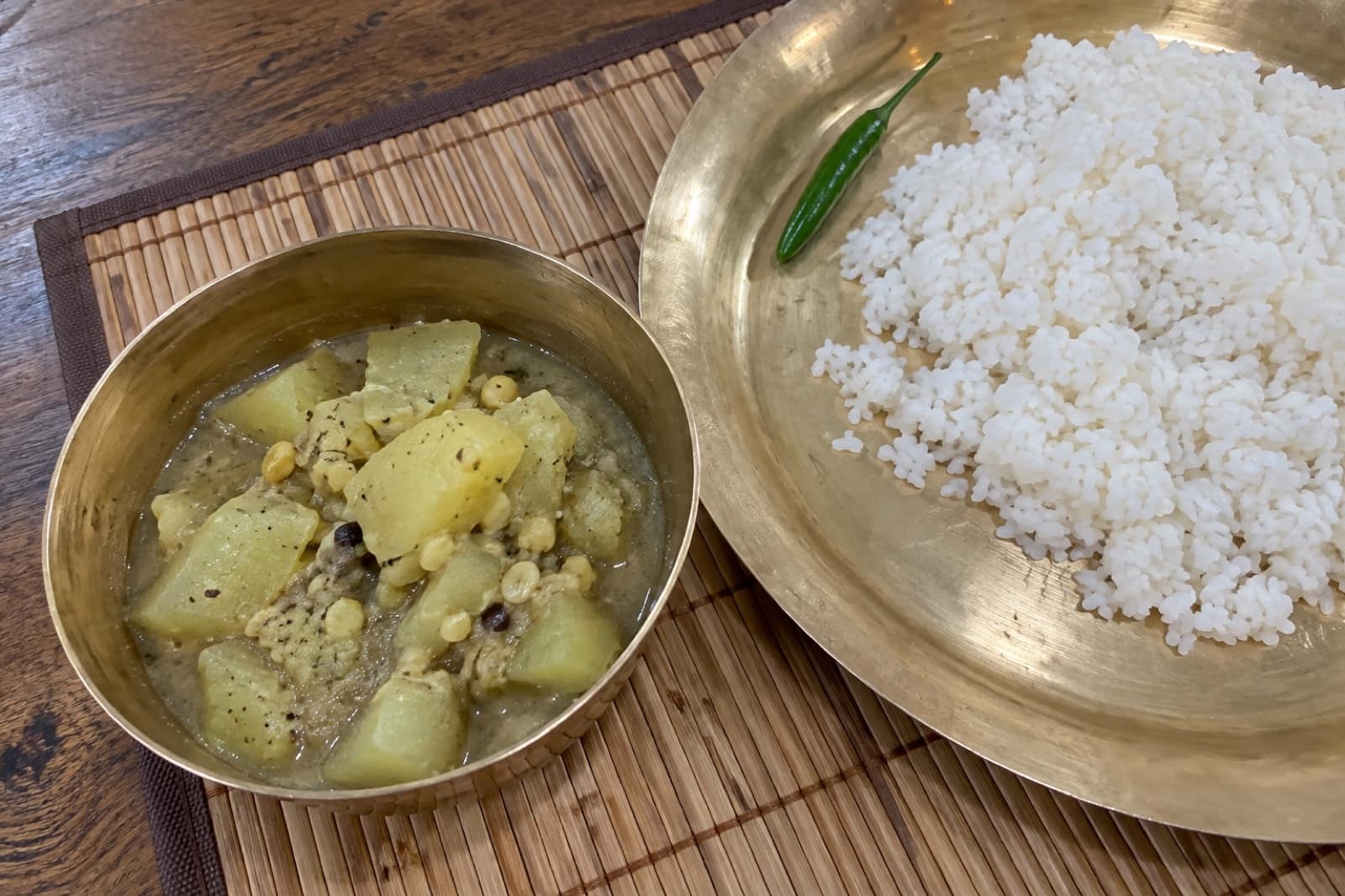
A uniquely Assamese dish cooked with khar (an alkaline extract), typically raw papaya and pulses — traditionally the first course of a meal.
Taste
Earthy, alkaline
Spice level
Not spicy
Best time to eat
Lunch
Price range
₹80–200
Food type & tags
Best paired with
Chaas or lassi
The dish
What is Khar?
Expect it to be earthy, alkaline, with a not spicy kick.
The story
Why is Khar famous in Majuli?
Khar is quintessentially Assamese, named for the alkaline filtrate that defines it, opening a traditional meal.
When to go
Best time to eat it
Khar is best enjoyed at lunch, ideally with chaas (spiced buttermilk) or a sweet lassi. Many spots make fresh batches through the day, so it’s easy to fit into your plan.
Where to eat
Best places to try Khar
Trusted Majuli spots — hours and directions.
 Representative photo
 Representative photo
Perfect pairing
What to eat with Khar
Khar pairs best with chaas (spiced buttermilk) or a sweet lassi. It’s a vegetarian lunch, so keep the rest of the plate light and let the dish be the star.
Make a morning of it
Pair it with a photo spot
Eat well, then shoot nearby in Majuli.

Auniati Satra
Late afternoon — warm light on the prayer hall and the tank; early morning for a calm, misty courtyard.
Fuel up on Khar, then shoot Auniati Satra.
See photo spot
Brahmaputra Ferry
Morning — soft light and mist over the river; late afternoon for golden light on the sandbanks from the last boats.
Fuel up on Khar, then shoot Brahmaputra Ferry.
See photo spot
Kamalabari Satra
Early morning — soft light in the courtyard and monks heading to prayer; late afternoon for warm light on the prayer hall.
Fuel up on Khar, then shoot Kamalabari Satra.
See photo spotWant something else?
Search Majuli food by craving
Khar in Majuli
Khar is one of the fixtures of the lunch plate in Majuli - earthy, alkaline, vegetarian, and filed firmly under midday meal.
The short version: A uniquely Assamese dish cooked with khar (an alkaline extract), typically raw papaya and pulses — traditionally the first course of a meal
🍛 What it is
Start with the description and hold it in mind: a uniquely Assamese dish cooked with khar (an alkaline extract), typically raw papaya and pulses — traditionally the first course of a meal. It is a vegetarian preparation, which shapes where you find it and when.
The category tells you most of the practical story: a midday meal, which in Majuli means a proper plate, portions sized to the moment rather than to a menu photograph.
Locally it is filed under: assamese, veg - which is the vocabulary to use when asking for it.
📜 Where it comes from
Khar is quintessentially Assamese, named for the alkaline filtrate that defines it, opening a traditional meal.
This is food with an address: Khar as Majuli makes it, for the people who have eaten it longest.
👅 The taste, honestly
Ask what it tastes like and the answer is earthy, alkaline; anything more specific you should taste rather than read.
There is no chilli heat in it at all.
The shape of the eating: it leads the plate. Plan the rest of the meal around that.
🕐 When to eat it
Locals eat it lunch - and matching the local clock is half the pleasure of the dish.
For a proper meal dish, the meal-time rhythm applies: the kitchen is at its sharpest in the run-up to the peak, and the plate you get at the height of service is the plate to judge.
🥣 Ordering it well
The Indian ordering rule that never fails: follow the local queue. A busy stall turns this dish over fresh many times an hour; an empty one has yesterday's oil and today's patience.
At pure-vegetarian places, the whole menu is safe ground - and in Majuli that is most of the city's best food anyway.
💰 What it costs
Expect to pay around ₹80–200 for it in Majuli - the honest local range, and a useful anchor for spotting the places priced for visitors rather than residents.
It is a budget-friendly item - kind to every wallet, and no less authentic for it.
Carry small notes - the smallest transactions run smoothest with the smallest denominations.
🤝 Eating it like a local
The Indian table habits apply: eaten with the right hand by tradition (cutlery always available), shared plates going around the table, and the order of eating - savoury first, sweet last - treated as common sense.
And the pairing instinct: keep the rest of the order simple and let one dish carry the meal.
Questions
Khar — FAQ
What is Khar?
A uniquely Assamese dish cooked with khar (an alkaline extract), typically raw papaya and pulses — traditionally the first course of a meal.
Is Khar veg or non-veg?
Khar is vegetarian. Spice level: not spicy.
Where can I try the best Khar in Majuli?
Try Majuli Kitchen. See the "Best places to try it" section above for hours and directions.
What should I eat with Khar?
Pair it with chaas (spiced buttermilk) or a sweet lassi.
When is the best time to eat Khar?
Khar is usually eaten at lunch.